

Visa and Mesh Partnership: Unlocking Global Crypto Spending Across 175 Million Merchants
Introduction
The integration of digital assets into everyday commerce has historically suffered from a persistent structural hurdle: the last-mile problem of liquidity. June 2026, global crypto ownership reached 774 million users, yet an overwhelming majority of these digital holdings remain locked away from everyday retail utility. On October 19, 2026, a groundbreaking partnership between global payments titan Visa and digital asset orchestration network Mesh addressed this gap directly by making cryptocurrency and stablecoin balances instantly spendable at upwards of 175 million merchant locations across more than 200 countries and territories. This development changes how digital wealth interacts with traditional financial rails, eliminating the need for manual pre-conversions or separate prepaid crypto cards.
Understanding the Visa and Mesh Partnership Mechanics
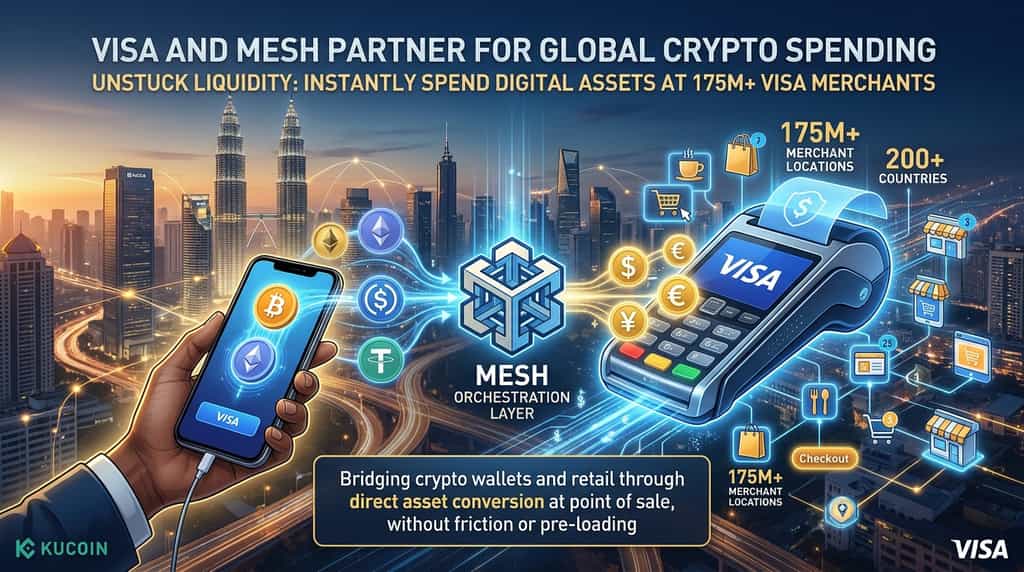
The Visa and Mesh partnership creates a seamless orchestration layer that bridges digital asset balances with standard Visa credentials without requiring any hardware or workflow modifications at the point of sale.
When a user initiates a transaction at a standard contactless terminal or through an online checkout, Mesh operates behind the scenes within the wallet application. The orchestration layer automatically handles the funding source, converting crypto, stablecoin, or fiat balances into the currency required by the merchant at the exact moment of payment. Meanwhile, the merchant receives a normal fiat settlement through Visa's trusted global network, completely insulated from the underlying asset conversion process. This architecture sidesteps the traditional friction of forcing users to pre-load specific cards or manually cash out holdings to a bank account ahead of time.
How Does the Mesh Orchestration Layer Solve the Last-Mile Problem?
The Mesh orchestration layer solves the last-mile spending problem by embedding financial routing directly inside existing wallet apps rather than forcing users into separate payment cards.
Traditional stablecoin spending models required consumers to maintain distinct balances on specialized crypto debit cards or endure cumbersome settlement delays. According to insights shared by Mesh CEO and co-founder Bam Azizi, crypto never suffered from a lack of utility demand, but rather from a fragmented last-mile delivery mechanism. By integrating directly into wallets and connecting to Visa’s vast network—which processed $14.2 trillion in payments volume during fiscal year 2025—Mesh allows consumers to utilize their preferred digital assets naturally. Users do not need to move funds manually or adopt a brand-new application; their existing digital balances instantly transform into active purchasing power at any standard retailer.
What Are the Implications for Global Crypto Adoption and Merchant Networks?
The alliance opens up a vast acceptance footprint by leveraging Visa’s network of over 175 million merchant locations worldwide.
Global adoption of digital assets has grown rapidly, with transactional data from American Banker indicating that monthly crypto card volumes approached $1.5 billion by late 2025. However, that figure remains a minor fraction of total addressable blockchain liquidity. By plugging into Visa's massive global infrastructure, the partnership scales digital asset utility to mainstream retail levels instantly. Enterprises integrated with Mesh—such as Kalshi, Tools for Humanity, Felix Pago, Majority, and KAST—can now offer their collective user bases direct checkout capabilities across millions of storefronts, driving real-world utility without imposing new integration burdens on merchants.
How Does This Partnership Compare to Other Stablecoin Rails?
The Mesh-Visa collaboration occupies a distinct structural position compared to other recent institutional stablecoin payment rails introduced across the industry.
While Visa Direct previously optimized cross-border prefunding for money transmitters, and Mastercard established stablecoin settlement rails linked through BVNK across 130 countries, these initiatives primarily targeted backend institutional settlement. Similarly, processing solutions on networks like Base focused on intermediary ledger efficiencies. In contrast, Mesh operates directly inside the consumer-facing wallet tier. Rather than issuing a new card or changing back-end institutional clearing systems, Mesh acts as the intelligent bridge between consumer-held digital balances and traditional card network endpoints, creating a unified consumer experience.
Beyond the Headlines: What KuCoin 5.0 Means for You
Market news moves fast — but where you act on it matters just as much. This October, KuCoin launches KuCoin 5.0, transforming KuCoin into a rebuilt platform. Here's what actually changes for you:
-
One account for everything. Older platforms split your money across separate "spot," "margin," and "futures" accounts and expected you to understand why. KuCoin 5.0's unified account removes that entirely — deposit once, and everything is simply there (only available to VIPs for now).
-
Stocks, indices, and commodities. KuCoin 5.0 expands beyond crypto into global markets. When crypto chops sideways and equities rally (or the reverse), you rotate in minutes instead of opening a brokerage account and waiting days for fiat rails.
-
Real-world assets (RWA). Tokenized exposure to traditional assets like commodities, right inside your crypto account. One of the fastest-growing segments in global finance is no longer reserved for institutions — you access it from the same balance you trade with.
-
Earn while you learn. Not ready to trade? KCUSD lets your stablecoins earn daily, auto-compounding interest. The lowest-stress way to put your idle deposit to work for 4% yield.
-
An AI assistant in plain language. Ask questions, get market context, understand what you're looking at — built into the platform, no jargon required.
-
An app that doesn't overwhelm. Faster, cleaner, and consistent — intuitive from the first tap, not after a tutorial.
-
Safety you can check, not just trust. A MiCAR-licensed EU entity, Proof of Reserves you can verify yourself, and internationally certified security (SOC 2 Type II, ISO 27001:2022).
Create your account in minutes — and start on the platform built for where crypto is going, not where it's been.
Conclusion
The partnership between Visa and Mesh marks a major milestone in bridging the gap between decentralized digital assets and traditional retail commerce. By connecting hundreds of millions of crypto holders to over 175 million merchant locations worldwide, the collaboration removes the historical friction points that restricted digital tokens to speculative trading rather than daily use. Supported by robust institutional momentum and technological integration, this initiative transforms stablecoins and cryptocurrencies into practical, everyday mediums of exchange. As the financial landscape continues to evolve toward seamless multi-rail payments, infrastructure solutions like Mesh and global networks like Visa are paving the way for broader, frictionless digital asset adoption across the global economy.
Frequently Asked Questions
Do merchants need to install new hardware to accept payments through this integration?
No, merchants require no new hardware, software updates, or modified workflows. Transactions process through standard contactless terminals or online gateways as normal Visa payments, while Mesh handles the underlying asset conversion behind the scenes.
How are crypto and stablecoin balances converted during a purchase?
Mesh acts as the orchestration layer inside participating wallet apps, automatically evaluating and converting the required amount of digital or stablecoin balances into standard fiat currency at the exact moment of checkout.
Which enterprises are initially connected to the Mesh network?
Mesh supports numerous prominent enterprise partners, including Kalshi, Tools for Humanity, Felix Pago, Majority, and KAST, giving their user bases immediate access to expanded spending capabilities.
Does the consumer need to apply for a new debit or credit card?
No, consumers do not need to apply for a separate card or open a new standalone account. The Visa credential provisions directly behind the scenes inside the user's existing participating wallet application.
How does this initiative impact overall stablecoin and crypto utility?
By linking digital holdings directly to Visa's extensive global merchant network of 175 million locations, the partnership transforms idle digital assets into practical, real-world purchasing power for millions of global users.
Disclaimer: This article is for informational purposes only and does not constitute financial, legal, or investment advice. Always conduct your own research before interacting with digital assets.