

Venezuela’s 25-Year U.S. Oil Deal Explained: Trump Claims Control of 65 Billion Barrels
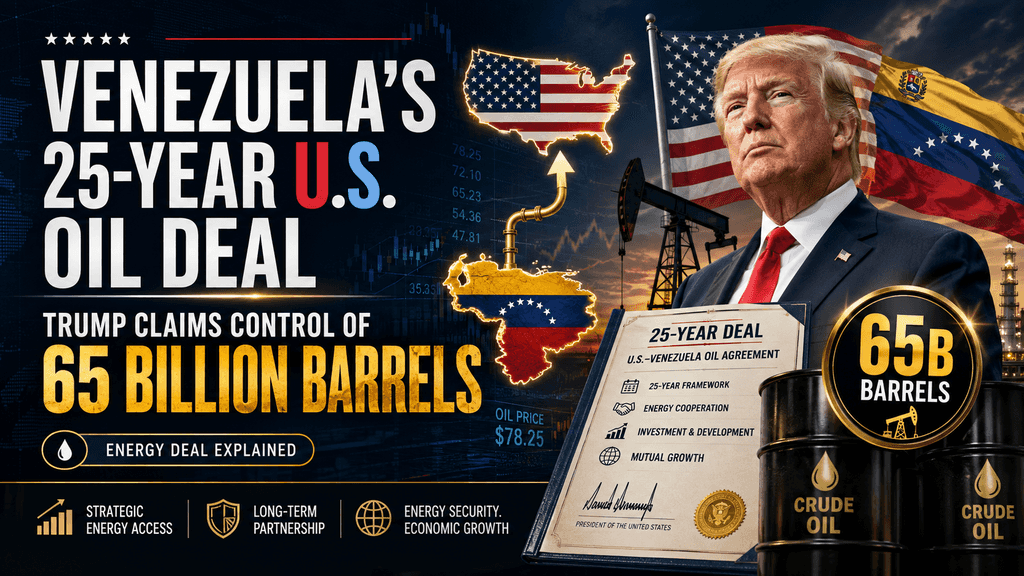
A sweeping new U.S.-Venezuela energy agreement has put one of the world’s largest pools of crude oil back at the center of global markets. U.S. President Donald Trump says the deal gives the United States majority control over more than 65 billion barrels of Venezuela’s proven oil reserves, while Venezuela’s interim President Delcy Rodríguez describes it as a 25-year partnership designed to revive the country’s oil industry, attract investment and expand production. The initial plan covers 17 strategic oilfields and targets more than 1.5 million barrels per day of production from the bilateral projects.
Yet the headline numbers raise as many questions as they answer. Venezuela insists it retains sovereignty over its natural resources, the full agreement has not been published, and substantial investment will be required before underground reserves become exportable barrels. The real significance of the deal therefore depends on what “control” means, how quickly production can increase, and whether U.S. companies are willing to commit the capital needed to rebuild Venezuela’s energy sector.
What Is in the 25-Year U.S.-Venezuela Oil Deal?
Rodríguez said the bilateral energy framework will run for 25 years and initially focus on 17 strategic oilfields with proven potential of roughly 65 billion barrels. The projects are intended to produce more than 1.5 million barrels per day, while a later phase could open another eight greenfield oil and gas blocks. Venezuelan officials estimate the broader arrangement could attract close to $100 billion in investment and ultimately generate more than $209 billion in government revenue. Rodríguez has also emphasized that the 1.5 million-barrel target refers to the bilateral projects rather than a ceiling for Venezuela’s total national oil production.
There is, however, an important distinction between the publicly announced 25-year framework and some of the commercial rights reportedly embedded in the arrangement. The Associated Press reported that the U.S. government and an unnamed private operator formed a new company that received rights to untapped Venezuelan oilfields for as long as 100 years. The complete legal text has not been released, so it is not yet possible to determine precisely how those century-long field rights interact with the 25-year government-to-government energy framework.
That uncertainty matters because the economic implications depend on details that remain undisclosed: who operates the fields, how revenues are divided, how much capital each side contributes, what happens when the bilateral framework expires, and what protections investors have if future governments change course. The deal is enormous in ambition, but its legal architecture remains less transparent than its headline numbers suggest.
What Does “Control of 65 Billion Barrels” Actually Mean?
Trump’s description of the agreement has generated the most attention because he says the United States has secured majority control over more than 65 billion barrels of Venezuelan proven reserves. That should not be interpreted as a simple transfer of ownership. Venezuela’s government has explicitly maintained that the country retains ownership and sovereignty over its natural resources. In other words, “control” may refer to the commercial and operational structure surrounding extraction rather than legal ownership of the oil while it remains underground.
Public reporting suggests that U.S. interests could take several forms, including equity in operating companies, greater influence over development decisions, rights to a portion of produced crude and preferential purchasing arrangements. Reuters separately reported that the U.S. government was considering a 35% passive interest in North American Blue Energy Partners alongside rights to purchase 20% of the venture’s production at cost, although the Pentagon later questioned whether the proposed equity structure was legally available to the relevant government office. That episode illustrates how complicated the meaning of “control” can become once political announcements are translated into corporate and legal arrangements.
| Term | What It Means in an Oil Deal |
| Reserve ownership | Legal sovereignty or ownership over oil still underground |
| Operational control | Authority over drilling, investment and production decisions |
| Equity interest | Economic ownership in a company developing the fields |
| Output rights | Entitlement to a share of oil that is actually produced |
| Purchase rights | Ability to buy part of the production under agreed terms |
For SEO and market analysis, this distinction is crucial: 65 billion barrels under U.S.-linked development arrangements is not the same as 65 billion barrels becoming U.S. government property.
Why Are 65 Billion Barrels Such a Big Deal?
Venezuela’s resource base is extraordinary. The U.S. Energy Information Administration estimated that the country held approximately 303 billion barrels of proven crude oil reserves in 2023, equivalent to about 17% of global reserves and the largest proven crude reserve base in the world. Most of those reserves consist of extra-heavy oil concentrated in the Orinoco Belt. Despite that geological wealth, Venezuela accounted for only about 0.8% of global crude production in 2023, illustrating the enormous gap between what exists underground and what the country can actually produce.
The 65 billion barrels associated with the new agreement therefore represent a significant share of one of the world’s most important hydrocarbon resource bases. But reserves are fundamentally different from immediate supply. Oil must be drilled, extracted, diluted or upgraded, transported through pipelines, stored and moved to export terminals before it can affect the physical market. Venezuela’s extra-heavy crude makes that process particularly demanding because it requires specialized technology, diluents and refining infrastructure.
That is why the most important number for oil markets will eventually be measured in barrels per day, not barrels of reserves. The reserve figure explains why the agreement is geopolitically significant. Production growth will determine whether it becomes economically significant for global crude prices.
Can Venezuela Really Add 1.5 Million Barrels a Day?
The 1.5 million-barrel-per-day target is ambitious. Venezuela’s current oil sector has been constrained by years of underinvestment, deteriorating infrastructure, sanctions, management problems and shortages of technical expertise. EIA analysis has documented decades of declining capacity and notes that many Venezuelan pipelines are more than 50 years old. It previously estimated that updating pipeline infrastructure alone could require around $8 billion if the country were to restore production toward much higher historical levels.
The new agreement could change that trajectory if it delivers foreign capital, drilling technology, field services, diluents and reliable infrastructure investment. But the process would take time. Wells need to be rehabilitated or drilled, pipelines repaired, heavy crude processing capacity expanded and export systems upgraded. Reuters has already cautioned that substantial investment and infrastructure work will be necessary before Venezuelan production can rise significantly.
The difference between the optimistic and cautious scenarios is therefore execution. In the bullish case, American capital and operating expertise could unlock fields that have remained underdeveloped and eventually add meaningful supply to the world market. In the bearish case, financing delays, political risk and infrastructure problems could leave the 1.5 million-barrel target as a long-term aspiration rather than a near-term reality. The deal creates potential capacity; it does not instantly create production.
Chevron Could Be the Deal’s First Big Test
Chevron is likely to provide one of the clearest early signals of whether the broader agreement can move from political announcement to actual investment. Reuters reported on August 28 that Chevron was close to finalizing negotiations to migrate its Venezuelan joint ventures into the country’s new energy framework, potentially giving the U.S. oil major greater operational control and opportunities to expand key projects.
One of the central projects is Petropiar, Chevron’s largest heavy-crude operation in Venezuela. The new arrangement is expected to include a previously announced asset swap that would allow Petropiar to expand into the neighboring Ayacucho 8 block in the Orinoco Belt. Chevron, Venezuela’s oil ministry and state-owned PDVSA have also discussed the possibility of adding another oil area to the company’s portfolio.
Chevron’s decisions matter because the real credibility test for the 25-year deal is not how many barrels governments say are available but how many billions of dollars companies are prepared to deploy. If Chevron expands aggressively and other major international producers follow, the probability of substantial production growth rises. If large operators remain cautious because of political, legal or contract risks, the timetable for bringing those reserves to market could stretch much further.
Why Does the U.S. Want Venezuelan Oil Now?
Energy security provides an immediate explanation. The United States is dealing with renewed geopolitical risks surrounding Middle Eastern oil supply while its Strategic Petroleum Reserve has fallen to historically low levels. Reuters reported that the SPR contained about 290 million barrels as of August 21, near a 44-year low. Trump subsequently said oil obtained through the Venezuelan agreement would be used to refill the reserve, although it remains unclear how quickly those barrels can actually become available.
Venezuela also produces the type of crude that parts of the U.S. refining system were designed to handle. Many complex Gulf Coast refineries can process heavy, high-sulfur crude, and Venezuelan barrels historically flowed into that system before sanctions sharply disrupted trade. EIA notes that Chevron resumed exporting Venezuelan crude to U.S. Gulf Coast refineries after receiving a U.S. sanctions waiver in late 2022, demonstrating that an established commercial and logistical relationship already exists.
The strategic logic therefore goes beyond simply finding “more oil.” Greater Venezuelan production could give Washington access to additional Western Hemisphere supply, support Gulf Coast refiners, contribute to SPR replenishment and reduce some exposure to disruptions along more distant geopolitical chokepoints. Whether that strategic potential is realized will depend on production growth rather than reserve announcements.
Could the Deal Lower Oil and Gas Prices?
Not immediately. The timing of the agreement illustrates why. On August 30, Brent crude climbed above $90 per barrel after a U.S. attack on Iran’s Larak Island intensified fears surrounding the Strait of Hormuz. Reuters reported Brent around $90.31 and noted that the strait historically carries roughly one-fifth of global oil supply. Those immediate physical supply risks are far more important to today’s crude price than Venezuelan barrels that may require years of investment before reaching the market.
Over the longer term, however, a sustained Venezuelan production recovery could become a bearish influence on crude prices, all else being equal. If large-scale investment eventually adds hundreds of thousands or more than a million barrels per day of reliable supply, global buyers would have another major source of crude. Greater supply competition could reduce the market’s vulnerability to disruptions elsewhere and potentially moderate prices during periods of normal demand.
That produces an unusual two-speed oil story. In the near term, the Iran conflict and Hormuz disruption create upward pressure on oil. In the longer term, Venezuela represents potential new supply and therefore downward pressure. The 25-year agreement matters because it could gradually change the supply curve, not because 65 billion barrels are about to arrive at refineries.
What Could the Deal Mean for Inflation and Markets?
Oil prices feed directly and indirectly into inflation. Consumers see the most obvious effect through gasoline and transportation costs, while businesses experience changes in freight, aviation, petrochemical and manufacturing expenses. If Venezuelan production eventually contributes to lower or more stable global crude prices, that could reduce some energy-driven headline inflation pressure in the United States and other importing economies.
The potential financial-market transmission would be broader. Lower energy inflation could, over time, reduce pressure on monetary policymakers, influence Treasury yields and alter expectations for the path of U.S. interest rates. Those changes could affect equities, the dollar and risk-sensitive markets such as cryptocurrency. But the chain is highly conditional. Venezuela is only one source of global oil supply, while Federal Reserve policy depends on employment, services inflation, wages and broader economic conditions rather than crude prices alone.
The appropriate conclusion is therefore modest: successful Venezuelan production growth could become one factor easing long-run energy and inflation pressures. It would be misleading to claim that the agreement by itself will lower inflation, force the Fed to change policy or immediately boost financial markets.
The Deal Could Reshape Venezuela’s Global Alliances
Venezuela’s oil sector has long been intertwined with international politics. During periods of strained relations with Washington, Caracas deepened energy, financial and strategic relationships with China, Russia, Iran and other partners. EIA data have highlighted Chinese technical support and Iranian assistance with diluents, refinery repairs and petroleum supplies during years when U.S. sanctions limited Venezuela’s access to Western capital and technology.
A large influx of American investment could gradually shift that balance. If U.S. firms gain greater roles in Venezuelan production, more crude returns to American refineries and Washington secures preferential access to output, the country’s oil economy could become more closely integrated with the United States. That would have implications far beyond corporate profits, potentially affecting Caracas’ diplomatic leverage and its relationships with other major energy partners.
Still, it would be premature to declare that Venezuela has abandoned China or Russia. The more useful indicators will be where new contracts are awarded, where Venezuelan crude is exported, who finances infrastructure and how the country balances its relationships with the United States, OPEC partners and existing international allies. The agreement creates the possibility of geopolitical realignment, not proof that the process is complete.
What Are the Biggest Risks to the Oil Deal?
Political and legal uncertainty is the most obvious risk. The full agreement has not been released, and AP reported domestic protests and skepticism over a structure that gives the United States a stake in Venezuela’s resource base. Rodríguez has defended the arrangement as consistent with Venezuelan sovereignty, but long-duration development rights inevitably raise questions about how future governments will treat the contracts. Energy investors have particularly long memories because Venezuela has previously changed terms and pushed foreign operators out.
Financing is the second challenge. Venezuelan officials have discussed up to $100 billion of potential investment, but the identity of the investors and detailed funding commitments remain unclear. Producing extra-heavy crude at scale requires considerably more than signing exploration rights. Operators must spend on drilling, diluents, pipelines, storage, electricity, upgrading equipment and export infrastructure, while also earning a return sufficient to compensate for political and commercial risk.
Execution is the third risk. Even a legally durable agreement backed by large amounts of capital would take time to translate into production. Venezuela’s geological resource is not the uncertain part; the path from reserves to reliable output is. That is why investors should treat the agreement as a long-term development framework rather than assume its headline reserve figure will quickly alter the global oil balance.
What We Still Don’t Know
Despite the scale of the announcement, some of the most important commercial details remain undisclosed. AP reported that no full agreement text had been made public and identified unresolved questions about how quickly drilling could begin and who would pay for the required investment. The identity and exact role of the private operator associated with some of the long-term field rights also remain important parts of the story.
The relationship between the 25-year bilateral framework and the reported 100-year rights for certain untapped fields also needs clarification. So does the structure behind Trump’s claim of majority U.S. control. Future disclosures will need to show how much of the American interest consists of equity, operational authority, output entitlements or low-cost purchase rights.
There are practical questions as well: How much crude will ultimately be directed to U.S. refineries? How much will go to the Strategic Petroleum Reserve? When will meaningful new production begin? And will the promised investment arrive quickly enough to prevent aging infrastructure from becoming the main bottleneck? Those answers will determine whether the agreement changes global energy markets or remains primarily a strategic declaration.
What Happens Next?
The next stage will be measured through corporate contracts and physical oil data rather than political statements. Chevron’s expected migration into the new framework will be an early milestone, particularly if it results in expansion at Petropiar and Ayacucho 8. Investors should also watch whether other major U.S. or international oil producers commit capital and whether Venezuela releases additional details about the 17 fields, the eight planned greenfield areas and the financing structure.
Production data will ultimately provide the clearest verdict. If Venezuelan output begins rising consistently alongside higher drilling activity, field rehabilitation and increased exports to the United States, the agreement will start moving from potential to measurable supply. U.S. imports of Venezuelan crude and the pace of SPR replenishment will also show whether Trump’s stated energy-security goals are being implemented.
The most important metrics, therefore, are not the 65 billion barrels in the ground. They are capital expenditure, active production and export volumes. Those numbers will reveal whether the agreement becomes a genuine transformation of Venezuela’s oil industry.
Conclusion: A Historic Deal, but the Barrels Still Have to Be Produced
The new U.S.-Venezuela oil agreement is significant because it links American capital and energy-security objectives with the world’s largest proven crude reserve base. Trump’s claim that the United States has secured majority control over 65 billion barrels captures the scale of the arrangement, while Venezuela’s 25-year framework outlines an ambitious plan for 17 fields, more than 1.5 million barrels per day of project production and potentially $100 billion in investment.
But “control” should not be confused with outright ownership, and reserves should not be confused with immediate supply. Venezuela still asserts sovereignty over its resources, key commercial details remain unpublished, and rebuilding the country’s aging oil infrastructure will require substantial capital and time.
If those obstacles are overcome, greater Venezuelan output could strengthen U.S. energy security, support Gulf Coast refiners and eventually add meaningful supply to the global crude market. Until production actually rises, however, the 65-billion-barrel figure should be understood primarily as a measure of the agreement’s potential. The next chapter will be determined not by how much oil Venezuela has underground, but by how much it can economically and reliably bring to market.
FAQs
Is Venezuela Still a Member of OPEC?
Yes. Venezuela is a founding member of the Organization of the Petroleum Exporting Countries. That means a major recovery in Venezuelan output could eventually interact with broader OPEC supply policy. However, the impact would depend on future production capacity, Venezuela’s commitments within the group and how other producers respond to changes in global supply.
What Type of Oil Does Venezuela Produce?
Much of Venezuela’s enormous reserve base consists of heavy and extra-heavy crude, particularly in the Orinoco Belt. EIA notes that these barrels require greater technical expertise to extract and process than conventional light crude. Extra-heavy oil may need diluents for transportation and specialized upgrading or refining equipment, making development more technically and financially demanding.
Why Are U.S. Gulf Coast Refineries Suited to Venezuelan Crude?
Many Gulf Coast refineries were built with sophisticated processing equipment capable of handling heavy, higher-sulfur crude. Venezuelan oil historically supplied this refining system, and Chevron resumed exports from its Venezuelan joint ventures to Gulf Coast facilities after receiving U.S. authorization in late 2022. This existing refinery configuration makes Venezuelan crude strategically useful even as the United States produces large volumes of lighter shale oil domestically.
Could Venezuela Become One of the World’s Largest Oil Producers Again?
It is technically possible over a long enough horizon because the country has an enormous resource base, but reserves alone are not sufficient. Venezuela would need sustained investment, infrastructure rehabilitation, skilled workers, reliable electricity and transportation systems, access to international technology and a political environment that gives investors confidence in long-term contracts. A return to much higher production would therefore be a multi-year industrial project rather than an automatic result of the new agreement.
Does the Deal Automatically End U.S. Sanctions on Venezuela?
No. Energy investment agreements and sanctions policy are related but separate legal issues. Individual companies and transactions can still depend on U.S. licenses, exemptions and other regulatory approvals. The existence of a political energy framework should not be interpreted as automatic removal of every restriction that has historically applied to Venezuelan companies, officials or financial transactions.
Could U.S. Companies Lose Their Venezuelan Oil Assets Again?
That risk cannot be ruled out. Venezuela has a history of nationalization and contract changes affecting foreign investors, while future governments in either Caracas or Washington could alter the policy framework. AP cited energy-policy specialists warning that investors are likely to remain cautious because long-term agreements can be exposed to political reversal. For companies considering multibillion-dollar projects, legal protections and contract durability will therefore be as important as the size of the oil reserves themselves.
🔥 KuCoin Offers A More Stable Option in A Volatile Market
If you worry about the frequent ups and downs in the market, and pursue a more stable option to earn money passively, KuCoin is the right place to come:

Simple Earn: Deposit and withdraw tokens anytime, earning stable returns.
Kucoin Earn: Earn stable profits with professional asset management.
Hold to Earn: Earn rewards by holding assets in Funding, Trading, Margin, Futures, Mining, and Unified Accounts.
Staking: Unlock the earning potential of on-chain assets.
Advanced Investments: Advanced Investments offer a variety of structured products to help your money grow in any market.
Shark Fin: Principal Protection and Guaranteed Gains
Dual Investment: Buy low and sell high with transparent return calculations.
Snowball: High yields, with price protection.
Discount Buy: Buy crypto at discount prices.
KCS Loyalty: Level up to enjoy exclusive perks by staking ≥ 1 KCS.
KuCoin Wealth: Discover future value and begin your smart investing journey.
KCS Benefits: Hold and stake KCS to access benefits across the platform.
KCS Staking 2.0: Participate in KCS on-chain governance to earn yield.
Disclaimer: This content is for informational purposes only and does not constitute investment advice. Cryptocurrency investments carry risk. Please do your own research (DYOR).