

U.S. Stocks Rise as Nvidia Earnings Fuel AI Optimism, but Inflation Risks Remain
2026/08/27 17:36:00
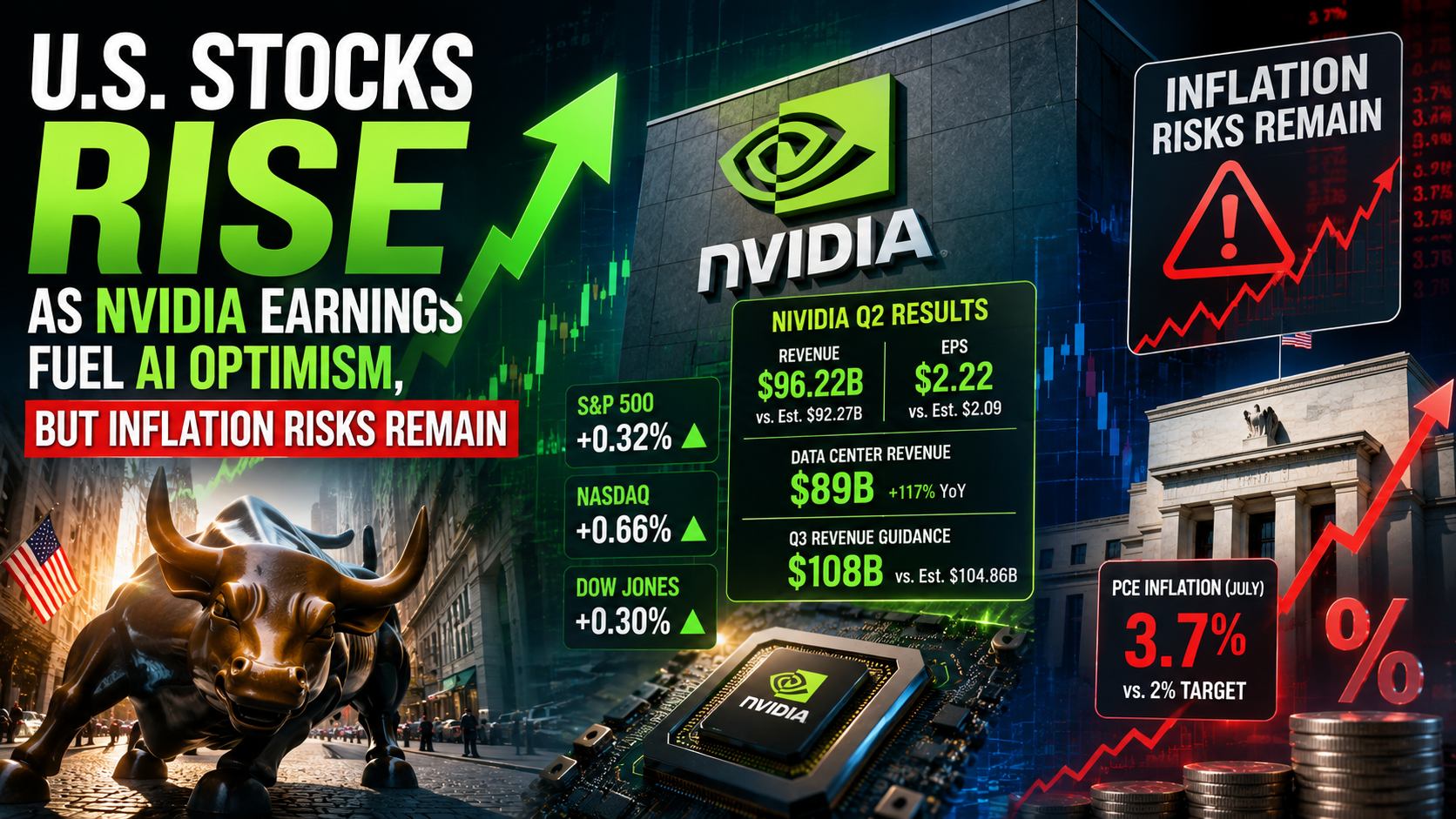
U.S. stocks have regained momentum as optimism around artificial intelligence returned to Wall Street, with Nvidia once again at the center of the market’s attention. Technology shares rebounded ahead of the chipmaker’s quarterly report, and Nvidia subsequently delivered revenue, earnings and forward guidance above Wall Street expectations, reinforcing the view that demand for AI computing infrastructure remains exceptionally strong.
Yet the macroeconomic backdrop is far less comfortable. U.S. inflation remains well above the Federal Reserve’s 2% target, Treasury yields are elevated and consumers are becoming more cautious about prices and the economic outlook. The result is a market caught between two powerful forces: rapidly expanding AI-related earnings and interest rates that could remain high for longer. For investors, the central question is no longer simply whether the AI boom is still alive. It is whether corporate earnings can grow fast enough to offset the valuation pressure created by persistent inflation.
U.S. Stocks Rise as AI Optimism Returns
Wall Street’s major indexes moved higher on August 25 as technology stocks recovered from a recent selloff and investors positioned for Nvidia’s earnings. The Dow Jones Industrial Average gained 0.30%, the S&P 500 rose 0.32%, and the Nasdaq Composite advanced 0.66%. Nvidia climbed 2.2%, Meta gained nearly 2%, AMD surged 4.9%, and the Philadelphia Semiconductor Index rose 1.4%.
The rebound was not caused by Nvidia alone. Falling oil prices and lower Treasury yields gave growth stocks additional support by easing some of the inflation and valuation pressure that had weighed on equities. Nvidia nevertheless became the focal point because investors were waiting for evidence that the enormous amount of capital being invested in AI data centers was still translating into real revenue growth. That evidence arrived the following evening when Nvidia reported another quarter well ahead of expectations.
| Market Factor | Potential Impact on U.S. Stocks |
| Strong Nvidia earnings | Reinforces AI growth expectations |
| Continued AI capital spending | Supports semiconductor and data-center demand |
| Lower Treasury yields | Reduces pressure on growth-stock valuations |
| Falling oil prices | Temporarily eases inflation concerns |
| Sticky inflation | Keeps Fed and rate risks elevated |
Nvidia Earnings Beat Wall Street Expectations
Nvidia’s fiscal second-quarter results provided a powerful confirmation that demand for AI hardware has not yet meaningfully slowed. The company reported quarterly revenue of $96.22 billion, while adjusted earnings reached $2.22 per share. Data-center revenue surged to approximately $89 billion, representing a 117% increase from a year earlier. Nvidia also projected third-quarter revenue of around $108 billion, above Wall Street expectations.
The results mattered because expectations were already extremely high. Nvidia has become so closely associated with the global AI investment cycle that simply producing respectable growth is no longer enough. Investors are looking for continued upside surprises, strong guidance and evidence that customers remain willing to expand infrastructure spending. The stock initially moved lower after the report but later reversed course and gained about 4.2% in extended trading, suggesting that investors ultimately viewed the numbers as sufficient to sustain the AI growth narrative.
More importantly, Nvidia signaled that the expansion may have years left to run rather than quarters. The company expects demand to broaden beyond large U.S. cloud companies toward AI laboratories, enterprises, sovereign buyers and industrial customers. That makes the report not just a snapshot of one semiconductor company, but an important test of how much computing capacity the global economy may continue building.
Why Nvidia Matters to the Entire Stock Market
Nvidia’s importance extends far beyond its own shareholders because the company has effectively become a barometer for AI capital expenditure. Microsoft, Amazon, Meta, Alphabet and other large technology companies are spending enormous sums on data centers, GPUs, networking equipment and power infrastructure. Reuters estimates that Big Tech companies could spend more than $730 billion on AI infrastructure in 2026, more than double the previous year’s level.
That spending creates a chain of economic effects. When hyperscalers increase capital expenditure, demand rises not only for Nvidia accelerators but also for memory chips, networking hardware, semiconductor manufacturing equipment, cooling technology, electricity generation and cloud infrastructure. Strong Nvidia results can therefore improve earnings expectations across a much wider group of technology and industrial companies.
The connection to the S&P 500 has become especially important. Reuters reported that AI infrastructure companies accounted for roughly one-third of the index’s earnings-per-share growth in the second quarter. S&P 500 aggregate earnings were running about 52% above the previous year, or roughly 33% higher after excluding large mark-to-market investment gains. In other words, AI is no longer just a popular investment theme; it is becoming a meaningful contributor to overall U.S. corporate profit growth.
Is the AI Boom Still Getting Stronger?
Nvidia’s latest numbers suggest the infrastructure phase of the AI boom remains strong. Demand is increasingly being driven by more than training large language models. AI inference—the computing required when users actually interact with models—is becoming a major source of workload growth, while new agentic AI systems are expected to require even more computing capacity as they perform increasingly complex tasks on behalf of users.
Another source of growth is the expansion of AI investment outside traditional U.S. hyperscalers. Governments are building sovereign AI capabilities, enterprises are experimenting with private AI infrastructure, cloud providers are adding specialized computing services, and AI laboratories continue to seek access to increasingly powerful systems. Nvidia is also preparing for its next-generation Vera Rubin platform, which could help extend the replacement and upgrade cycle beyond its current products.
The harder question is whether the companies spending hundreds of billions of dollars on AI will eventually earn enough revenue to justify the investment. The market has largely moved beyond asking whether AI capital spending will increase; current plans make that relatively clear. Investors are increasingly focused on the return on that spending, including whether AI products can generate sufficient subscription, advertising, productivity or cloud revenue to support the scale of the infrastructure buildout.
Why Tech Stocks Are Rallying With Nvidia
Nvidia’s strong results can lift other technology stocks because its sales provide information about demand across the entire AI supply chain. If Nvidia continues selling record quantities of accelerators, investors may assume that data-center construction, advanced memory demand, networking requirements and cloud capacity will remain strong as well.
That helps explain why companies such as AMD, Micron and other semiconductor names often move alongside Nvidia even though their businesses differ significantly. The same logic can extend to cloud providers, utilities supplying data-center electricity, chip-equipment manufacturers and networking companies. Investors effectively use Nvidia’s order book as one signal about how rapidly AI infrastructure is expanding.
Still, the benefits are unlikely to be evenly distributed. Simply attaching an “AI” label to a company does not ensure sustainable earnings. As valuations rise, investors will increasingly demand evidence of revenue growth, margins and cash flows. The AI rally may remain broad, but financial performance will become more important in determining which companies can maintain premium valuations.
Inflation Is Still the Biggest Risk to the Rally
The bullish earnings story collided almost immediately with a less favorable macroeconomic signal. U.S. Personal Consumption Expenditures inflation rose 3.7% year over year in July, slightly above expectations, while core PCE remained around 3.3%. Inflation has now remained above the Federal Reserve’s 2% objective for 65 consecutive months.
That matters because the Federal Reserve cannot base monetary policy on Nvidia earnings. Strong corporate profits may support stock prices, but persistent inflation reduces the central bank’s ability to lower interest rates and can even reopen discussion of additional tightening. After the PCE report, market expectations for another Fed rate increase moved higher, although the probability remains sensitive to incoming data and policy communication.
The conflict is straightforward. Nvidia is strengthening the earnings side of equity valuation, while inflation is threatening the multiple investors are willing to pay for those earnings. As long as price pressures remain materially above the Fed’s target, this tension is likely to remain one of the defining forces in U.S. markets.
Why Higher Treasury Yields Hurt AI Stocks
High-growth technology companies are particularly sensitive to interest rates because much of their valuation depends on profits expected years into the future. When bond yields are low, those future earnings are discounted at a relatively low rate and therefore have a higher present value. When yields rise, the opposite happens: investors apply a higher discount rate, reducing the value they assign to future cash flows.
The effect becomes more important when valuations are already elevated. Treasury bonds also compete with stocks for capital. If investors can receive an attractive return from long-duration U.S. government securities, they may require a higher expected return before accepting the volatility of expensive technology shares. The 30-year Treasury yield recently reached its highest level since 2007, contributing to pressure on semiconductor stocks before the latest rebound.
This is why even an exceptional company can see its stock fall despite rising profits. Earnings growth and valuation multiples do not always move in the same direction. Nvidia may continue increasing revenue rapidly, but if long-term interest rates rise enough, investors could still become less willing to pay extremely high prices for each dollar of future earnings.
Falling Oil and Bond Yields Gave Stocks Some Relief
The August 25 equity rebound was helped by temporary improvement in both oil and bond markets. Oil prices fell sharply, with Brent crude moving below $90 per barrel, while Treasury yields also declined. Those developments reduced two of the most immediate pressures facing equity investors.
Lower oil prices can reduce expected transportation and energy costs, potentially easing future inflation pressure. Falling Treasury yields simultaneously make the valuation environment more favorable for growth stocks. The combination therefore produces a powerful short-term effect: less concern about inflation and less pressure on equity discount rates.
The relief may not last if underlying inflation remains persistent. Oil prices can reverse quickly because of geopolitical developments, while bond yields remain sensitive to government borrowing, inflation expectations and Fed policy. For technology investors, falling yields are supportive, but the more durable solution would be sustained evidence that inflation itself is moving back toward target.
Consumer Confidence Is Sending a Warning
The corporate earnings picture looks strong, but U.S. households are sending a more cautious message. The Conference Board’s Consumer Confidence Index fell to 89.4 in August, down from a revised 90.2 in July and the lowest level in seven months. Expectations for business and labor-market conditions weakened, while consumers’ one-year inflation expectations increased to 5.8% from 5.6%.
This creates an important divide between Wall Street and Main Street. AI companies are reporting exceptional growth and large corporations continue to spend heavily on infrastructure, but households remain concerned about jobs, purchasing power and living costs. Consumer spending remains a major driver of the U.S. economy, so sustained weakness in confidence could eventually affect retail demand, housing, travel and discretionary spending.
That does not mean an economic contraction is imminent. Corporate profits remain strong and labor-market conditions have not collapsed. But the contrast highlights why investors cannot rely on AI earnings alone when evaluating the broader stock market. A healthy expansion ultimately requires income and demand outside a relatively narrow group of technology companies.
Could the Fed Raise Rates Again?
Persistent inflation has put another rate increase back into the conversation. After the July PCE data, traders increased the probability they assigned to a September hike, although markets remain divided and expectations could shift quickly before the meeting. Fed Chair Kevin Warsh’s upcoming Jackson Hole speech is therefore being watched closely for clues about how policymakers are balancing inflation against signs of slower growth.
If inflation remains near current levels or begins accelerating again, the Fed could keep policy restrictive for longer or consider another increase. Conversely, weaker labor demand, softer consumption and improving inflation data could reduce the need for additional tightening. For equities, the distinction between an actual hike and a prolonged “higher for longer” stance may be less important than it first appears: both can keep long-term yields elevated and restrict valuation expansion.
The Fed therefore represents the macro counterweight to the AI boom. Companies can control investment, innovation and operating efficiency, but they cannot control the discount rate applied by financial markets.
Can Strong Earnings Offset High Interest Rates?
This is the central question facing U.S. stocks. Equity prices are broadly influenced by two variables: how much profit companies generate and how much investors are willing to pay for that profit. Nvidia and the wider AI boom are pushing earnings upward, while inflation and high bond yields threaten to push valuation multiples downward.
| Scenario | AI Earnings | Inflation and Rates | Potential Market Effect |
| Bullish | Strong | Cooling | Earnings and valuations both receive support |
| Mixed | Strong | Stay high | Profit growth offsets some valuation pressure |
| Bearish | Slowing | Stay high | Earnings and multiples weaken together |
| Goldilocks | Strong | Gradually easing | Most supportive backdrop for stocks |
The current environment most closely resembles the mixed scenario. Corporate earnings are exceptionally strong—Reuters estimates second-quarter S&P 500 profit growth at about 33% even after stripping out unusually large investment gains—but inflation remains persistent. That means companies may need to keep delivering strong earnings merely to prevent elevated rates from becoming a larger drag.
The ideal outcome for equity bulls would be a “Goldilocks” combination in which AI-related profits continue growing while inflation gradually declines and Treasury yields stabilize. That would allow earnings to rise without forcing investors to significantly reduce the valuation multiples they are willing to pay.
Are AI Stock Valuations Getting Too High?
Strong fundamentals do not eliminate valuation risk. Nvidia and other major AI beneficiaries are already priced on assumptions that demand will remain strong for years, hyperscalers will continue spending aggressively and AI products will eventually generate substantial economic returns. When expectations are this high, companies have less room for disappointment.
This creates an unusual situation in which beating analyst forecasts may not always be enough. Investors increasingly look for a combination of higher-than-expected revenue, strong margins, rising guidance and evidence that future demand remains durable. Nvidia’s results met much of that test, but the company is also facing higher memory costs, supply constraints and uncertainty around Chinese sales.
High valuations therefore do not prove that AI stocks are in a bubble. They simply raise the performance threshold. The more optimism already embedded in a stock price, the more damaging even a modest slowdown can become.
What Could Push U.S. Stocks Higher From Here?
Further gains would become easier to sustain if several supportive developments occur at the same time. First, Nvidia and other technology leaders would need to continue translating AI demand into earnings rather than relying on long-term promises. Continued capital spending by Microsoft, Meta, Amazon and Alphabet would reinforce expectations that the infrastructure cycle has further room to run.
Second, inflation would need to show a more convincing decline. Slower PCE and CPI readings could reduce expectations for additional Fed tightening and allow Treasury yields to stabilize. Stronger participation from non-technology sectors would also improve the quality of the rally. Recent earnings have already been positive beyond technology, with profit growth reported across seven of the 11 S&P 500 sectors.
The healthiest stock-market advance would therefore be broader than Nvidia alone: AI earnings remain strong, inflation gradually cools, interest rates stop rising and consumers continue spending. That combination would reduce the market’s dependence on a small number of mega-cap technology stocks.
What Could Trigger the Next Stock Market Pullback?
The most immediate risk would be another upside inflation surprise. If CPI or PCE data begin accelerating, markets could price in more aggressive Fed policy and push Treasury yields higher. Because technology valuations remain sensitive to long-term rates, this could pressure the Nasdaq even if corporate earnings remain strong.
A second risk would come from the AI investment cycle itself. Any indication that hyperscalers are reducing capital expenditure, delaying data-center projects or questioning returns on AI spending could quickly affect Nvidia and the wider semiconductor sector. Investors are also paying closer attention to how AI infrastructure is financed, because the growing scale and complexity of financing arrangements may make it harder to determine where genuine end-user demand ends and capital recycling begins.
The most challenging combination would be slowing AI earnings, persistent inflation and rising Treasury yields. In that environment, both the earnings outlook and the valuation multiple could deteriorate simultaneously.
What Investors Should Watch Next
Nvidia’s guidance will remain one of the clearest indicators of AI infrastructure demand. The company currently expects roughly $108 billion in third-quarter revenue, so future results will show whether that growth rate remains achievable. Big Tech capital expenditure is equally important because Nvidia’s growth ultimately depends on customers continuing to build AI capacity.
Macro data will provide the other half of the market equation. PCE and CPI inflation, Treasury yields and Federal Reserve communication will determine whether the valuation backdrop improves or becomes more restrictive. Consumer confidence and spending also deserve attention because a market driven only by AI capital investment would be less balanced than one supported by broad economic demand.
Finally, investors should watch the breadth of S&P 500 earnings. If strong growth spreads beyond AI and technology into industrials, financials, healthcare and consumer companies, the rally would become less dependent on Nvidia and other mega-cap leaders.
Can AI Optimism Keep U.S. Stocks Rising?
The bullish case remains substantial. Nvidia’s revenue, data-center growth and guidance show that AI computing demand is still expanding rapidly, while Big Tech continues committing extraordinary amounts of capital to infrastructure. Strong corporate profits give U.S. equities fundamental support that is difficult to dismiss.
But inflation remains the constraint. A 3.7% PCE rate is far above the Federal Reserve’s objective, and high long-term yields make investors more sensitive to valuation. Consumer confidence is also weakening, suggesting that the strength visible in corporate earnings is not being felt equally across the economy.
The most balanced conclusion is therefore that AI growth is strong enough to support U.S. stocks, but sustained gains will become harder if inflation keeps interest rates and Treasury yields elevated. Nvidia has answered one of Wall Street’s biggest questions by demonstrating that AI demand remains strong. The Fed and inflation data will now determine how much investors are willing to pay for that growth.
Conclusion
Nvidia’s latest earnings have strengthened the argument that the AI infrastructure boom remains intact. Revenue reached $96.22 billion, data-center sales more than doubled from a year earlier, and the company issued stronger-than-expected guidance. Those results support not only Nvidia but also the broader technology and semiconductor ecosystem tied to AI investment.
The challenge is that excellent corporate earnings are arriving alongside stubborn inflation. As long as price growth remains well above the Federal Reserve’s target, interest rates and Treasury yields could stay high enough to restrict valuation expansion.
For U.S. stocks, the next stage of the rally may therefore depend on whether two conditions can coexist: AI earnings continue to grow rapidly while inflation finally begins moving lower. The AI story remains powerful. Inflation, however, still sets the rules.
FAQs
When does Nvidia usually report earnings?
Nvidia typically reports results four times a year following the end of each fiscal quarter. Its fiscal calendar differs from the standard calendar year, so investors often see Nvidia refer to a fiscal year or quarter that appears one year ahead of the current calendar date. Exact reporting dates are announced by the company before each earnings release.
What is Nvidia’s Data Center business?
Nvidia’s Data Center segment includes computing and networking products used in cloud infrastructure, artificial intelligence training and inference, high-performance computing and related workloads. It has become much larger than Nvidia’s traditional gaming business and is now the main driver of the company’s revenue growth.
Who are Nvidia’s biggest AI customers?
Major cloud and technology companies such as Microsoft, Amazon, Meta and Alphabet are among the most important buyers of AI infrastructure, while demand is increasingly expanding to AI laboratories, enterprises, governments and industrial customers. Exact customer contributions can change from quarter to quarter and are not always disclosed individually.
What is the difference between CPI and PCE inflation?
The Consumer Price Index measures changes in prices paid directly by consumers for a basket of goods and services. The Personal Consumption Expenditures price index uses a broader methodology and adjusts more readily for changes in consumer behavior. The Federal Reserve places particular emphasis on PCE inflation when assessing progress toward its long-term price-stability objective.
Why does the Federal Reserve target 2% inflation?
The Fed views 2% inflation over the longer run as consistent with price stability while providing enough room for wages and prices to adjust during economic changes. Persistently higher inflation can erode purchasing power, while inflation that is too low can increase the risk of deflation and make economic downturns harder to manage.
Why do oil prices affect the stock market?
Oil influences transportation, manufacturing and household energy costs, making it an important input into inflation expectations. Higher oil prices can squeeze corporate margins and consumer spending while increasing pressure on interest rates. Falling oil prices can have the opposite effect, although their impact varies by sector.
What is the difference between the Nasdaq and the S&P 500?
The S&P 500 includes roughly 500 large U.S. companies across many industries, while the Nasdaq Composite contains thousands of Nasdaq-listed companies and has a much heavier concentration in technology and growth stocks. Because Nvidia is a major technology company, changes in its share price and the broader semiconductor sector often have a particularly visible impact on Nasdaq performance.
🔥 KuCoin Offers A More Stable Option in A Volatile Market
If you worry about the frequent ups and downs in the market, and pursue a more stable option to earn money passively, KuCoin is the right place to come:

Simple Earn: Deposit and withdraw tokens anytime, earning stable returns.
Kucoin Earn: Earn stable profits with professional asset management.
Hold to Earn: Earn rewards by holding assets in Funding, Trading, Margin, Futures, Mining, and Unified Accounts.
Staking: Unlock the earning potential of on-chain assets.
Advanced Investments: Advanced Investments offer a variety of structured products to help your money grow in any market.
Shark Fin: Principal Protection and Guaranteed Gains
Dual Investment: Buy low and sell high with transparent return calculations.
Snowball: High yields, with price protection.
Discount Buy: Buy crypto at discount prices.
KCS Loyalty: Level up to enjoy exclusive perks by staking ≥ 1 KCS.
KuCoin Wealth: Discover future value and begin your smart investing journey.
KCS Benefits: Hold and stake KCS to access benefits across the platform.
KCS Staking 2.0: Participate in KCS on-chain governance to earn yield.
Disclaimer: This content is for informational purposes only and does not constitute investment advice. Cryptocurrency investments carry risk. Please do your own research (DYOR).