

US Democrats Win Congress: Why Are December Fed Rate Hike Odds Still at 76.9%?
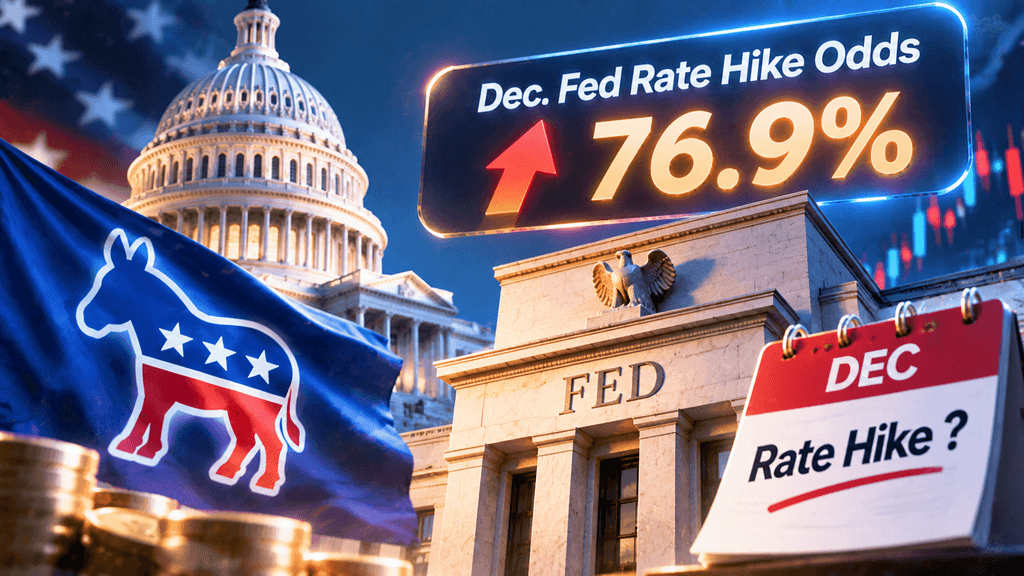
Democrats have won control of both chambers of the U.S. Congress in the November 3, 2026, midterm elections, reshaping Washington's political balance and prompting investors to reassess the outlook for fiscal policy, inflation, and Federal Reserve interest rates. Yet despite expectations that divided government could constrain federal spending and ease some inflation concerns, market-implied odds of a 25-basis-point Federal Reserve rate hike in December remain around 76.9%.
The apparent contradiction reflects the difference between political developments and near-term monetary policy. Congressional control may influence the economic outlook over the coming months, but the Fed's next decision will depend primarily on inflation, employment, financial conditions, and economic growth. For cryptocurrency investors, the interaction between these factors could influence the dollar, Treasury yields, borrowing costs, and appetite for digital assets.
Key Takeaways
-
Democrats won control of both the House and Senate in the November 3 midterm elections, creating a divided government for the remainder of President Donald Trump's term.
-
December rate hike expectations remain elevated, with the 76.9% probability representing a market snapshot rather than an official Federal Reserve forecast.
-
Inflation remains above the Fed's 2% target, with September headline PCE inflation reaching 3.6% year over year and core PCE reaching 3.1%.
-
The Federal Reserve held rates at 3.75%–4.00% in October, but two policymakers dissented in favor of an immediate 25-basis-point increase.
-
The election has affected the dollar, Treasury yields, and risk sentiment, while the December FOMC decision and incoming economic data remain the main near-term monetary policy catalysts.
Why Did Democrats Win Control of Congress in the 2026 Midterm Elections?
Democrats secured majorities in both chambers of Congress in the November 3, 2026, midterm elections, ending two years of unified Republican control in Washington. According to Reuters, Democratic candidates made substantial gains in traditionally Republican states, including Texas, Kansas, and South Carolina. The results will give Democrats greater influence over legislation, government investigations, budget negotiations, and presidential appointments once the new Congress takes office in January 2027.
The election also reflected concerns about the cost of living, economic policy, and the administration's handling of domestic and international issues. Reuters reported that exit polls found approximately half of voters viewed the election as an opportunity to express opposition to President Trump, while 70% wanted Congress to provide stronger checks and balances on the presidency. These results indicate a shift in congressional representation, although they do not establish that all voters supported the same economic or monetary policy positions.
The new political arrangement does not give Democrats unlimited legislative authority. President Trump retains the power to veto legislation, while Senate procedural requirements can make major policy changes difficult without broader support. Consequently, the election is more likely to introduce additional negotiations and constraints on the administration's agenda than to produce an immediate reversal of existing economic policies. Investors are particularly interested in how this divided government could affect fiscal spending, taxation, technology regulation, and federal borrowing.
How Could Democratic Control of Congress Affect Fed Rate Expectations?
Democratic control of Congress could influence Federal Reserve expectations indirectly through fiscal policy, government borrowing, and economic growth. Congress does not set the federal funds rate, and lawmakers cannot instruct the Federal Reserve to raise or lower interest rates. However, changes in the legislative environment can affect the economic conditions that policymakers consider when determining monetary policy.
Fiscal Policy and Government Spending
One important transmission channel is the possibility of reduced fiscal expansion. If the new congressional majority makes it more difficult to pass additional spending measures or tax initiatives, investors may reassess expectations for government borrowing and aggregate demand. Lower expectations for deficit-financed stimulus could reduce some concerns about future inflationary pressure and support demand for Treasury securities.
However, this outcome is not guaranteed. Federal spending depends on existing legislation, mandatory expenditures, presidential authority, and future budget negotiations. A divided Congress can also create disagreements over government funding, potentially increasing uncertainty around federal operations and borrowing. Investors must therefore distinguish between expectations of reduced fiscal expansion and an actual decline in government spending.
AI Investment and Economic Growth
Technology regulation is another potential channel. Democratic victories in Texas and other states have increased investor attention on proposals involving data-center construction, electricity demand, and AI oversight. These issues matter because AI infrastructure investment has become an important contributor to U.S. business spending and economic activity.
Reuters reported that investors were concerned that tighter AI regulation or restrictions on data-center expansion could slow parts of the investment cycle. If capital expenditure growth weakens, the economic outlook could change, potentially reducing some of the pressure for additional monetary tightening. However, the scale and timing of any regulatory changes remain uncertain, and the federal government still faces legislative and procedural constraints. (Reuters)
Why the Election Does Not Automatically Change Fed Policy
The Federal Reserve operates independently in setting monetary policy and is guided by its dual mandate of maximum employment and price stability. Congressional election results can influence the economic outlook, but they do not replace inflation and employment data in the FOMC's decision-making process.
This distinction explains why the election can produce a softer outlook for longer-term interest rates without immediately eliminating expectations of a December increase. Investors may anticipate less fiscal stimulus or slower AI investment in 2027 while still believing that current inflation conditions justify another rate increase before the end of 2026.
Why Are December Fed Rate Hike Odds Still at 76.9%?
December rate hike expectations remain elevated because the latest inflation and economic data continue to present challenges for policymakers. Although the election has changed expectations for future fiscal and regulatory policies, the Federal Reserve must evaluate the economic conditions already visible in its data. Persistent inflation, resilient economic activity, and disagreement among policymakers provide reasons why markets continue to assign a relatively high probability to another 25-basis-point increase.
The 76.9% figure cited in this article represents a market-implied probability at a particular reporting snapshot. CME FedWatch calculates its probabilities using prices from 30-Day Federal Funds futures, meaning estimates can change throughout the trading day as market expectations evolve. A separate tracker displaying CME-derived data showed approximately 77.4% on November 4. These figures should therefore be treated as time-sensitive market estimates, not as a fixed probability or an official Fed forecast.
Inflation Remains Above the Federal Reserve's Target
Inflation is one of the most important reasons markets continue to anticipate further tightening. The Bureau of Economic Analysis reported that the September 2026 Personal Consumption Expenditures (PCE) price index increased 3.6% year over year, compared with 3.4% in August. Core PCE inflation, which excludes food and energy, reached 3.1%, remaining above the Federal Reserve's 2% long-term inflation objective.
Monthly figures also showed continued price pressure. The headline PCE index increased 0.5% in September, while core PCE rose 0.3%. These readings suggest that inflation has not yet returned to a level consistent with the Fed's objective, although policymakers will need additional observations to determine whether the acceleration represents a persistent trend. (BEA)
Strong Economic Growth Complicates the Inflation Outlook
Economic activity also remains relatively resilient. The BEA's advance estimate showed that U.S. real GDP expanded at an annualized rate of 3.4% in the third quarter of 2026, accelerating from 2.2% in the second quarter. Investment, consumer spending, and government spending contributed to the increase, although weaker exports partly offset growth.
The combination of above-target inflation and solid economic growth creates a difficult environment for the Federal Reserve. If consumer demand and business investment remain strong while prices continue rising, policymakers may have less reason to delay additional tightening. Conversely, a meaningful slowdown in consumption, employment, or investment could reduce the need for another increase.
Two FOMC Members Already Favored an Immediate Rate Increase
The Federal Reserve's October 28 meeting provides another important explanation for the elevated market probability. The FOMC voted 10–2 to maintain the federal funds target range at 3.75%–4.00%. However, Governor Lisa Cook and Cleveland Fed President Beth Hammack dissented, preferring an immediate 25-basis-point increase.
The official statement described economic activity as expanding at a strong pace and inflation as remaining elevated. It also emphasized the need for additional information before determining the appropriate policy stance. The divided vote demonstrates that policymakers have different assessments of the timing of further tightening, but the decision itself did not commit the committee to a December increase.
How Did the Dollar, Treasury Yields and Gold React to the Election?
The election results triggered changes across major financial markets as investors reassessed the implications of divided government for U.S. growth, fiscal policy, and regulation. The dollar weakened, Treasury prices increased, and gold advanced as market participants evaluated the possibility of slower government spending and tighter oversight of AI-related investment. These movements reflect several overlapping factors rather than a direct change in Federal Reserve policy.
| Asset | November 4 market reaction | Key consideration |
| U.S. Dollar Index | Fell to 101.41, a one-month low | Growth expectations and policy uncertainty |
| 10-Year Treasury Yield | Fell to approximately 4.921% | Fiscal expectations and bond demand |
| Gold | Rose approximately 3% to $4,046 per ounce | Weaker dollar and uncertainty |
Dollar Weakness Reflects Changing Growth Expectations
Reuters reported that the U.S. Dollar Index fell to 101.41 on November 4, reaching its lowest level in approximately one month. The euro advanced 0.4% to $1.1236, while the British pound gained 0.46% to $1.3475. The yen and Swiss franc also strengthened against the dollar.
Part of the decline reflected concerns that additional scrutiny of AI infrastructure and data-center investment could affect U.S. growth. A weaker growth outlook can reduce expectations for future interest rate increases, making the dollar less attractive relative to currencies whose central banks maintain competitive yields. Nevertheless, geopolitical developments, energy prices, and incoming U.S. economic data remain important influences on the exchange rate.
Treasury Yields Decline as Investors Reassess Fiscal Risks
The 10-year Treasury yield declined nearly three basis points to approximately 4.921% during the reported market session. Treasury prices move inversely to yields, meaning the decline indicated increased demand for government bonds. Investors considered whether divided government could limit additional fiscal expansion and reduce some concerns about future government borrowing.
However, lower yields do not necessarily indicate that investors expect immediate monetary easing. Treasury yields reflect expectations for future short-term rates, inflation, economic growth, and the compensation investors require for holding longer-term debt. The 10-year yield can therefore decline even while the market continues to price in a December rate increase.
Gold Gains as the Dollar Weakens
Gold also benefited from the market reaction. Spot prices rose approximately 3% to around $4,046 per ounce, supported by a weaker dollar and demand for assets traditionally used to diversify exposure during periods of uncertainty.
The relationship between gold and interest rates remains important. Because gold does not generate interest income, higher real yields can increase its opportunity cost relative to interest-bearing assets. If markets begin to anticipate a less restrictive monetary policy path, gold may receive additional support. However, persistent inflation and the possibility of further Fed tightening could limit that effect.
What Does the Election Mean for Bitcoin and Cryptocurrency Markets?
The election could influence cryptocurrency markets through changes in interest rate expectations, dollar liquidity, Treasury yields, and regulatory policy. Bitcoin and other digital assets are sensitive to shifts in global risk appetite, although their prices also respond to crypto-specific developments such as exchange security, institutional flows, derivatives positioning, and network activity. Consequently, the election should be viewed as one macroeconomic factor rather than a standalone signal for cryptocurrency prices.
A December Rate Hike Could Increase Risk-Asset Pressure
If the Federal Reserve raises rates by 25 basis points in December, the federal funds target range would increase from 3.75%–4.00% to 4.00%–4.25%. Higher borrowing costs could increase the relative attractiveness of interest-bearing dollar assets and make leveraged cryptocurrency positions more expensive to maintain.
This environment could create pressure on speculative digital assets, particularly smaller tokens that depend heavily on favorable liquidity conditions. DeFi borrowing rates may also respond to changes in broader funding conditions, although their movements depend on protocol-specific supply, demand, and utilization rather than directly tracking the federal funds rate.
A Pause Could Improve the Risk-Asset Environment
If inflation moderates or employment conditions weaken, the Federal Reserve could decide to maintain its existing target range. A pause may reduce expectations for additional monetary tightening and support demand for risk-sensitive assets, depending on the broader economic outlook.
A weaker dollar and lower Treasury yields could also improve financial conditions for some cryptocurrency investors. However, a pause should not be confused with a rate cut or an immediate expansion of dollar liquidity. The Fed could maintain restrictive rates for an extended period even without announcing another increase.
Regulatory Uncertainty Is Another Risk for the Crypto Industry
The election also creates a separate policy consideration for digital assets. Reuters reported that market participants were concerned about the possibility of additional scrutiny of AI and cryptocurrency businesses, while some analysts warned that political gridlock could slow structural crypto legislation and institutional framework development.
For the cryptocurrency sector, this creates two distinct sources of uncertainty. Monetary policy affects the cost of capital and risk appetite, while congressional disagreements can influence the progress of digital-asset legislation and regulatory oversight. Bitcoin's market reaction should therefore be assessed alongside both macroeconomic developments and the industry's own regulatory environment.
What Economic Events Could Change the Fed's December Decision?
The next several weeks will be important because the Federal Reserve will receive additional information before its final policy meeting of 2026. The October decision left the door open to further tightening, but policymakers have emphasized that incoming data will determine whether another increase is necessary. Investors should focus on inflation, employment, consumer activity, and financial conditions rather than assuming the election has settled the direction of monetary policy.
The October employment report, scheduled for November 6, is an important near-term indicator. Changes in nonfarm payrolls, unemployment, and wage growth could influence expectations about labor-market strength and inflation persistence. The next PCE inflation report, covering October, is scheduled for November 25. It will provide another assessment of whether price pressures are easing or remaining above the Fed's objective. The BEA also plans to publish its second estimate of third-quarter GDP on the same date.
The final FOMC meeting of 2026 is scheduled for December 8–9, with the policy announcement on December 9. This meeting will be particularly important because policymakers will also release updated economic projections. Those projections may provide additional information about the expected path of interest rates, inflation, and economic growth into 2027. Until then, the market-implied probability of a 25-basis-point increase will remain sensitive to new economic releases and Fed communications.
Conclusion
Democrats' victory in the 2026 U.S. midterm elections has changed the political balance in Washington, prompting investors to reconsider the outlook for government spending, AI regulation, economic growth, and future inflation. Yet the market-implied probability of a December 25-basis-point Fed rate hike remains elevated at approximately 76.9% in the snapshot cited for this report. The difference reflects the distinction between longer-term fiscal expectations and the near-term economic data guiding monetary policy.
Inflation remains above the Fed's 2% target, third-quarter GDP expanded at an annualized 3.4%, and two FOMC members favored an immediate rate increase in October. These factors explain why the election has not automatically removed expectations of further tightening. For cryptocurrency investors, the key variables are the dollar, Treasury yields, financial conditions, and the progress of digital-asset regulation. The December FOMC meeting and upcoming inflation and employment releases will provide more meaningful evidence about the next stage of U.S. monetary policy.
FAQs
What is the difference between the federal funds rate and the prime rate?
The federal funds rate is the overnight interest rate at which banks lend reserve balances to one another. The prime rate is a benchmark commercial banks use when pricing certain loans for customers and businesses. Changes in the federal funds rate often influence the prime rate, although banks determine their own lending terms.
What is CME FedWatch and how does it calculate rate probabilities?
CME FedWatch is a market-monitoring tool that estimates the probability of future Federal Reserve rate decisions using 30-Day Federal Funds futures prices. It translates market pricing into implied probabilities for different target-rate outcomes. These estimates change as futures prices move and should not be interpreted as official Fed forecasts.
Why do U.S. Treasury yields sometimes fall when inflation remains high?
Treasury yields reflect several factors, including expected future interest rates, inflation, economic growth, and demand for government bonds. Even when current inflation remains elevated, yields can decline if investors anticipate slower economic growth, weaker future inflation, or increased demand for relatively safe assets.
What is the difference between nominal interest rates and real interest rates?
Nominal interest rates represent the stated cost of borrowing or return on an investment before adjusting for inflation. Real interest rates account for the purchasing power of money after inflation. For example, if a nominal yield is 4% and expected inflation is 2.5%, the approximate real yield is 1.5%. Real yields are particularly important when evaluating assets such as gold and Bitcoin.
Why does the Federal Reserve publish a Summary of Economic Projections?
The Summary of Economic Projections (SEP) provides policymakers' assessments of future economic growth, unemployment, inflation, and appropriate interest rates. It includes the widely followed dot plot, which illustrates individual FOMC participants' expectations for the federal funds rate. The projections help markets understand policymakers' outlook, although they do not represent a binding commitment to future decisions.
Disclaimer: This general market information, possibly from third-party, commercial, or sponsored sources, is provided for reference and educational purposes only and does not constitute financial or investment advice, an offer, solicitation, or guarantee. We disclaim liability for its accuracy, completeness, reliability, and any resulting losses. Investments/trading are risky; past performance doesn’t guarantee future results. Users should research, judge prudently, and take full responsibility. For further details, please consult KuCoin’s Terms of Use and Risk Disclosure.