

U.S. Treasury, SEC, and Regulatory Bodies Coordinate Supervisory Frameworks for Digital Asset Markets Post-Legislative Session
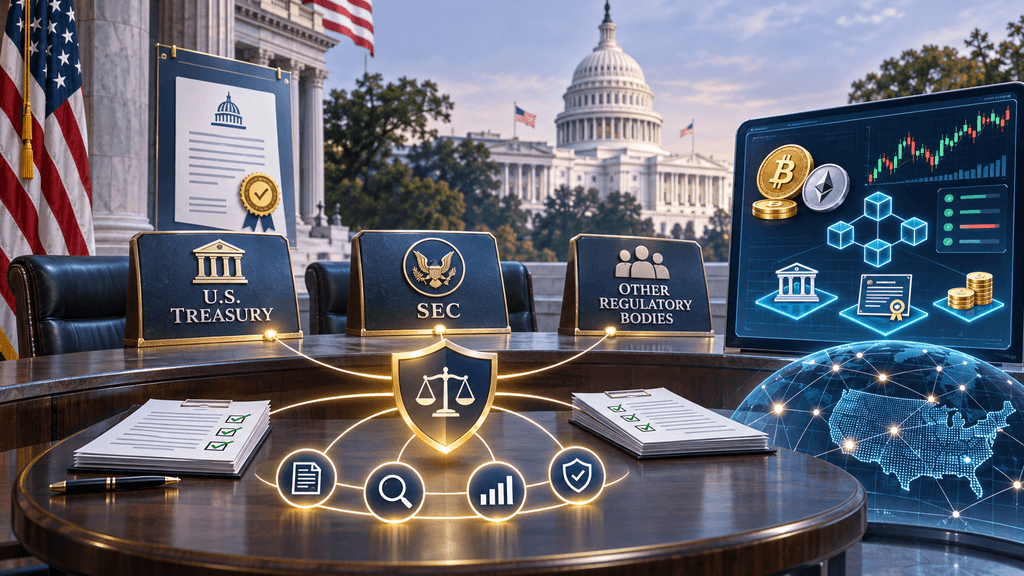
Federal Agencies Accelerate Digital Asset Regulation Following CLARITY Act Setback
In the weeks after the Digital Asset Market Clarity Act fell short of the 60 votes needed for Senate advancement on September 15, 2026, federal agencies moved quickly to fill the resulting policy vacuum with existing statutory tools. The Securities and Exchange Commission issued temporary conditional exemptions for tokenized National Market System stocks, proposed a dedicated custody framework for investment advisers and regulated funds, and continued work on Regulation Crypto Assets. The Office of the Comptroller of the Currency finalized implementing rules under the Guiding and Establishing National Innovation for U.S. Stablecoins Act.
Treasury Secretary Scott Bessent publicly committed the department to closing longstanding gaps between SEC and Commodity Futures Trading Commission oversight of digital asset markets, regardless of further congressional action. These steps reflect a deliberate shift toward agency-led coordination rather than waiting for comprehensive market-structure legislation. Post-legislative-session coordination among the Treasury, SEC, OCC, and related bodies is producing a more coherent, if still incomplete, supervisory architecture for digital asset markets by clarifying custody pathways, stabilizing payment stablecoin reserves, and aligning enforcement and surveillance practices under existing authorities.
SEC Custody Proposal Creates First Explicit Pathways for Digital Assets Held by Advisers and Funds
On October 1, 2026, the Securities and Exchange Commission proposed amendments to the custody rules under the Investment Advisers Act of 1940 and the Investment Company Act of 1940, which would establish the first tailored framework for how registered investment advisers and regulated funds may hold digital assets. The proposal permits two new options that do not exist under current rules: self-custody by the adviser or fund under specified safeguarding conditions and custody with a state-chartered trust company that meets defined standards. These pathways apply only to digital assets that constitute client funds or securities under the Advisers Act or securities and similar investments under the Investment Company Act. Chairman Paul S. Atkins framed the proposal as closing a longstanding gap that had left market participants without clear, compliant methods for an asset class their clients increasingly demand. The release also modernizes broader custody requirements, eases certain audit obligations, and updates related recordkeeping and Form ADV disclosures. Legal analyses note that a final rule is unlikely before mid-2027 given the 60-day comment period and the proposal’s scope, yet the direction signals regulators’ willingness to adapt legacy rules designed for traditional assets.
Market participants have long cited custody uncertainty as a barrier to institutional participation. The proposal addresses this by requiring additional safeguards for self-custody, including robust cybersecurity, private-key management, and, for regulated funds, enhanced board oversight. State trust companies would face diligence and ongoing monitoring obligations. The framework remains limited to assets already within the securities laws’ reach and does not resolve classification questions for all tokens. Still, by providing explicit options rather than relying solely on no-action relief or enforcement discretion, the SEC is reducing the gray area that previously constrained product development. Industry observers expect the final rule, if adopted with workable conditions, to expand the range of crypto-related strategies available through registered vehicles while preserving core investor-protection principles that have governed traditional custody for decades. The proposal sits alongside the Commission’s broader digital-asset agenda, including earlier interpretive guidance and the Innovation Exemption for tokenized stocks.
Innovation Exemption Opens Temporary On-Chain Trading of Tokenized NMS Stocks
Within 48 hours of the CLARITY Act’s failure, the SEC issued an order granting five-year temporary conditional exemptive relief that allows certain Tokenized Securities Venues to facilitate trading of tokenized versions of eligible U.S.-listed stocks without registering as national securities exchanges. The exemption also provides limited relief from the dealer definition for liquidity providers using proprietary capital in automated market-maker pools. Conditions include limits on the number of symbols and trading volume, verification that tokenized shares confer identical legal rights to traditional NMS stock, concurrent trading halts with the primary listing exchange, and public disclosure of operations and affiliate activity. Staff later released frequently asked questions clarifying operational details. The order is expressly interim, designed to permit innovation in a permissioned environment while the Commission evaluates the need for permanent rules.
This relief represents a practical response to legislative gridlock. Tokenization of listed equities had faced regulatory barriers because traditional exchange and broker-dealer definitions did not readily accommodate distributed-ledger mechanisms. By carving out a supervised pathway under existing authority, the SEC is testing on-chain market structure without awaiting new statutes. Early market reaction has focused on the potential for improved settlement efficiency and reduced intermediary layers, though volume and symbol caps constrain immediate scale. The five-year sunset and conditionality underscore that the relief is not a permanent redesign. Coordination with the CFTC remains relevant because some tokenized instruments may intersect derivatives markets. The exemption’s publication so soon after the Senate vote illustrates the agencies’ readiness to act independently when legislation stalls, shifting the locus of market-structure development from Capitol Hill to the regulators themselves.
OCC Finalizes GENIUS Act Rules Establishing a Federal Stablecoin Framework
On October 21, 2026, the Office of the Comptroller of the Currency issued a comprehensive final rule implementing key provisions of the GENIUS Act for payment stablecoin issuers under its jurisdiction. The rule, effective January 18, 2027, sets licensing, reserve, redemption, capital, risk management, and reporting requirements. Permissible reserves center on U.S. currency, Federal Reserve balances, short-term Treasury securities (maturing in 93 days or less), overnight repurchase agreements meeting specified conditions, and registered government money-market funds invested solely in those assets. Tokenized forms of eligible reserves are permitted provided they confer identical legal rights. The final rule lowers the daily liquidity requirement from the proposed 10 percent to 5 percent of reserves, reflecting the high liquidity of eligible assets and complementary stress-testing obligations. Separate rulemaking will address Bank Secrecy Act, anti-money laundering, and sanctions issues in coordination with the Treasury Department.
The OCC’s action marks the first completed federal implementing framework under the GENIUS Act, which Congress enacted in 2025 to create a national regime for payment stablecoins distinct from securities, commodities, or deposits. Parallel proposals from the Federal Reserve, FDIC, and Treasury remain in process, creating a multi-agency implementation phase. Commenters had pressed for greater flexibility on longer-dated Treasuries and clearer treatment of tokenized assets; the final rule retains the short-maturity focus while defining “tokenized form” to require equivalent legal rights. The rule also includes a reservation of authority allowing the OCC to modify requirements as needed for financial stability or timely redemption. By establishing clear operational standards ahead of the statutory effective date, the OCC is providing issuers under its supervision a concrete compliance path and reducing the uncertainty that previously surrounded dollar-pegged tokens used extensively in trading and payments.
Treasury Signals Active Role Closing SEC-CFTC Oversight Gaps
Treasury Secretary Scott Bessent stated on October 28, 2026, that the department will work to address gaps in cryptocurrency oversight between the SEC and the CFTC even if Congress takes no further legislative action. The remarks position Treasury as a coordinating force focused specifically on the jurisdictional divide that has long complicated supervision of digital asset markets. Bessent indicated the effort would proceed regardless of legislative outcomes, underscoring an administrative commitment to coherence. The announcement builds on earlier inter-agency work, including a formal cooperation agreement signed by the SEC and CFTC in March 2026 that prioritizes common definitions, simplified dual registration, data sharing for surveillance and enforcement, and institutional continuity beyond current leadership.
This Treasury posture is important because market participants have repeatedly cited fragmented oversight as a source of compliance cost and legal uncertainty. Assets or activities that could reasonably fall under either securities or commodities jurisdiction have faced dual or sequential scrutiny. By elevating gap-closing as a departmental priority, Treasury is leveraging its convening authority and its statutory role under the GENIUS Act. Practical outcomes could include joint interpretive guidance, shared examination protocols, or standardized reporting that reduces duplicative burdens. The statement also signals that the post-CLARITY environment will feature sustained executive-branch coordination rather than a pure return to pre-2025 enforcement-heavy approaches. Industry and legal observers will watch for concrete inter-agency deliverables in the coming months as evidence that the announced coordination produces measurable clarity.
Regulation Crypto Assets Proposal Advances Tailored Offering Regime
The SEC’s Regulation Crypto Assets proposal, issued in August 2026 with a comment period that closed on October 20, would create a specialized offering framework for certain investment contracts involving crypto assets. It includes two exemptions from Securities Act registration: a one-time exemption permitting offerings of up to $5 million over four years and a larger exemption allowing up to $75 million in any 12 months. Issuers would provide principles-based disclosures and remain subject to antifraud and antimanipulation provisions. The proposal also contains a conditional safe harbor from the “investment contract” definition under specified conditions. The package builds on the Commission’s March 2026 interpretive release clarifying how federal securities laws apply to particular crypto assets and transactions.
Closing of the comment period marks a transition from proposal to potential final rulemaking. Market participants submitted substantial input on disclosure calibration, eligibility criteria, and the safe-harbor conditions. The proposal aims to lower barriers to responsible capital formation while retaining core investor protections. Its coexistence with the Innovation Exemption and the custody proposal demonstrates a multi-pronged SEC strategy: classification clarity, offering pathways, trading venues, and custody arrangements. Because the CLARITY Act did not become law, these administrative tools have assumed greater practical importance. Final adoption timelines remain uncertain, yet the direction indicates the Commission is constructing a workable regime under existing statutes rather than waiting for new market-structure legislation. Coordination with Treasury and the CFTC will influence how the offering regime interfaces with stablecoin and derivatives oversight.
Inter-Agency Harmonization Efforts Build on 2026 Cooperation Agreement
Since January 2026, SEC Chairman Paul Atkins and CFTC Chairman Michael Selig have pursued four shared goals: common definitions for digital-asset categories, simplified registration for firms operating across securities and derivatives markets, mechanisms for sharing enforcement and surveillance data, and a formal agreement ensuring cooperation continues beyond current leadership. That agreement was signed in March 2026. Subsequent actions, including the SEC’s Innovation Exemption and the CFTC’s advanced notice of proposed rulemaking on crypto asset transactions and markets, reflect this collaborative posture. The CFTC’s October notice seeks comment on fit-for-purpose rules for retail commodity transactions involving crypto assets and on a potential subcategory of designated contract markets tailored to those products.
The formal agreement does not expand either agency’s statutory authority, yet it reduces the risk of uncoordinated or contradictory positions. Shared data protocols can improve market surveillance without requiring new legislation. Common definitions lessen the classification disputes that previously generated litigation risk. For dual-registered or multi-activity firms, streamlined processes lower compliance friction. Treasury’s October commitment to address remaining gaps adds a third institutional voice focused on coherence. Collectively, these steps illustrate a maturing supervisory architecture that prioritizes practical coordination after the legislative process stalled. Market participants gain greater predictability when agencies communicate regularly and align on core concepts, even if comprehensive statutory reform remains elusive.
Stablecoin Reserve Standards Emphasize Liquidity and Legal Equivalence
The OCC’s final GENIUS Act rule places heavy emphasis on reserve quality and liquidity. Eligible assets are limited to instruments that can be monetized rapidly, with a reduced but still meaningful daily liquidity buffer. Tokenized versions of those assets are allowed only when they deliver identical legal rights to their non-tokenized counterparts. Reporting schedules require detailed information on Treasury securities held, including CUSIP-level data, remaining maturity, and whether the security is tokenized. These requirements aim to ensure that payment stablecoins can meet redemption demands promptly even under stress, protecting both holders and financial stability.
Parallel proposals from the Federal Reserve and other agencies are expected to produce consistent standards across the federal banking system. The focus on short-term Treasuries aligns stablecoin reserves with the deepest and most liquid segment of the government securities market. By defining tokenized form rigorously, regulators address operational and legal risks that could arise if on-chain representations diverged from underlying rights. The multi-agency process also creates opportunities for harmonized examination and reporting expectations. Once the full suite of rules is in place, permitted payment stablecoin issuers will operate under a clearer, more uniform federal framework than existed before the GENIUS Act, reducing the patchwork of state and informal standards that previously applied.
Custody Modernization Extends Beyond Crypto to Broader Industry Practices
Although the October 1 SEC proposal is notable for its digital-asset provisions, it also revises custody requirements that apply to traditional assets. Changes include expanded options for broker-dealer custody, adjustments to audit and surprise-examination requirements, and updates intended to reflect current industry practices. For regulated funds, the proposal introduces distinct crypto-specific pathways while maintaining board oversight responsibilities. Advisers gain clearer self-custody possibilities where qualified custodians are unavailable, subject to heightened safeguarding duties. These reforms respond to longstanding industry feedback that the existing custody rule, crafted for an earlier era, had become outdated in multiple respects.
By addressing both digital and traditional custody in a single package, the Commission is modernizing a foundational investor-protection rule rather than creating an isolated crypto exception. The approach reduces the risk that digital-asset rules develop in isolation from the rest of the custody regime. Legal analyses highlight that final conditions on self-custody and state-trust-company arrangements will determine practical utility. If those conditions prove workable, the rule could facilitate greater institutional access to digital assets through registered channels. The proposal’s dual focus also signals that the Commission is integrating digital-asset supervision into its ordinary rulemaking processes rather than treating it as a permanent special case.
How Markets Are Responding to Agency-Led Regulatory Progress
The shift from legislative to administrative leadership has immediate consequences for market structure, product design, and compliance planning. Firms can no longer assume that a comprehensive market-structure statute will resolve classification, registration, and custody questions in the near term. Instead, they must navigate a series of agency actions that, while more coherent than prior years, still leave certain boundaries unsettled. The Innovation Exemption creates a controlled laboratory for tokenized equities; the custody proposal opens pathways for advisers and funds; the GENIUS Act rules stabilize the payment-stablecoin layer that underpins much of crypto trading. Together, these measures lower some barriers while introducing new compliance obligations and transition timelines.
Investors and intermediaries gain clearer, if still evolving, rules of the road. The temporary nature of the Innovation Exemption and the pending status of several proposals mean business models built on current relief must plan for possible modification or expiration. Coordination among Treasury, the SEC, CFTC, and banking regulators reduces the likelihood of contradictory requirements, yet differences in statutory mandates will persist. The overall trajectory favors greater institutional participation under supervised conditions rather than a return to the more fragmented environment that characterized earlier periods. Market participants that engage constructively with the comment processes and prepare for the January 2027 GENIUS Act effective date will be better positioned as the frameworks solidify.
Remaining Gaps and the Path Toward Greater Clarity
Despite substantial progress, important questions remain open. Full harmonization of SEC and CFTC approaches to assets that exhibit characteristics of both securities and commodities is still evolving. Parallel GENIUS Act rulemakings by the Federal Reserve, FDIC, and Treasury must be completed and aligned with the OCC’s final rule. The Regulation of Crypto Assets proposal awaits potential finalization after the closed comment period. Examination priorities for fiscal 2027 already flag tokenization risks, indicating that supervisory attention will intensify even as rulemaking continues. Treasury’s commitment to gap-closing provides a mechanism for further alignment, yet concrete deliverables will determine its effectiveness.
These residual uncertainties are the natural result of building a supervisory architecture through sequential agency actions rather than a single legislative package. They do not negate the advances already achieved. Market participants now operate with more explicit custody options, a defined stablecoin regime approaching effectiveness, temporary trading pathways for tokenized stocks, and formal inter-agency cooperation structures. Continued coordination, transparent rulemaking, and careful calibration of conditions will determine whether the emerging framework achieves the dual goals of investor protection and responsible innovation that regulators have articulated throughout 2026.
Practical Compliance Considerations for Market Participants
Firms active in digital-asset markets should prioritize several near-term steps. Those considering registered investment-adviser or fund products that hold crypto assets must monitor the custody proposal’s comment process and begin evaluating self-custody or state-trust arrangements against the proposed conditions. Payment-stablecoin issuers under OCC jurisdiction need to prepare for the January 18, 2027, effective date, including reserve composition, reporting systems, and redemption capabilities. Operators interested in tokenized NMS stock trading should review the Innovation Exemption conditions and staff FAQs carefully. Dual-registered entities will benefit from tracking SEC-CFTC data-sharing and definitional work. Across all categories, engagement with the remaining open comment periods and readiness for examination focus on tokenization will be essential.
The coordinated agency approach reduces some of the pure legal uncertainty of prior years, yet it introduces a denser web of specific requirements. Compliance programs must therefore become more granular, mapping activities to the particular frameworks that now apply. Documentation of custody arrangements, reserve attestations, and trading-venue controls will face heightened scrutiny. By treating the post-legislative period as an opportunity to operationalize the new pathways rather than merely await further legislation, market participants can position themselves for the more structured supervisory environment that is taking shape.
Looking Ahead: Sustained Coordination as the Operating Model
The events of September and October 2026 demonstrate that U.S. digital-asset supervision will advance primarily through agency action and inter-agency coordination for the foreseeable future. Treasury’s explicit commitment, the SEC’s multi-track rulemaking and exemptions, the OCC’s completed stablecoin framework, and the CFTC’s parallel initiatives collectively form a working model. This model prioritizes clarity under existing statutes, targeted innovation relief, and institutional cooperation.
While comprehensive market-structure legislation may eventually return, the current trajectory embeds coordination as the default operating mode. The resulting frameworks are more detailed and more coherent than those available before the CLARITY Act’s failure, even if they remain incomplete. Continued disciplined execution by the agencies, coupled with constructive industry engagement, will determine how effectively this supervisory architecture supports both market integrity and the development of digital-asset markets in the United States.
FAQs
What specific actions did the SEC take immediately after the CLARITY Act failed in the Senate?
Within two days, the Commission issued a temporary conditional Innovation Exemption permitting certain venues to trade tokenized versions of eligible NMS stocks under defined limits and safeguards, providing a supervised on-chain pathway while permanent rules are considered.
How does the OCC’s final GENIUS Act rule treat tokenized reserve assets?
Tokenized forms of eligible reserves are permitted only when they confer identical legal rights to the corresponding non-tokenized asset under applicable law, ensuring that on-chain representations do not diminish holder protections or create legal discrepancies.
What role has Treasury indicated it will play in digital-asset oversight going forward?
Secretary Bessent stated that the department will work to close remaining gaps between SEC and CFTC supervision of cryptocurrency markets whether or not Congress enacts further legislation, positioning Treasury as an active coordinating body.
Does the October 2026 SEC custody proposal allow investment advisers to self-custody digital assets?
Yes, under specified safeguarding conditions when no qualified custodian is available, regulated funds face additional board oversight requirements for self-custody arrangements.
When does the OCC’s GENIUS Act implementing rule become effective?
The final rule takes effect on January 18, 2027, giving issuers under OCC jurisdiction a defined compliance runway.
What is the status of the SEC’s Regulation Crypto Assets proposal?
The public coxmment period closed on October 20, 2026; the Commission is now reviewing input before deciding on potential final rulemaking that would create tailored offering exemptions for certain crypto-related investment contracts.
Disclaimer: This general market information, possibly from third-party, commercial, or sponsored sources, is provided for reference and educational purposes only and does not constitute financial or investment advice, an offer, solicitation, or guarantee. We disclaim liability for its accuracy, completeness, reliability, and any resulting losses. Investments/trading are risky; past performance doesn’t guarantee future results. Users should research, judge prudently, and take full responsibility. For further details, please consult KuCoin’s Terms of Use and Risk Disclosure.