

Toyota Finance Opens ¥1 Billion Tokenized Bond to Retail Investors via Toyota Wallet
2026/08/21 15:22:00
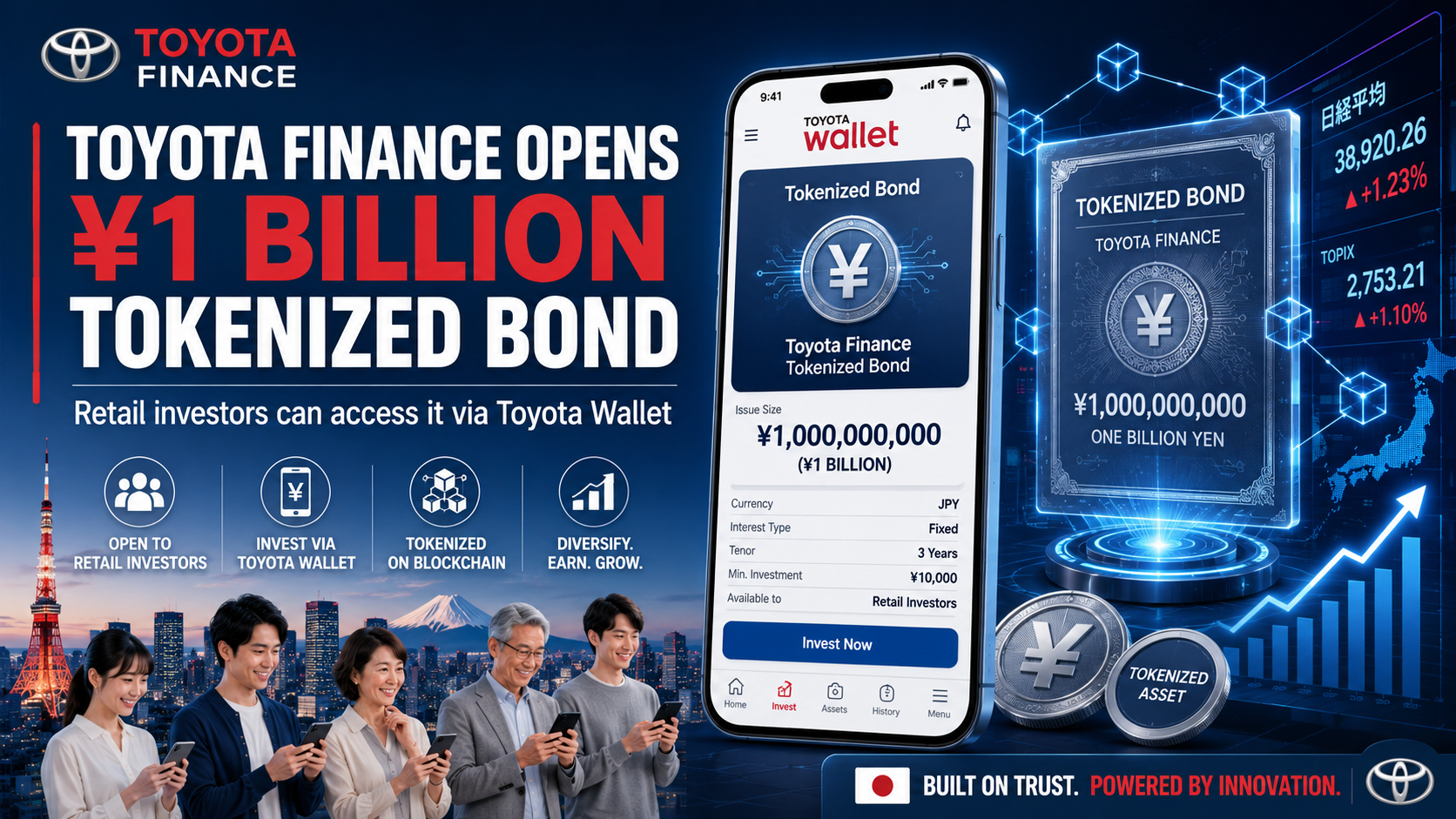
Toyota Brings Security Token Bonds to Retail Investors Through Toyota Wallet
Toyota Finance Corporation has opened applications for its second security token bond, a ¥1 billion (approximately $6.8 million) one-year instrument that retail investors in Japan can buy straight through the Toyota Wallet mobile payment app. Applications began on August 18, 2026, with a minimum investment of ¥100,000 and no requirement to open a traditional securities account. The bond, formally the Toyota Finance Second Security Token Bond and branded the TOYOTA Wallet Tsumugu Bond, carries a fixed 1.72% annual coupon, is scheduled for issuance on October 27, 2026, and matures on October 27, 2027. Ownership records sit on the permissioned ibet for Fin blockchain operated by BOOSTRY.
This self-offering structure marks the Toyota Group’s first publicly offered security token bond distributed directly by the issuer rather than through securities companies. By embedding a regulated corporate bond into an everyday consumer payment app and pairing it with brand-specific rewards, Toyota Finance is testing whether a major non-financial corporation can use blockchain-based security tokens to deepen customer relationships while accessing retail funding at competitive cost, all within Japan’s carefully supervised digital securities framework.
Direct Retail Access Removes the Brokerage Layer for Everyday Toyota Customers
Toyota Finance is selling the bond itself rather than routing subscriptions through securities firms. Investors install the Toyota Wallet app, already used for parking payments, electronic money top-ups, and mobility services, and apply via a dedicated page on the Toyota Finance website. The company designed the process so that holders of its TS CUBIC CARD are not required; a separate payment structure accommodates applicants without that card. Applications run through September 2, 2026, and allocations will be determined by lottery if demand exceeds the ¥1 billion ceiling. Official details appear in the joint announcement by Toyota Financial Services, Toyota Finance, SMBC Group, and BOOSTRY published on PR TIMES.
This direct channel lets Toyota control the entire investor journey, from application and communications to delivery of benefits, inside one ecosystem. The approach reduces intermediation costs and creates a continuous data link between the bondholder and the broader Toyota mobility and finance services. Proceeds support the company’s vehicle installment credit business, so the underlying economic activity remains conventional auto finance rather than speculative blockchain activity. The self-offering model represents a deliberate evolution from the company’s first security token bond, which relied on securities companies for distribution.
Minimum Investment and Coupon Terms Positioned for Retail Accessibility
The ¥100,000 minimum equates to roughly $676–$680 at recent exchange rates, placing the product within reach of ordinary savers. The 1.72% fixed annual rate exceeds the coupon on Toyota Finance’s first security token bond issued in early 2025, which paid 0.83%. Maturity is exactly one year from the planned October 27, 2026, payment date. The issue carries an AAA rating from the Japan Credit Rating Agency and is unsecured, supported by long-standing credit arrangements with Toyota Motor and Toyota Financial Services. Net proceeds after issuance costs are reported around ¥925 million.
These parameters keep the instrument simple and short-duration while offering a yield that, at the time of launch, compared favorably with many short-term bank deposits in Japan. Because the bond is non-transferable, investors lock in the rate and hold to maturity or accept an issuer buyback as the only early-exit option. The combination of modest ticket size, fixed income, and brand familiarity is intended to attract Toyota’s existing customer base rather than professional fixed-income traders. Full terms are set out in the registration documents filed with the Tokai Local Finance Bureau.
Ownership Recorded on BOOSTRY’s ibet for Fin Consortium Blockchain
The bond is issued and administered as a security token on ibet for Fin, the consortium-type blockchain platform developed and operated with participation from major Japanese financial institutions under BOOSTRY’s leadership. ibet for Fin specializes in regulated security tokens and restricts participants to registered financial instruments, business operators, and related entities. Sumitomo Mitsui Banking Corporation serves as bond administrator. The ledger records ownership digitally in place of traditional book-entry or paper certificates, enabling efficient primary issuance and ongoing administration.
According to BOOSTRY’s market data, ibet for Fin has handled a substantial share of Japan’s public security token issuance volume. Cumulative public security token issuance across platforms reached hundreds of billions of yen by early 2026, with corporate bonds forming one of the active categories. The platform’s permissioned design ensures compliance with Japanese securities regulations while delivering the operational benefits of distributed ledger technology for issuance and registry management. Toyota Finance’s choice of ibet for Fin after using Progmat for its first bond demonstrates flexibility among available domestic tokenization infrastructures.
Self-Offering Structure Marks Toyota Group’s First Direct Public Security Token Sale
Previously, Toyota Finance’s March 2025 security token bond of the same ¥1 billion size was distributed exclusively through securities companies. That earlier instrument also carried a one-year tenor and ¥100,000 minimum but matured in March 2026. The current offering is the first in which Toyota Finance itself conducts the public offering without intermediary sales agents. SMBC Nikko Securities advised on the transaction. The self-offering enables Toyota to design the application flow, ongoing communications, and benefit delivery as an integrated experience centered on Toyota Wallet.
This structural change gives the issuer greater control over investor relationships and allows seamless attachment of loyalty rewards. It also tests whether a consumer-facing corporation can successfully market a regulated investment product through its own digital channels. The official press release emphasizes that the goal is a more familiar and seamless investment experience for Toyota customers while advancing the company’s digital finance capabilities.
Non-Transferable Feature Eliminates Secondary Market Trading by Design
Holders cannot resell the bond to other investors or pledge it as collateral. The only path to early liquidity is a buyback by Toyota Finance. This restriction is explicit in the bond’s formal name and documentation. By removing secondary trading, the issuer avoids the additional regulatory and operational complexity that would accompany a freely transferable security token. Redemption occurs solely with the issuer at maturity or under the buyback terms.
The design choice prioritizes simplicity and regulatory clarity over liquidity. It suits a short-duration retail product intended to sit alongside everyday wallet usage rather than function as a tradable fixed-income instrument. Market observers note that many early Japanese corporate security token bonds have adopted similar transfer restrictions to streamline approval and administration. Investors therefore evaluate the bond primarily on credit quality, coupon, and the attached experiential benefits rather than secondary-market exit opportunities.
Experiential Rewards and Wallet Credits Enhance the Investor Proposition
Beyond the 1.72% coupon, bondholders may receive Toyota Wallet QUICPay electronic money balances ranging from several hundred to a few thousand yen depending on conditions, plus entries into lotteries for mobility experiences. Confirmed prizes include family tickets to Fuji Speedway events, KINTO rental-car vouchers, and test-drive opportunities involving Lexus, GR, and selected classic Toyota vehicles. Additional Wallet balance incentives may apply for purchasers of Toyota or Lexus vehicles under specified conditions. Details are communicated after issuance through the app or registered email.
These perks convert a standard corporate bond into a brand engagement tool. Toyota leverages its existing ecosystem of mobility services, motorsport venues, and vehicle experiences to differentiate the product from generic fixed-income offerings. The rewards are structured as lotteries and conditional grants, so not every holder receives the same package. The approach aligns the investment with the company’s broader customer-relationship strategy while providing tangible non-cash value that may appeal to Toyota enthusiasts.
Application Mechanics Rely on Lottery Allocation When Oversubscribed
Investors apply online through the dedicated Toyota Finance portal after installing Toyota Wallet. The subscription window runs from August 18 to September 2, 2026. If total applications exceed ¥1 billion, a lottery determines successful allotments. Payment and issuance occur on the scheduled October 27, 2026, date. The process is designed to be accessible to individuals who may never have opened a brokerage account. Official application information is available at the Toyota Finance security token page.
Lottery allocation is a common mechanism in Japanese retail bond and security token offerings to manage demand fairly when interest is high. Combined with the low minimum and absence of a securities account requirement, the mechanics lower the barrier for first-time or occasional investors. Clear communication of the lottery and subsequent allocation results through the Wallet app is intended to maintain transparency and trust in the process.
Japan’s Security Token Market Provides Supportive Backdrop for Corporate Issuers
Japan’s public security token market has grown steadily. BOOSTRY reported the FY2025 issuance of approximately ¥165 billion, bringing cumulative volume to roughly ¥333 billion by early 2026. Corporate bond security tokens formed a meaningful segment alongside real-estate-backed tokens. ibet for Fin and Progmat have been the two primary platforms, together accounting for the large majority of public issuance. Secondary-market venues such as Osaka Digital Exchange’s START platform have begun listing a limited number of tokens.
Regulatory clarity under the Financial Instruments and Exchange Act, combined with active participation by major banks and securities firms, has enabled both financial and non-financial issuers to experiment with tokenized instruments. Toyota Finance’s successive issuances illustrate how a large industrial group can use the framework for direct retail funding while testing digital distribution channels. The market’s emphasis on compliance and controlled participation distinguishes Japan’s approach from more open crypto-asset environments elsewhere.
Credit Support and Rating Underpin the Instrument’s Risk Profile
Although the bond is unsecured and unguaranteed in the conventional sense, it benefits from longstanding credit support agreements dating to 2000 with Toyota Motor Corporation and Toyota Financial Services. The Japan Credit Rating Agency assigned an AAA rating. Sumitomo Mitsui Banking Corporation administers the bond for a fixed fee. These features place the credit risk profile close to that of other Toyota Finance obligations of similar tenor. Proceeds are earmarked for the company’s auto-loan and installment-credit operations, linking the instrument directly to the core business of financing vehicle purchases.
Investors therefore assess the bond primarily as exposure to Toyota Finance’s creditworthiness rather than to blockchain technology risk. The short one-year maturity further limits duration risk. The combination of high rating, group support, and conventional use of proceeds is intended to reassure retail participants who may be new to security tokens.
Comparison of the Two Toyota Finance Security Token Bonds Highlights Evolution
The 2025 debut bond and the current offering share the same ¥1 billion size and ¥100,000 minimum. Differences appear in distribution channel, coupon (0.83% versus 1.72%), blockchain platform (Progmat versus ibet for Fin), and the addition of richer experiential rewards. The first bond was sold through securities companies; the second is self-offered. Both are non-transferable. The higher coupon on the 2026 bond reflects prevailing interest-rate conditions at the time of pricing.
This evolution shows Toyota Finance refining its approach after the initial experiment. The move to self-offering and deeper Wallet integration prioritizes customer experience and data continuity. The platform switch indicates that issuers can select among competing domestic tokenization infrastructures according to operational fit. Together, the two transactions provide a practical case study of iterative product development within Japan’s regulated security token environment.
Consumer Brand Distribution of Regulated Investments Raises Practical Questions
Toyota’s experiment tests whether a large consumer brand can successfully market a regulated fixed-income product through its own digital channels. Success would encourage other non-financial corporations with strong retail relationships to explore similar direct offerings. Challenges include ensuring investor understanding of the product’s features and risks, managing lottery allocations transparently, and delivering promised benefits consistently. The closed, non-transferable design reduces some operational complexities but also limits the instrument’s role in secondary-market development.
For investors, the key considerations remain the issuer’s credit quality, the locked-in coupon, the one-year horizon, and the value of the associated rewards. The product is not a cryptocurrency; it is a corporate bond whose ownership is recorded on a permissioned blockchain. Clear disclosure of these characteristics is essential for informed participation. Toyota Finance’s filings and the joint press release provide the primary source material for evaluating the terms.
Longer-Term Significance for Tokenized Corporate Funding in Japan
If the offering attracts solid retail demand and operates smoothly, it may encourage further self-offered security token bonds by industrial issuers. The ability to combine funding with customer engagement offers a dual benefit that traditional intermediated bonds cannot easily replicate. At the same time, the non-transferable structure means these instruments contribute primarily to primary-market innovation rather than to liquid secondary markets. Broader market growth will depend on continued regulatory support, platform interoperability, and investor familiarity.
Toyota Finance’s successive transactions demonstrate that established corporations can use security tokens for practical, short-term retail funding while advancing digital capabilities. The integration with Toyota Wallet shows how tokenization can sit inside existing consumer applications rather than requiring separate investment platforms. Observers will watch allocation results, investor feedback, and any follow-on issuances for signals about the model’s scalability.
FAQ
What exactly is a security token bond in this context?
A security token bond is a corporate bond whose ownership and administration are recorded on a blockchain ledger rather than solely through traditional book-entry systems. In Toyota Finance’s case, the instrument remains a conventional unsecured corporate debt obligation under Japanese securities law; the blockchain (ibet for Fin) simply provides the registry and operational infrastructure. Investors receive a fixed coupon and repayment of principal at maturity, subject to the issuer’s creditworthiness. The tokenized form enables digital application, ownership tracking, and integrated benefit delivery without changing the fundamental legal and economic nature of the bond.
Do investors need a securities account or brokerage relationship?
No. One of the defining features of this offering is that applicants can purchase through the Toyota Wallet app and the dedicated Toyota Finance application page without opening a securities account. This self-offering structure is the first of its kind for the Toyota Group’s public security token bonds. The company has arranged a payment pathway that does not require its own TS CUBIC CARD, further lowering barriers for retail participants who may not already hold investment accounts.
Can the bond be sold before maturity?
No. The bond is explicitly non-transferable. Holders cannot resell it to other investors or use it as collateral. The only early-exit route is a buyback by Toyota Finance under the terms set out in the documentation. This design simplifies regulatory treatment and administration while locking investors into the one-year term or the issuer’s buyback option. Prospective buyers should treat the instrument as a hold-to-maturity product.
What rewards are available beyond the interest payment?
Eligible holders may receive Toyota Wallet electronic money balances and entries into lotteries for Fuji Speedway tickets, vehicle test drives (including Lexus and classic models), and related mobility experiences. Additional wallet incentives may apply when purchasing Toyota or Lexus vehicles under specified conditions. Exact amounts and eligibility rules are communicated after issuance through the app or email. These perks are designed to enhance the overall value proposition for Toyota customers.
🔥 KuCoin Offers A More Stable Option in A Volatile Market
If you worry about the frequent ups and downs in the market, and pursue a more stable option to earn money passively, KuCoin is the right place to come:
Simple Earn: Deposit and withdraw tokens anytime, earning stable returns.
Kucoin Earn: Earn stable profits with professional asset management.
Hold to Earn: Earn rewards by holding assets in Funding, Trading, Margin, Futures, Mining, and Unified Accounts.
Staking: Unlock the earning potential of on-chain assets.
Advanced Investments: Advanced Investments offer a variety of structured products to help your money grow in any market.
Shark Fin: Principal Protection and Guaranteed Gains
Dual Investment: Buy low and sell high with transparent return calculations.
Snowball: High yields, with price protection.
Discount Buy: Buy crypto at discount prices.
KCS Loyalty: Level up to enjoy exclusive perks by staking ≥ 1 KCS.
KuCoin Wealth: Discover future value and begin your smart investing journey.
KCS Benefits: Hold and stake KCS to access benefits across the platform.
KCS Staking 2.0: Participate in KCS on-chain governance to earn yield.
Disclaimer: This content is for informational purposes only and does not constitute investment advice. Cryptocurrency investments carry risk. Please do your own research (DYOR).