

Sui Gas-Free Stablecoin Transfers Go Live on Mainnet: The Zero-Fee Era Begs
2026/05/22 15:48:20
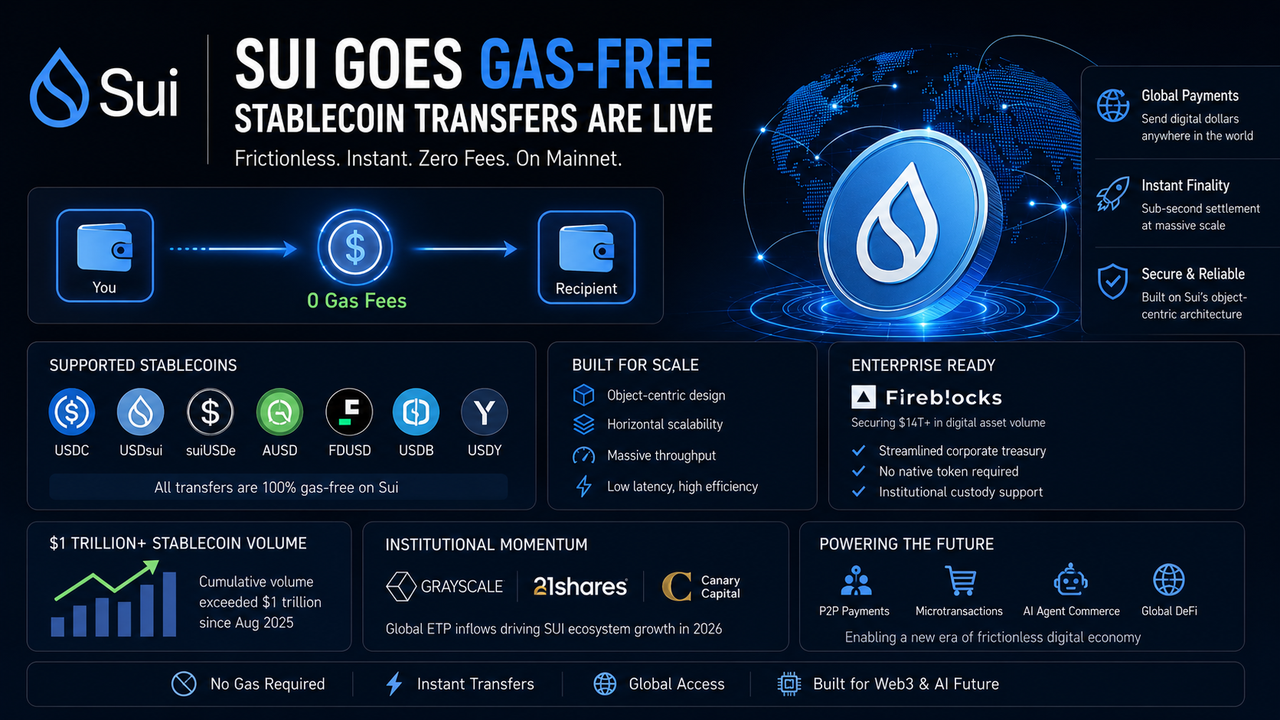
The global landscape of digital asset transactions has shifted dramatically with a major network upgrade. As blockchain infrastructure evolves to meet mainstream financial demands, the Sui network has introduced an unprecedented protocol-level advancement that permanently eliminates the standard gas fee barriers associated with moving digital currencies peer-to-peer.
This monumental deployment marks the official realization of friction-free, institutional-grade web3 payments. By executing this upgrade, the network delivers a comprehensive framework where a Sui gas-free stablecoin transaction can successfully go live on mainnet, fundamentally altering peer-to-peer value transfers.
Quick Overview:
The deployment of gasless stablecoin transfers directly onto the mainnet addresses one of the longest-standing hurdles in the entire cryptocurrency industry: user friction. For over a decade, sending a dollar-denominated token on a blockchain required the sender to possess a fractional amount of that specific network's native utility token just to power the underlying computation. This operational paradigm routinely caused failed transactions, confusion for newcomers, and severe structural accounting headaches for commercial enterprises.
By implementing this capability at the fundamental protocol layer, the network eliminates the necessity of pre-funding user accounts with native gas assets. The change is not a temporary marketing campaign or an applications-specific abstraction layer, but a permanent, structural adjustment to how value moves across the internet. At a time when traditional fintech applications offer instantaneous, free peer-to-peer transfers within centralized borders, this update brings that identical ease of use to a decentralized, globally accessible payment rail.
The update arrives at a period of intense network expansion, positioning the layer-1 blockchain as a dominant infrastructure provider for digital commerce. Both retail users and enterprise institutions can now move multi-million dollar tranches or fractional cents across the planet without incurring network fees. Consequently, the operational barrier to web3 onboarding drops effectively to zero, signaling a profound shift in the broader digital asset economy.
The Tech Behind Sui Gas-Free Stablecoin Architecture
Protocol-Level Engine vs Temporary Subsidies
Many prior attempts across the broader blockchain ecosystem to offer "gasless" experiences have relied on gas-station networks, centralized relayer pools, or developer-funded promotional budgets. These legacy approaches introduced systemic vulnerabilities, including central points of failure, smart contract vulnerabilities, and unsustainable economic dynamics that vanished once marketing funds dried up.
In sharp contrast, this update integrates the feature directly into the network's consensus and execution layer. The blockchain utilizes an innovative Address Balances system that drastically cuts the transactional processing overhead for single and batched peer-to-peer movements. This structural efficiency allows validators to process stablecoin transfers at an internal cost profile of zero, ensuring the network remains permanently free for these transactions without eating away at developer resources or relying on third-party marketing subsidies.
Object-Centric Design and Horizontal Scalability
The underlying architecture of the blockchain relies heavily on an object-centric data model, which stands in stark contrast to the traditional account-based systems used by alternative smart contract platforms. In this environment, every digital asset, smart contract, and stablecoin balance is categorized as an independent, programmable object.
This unique design enables parallel execution, allowing transactions involving completely independent objects to be processed simultaneously rather than sequentially. The practical benefits of this architecture include:
-
Massive Throughput Optimization: Independent stablecoin transfers bypass global state bottlenecks, enabling hundreds of thousands of concurrent transactions.
-
Predictable Operational Performance: Eliminates fee spikes during periods of high network congestion elsewhere on the blockchain.
-
Minimal Computational Overhead: Streamlines validator validation logic, lowering the physical hardware strain required to process basic asset movements.
-
Horizontal Scalability: Allows validators to dynamically scale capacity by adding more computing power as transaction volumes escalate.
Why No SUI Token Balance Is Required
Because the architecture recognizes stablecoin transfers as highly optimized, direct object mutations, the protocol bypasses the traditional gas-metering loop entirely for supported payment actions. In a standard layer-1 environment, a virtual machine must calculate precise gas units consumed, cross-reference the current gas price, and deduct that sum from the user’s native balance before authorizing the transaction.
By utilizing the newly deployed Address Balances framework, the protocol recognizes specific peer-to-peer transfers of verified stablecoin objects as exempt from native gas demands. This means a newly created wallet can receive a transfer of digital dollars and instantly send them onward to another address without ever interacting with a secondary asset marketplace to acquire native utility tokens.
Supported Tokens: Moving Digital Dollars for Free
Native USDC and USDsui Integration
The cornerstone of this zero-gas ecosystem relies heavily on the integration of highly liquid, federally compliant, and globally trusted digital dollar assets. Chief among these is USDsui, a stablecoin backed by institutional liquidity channels and integrated through payment infrastructure giants like Stripe via their native bridge systems.
Simultaneously, the deployment fully supports native USDC issued by Circle, providing users with direct access to the largest regulated stablecoin infrastructure in the world. The uninhibited flow of native USDC and USDsui across the mainnet ensures that deep liquidity pools remain constantly accessible to everyday consumers and market makers alike. Users can swap, send, and settle payments instantly using these core assets, confident that their principal value remains securely pegged to the United States dollar while bypassing network fees.
Rising Ecosystem Assets: suiUSDe, AUSD, and FDUSD
Beyond the standard fiat-backed pillars, the mainnet deployment extends its zero-fee architecture to several rapidly growing alternative stablecoins and synthetic assets. This includes suiUSDe, the network’s native implementation of Ethena’s synthetic dollar, which offers decentralized, yield-generating utility to participants across the ecosystem.
Additionally, the protocol supports Agora’s AUSD and First Digital’s FDUSD, both of which have seen substantial traction among liquidity providers, institutional traders, and cross-border payment platforms. Incorporating these varied stablecoins ensures that users are never locked into a single issuer or centralized counterparty. Instead, they can select the specific asset architecture that aligns with their personal compliance, risk, and structural preferences, while continuing to experience identical zero-gas operational efficiencies.
Yield and Bridge Tokens: USDB and USDY Support
To further bridge the divide between native web3 yield mechanics and traditional real-world assets (RWAs), the network has integrated specialized tokens into its gasless framework. These assets include:
-
USDB: A yield-bearing stablecoin originating from native bridge ecosystems, designed to pass underlying capital efficiencies directly to holders.
-
USDY: Issued by Ondo Finance, this token functions as a secured note backed by short-term US Treasuries, providing global access to institutional-grade yield.
By including USDB and USDY within the gasless transfer catalog, the protocol allows global retail users to hold yield-bearing, treasury-backed instruments and transact with them as liquid cash. This effectively transforms interest-bearing capital into a frictionless, free medium of exchange for everyday global commerce.
Enterprise Adoption: The Crucial Fireblocks Partnership
How Fireblocks Streamlines Corporate Treasury
The institutional viability of any public blockchain relies entirely on the quality of its security and custody infrastructure. The integration of this feature by Fireblocks—an enterprise-grade digital asset infrastructure platform responsible for securing over $14 trillion in cumulative transactional volume—serves as a massive validation for the network.
Prior to this upgrade, corporate treasuries managing web3 operations had to maintain complex multi-asset portfolios simply to cover transactional overhead. An enterprise processing thousands of global supplier invoices via stablecoins had to continuously monitor, hedge, and replenish native gas tokens across hundreds of disparate employee or regional settlement wallets. Fireblocks’ native integration allows corporate operations to completely eliminate this operational burden. Treasuries can now execute high-frequency, high-value stablecoin payments using clean, single-asset accounting frameworks that entirely omit volatile gas management from the ledger.
Institutional Custody Support at Launch
The rollout of gasless transfers is backed by a broad consortium of institutional custodians, digital asset banks, and secure retail-facing wallet applications. Having custody support live at launch ensures that institutional capital allocators can instantly utilize these cost-saving features without waiting for multi-month development or compliance compliance cycles.
Financial service providers, payment processors, and OTC desks can now pass these zero-overhead benefits directly down to their respective client bases. This institutional backing fundamentally changes the risk-reward calculus for commercial entities evaluating public blockchain options, positioning the network as a premier, business-ready payments infrastructure layer.
Breaking Down Sui’s $1 Trillion Volume Milestone
The rollout of this protocol-level feature comes on the heels of an explosive growth trajectory for the ecosystem. Since August 2025, the network has crossed a staggering $1 trillion in cumulative stablecoin transfer volume.
This immense figure proves that market demand for the network’s high-throughput, low-latency architecture is already well-established among global market participants. By driving transactional costs to zero precisely as volume metrics reach an institutional tipping point, the network creates a powerful compounding network effect that incentivizes further migration of capital away from legacy, high-fee layer-1 platforms.
Market Momentum: SUI Ecosystem Growth in 2026
Tracking the ETP Inflows: Grayscale and 21Shares
The year 2026 has marked a definitive turning point for the network's mainstream Wall Street presence. A succession of regulated exchange-traded products (ETPs) have launched globally, backed by premium digital asset asset management firms including Grayscale and 21Shares.
These investment vehicles provide institutional fund managers, pension programs, and traditional retail brokerage accounts with direct, compliant exposure to the network's native economic expansion. The consistent capital inflows into these ETPs mirror a growing global consensus that the network's underlying technological foundation represents the premier architecture for modern, scalable decentralized finance.
Canary Capital and Global Financial Integration
Further elevating the network's global standing, Canary Capital introduced dedicated investment offerings targeting the ecosystem's expanding infrastructure. This wave of institutional products bridges the gap between traditional equity markets and decentralized networks.
As financial firms seek out highly performant, web2-compatible layer-1 solutions to house tokenized real-world assets, the network's continuous technological advancements make it an obvious destination. The convergence of regulated investment products with real-world payment utility creates a robust economic loop that dramatically elevates the asset's long-term market profile.
Impact on Exchange Liquidity and Stablecoin Pools
For centralized trading platforms and decentralized liquidity venues, the introduction of gasless transfers introduces massive structural benefits. Exchanges can expect a series of critical operational optimizations across their internal ecosystems:
-
Lower Operational Withdrawals Fees: Centralized exchanges can significantly reduce or entirely remove withdrawal fees for supported stablecoins, enhancing the user experience.
-
Rapid Arbitrage Capabilities: Traders can shift stablecoin capital between external custody solutions and exchange order books instantly without fee degradation.
-
Elevated Pool Velocity: Decentralized automated market makers (AMMs) can process high-volume rebalancing trades without accumulating gas overhead.
-
Streamlined Market Making: Liquidity providers can deploy capital across various ecosystem nodes with drastically reduced execution friction.
Web3 Revolution: P2P Payments and AI Agents
Redefining P2P Transfers with Web2 Usability
For blockchain technology to achieve true global ubiquity, the end-user experience must become completely indistinguishable from the centralized fintech tools that consumers use daily. By eliminating the necessity of native token balances for basic dollar movements, this network upgrade bridges the longstanding usability gap between legacy platforms and web3.
An everyday user can now download a compatible wallet, scan a QR code, and send or receive digital dollars instantly across the planet. The transaction processes in milliseconds with zero fees, mimicking the smooth, intuitive interface of platforms like Venmo or CashApp, while retaining the censorship resistance, self-custodied security, and open-source freedom of a decentralized public ledger.
Powering Microtransactions and Agentic Commerce
The broader economic implications of permanent zero-fee transactions become particularly disruptive when applied to the realm of microtransactions. In legacy payment structures—including traditional credit card networks and standard layer-1 blockchains—flat transaction minimums and processing fees make it economically impossible to send fractional currency amounts.
Paying two cents to unlock a premium news article, a fraction of a cent to stream a second of high-definition video, or fractional dollars for metered API access becomes entirely viable under a gasless framework. This capability unlocks entirely new monetization paradigms for global digital creators, enterprise software providers, and subscription-weary consumers.
Autonomous Payment Paths for AI Systems
As artificial intelligence models transition from passive analytical tools into autonomous entities capable of executing complex workflows, they require a compatible, native financial rail. Traditional legacy banking systems—reliant on human legal identities, credit checks, and slow settlement windows—are fundamentally incapable of supporting autonomous machine commerce.
AI agents operate on logic centered on mathematical optimization and will systematically seek out the absolute lowest path of economic resistance. By offering a secure environment where digital dollars move instantly with zero fee overhead, the network positions itself as the default native layer for the nascent machine-to-machine economy, enabling automated systems to trade data, compute power, and specialized services with total financial autonomy.
FAQ
What does the gasless stablecoin transfer update mean for everyday users on Sui?
This protocol-level update allows everyday users to send supported stablecoins across the Sui network completely free of charge. Users no longer need to buy or hold any native SUI tokens to pay for transaction gas fees when making peer-to-peer digital dollar payments.
Which specific stablecoins are supported by this zero-fee mainnet feature?
The mainnet deployment fully supports a broad range of leading stablecoin assets, including native USDC, USDsui, suiUSDe, AUSD, FDUSD, USDB, and USDY. This wide asset selection provides users with extensive liquidity and freedom of choice for global settlements.
Is this gasless transaction feature a temporary marketing promotion?
No, this feature is a permanent, structural upgrade implemented directly at the core Sui protocol layer. It does not rely on temporary developer subsidies, third-party marketing budgets, or external relayer networks, ensuring long-term operational sustainability for the entire ecosystem.
How does the Fireblocks integration benefit enterprises using the network?
Fireblocks provides enterprise-grade infrastructure that allows corporate treasuries to execute high-volume stablecoin transfers without managing separate native gas token balances. This drastically simplifies accounting processes, eliminates asset volatility risks, and streamlines global corporate payment workflows.
How does this network upgrade impact the development of AI agents?
AI agents require highly efficient, low-cost programmatic payment networks to execute autonomous machine-to-machine commerce. By offering a secure framework for instant microtransactions with zero fee overhead, the network becomes an ideal infrastructure layer for autonomous AI economic systems.
Conclusion
The successful mainnet deployment of gasless stablecoin transfers positions the Sui network as a premiere, institutional-grade payment rail for the next generation of digital commerce. By leveraging its unique object-centric architecture to entirely eliminate transaction fee friction for digital dollars, the protocol effectively bridges the operational gap between traditional web2 fintech convenience and web3 financial sovereignty. Backed by enterprise infrastructure giants like Fireblocks and supported by deep global liquidity assets like USDC and USDsui, this upgrade represents a permanent structural evolution that drastically accelerates global blockchain adoption across retail, corporate treasury, and autonomous AI ecosystems alike.