

SK Hynix Stock Outlook After Record Q3 2026 Earnings: Can the AI Memory Boom Last?
Introduction
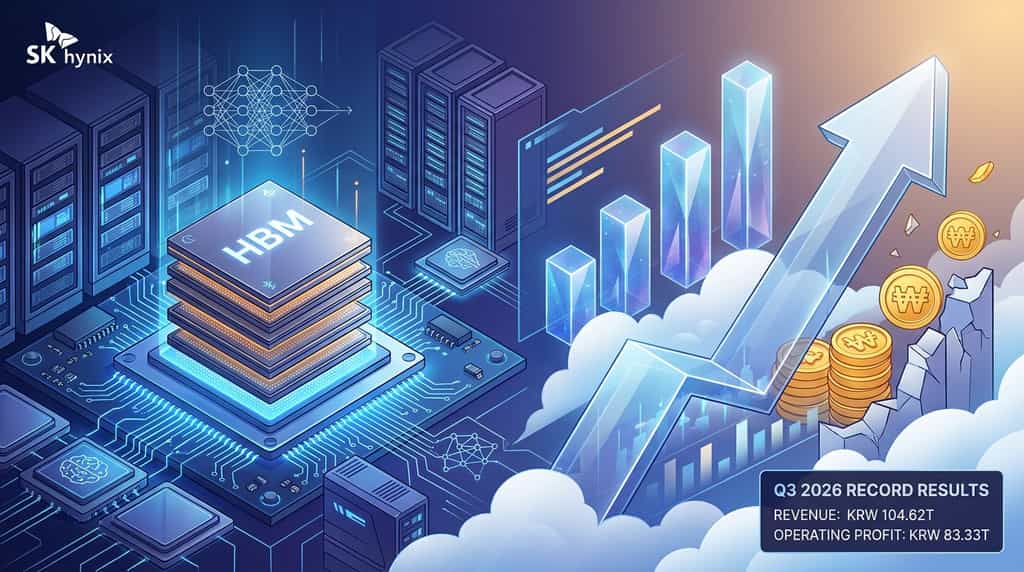
SK Hynix reported record quarterly revenue of KRW 104.62 trillion and operating profit of KRW 83.33 trillion in Q3 2026, as demand for high-bandwidth memory (HBM) and other AI-related memory products continued to expand. According to the company's official Q3 2026 earnings release, published on October 28, 2026, revenue increased 32% quarter over quarter, while operating profit rose 38%. The results highlight SK Hynix's position in the AI infrastructure supply chain, but they also raise a key question: can exceptional profitability persist as memory supply expands and the semiconductor cycle evolves?
The SK Hynix stock outlook depends on several factors, including HBM4 adoption, AI data center investment, long-term customer contracts, production capacity, and memory pricing. Investors also need to distinguish operating performance from net income, which declined quarter over quarter despite record revenue and operating profit.
Why Did SK Hynix Report Record Q3 2026 Earnings?
SK Hynix's record Q3 results were driven by strong AI memory demand, higher prices for key products, and growth in high-value-added server memory. The company reported revenue of KRW 104.6155 trillion, operating profit of KRW 83.3338 trillion, and net income of KRW 39.7756 trillion, based on its official Q3 2026 financial results.
The company's revenue increased 32% from Q2 2026 and 328% year over year. Operating profit rose 38% quarter over quarter and 632% year over year. Operating margin reached 80%, compared with 76% in Q2 and 47% in Q3 2025. These figures show how strong product demand and favorable pricing can affect profitability when a memory supplier has products that customers urgently need.
The results also show why investors should examine multiple financial measures. Net income fell 58% quarter over quarter, from KRW 93.92 trillion in Q2 to KRW 39.78 trillion in Q3, even as revenue and operating profit increased. SK Hynix's latest release does not provide a full explanation of every factor behind that quarterly decline in its summary figures, so investors should review the complete financial statements and earnings-call materials before drawing conclusions.
The broader takeaway is that SK Hynix has benefited from a powerful memory-market upcycle, but one record quarter cannot establish how long current margins will last. Investors need to assess product demand, pricing, production capacity, and future capital spending alongside the headline earnings numbers.
How Important Is HBM4 to the SK Hynix Stock Outlook?
HBM4 is a key part of SK Hynix's growth strategy because advanced AI accelerators require high memory bandwidth and efficient access to large volumes of data. In its October 28 earnings release, SK Hynix said HBM4 shipments had begun in earnest and that HBM4 was expected to become its mainstream HBM product from Q4 2026.
High-bandwidth memory stacks multiple memory dies to provide high data throughput in a compact package. This makes HBM important for AI accelerators that need to move large amounts of model data while running demanding training and inference workloads. As AI models and data center systems become more complex, memory performance can become an important part of overall system performance.
SK Hynix is also expanding its wider AI memory portfolio. The company reported stronger sales of server DDR5 and high-value-added server products, while its NAND business benefited from growing sales of 321-layer TLC enterprise solid-state drives (eSSDs). These products serve different parts of AI infrastructure: HBM supports high-bandwidth accelerator workloads, server DRAM provides working memory, and enterprise SSDs provide high-capacity data storage.
The company's production plans are therefore important to its future earnings. SK Hynix said it planned to ramp up its M15X facility to maximum capacity by the end of 2026 to increase HBM4 production. It also intends to expand production of advanced DRAM and high-performance NAND products. These are company plans, not guarantees of future sales or profits, and their financial impact will depend on customer demand, manufacturing execution, yields, and product pricing.
Investors should also remember that a successful product transition does not eliminate competition. The HBM market is technically demanding, and customers may assess suppliers on performance, reliability, manufacturing capacity, cost, and delivery schedules. SK Hynix's ability to maintain its product position as HBM4 adoption expands will be a central factor in the stock's longer-term outlook.
Can AI Memory Demand Sustain SK Hynix's Growth Through 2030?
SK Hynix expects demand for memory to remain strong, partly because AI infrastructure investment is broadening beyond early adopters. In its Q3 2026 earnings release, the company said it expects memory supply constraints to persist through 2030, citing the complexity of leading-edge manufacturing and the long lead times required to build new production facilities.
The company's outlook rests on a widening range of AI applications. AI data centers need advanced memory to support model training, inference, and other computing workloads. SK Hynix also points to enterprise and personal AI in the nearer term, with physical AI applications such as autonomous driving and robotics potentially supporting demand over a longer horizon.
This demand thesis is important because memory is a cyclical industry. When demand rises faster than supply, product prices and manufacturer margins can improve sharply. When supply catches up or customers reduce orders, pricing can weaken and profitability can fall. The current record operating margin should therefore not be assumed to continue indefinitely.
Supply expansion creates a balancing challenge. SK Hynix plans to increase production capacity and expects significant investment in 2027 as its Yongin Phase 1 facility moves into full-scale operation and other infrastructure projects progress. More capacity can help the company serve customers and support revenue growth, but it also requires capital, time, and careful execution. If industry supply eventually expands faster than demand, pricing pressure could return.
The company's forecast of a supply-demand imbalance through 2030 is a management assessment, not an independently guaranteed outcome. Investors should monitor subsequent earnings releases for changes in customer demand, memory prices, capital expenditure plans, and production guidance. The longer-term outlook is stronger if AI demand broadens while supply growth remains disciplined; it becomes less favorable if spending slows or new capacity creates excess supply.
SK Hynix has announced a substantial shareholder return plan for 2026, linking its improved financial performance with dividends and share repurchases. According to the October 28 company release, the plan targets approximately KRW 100 trillion in shareholder returns this year, including cash dividends of at least KRW 30 trillion and share repurchases and cancellations totaling at least KRW 60 trillion.
The company also announced a Q3 cash dividend of KRW 14 trillion, equivalent to KRW 20,000 per share, including a special dividend related to gains from its investment in Kioxia. SK Hynix said it had completed the KRW 40 trillion share repurchase announced in August and planned to cancel those shares shortly. The latest release also described an additional share repurchase, part of which is intended for cancellation and part for employee compensation.
Shareholder returns can be relevant to investors because dividends provide direct cash distributions, while share cancellations can reduce the number of shares outstanding. However, the effect on an individual shareholder depends on the company's final actions, the amount of shares cancelled, the stock price, and the company's future financial needs.
The plan should also be considered alongside SK Hynix's investment requirements. Expanding HBM production and adding manufacturing capacity require substantial resources. Investors should assess whether the company can maintain competitive investment levels while delivering the shareholder returns it has announced. The company stated that it intends to base investment decisions on demand, competitiveness, profitability, and investment efficiency, but the eventual results will depend on market conditions.
Conclusion
SK Hynix's Q3 2026 results demonstrate how strongly AI-related memory demand can affect semiconductor revenue and profitability. Revenue reached KRW 104.62 trillion, operating profit hit KRW 83.33 trillion, and the company reported an 80% operating margin. HBM4 adoption, growing server memory sales, and long-term agreements covering more than half of planned production capacity for 2027 and 2028 provide important context for the company's growth strategy.
However, the sustainability of these results depends on factors beyond one record quarter. AI infrastructure spending must remain sufficient to support demand, production expansion must be managed carefully, and SK Hynix must maintain its product competitiveness as memory technology advances. Memory pricing can also change as supply and demand evolve, while higher capital expenditure may affect future cash generation.
The company's shareholder return plan adds another dimension to the outlook, but investors should evaluate it alongside the resources required for manufacturing expansion. SK Hynix's forecast of tight memory supply through 2030 is a company assessment, not a guaranteed outcome. A balanced stock analysis should therefore combine current earnings, product developments, supply conditions, valuation, and execution risks. Strong operating performance is important, but it does not by itself determine future share-price performance.
FAQs
1. What were SK Hynix's Q3 2026 revenue and operating profit?
According to SK Hynix's October 28, 2026 earnings release, Q3 revenue was KRW 104.6155 trillion and operating profit was KRW 83.3338 trillion. Revenue rose 32% quarter over quarter, while operating profit increased 38%.
2. Why is HBM important to SK Hynix?
High-bandwidth memory provides the data throughput required by demanding AI computing systems. Growing demand for AI accelerators has increased the importance of HBM performance, manufacturing capacity, and product availability.
3. When does SK Hynix expect HBM4 to become its mainstream product?
SK Hynix said in its Q3 2026 earnings release that HBM4 was expected to become its mainstream HBM product from Q4 2026. This is a company forecast, and actual adoption will depend on production, customer demand, and execution.
4. Why did SK Hynix's net income fall while operating profit increased in Q3 2026?
Net income declined 58% quarter over quarter to KRW 39.7756 trillion, while operating profit increased to KRW 83.3338 trillion. Investors should consult the full financial statements and earnings-call materials to understand the factors behind the difference, rather than infer the cause from headline figures alone.
5. Does record earnings mean SK Hynix stock will rise?
No. Future share-price performance depends on valuation, market expectations, future earnings, industry conditions, and broader financial markets. Record earnings are relevant evidence of current performance, but they do not guarantee future stock returns.
Disclaimer
This general market information, possibly from third-party, commercial, or sponsored sources, is provided for reference and educational purposes only and does not constitute financial or investment advice, an offer, solicitation, or guarantee. We disclaim liability for its accuracy, completeness, reliability, and any resulting losses. Investments/trading are risky; past performance doesn’t guarantee future results. Users should research, judge prudently, and take full responsibility. For further details, please consult KuCoin’s Terms of Use and Risk Disclosure.