

Ripple Warns Cross-Border Stablecoin Recognition Gap Could Fragment Global Payments
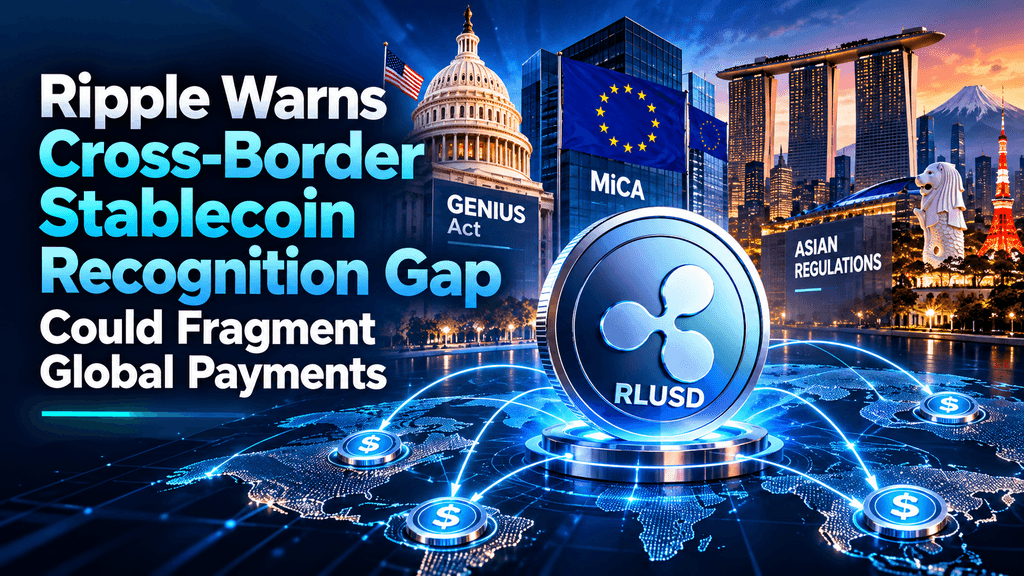
Ripple has raised concerns that differences in cross-border stablecoin recognition could fragment global payments, despite progress toward clearer digital asset regulations. While the U.S. GENIUS Act, European Union's MiCA framework, and Asian stablecoin regulations establish requirements for issuers, international acceptance remains a challenge. Ripple policy executive Rahul Advani warns that these gaps could prevent regulated stablecoins from operating efficiently across financial markets. The issue is particularly important for banks, payment providers, and businesses exploring blockchain-based international settlements. As Ripple USD (RLUSD) and other regulated stablecoins gain institutional attention, regulatory cooperation, liquidity access, and interoperability will play important roles in determining their practical use in global payments.
Ripple Warns Cross-Border Stablecoin Recognition Gaps Could Fragment Global Payments
Ripple has warned that inconsistent cross-border stablecoin recognition could fragment global payments, even as major economies develop similar regulatory frameworks for digital assets. According to a TokenPost report, Ripple policy executive Rahul Advani raised concerns about the lack of international recognition for regulated stablecoins during policy discussions in Bangkok. The central issue is that a stablecoin approved in one jurisdiction may still face restrictions in another, creating obstacles for international transactions. These regulatory differences could limit the efficiency of blockchain-based settlements, increase compliance costs, and complicate stablecoin adoption among banks and global payment providers.
Rahul Advani Highlights Cross-Border Stablecoin Recognition Risks at Bangkok Policy Discussions
Rahul Advani, a policy executive at Ripple, addressed stablecoin regulation during an Atlantic Council GeoEconomics Center panel on settlement in tokenized markets, held alongside the International Monetary Fund (IMF) and World Bank Annual Meetings in Bangkok. Advani reportedly warned that differences in how jurisdictions recognize foreign-regulated stablecoins could create separate digital payment markets. Although the United States, European Union, Singapore, Hong Kong, and Japan have introduced frameworks addressing stablecoin issuance and oversight, international recognition remains inconsistent. This creates uncertainty for financial institutions seeking to use the same digital assets across multiple markets.
The concern extends beyond regulatory approval to the practical requirements of institutional adoption. Banks evaluate stablecoins based on reserve backing, capital treatment, settlement liquidity, and compatibility with existing custody and treasury infrastructure. Advani's reported remarks also highlighted the importance of dollar-denominated stablecoins for international liquidity and local-currency stablecoins for domestic payments. Supporting both models could improve payment flexibility, but differences in legal recognition may prevent financial institutions from accessing and settling transactions using the same regulated digital assets across jurisdictions.
Domestic Stablecoin Regulation Does Not Guarantee International Recognition
Cross-border stablecoin recognition refers to the legal acceptance or permitted use of stablecoins issued under another jurisdiction's regulatory framework. A stablecoin may satisfy domestic reserve, redemption, and supervisory requirements without automatically qualifying for payment services in foreign markets. For example, a U.S.-regulated dollar stablecoin may encounter additional authorization, distribution, or compliance requirements when used by financial institutions operating in Europe or Asia. Although blockchain networks enable international token transfers, technical connectivity does not eliminate financial regulations. These differences can increase operational expenses, complicate redemption arrangements, and divide stablecoin liquidity across regional payment markets.
Ripple has previously identified regulatory convergence and stablecoin fungibility as important factors supporting international digital asset adoption. Its policy research, developed by Rahul Advani and Caren Tso, emphasized that differences in legal classifications, supervisory requirements, and technical standards could limit the ability of stablecoins to operate across borders. Greater regulatory cooperation and compatible settlement arrangements could help financial institutions transfer and redeem regulated digital assets more efficiently while maintaining financial safeguards. Ripple's warning reinforces the broader challenge facing global payments: national stablecoin regulations may become increasingly aligned, but meaningful international integration also requires clear recognition mechanisms and cooperation between financial authorities.
Global Stablecoin Regulations: U.S. GENIUS Act, EU MiCA, and Asian Recognition Frameworks
Global stablecoin regulations are becoming more defined, but the United States, European Union, and major Asian financial centers continue to apply different requirements to digital asset issuers and payment providers. The U.S. GENIUS Act establishes federal standards for payment stablecoins, while the EU's Markets in Crypto-Assets Regulation (MiCA) governs stablecoin issuance and related crypto-asset services. Singapore, Hong Kong, and Japan have developed separate regulatory approaches focusing on financial stability, consumer protection, and market access. Understanding these differences is essential for assessing how regulated stablecoins can support international payments and institutional settlement.
U.S. GENIUS Act Establishes Federal Stablecoin Issuer Requirements
The GENIUS Act, formally known as the Guiding and Establishing National Innovation for U.S. Stablecoins Act, creates a federal regulatory framework for payment stablecoins in the United States. The legislation establishes requirements for permitted issuers, including reserve backing, redemption rights, financial disclosures, and risk management. The Office of the Comptroller of the Currency (OCC) has finalized implementing regulations covering eligible reserve assets, custody arrangements, audits, supervision, and issuer licensing. These rules are designed to strengthen confidence in dollar-backed stablecoins by ensuring that issuers maintain sufficient liquid assets to meet redemption obligations. However, the finalized regulations have not yet reached their effective date, making implementation status an important distinction.
The framework also addresses foreign payment stablecoin issuers seeking access to the U.S. market. Overseas issuers must satisfy applicable eligibility and regulatory requirements rather than relying solely on authorization from their home jurisdictions. This creates an additional compliance consideration for international payment companies using stablecoins across multiple financial markets. Although the GENIUS Act provides greater clarity for U.S. payment stablecoin activities, it does not establish automatic recognition under foreign regulations. Issuers expanding internationally must still account for local licensing, redemption arrangements, and payment-service requirements.
EU MiCA Sets Separate Standards for Stablecoin Issuers and Crypto-Asset Services
The European Union's Markets in Crypto-Assets Regulation (MiCA) establishes a regulatory framework for crypto-assets, including asset-referenced tokens (ARTs) and e-money tokens (EMTs). ARTs seek to maintain a stable value by referencing assets or combinations of assets, while EMTs reference the value of a single official currency. MiCA requires relevant issuer authorization and imposes requirements concerning reserve management, redemption, governance, and consumer protection. The European Securities and Markets Authority (ESMA) has clarified that authorized crypto-asset service providers should not offer services involving stablecoins that fail to meet MiCA requirements. These expectations cover activities such as trading, transfers, custody, and exchange services. The European Banking Authority (EBA) has also identified USDC as the first significant e-money token under MiCA, among 45 notified EMTs, bringing additional supervisory requirements into focus. Consequently, a dollar-backed stablecoin regulated outside Europe cannot assume unrestricted access to EU financial services without meeting the applicable framework.
Singapore, Hong Kong, and Japan Develop Distinct Stablecoin Recognition Frameworks
Asian financial regulators are pursuing different approaches to stablecoin issuance and international market access. The Monetary Authority of Singapore (MAS) has proposed legislative amendments to implement its Single-Currency Stablecoin framework, covering stablecoins pegged to the Singapore dollar or G10 currencies. The proposed requirements address reserve backing, capital, redemption at par, and disclosure obligations. Importantly, MAS has also proposed recognizing a limited number of foreign-issued stablecoins regulated under comparable overseas frameworks. Another proposal would permit certain stablecoins to be jointly issued by Singapore-based and foreign issuers, subject to appropriate safeguards. These proposals offer potential pathways for international stablecoin integration, although they should not be treated as approved recognition arrangements.
Hong Kong and Japan demonstrate how regional stablecoin regulation can differ in practice. The Hong Kong Monetary Authority (HKMA) operates a licensing regime for fiat-referenced stablecoin issuers and has granted licences to Anchorpoint Financial Limited and HSBC, reflecting its focus on supervised issuance and financial safeguards. Japan's Financial Services Agency (FSA), meanwhile, regulates qualifying fiat-backed stablecoins as electronic payment instruments under its Payment Services Act, with separate requirements for issuers and intermediaries. Japanese rules also address information-sharing obligations for qualifying transfers involving domestic and foreign service providers. Together, these frameworks demonstrate that international stablecoin adoption depends on more than reserve quality or blockchain compatibility. Payment providers must also satisfy jurisdiction-specific authorization, intermediary oversight, and transaction compliance requirements.
Stablecoin Interoperability Challenges: Bank Adoption, Settlement Liquidity, and Ripple RLUSD
Stablecoin interoperability is becoming an important factor in the development of global digital payments as banks and financial institutions explore blockchain-based settlement systems. Although stablecoins can transfer value across blockchain networks, integrating them into traditional banking infrastructure requires reliable liquidity, secure custody, and access to fiat currency. Ripple USD (RLUSD) represents one approach to institutional stablecoin payments, but broader adoption depends on how effectively digital assets connect with existing financial systems and operate across different blockchain networks.
Institutional Stablecoin Adoption Depends on Banking Infrastructure
Banks considering stablecoin payments must evaluate more than transaction speed and network fees. Financial institutions need secure custody arrangements, customer verification procedures, transaction monitoring, and integration with existing treasury management systems. Capital requirements and the reliability of settlement arrangements also influence whether banks can incorporate stablecoins into routine operations. These considerations are particularly important for cross-border payments, where several financial intermediaries may participate in a single transaction. Even when blockchain settlement occurs quickly, banks must ensure that funds can be received, reconciled, and made available to customers without introducing unacceptable operational or counterparty risks.
Settlement Liquidity and Blockchain Interoperability Remain Major Challenges
Stablecoin settlement liquidity depends on whether sufficient funds and trading depth are available to exchange digital tokens for fiat currencies or other payment assets. A transfer completed on a blockchain does not necessarily mean the recipient can immediately convert the stablecoin into local currency at a predictable cost. Limited market depth, exchange fees, and differences in liquidity across blockchain networks can increase settlement expenses. The Bank for International Settlements (BIS) has also identified fragmented blockchain infrastructure as a barrier to interoperability, since tokens on separate networks cannot automatically move between them. Cross-chain bridges and other transfer mechanisms may improve connectivity but introduce additional technical and security risks. Reliable conversion channels, market-maker participation, and effective liquidity management are therefore essential for stablecoin-based international payments.
Ripple RLUSD Supports Institutional Payments Across Blockchain Networks
Ripple USD (RLUSD) is a U.S. dollar-backed stablecoin designed for payments, trading, treasury operations, and digital asset settlement. It is issued through a New York-regulated trust structure and backed by segregated reserves comprising cash and high-quality liquid assets, including U.S. Treasury securities. Ripple publishes independent monthly reserve attestations, while direct redemption at a 1:1 dollar value is subject to applicable customer eligibility and terms. RLUSD operates on the XRP Ledger and Ethereum, alongside other supported blockchain networks, giving institutions multiple options for integrating digital dollar payments. Unlike XRP, whose market value fluctuates, RLUSD is designed to maintain a stable dollar value. However, availability across multiple networks does not automatically create unified liquidity or seamless transfers between them. Its usefulness for cross-border settlement ultimately depends on supported payment corridors, reliable conversion services, institutional integration, and sufficient market liquidity.
Future of Cross-Border Stablecoin Payments: Regulatory Cooperation, Market Risks, and Global Outlook
The future of cross-border stablecoin payments will depend on stronger international regulatory cooperation, practical settlement infrastructure, and the ability to manage financial risks across jurisdictions. As digital currencies become more integrated into financial services, central banks and payment providers are exploring ways to connect different forms of tokenized money. However, wider adoption will require more than faster blockchain transactions. Stablecoin payment systems must demonstrate reliable performance, regulatory compliance, and measurable advantages over established international payment networks.
Singapore's BLOOM Initiative Advances Cross-Border Digital Settlement Cooperation
The Monetary Authority of Singapore (MAS) is working with Bank Negara Malaysia and the Bank of Thailand through BLOOM, a regional initiative focused on cross-border digital money settlement. The program brings together central banks, financial institutions, and payment technology companies, including Ripple, Visa, Mastercard, and the World Bank Group. Its objective is to develop common approaches for accepting and settling different forms of digital money across financial networks. The initiative covers regulated stablecoins and tokenized commercial bank deposits, offering a practical framework for exploring how these assets could function within international payment systems.
BLOOM participants are examining three main areas: cross-border acceptance and settlement, interoperability between digital money arrangements, and programmable transaction safeguards. These include identity verification, transaction monitoring, and operational controls designed to support compliant payments. By developing shared implementation frameworks, the initiative aims to reduce the need for separate arrangements between every participating institution. However, BLOOM remains a collaborative development initiative rather than proof that a unified international stablecoin payment network is already operational.
Financial Stability Risks Could Influence Global Stablecoin Adoption
The Financial Stability Board (FSB) has identified global stablecoin arrangements as a potential source of cross-border financial vulnerabilities. Stablecoins can operate across multiple financial markets, making it difficult for individual regulators to assess their full exposure to issuer failures, operational disruptions, or financial stress. The FSB has emphasized international information-sharing, improved risk monitoring, and stronger coordination between supervisory authorities. These measures could become increasingly important if stablecoins develop significant connections with traditional banks, financial markets, and payment infrastructure.
Another concern involves the growing international use of dollar-denominated digital assets. Research published by the Bank for International Settlements (BIS) estimates that approximately 98% of stablecoin value is denominated in U.S. dollars. Widespread adoption of foreign-currency stablecoins could influence domestic currency demand, monetary policy effectiveness, and financial stability, particularly in emerging economies. This creates a policy challenge for governments seeking to benefit from digital payment innovation while maintaining oversight of their financial systems. Future regulatory approaches may therefore place greater emphasis on the relationship between stablecoins, domestic currencies, and other forms of digital money.
Global Stablecoin Payment Growth Will Depend on Costs, Reliability, and Real-World Adoption
Stablecoins could become a more established component of international payments, but their competitiveness will depend on practical economic advantages rather than blockchain transaction speeds alone. BIS research comparing traditional bank transfers, fintech money transfer services, and stablecoin-based payments found that established fintech providers have already reduced international transfer costs substantially. Stablecoin transactions may offer advantages in particular payment corridors, but conversion fees, foreign exchange pricing, and cash-out requirements can affect their overall competitiveness. This suggests that future adoption will depend on delivering better payment outcomes across the entire transaction process.
The most important indicators to monitor include:
Total payment costs: Whether stablecoin transfers consistently offer lower combined transaction, currency conversion, and withdrawal expenses than existing services.
Commercial adoption: Whether banks, payment processors, and international businesses expand stablecoin use beyond limited trials into routine settlement activities.
Payment reliability: Whether stablecoin networks maintain dependable transaction processing, clear settlement arrangements, and effective customer protections under changing market conditions.
International coordination: Whether regulators and financial institutions establish workable arrangements that support cross-border transactions while meeting local requirements.
The long-term outlook points toward a financial system where stablecoins may operate alongside traditional bank payments, tokenized deposits, and other regulated digital money arrangements. Rather than replacing existing infrastructure entirely, stablecoins could serve specific international payment needs where they offer measurable benefits. For Ripple and the broader digital asset industry, sustained growth will ultimately depend on successful institutional deployment, regulatory cooperation, and evidence that stablecoin payments can operate securely and efficiently across international markets.
Conclusion
Ripple's warning highlights a major challenge facing the development of global stablecoin payments: regulatory progress within individual countries does not automatically create a connected international financial system. Although the GENIUS Act, EU MiCA, and Asian stablecoin frameworks are strengthening oversight, differences in legal recognition, institutional requirements, and settlement arrangements remain important obstacles. Addressing these gaps could help banks and payment providers use regulated digital assets more efficiently while maintaining necessary financial safeguards.
The future of cross-border stablecoin payments will depend on cooperation between regulators, stronger financial infrastructure, and practical evidence of lower costs and reliable settlement. Initiatives such as Singapore's BLOOM program and the development of Ripple RLUSD demonstrate growing interest in institutional blockchain payments, but large-scale international adoption is not guaranteed. Continued progress in regulatory coordination, liquidity management, and payment interoperability will determine how effectively stablecoins can complement traditional financial services.
FAQs
Are cross-border stablecoin payments always instant?
No. Blockchain transfers may settle within seconds or minutes, depending on the network, but receiving funds in a traditional bank account can take longer. Payment providers may need to complete transaction checks, currency conversions, and bank withdrawals before recipients can access their money. Processing times also depend on the service provider and local banking infrastructure.
Can stablecoin transactions be reversed after sending funds?
Most confirmed blockchain transactions cannot be reversed directly. If stablecoins are transferred to an incorrect wallet address or unsupported network, recovering the funds may be difficult or impossible. Some custodial payment providers offer recovery assistance, but success is not guaranteed. Users should verify the recipient's address, supported blockchain, and token details before transferring funds.
Can businesses receive stablecoin payments without owning a cryptocurrency wallet?
Yes. Some payment service providers allow businesses to accept stablecoin payments while receiving settlement in traditional currency through their bank accounts. The provider handles the blockchain transaction and conversion process. Availability depends on the provider's services, supported countries, banking partnerships, and regulatory permissions. Businesses should also review settlement fees and payment processing conditions.
How can businesses calculate the total cost of stablecoin payments?
Businesses should consider blockchain network fees, exchange trading charges, foreign exchange spreads, payment processing fees, and fiat withdrawal costs. A transaction with low network fees may still become expensive when several intermediaries are involved. Comparing the total amount received after all charges with conventional international payment services provides a more accurate assessment of potential savings.
Does a stablecoin reserve attestation guarantee that customer funds are safe?
No. An independent reserve attestation provides information about an issuer's reported assets and outstanding tokens at a specified reporting point, but it is not equivalent to a comprehensive financial audit or a guarantee against losses. Users should also examine reserve composition, redemption conditions, custody arrangements, regulatory oversight, and the frequency of independent reporting.
What happens if Ripple RLUSD trades below one U.S. dollar?
RLUSD is designed to maintain a value of one U.S. dollar, but prices on third-party trading platforms can temporarily move above or below that level. Ripple's terms provide eligible customers with redemption rights under applicable conditions, although not every holder can redeem directly with the issuer. Market liquidity, trading spreads, and access to redemption services can influence how quickly the price returns toward its intended value.
Disclaimer: This article is for informational purposes only and does not constitute investment advice. Financial markets involve risks, and past performance does not guarantee future results.