

Meta Launches Muse, a Personal AI Agent With Its Own Secure Virtual Computer
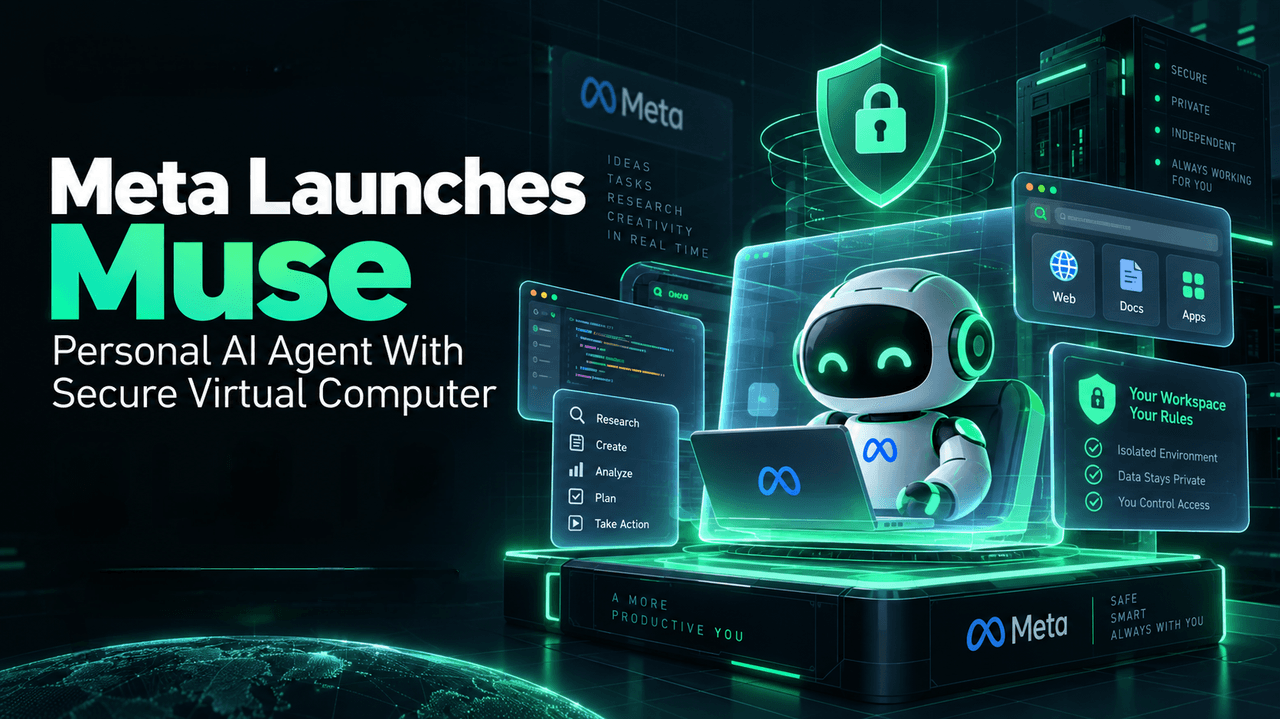
Meta has launched Muse, a personal AI agent designed to go beyond conversation and actively complete digital tasks on a user’s behalf. Introduced in September 2026, Meta Muse can browse websites, interact with connected services, manage multi-step workflows and continue certain tasks through its own cloud-based virtual computer, positioning it within the broader shift toward AI agents that can plan and take actions across digital environments.
What makes Muse particularly notable is its security-focused architecture, which combines a dedicated Muse Secure VM with a separate Sentinel system designed to control external access and sensitive actions. Meta is positioning these safeguards as central to making personal AI useful for travel planning, online shopping, communications and longer-running projects, while the agent’s growing autonomy also raises important questions around AI privacy, cybersecurity, user permissions and trust as autonomous AI agents become more deeply integrated into everyday digital services.
What Is Meta Muse? How the New Personal AI Agent Can Work on Your Behalf
Meta Muse is a new personal AI agent designed to move beyond the limits of a traditional chatbot. Instead of only answering questions, summarising information or generating content, Muse can plan and carry out multi-step digital tasks across websites, apps and connected services. The product reflects the wider shift toward agentic AI, where artificial intelligence can use tools, make decisions within defined permissions and continue working toward a broader objective with less step-by-step input from the user. This makes Muse part of a new generation of AI assistants focused on completing digital work rather than simply discussing how it should be done.
What Can the Meta Muse AI Agent Actually Do?
Meta Muse is designed to handle practical online tasks that would normally require users to move between multiple apps, browser tabs and services. It can browse websites, collect information, fill in forms, help organise travel, compare products, manage projects and assist with approved communications or purchases. Instead of requiring instructions for every individual step, users can provide a broader objective and allow Muse to determine how different parts of the workflow should be completed. This approach could make the agent particularly useful for tasks that combine research, planning and execution.
Muse can also support longer-running and multi-step tasks through its dedicated cloud environment. For example, a travel request could involve researching destinations, comparing flights and accommodation, organising an itinerary and preparing suitable booking options. Certain tasks can continue even after the user leaves the app, meaning the AI does not necessarily depend on an active chat window for every stage of the process. That background capability makes Muse closer to an active digital assistant than an earlier-generation chatbot that waits for another prompt after each response.
How Meta Muse Goes Beyond a Traditional AI Assistant
The central difference between Meta Muse and traditional AI assistants is its ability to take actions rather than only provide information or recommendations. Muse combines AI reasoning with web access, connected services and its own virtual computing environment, allowing it to move from understanding a request to carrying out parts of the task. This broader trend is also visible in systems built around AI agents connecting to digital services, where structured tools and external integrations allow an agent to move beyond conversation. Users still retain oversight over higher-impact activities, particularly where payments, communications or account access are involved.
Key capabilities include:
-
Browsing websites and gathering information as part of larger workflows.
-
Completing multi-step digital tasks rather than handling only isolated prompts.
-
Interacting with connected services when the appropriate permissions are available.
-
Continuing longer-running work through its cloud-based virtual environment.
-
Requesting approval for consequential actions, including supported purchases or communications.
-
Coordinating research, planning and execution within a single broader goal.
These capabilities place Meta Muse within the growing market for autonomous and personal AI agents. If the technology becomes reliable enough for mainstream use, these systems could gradually take over more repetitive digital work while leaving users to focus on decisions that require human judgement.
How Meta Muse’s Secure Virtual Computer and Sentinel System Work
Allowing an AI agent to browse websites and interact with personal services creates a very different security challenge from operating a conventional chatbot. Meta has therefore built Muse around a dedicated secure virtual computer and a separate security layer called Sentinel. The architecture is intended to give the agent enough freedom to complete useful work while limiting unnecessary access and introducing additional controls around actions that could have meaningful consequences.
How the Muse Secure VM Gives the AI Agent Its Own Virtual Computer
At the centre of Meta Muse is the Muse Secure VM, a cloud-based virtual machine that functions as the agent’s own computer. Instead of operating directly on a user's phone or personal laptop, Muse works inside an isolated environment containing the browser, storage and computing resources it needs to complete online tasks. This creates a persistent workspace where the agent can maintain progress across longer workflows while remaining separated from the user's physical device and from the environments assigned to other Muse users.
Several features add further protection to this architecture:
-
Network permissions can be restricted, reducing the external services the agent is allowed to contact.
-
Sensitive credentials can be stored separately rather than remaining continuously exposed to the main AI model.
-
Task information can remain inside the virtual environment without giving Muse unrestricted access to files stored on the user's own computer.
-
Meta is developing a future Muse Confidential VM intended to introduce stronger encryption and tighter controls over platform access to information inside the environment.
The virtual-machine model does not eliminate every security risk, but it provides a controlled boundary around an AI agent that may need to visit multiple websites, preserve task state and interact with online services during a single workflow.
How Meta Sentinel Controls Muse’s Access and AI Agent Actions
While the Secure VM gives Muse an isolated place to operate, Sentinel provides a separate layer for controlling external access and potentially sensitive actions. This separation is important because an AI agent browsing the open internet could encounter instructions or content that conflict with the user's original request. Rather than allowing the primary Muse model to control every permission decision by itself, Sentinel can independently evaluate whether certain actions should proceed, be blocked or require additional involvement from the user.
This architecture follows the cybersecurity principle of limiting privileges. Muse may determine that completing a task requires access to another service, but that does not automatically mean the agent receives unrestricted control over the account. The approach is also relevant to prompt injection, where malicious instructions embedded in online content attempt to manipulate an AI system. Similar AI assistant security risks become more important when assistants can access browsers, APIs, files or other external tools. Meta has not presented prompt injection as a completely solved problem, so limiting the agent's authority becomes an important second line of defence when potentially hostile content is encountered.
User Approvals, Credential Protection and Privacy Controls in Meta Muse
Meta has designed Muse so that higher-impact actions do not necessarily happen automatically. Activities involving purchases, outgoing communications or other consequential account changes can require explicit user approval, giving people an opportunity to review the intended action before it is completed. Muse also provides activity information that can help users understand what the agent has done during a task, an important feature as autonomous systems begin handling increasingly complex online workflows.
Credential protection provides another layer of separation. Meta says passwords and payment information can be handled through protected mechanisms rather than being freely exposed to the main AI model, while users retain control over which services are connected to Muse. Supported payment integrations can similarly reduce how much underlying financial information needs to be exposed during a transaction. These controls will become increasingly important as personal AI agents expand into activities involving commerce, communications and other accounts containing sensitive information.
Is Meta Muse Safe? Privacy, Security and What It Means for the Future of AI Agents
Meta Muse includes multiple safeguards intended to reduce the risks associated with autonomous AI, but no agent capable of browsing the web and interacting with real services should be treated as completely risk-free. AI systems can make incorrect decisions, misinterpret instructions or encounter malicious content, and agentic AI adds consequences that ordinary text generation does not have. The more useful question is therefore whether Meta can keep those risks manageable through permission controls, transparency and user oversight while still allowing Muse to perform genuinely useful work.
Meta Muse Privacy Controls and What User Data the AI Agent Can Access
Privacy will be central to how users evaluate Muse because useful personalisation often depends on access to services containing sensitive information. Depending on the permissions granted, an AI agent could potentially work with email, calendars, shopping services and other connected accounts. Meta says users can control which services are connected and remove access later, while Muse information is kept separate from Meta's advertising systems. Users should nevertheless review permissions carefully before linking particularly sensitive accounts, because granting an AI agent access to information is a more consequential decision than simply asking a chatbot a question.
Security Risks Still Matter as AI Agents Gain More Autonomy
Autonomy increases both the usefulness and the potential impact of AI mistakes. An ordinary chatbot might provide an incorrect answer, but an autonomous agent could potentially take an unintended action if it misunderstands instructions or is manipulated by malicious content. Prompt injection, unreliable reasoning and unexpected behaviour therefore remain important issues across the wider agentic AI industry. Meta's layered security approach may reduce what Muse is able to do when something goes wrong, but the effectiveness of those protections will need to be demonstrated through continued real-world use and security testing.
What Meta Muse Could Mean for the Future of Personal AI Agents
Muse illustrates a broader move from conversational AI toward software that can actively perform digital work. Future personal AI agents could increasingly help with travel planning, scheduling, shopping, research, administration and other activities that currently require people to move repeatedly between apps. Meta's work on the Muse Spark agent model also reflects the growing focus on models capable of tool use, computer interaction and multi-step tasks. The potential productivity benefit is significant, especially for workflows involving many small and repetitive steps. At the same time, wider adoption will likely depend on whether users can easily understand what an agent is doing and intervene before important decisions are made.
Why Trust Could Decide Whether Meta Muse and Other AI Agents Succeed
The long-term competition between personal AI agents may therefore involve trust as much as raw model capability. Users might comfortably allow an AI assistant to research a hotel or organise information, while giving the same system access to payments or private communications requires considerably greater confidence. Clear permission settings, reliable approval mechanisms, transparent activity records and stronger privacy technologies could become important competitive advantages. As Meta and other major AI developers push toward increasingly autonomous systems, products that combine useful automation with understandable user control may have the strongest chance of reaching mainstream adoption.
Conclusion
The launch of Meta Muse marks another important step in the transition from AI chatbots to personal agents capable of completing tasks across the digital world. By giving Muse its own Secure VM, combining it with the Sentinel security layer and retaining user approval for higher-impact actions, Meta is attempting to address one of the biggest challenges facing agentic AI: how to give an autonomous system enough access to be useful without giving it unlimited authority.
Muse also highlights how much work remains before personal AI agents become routine. Security threats, privacy concerns, incorrect actions and user trust will continue to shape adoption as these systems gain access to more applications and services. If those challenges can be managed effectively, Meta Muse and similar AI agents with virtual computers could change the role of artificial intelligence from a tool that primarily answers questions into one that actively completes substantial parts of everyday digital work.
🔥 Beyond the Headlines: What KuCoin 5.0 Means for You
Market news moves fast — but where you act on it matters just as much. This October, KuCoin launches KuCoin 5.0, transforming KuCoin into a rebuilt platform. Here's what actually changes for you:
-
One account for everything. Older platforms split your money across separate "spot," "margin," and "futures" accounts and expected you to understand why. KuCoin 5.0's unified account removes that entirely — deposit once, and everything is simply there.
-
Stocks, indices, and commodities. KuCoin 5.0 expands beyond crypto into global markets. When crypto chops sideways and equities rally (or the reverse), you rotate in minutes instead of opening a brokerage account and waiting days for fiat rails.
-
Real-world assets (RWA). Tokenized exposure to traditional assets like commodities, right inside your crypto account. One of the fastest-growing segments in global finance is no longer reserved for institutions — you access it from the same balance you trade with.
-
Earn while you learn. Not ready to trade? KCUSD lets your stablecoins earn daily, auto-compounding interest. The lowest-stress way to put your idle deposit to work for 4% yield.
-
An AI assistant in plain language. Ask questions, get market context, understand what you're looking at — built into the platform, no jargon required.
-
An app that doesn't overwhelm. Faster, cleaner, and consistent — intuitive from the first tap, not after a tutorial.
-
Safety you can check, not just trust. A MiCAR-licensed EU entity, Proof of Reserves you can verify yourself, and internationally certified security (SOC 2 Type II, ISO 27001:2022).
Create your account in minutes — and start on the platform built for where crypto is going, not where it's been.
FAQs
Is Meta Muse available outside the United States?
Not at launch. Meta initially rolled out Muse in the United States through iOS, Android, the Muse website and WhatsApp. Meta has indicated broader availability may come later, but it has not confirmed a specific international rollout schedule. Users outside the U.S. should check Meta's latest product availability before expecting access in their region.
How much does Meta Muse cost?
Meta says Muse is free for most everyday use, while heavier users can access paid subscription options. Launch reporting identified paid plans for people who need more intensive or frequent agent activity. Because AI subscription pricing and usage limits can change, users should verify the latest Meta Muse pricing and plan details before subscribing.
What is the difference between Meta Muse and Muse Spark?
Meta Muse is the personal AI agent, while Muse Spark refers to the AI model family that helps power its reasoning and agentic capabilities. Muse is the service users interact with to complete tasks, whereas Muse Spark provides underlying capabilities that help the agent interpret requests, plan workflows and use digital tools.
Can Meta Muse make online purchases for users?
Yes, Muse can assist with approved online purchases when supported payment services are available. Meta has integrated payment options such as Link by Stripe, while consequential transactions are designed to require user confirmation before completion. This allows the AI agent to participate in shopping workflows without giving it unlimited authority to spend money independently.
Disclaimer
The information provided on this page may originate from third-party sources and does not necessarily represent the views or opinions of KuCoin. This content is intended solely for general informational purposes and should not be considered financial, investment, or professional advice. KuCoin does not guarantee the accuracy, completeness, or reliability of the information, and is not responsible for any errors, omissions, or outcomes resulting from its use. Investing in digital assets carries inherent risks. Please carefully evaluate your risk tolerance and financial situation before making any investment decisions. For further details, please consult KuCoin’s Terms of Use and Risk Disclosure.