

KuCoin Ventures Weekly Report: Stablecoin Infrastructure Consolidates as Energy Shocks and Tech Deleveraging Reshape Global Risk Markets
1. Weekly Market Highlights
Stablecoin Competition Enters an Infrastructure Consolidation Phase: Circle Secures a License, Stripe Bids for PayPal
Last week, the global crypto market and digital asset payments sector saw several major developments across regulatory compliance, legislative progress, and corporate M&A, highlighting the growing convergence between stablecoins and traditional payment networks:
-
Circle receives OCC approval for a national trust bank charter: Circle announced that it had received approval from the Office of the Comptroller of the Currency, or OCC, to establish First National Digital Currency Bank, N.A., which is expected to operate under the name Circle National Trust. As a national trust bank, the institution will be directly supervised by the OCC at the federal level, provide federally regulated custody support for Circle’s USDC stablecoin, and potentially assume reserve management functions in the future.
-
The CLARITY Act enters a critical window for a Senate floor vote: A consolidated Senate draft is expected to be released, with the aim of bringing the legislation to a floor vote after July 20. Passage would require at least 60 votes. Key areas of focus include the division of regulatory authority between the SEC and CFTC, exemptions for DeFi developers, and consumer protection mechanisms. With the August congressional recess approaching, the legislation is widely viewed by the industry as an important step toward greater clarity in the US digital asset market structure.
-
Consolidation among traditional payment giants and broader stablecoin use cases: Reports have emerged that Stripe is seeking to acquire PayPal in a major fintech transaction. At the same time, the overlap between traditional payment companies and crypto-based payment and settlement networks is becoming increasingly apparent, while the use of stablecoins in cross-border payments and merchant settlement continues to expand.
On the surface, these developments relate separately to a banking charter, a fintech acquisition, and digital asset legislation. Taken together, however, they suggest that the competition may no longer be limited to the issuance scale of USDC, PYUSD, or other stablecoins. Instead, the stablecoin industry is moving beyond competition between individual tokens and entering a broader infrastructure contest involving reserve management, regulatory licenses, merchant access, consumer wallets, and underlying settlement networks.
According to reports from The Wall Street Journal, the Financial Times, Reuters, and other major media outlets, payments company Stripe has joined forces with private equity firm Advent International to submit a joint offer for PayPal. Reuters reported that the consortium proposed a price of USD 60.50 per share, valuing PayPal at more than USD 53 billion and representing a premium of approximately 28% over its share price before the news emerged. According to the sources, the offer is backed by around USD 50 billion in bank financing. Stripe and Advent are expected to contribute approximately USD 17 billion in equity capital and would each hold a 50% stake in PayPal if the transaction is completed.
The transaction, however, remains at an early stage. As of July 17, PayPal had not formally responded to the offer. Sources said PayPal’s board initially believed the proposal did not fully reflect the company’s potential value following the implementation of its restructuring plan. The board was also assessing the certainty of the financing, potential antitrust scrutiny, and the expected timetable for completing the transaction. Negotiations may continue and the offer could be revised, but considerable uncertainty remains.
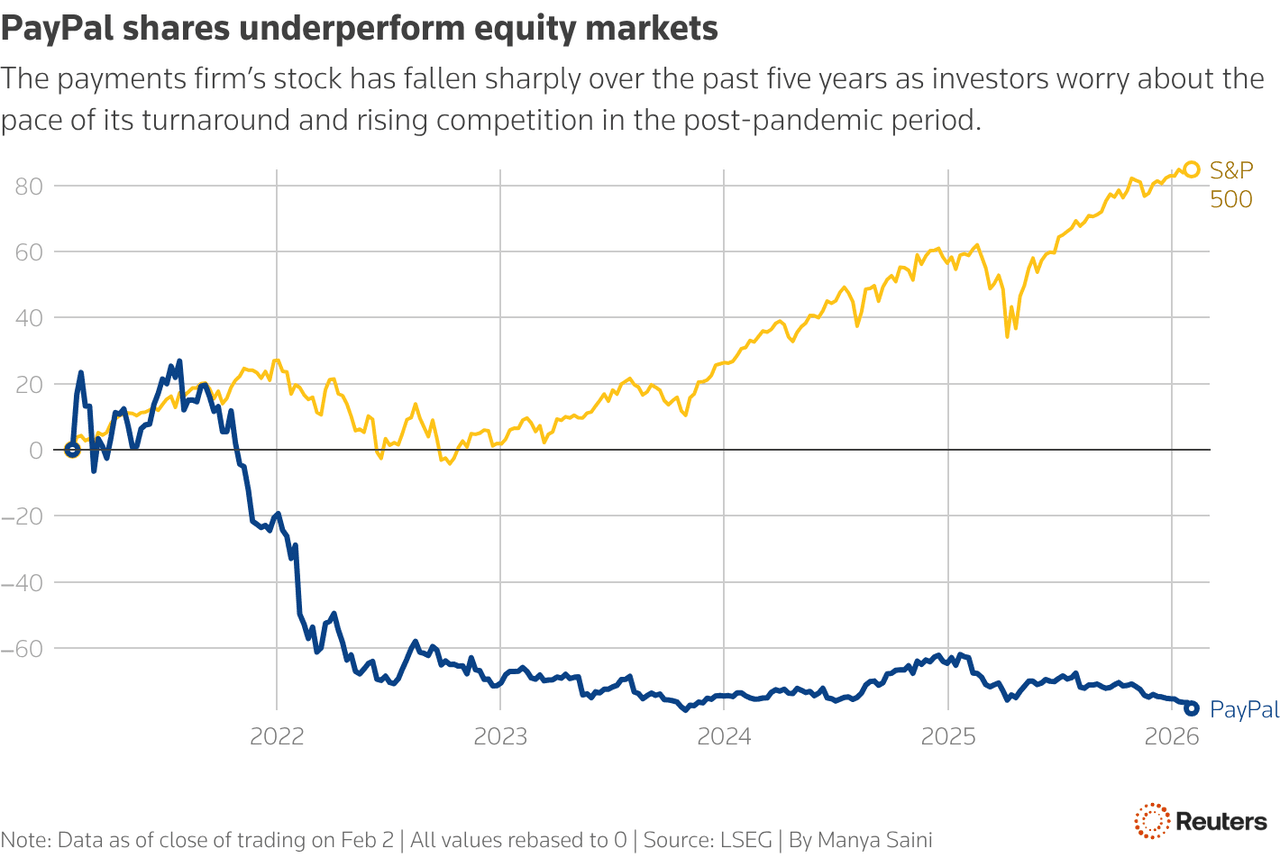
Although PayPal’s growth has slowed in recent years and its share price has underperformed the broader market, this does not mean the company lacks strategic value. As of the first quarter of 2026, PayPal still had approximately 439 million active accounts, processed around USD 464 billion in total payment volume during the quarter, and generated USD 8.35 billion in net revenue. Total payment volume increased by 11% year on year, although its operating margin declined from 19.6% a year earlier to 17.8%. This reflects PayPal’s continued scale in global payments, while also highlighting the pressure it faces in terms of growth quality and cost efficiency.
PayPal also operates a relatively diversified portfolio of businesses. PayPal Checkout provides a direct online payment interface for consumers; Venmo has developed a large peer-to-peer transfer and consumer payments network; Braintree offers payment processing services to major internet merchants; and PayPal also owns the cross-border remittance platform Xoom, as well as PYUSD, a US dollar stablecoin issued by Paxos. PayPal therefore possesses three assets that would be difficult to rebuild from scratch: a consumer wallet network, a merchant network, and an existing stablecoin product.
In March, former HP CEO Enrique Lores formally became PayPal’s CEO. In April, the company further reorganized its operations into three main divisions: checkout, Venmo consumer financial services, and payments and crypto assets. The restructuring was intended to simplify the organization and improve execution. The timing of the Stripe and Advent offer means that PayPal’s board must now weigh the potential value of continuing its independent restructuring plan against accepting an external acquisition proposal.
From Stripe’s perspective, the company has already built a relatively comprehensive merchant payments and stablecoin technology stack, but its direct consumer account and wallet network remains comparatively limited. From a strategic standpoint, Stripe may be seeking to connect its existing stablecoin issuance, wallet, and settlement infrastructure with PayPal’s consumer distribution channels. Based on current reporting, Advent is also unlikely to be merely a temporary source of capital. It may serve simultaneously as a financial partner, an experienced payments-sector consolidator, and a potential acquirer of assets that might need to be separated from the combined business.
Overall, stablecoin competition is entering an infrastructure consolidation phase. The contest is no longer only about issuing an on-chain digital dollar. The more important question is which companies can control the full value chain, from issuance and custody to payments and settlement.
2. Weekly Selected Market Signals
Rising Oil Prices and Tech Deleveraging Weigh on Risk Appetite, While Softer Inflation Eases Near-Term Rate-Hike Pressure and ETF Inflows Support Crypto Resilience
Global markets traded primarily around three themes last week: developments in the Middle East, U.S. inflation data, and deleveraging across technology stocks. Escalating tensions between the United States and Iran, together with risks to shipping through the Strait of Hormuz, drove a sharp rise in crude oil prices and renewed concerns over energy-driven inflation. At the same time, softer-than-expected U.S. inflation data for June temporarily reduced the pressure for the Federal Reserve to raise rates in the near term.
Risk assets came under broad pressure, but performance diverged significantly across sectors. AI and semiconductor stocks, which had previously delivered some of the strongest gains, experienced deeper corrections. Energy equities benefited from higher oil prices, while crypto assets remained relatively resilient, supported by renewed inflows into spot ETFs.
Macro and Global Risk Assets: Energy Shock Revives Inflation Risks as Crowded Semiconductor Trades Unwind
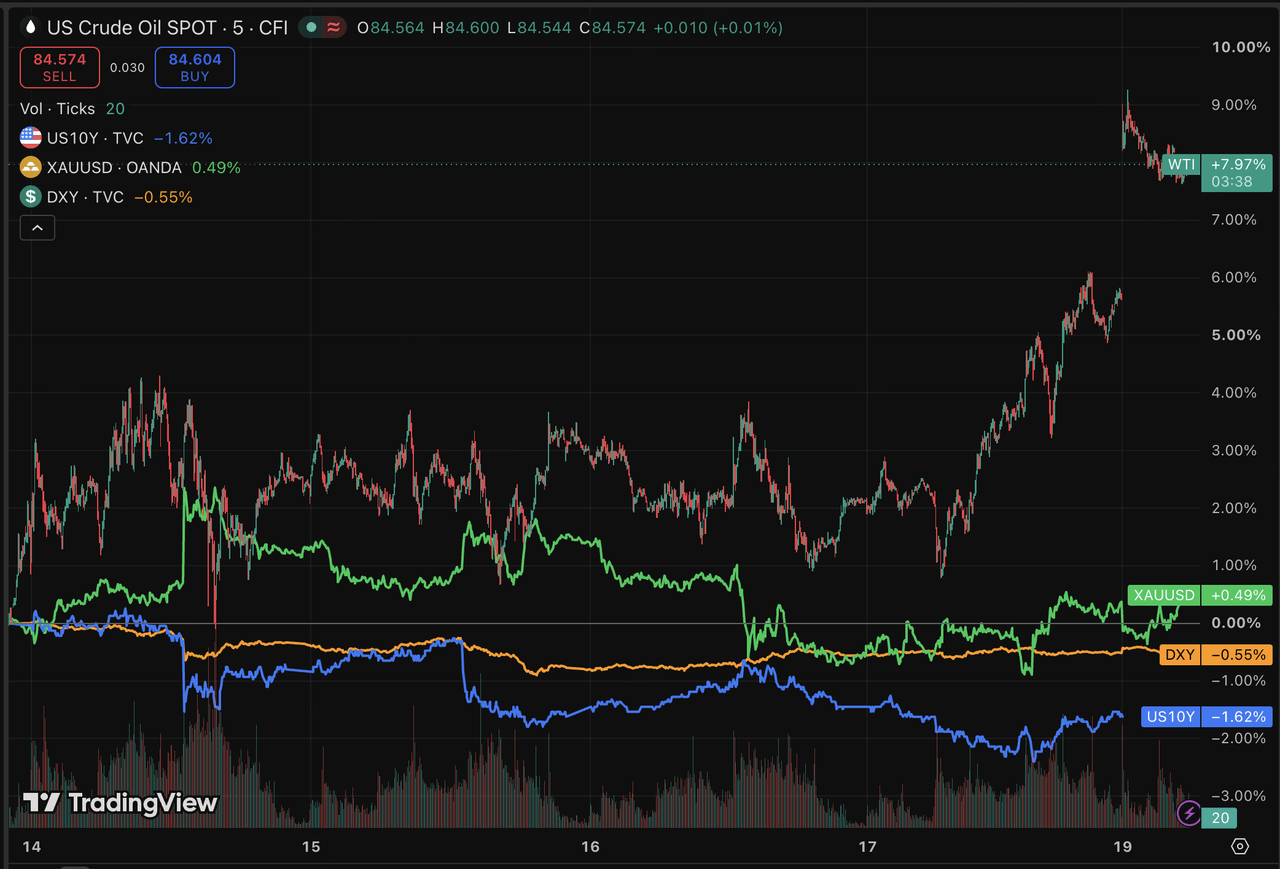
Developments in the Middle East remained the main external driver of markets last week. Escalating U.S.-Iran tensions and restrictions on shipping through the Strait of Hormuz pushed Brent crude up approximately 16% over the week to above $90 per barrel, while WTI moved back above $80.
The oil rally prompted markets to reassess how higher energy costs could feed through into inflation and consumer spending. It also lifted the U.S. dollar and Treasury yields, placing further pressure on high-valuation growth assets.
Data Source: TradingView
Gold did not benefit materially from heightened geopolitical risks, falling approximately 2.6% over the week. The key reason was that rising oil prices simultaneously reinforced expectations for higher inflation and interest rates. The strengthening dollar and higher real yields therefore outweighed safe-haven demand.
In the near term, oil remains the primary asset through which markets are expressing concerns over Middle East supply disruption, while gold continues to trade between geopolitical demand and the pressure of persistently high interest rates.
U.S. core CPI growth slowed to approximately 2.6% year-on-year in June, below market expectations. This eased immediate concerns over another rate increase, but was not sufficient to offset the potential inflationary impact of persistently elevated energy prices.
All three major U.S. equity indices declined over the week, with the Nasdaq falling approximately 2.9% and underperforming both the S&P 500 and the Dow. The Philadelphia Semiconductor Index had fallen more than 20% from its previous high, with AI chips, memory, and server-related stocks among the main areas of selling. This reflected concentrated deleveraging in previously crowded and highly valued positions. Energy stocks, by contrast, outperformed.
Japanese and South Korean equities were also affected by the semiconductor correction. The Nikkei 225 entered technical correction territory, while volatility increased in the KOSPI, with heavyweight names including Samsung Electronics and SK Hynix under pressure. Because Japanese and South Korean indices have relatively high exposure to chips and memory, the unwinding of the global AI trade had a more concentrated impact on these markets.
In China’s AI sector, ChangXin Memory Technologies’ planned STAR Market IPO attracted considerable attention, with the company seeking to raise approximately RMB 58 billion to RMB 66.6 billion. Activity in related pre-market contracts on Hyperliquid reflected overseas demand for exposure to Chinese memory-chip assets, with on-chain prices at one point trading significantly above the IPO issue price of RMB 8.66.
Kimi K3 further strengthened market interest in lower-cost large language models and agent-based applications. Although lower unit inference costs may reduce the cost of individual tasks, longer context windows, more agent workloads, and higher token consumption could increase demand for GPUs, HBM, server-grade DDR5, enterprise SSDs, and high-speed networking.
Its broader significance lies in intensifying global competition on both model performance and cost, while expanding the AI investment thesis from training compute alone toward inference, memory, storage, and network infrastructure.
Data Source: SoSoValue
Crypto Assets and ETFs: BTC Outperforms Tech Stocks as Capital Returns at the Margin, but Broader Expansion Remains Limited
The crypto market rebounded overall last week. BTC recovered from approximately $62,000 at the beginning of the week to around $65,000, gaining roughly 4%. ETH returned to the $1,850–$1,900 range and slightly outperformed BTC.
Compared with the clear declines in the Nasdaq and semiconductor stocks over the same period, BTC showed relative resilience. This was mainly supported by softer inflation data, renewed inflows into spot ETFs, and reduced leverage following the earlier market correction.
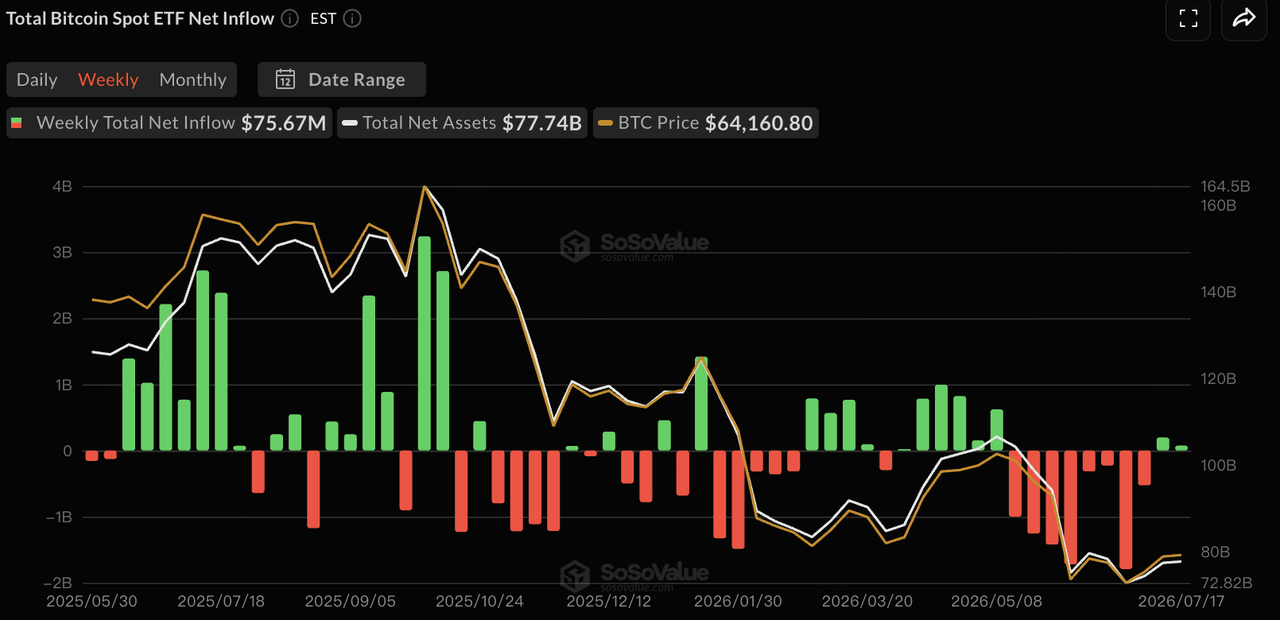
According to SoSoValue, U.S. spot BTC ETFs recorded approximately $76 million in net inflows last week, ending the previous period of consecutive outflows. BlackRock’s IBIT remained the main source of incremental demand.
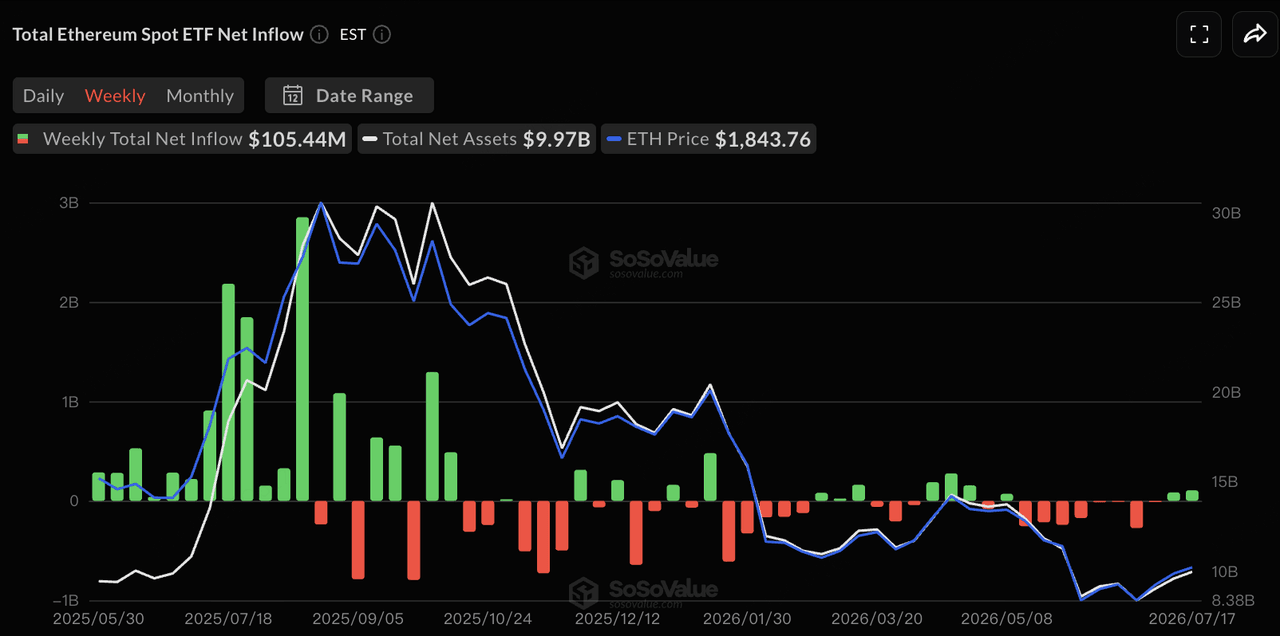
Spot ETH ETFs posted approximately $105 million in weekly net inflows, marking a second consecutive positive week, with flows concentrated primarily in BlackRock’s ETHA.
Improving ETF flows provided near-term support for both BTC and ETH. However, inflows remained well below previous peaks and were still highly concentrated in the largest products. Stablecoin supply also failed to return to sustained growth.
As a result, the recent rebound appears more consistent with a price recovery following easing funding pressure than the beginning of a new phase of broad-based risk expansion.
Data Source: DeFiLlama
Stablecoins: Total Market Capitalization Continues to Contract as New Capital Remains Limited
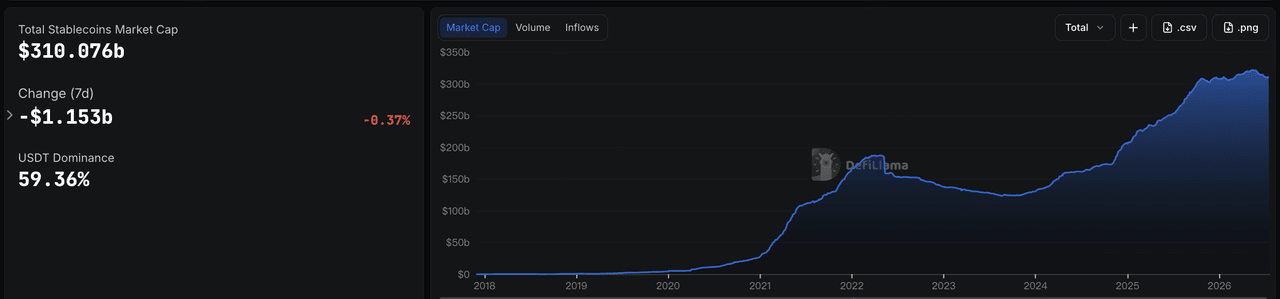
According to DeFiLlama, total stablecoin market capitalization stood at approximately $310.1 billion, down around 0.37% over the previous seven days and 1.44% over the previous 30 days.
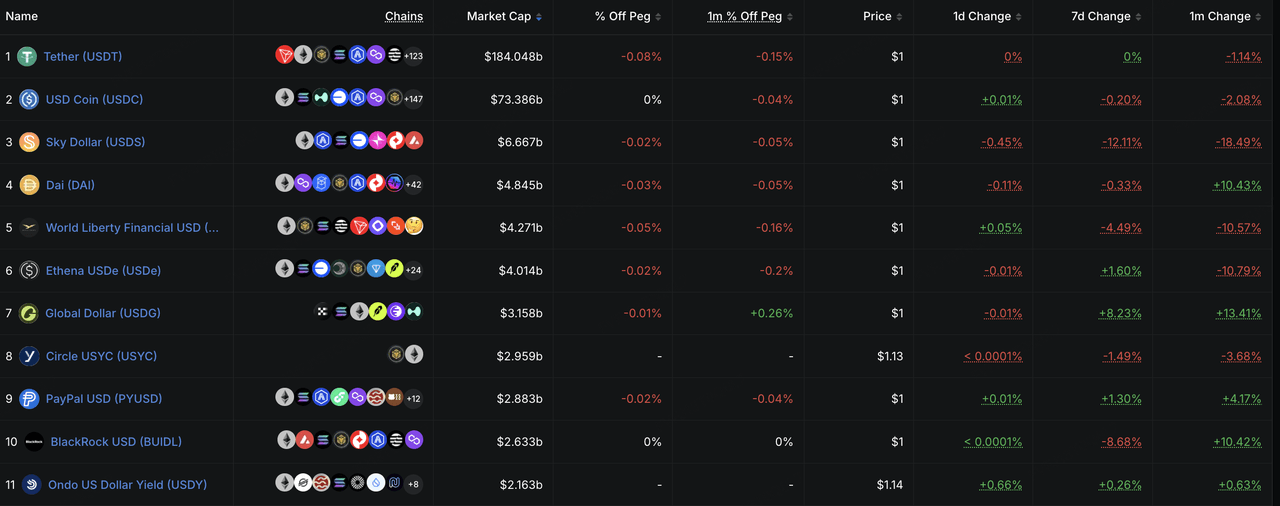
USDT supply remained broadly stable, causing its market share to rise passively to approximately 59.4%, while USDC declined slightly.
Among the ten largest stablecoins, USDS and USD1 recorded more visible supply contractions, indicating that demand linked to DeFi collateral, ecosystem incentives, and on-chain leverage remained weak. USDG continued to expand, mainly supported by exchange distribution, payment channels, and yield incentives.
USDe recorded a modest recovery but had not yet reversed its contraction over the previous month.
Overall, stablecoin activity remained dominated by the rotation of existing liquidity rather than the entry of meaningful new capital. The lack of simultaneous expansion alongside the rebound in BTC and ETH remains an important indication that the current market move is still primarily corrective in nature.
Data Source: CME FedWatch Tool
Federal Reserve Outlook: July Rate-Hike Expectations Decline, but Energy Prices Will Shape the Policy Path Ahead
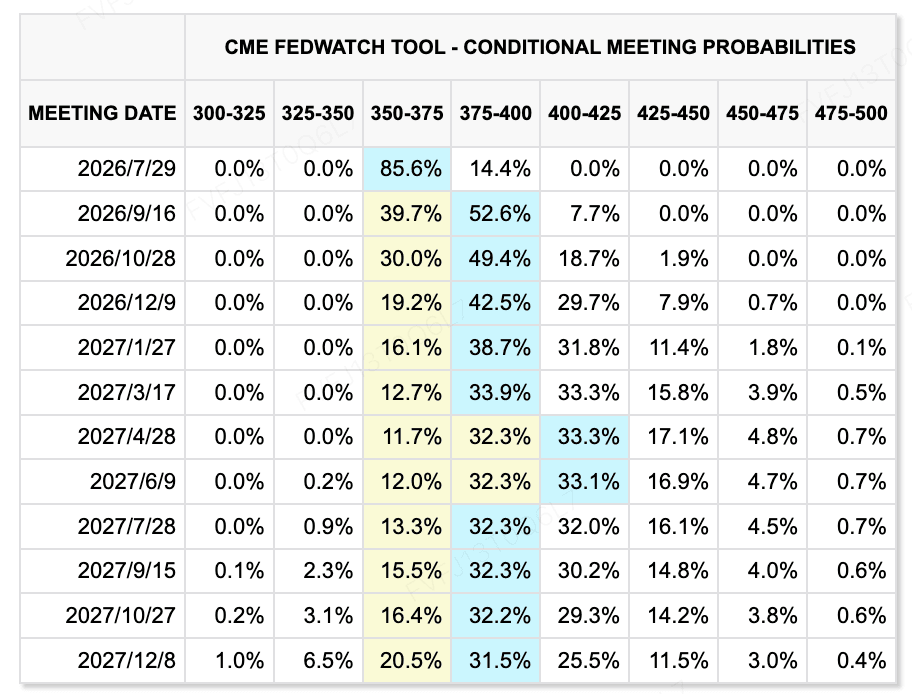
The CME FedWatch Tool showed a clear increase in market expectations that the Federal Reserve would leave interest rates unchanged at its July 29 meeting.
Following softer-than-expected U.S. inflation data for June, the window for a July rate increase has largely closed. However, markets continue to price in the possibility of renewed tightening in September or during the fourth quarter.
Federal Reserve Chair Kevin Warsh reiterated the importance of price stability and data dependence during congressional testimony last week but did not provide a clear signal regarding the next policy move.
The key variable is likely to shift from a single month of inflation data toward the persistence of higher energy prices. If crude oil remains elevated for an extended period and pushes inflation expectations higher, the Federal Reserve may maintain a restrictive policy stance during the second half of the year.
Conversely, if the Middle East risk premium declines while employment and consumption continue to cool, current expectations for additional tightening could be revised lower.
Key Events to Watch This Week
Markets will focus this week on the European Central Bank’s interest-rate decision, Japan’s June CPI, preliminary U.S. manufacturing and services PMIs for July, South Korea’s second-quarter GDP, and its export data for the first 20 days of the month.
South Korean semiconductor exports will be an important leading indicator for global memory and AI hardware demand.
The U.S. earnings season is also entering a period of concentrated technology-sector reporting, with Alphabet, Tesla, Intel, and Texas Instruments among the companies due to release results.
Investors will focus on whether AI-related capital expenditure is continuing to translate into growth across cloud services, data centers, and semiconductor revenue, as well as management guidance for demand during the second half of the year.
If earnings fail to justify current valuations, deleveraging pressure across technology stocks may continue. Strong results, by contrast, could shift the market from broad-based selling toward greater differentiation based on company fundamentals.
Geopolitical developments remain the most important near-term risk. Continued disruption to shipping through the Strait of Hormuz could further reinforce inflation and rate-hike expectations. A de-escalation in regional tensions and a decline in the energy risk premium would instead support a further recovery in technology stocks and crypto assets.
Primary Market Fundraising Review: Large Strategic Transactions Lift Headline Volumes as Capital Remains Concentrated in Mature Infrastructure
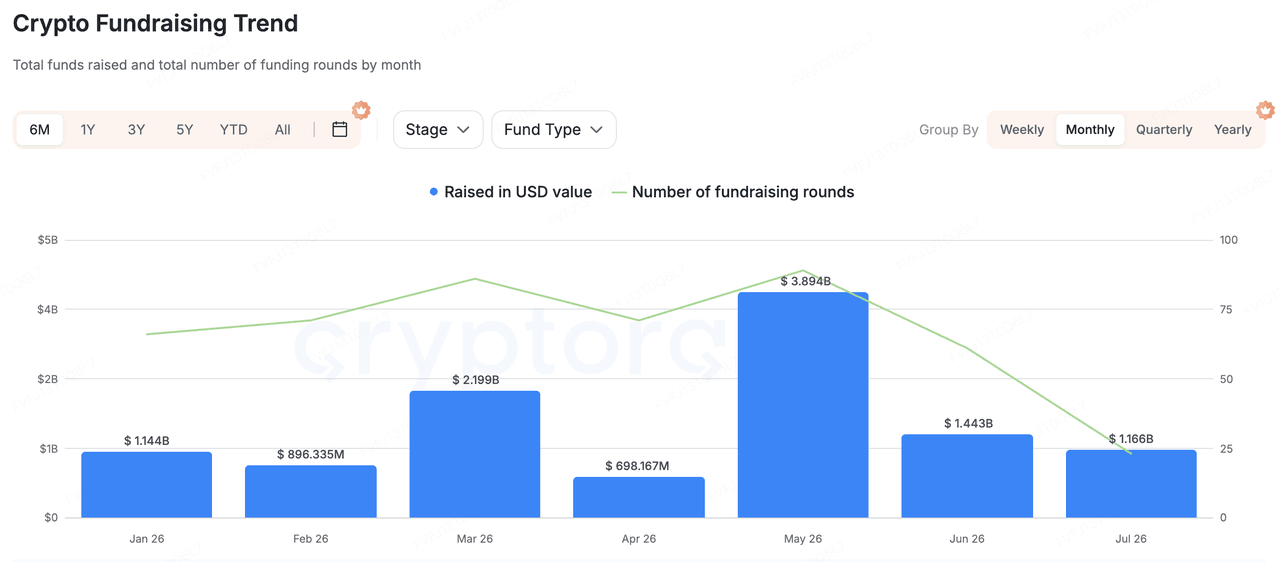
Data Source: CryptoRank
Based on combined data from CryptoRank and RootData, private-market funding last week remained concentrated in established trading platforms, payment and settlement infrastructure, and institutional-grade financial services.
Because some data providers include strategic investments, debt financing, and other non-standard transactions, weekly funding totals can be significantly distorted by a small number of large deals. The headline figure should therefore not be interpreted as evidence of a broad recovery in early-stage venture capital activity.
The most representative transaction of the week was Citadel Securities’ $400 million strategic investment in Crypto.com, valuing the company at $20 billion. It also marked Crypto.com’s first external institutional equity financing.
The proceeds will be used to expand into tokenized securities, derivatives, and other traditional asset classes, supporting Crypto.com’s evolution from a crypto trading platform into a broader multi-asset financial platform.
The significance of the transaction lies primarily in the identity of the investor. As one of the world’s leading market makers, Citadel Securities brings expertise in cross-asset liquidity, pricing, and institutional trade execution.
Its investment indicates that traditional financial institutions are moving beyond providing external liquidity and are increasingly seeking direct strategic exposure to crypto trading platforms and tokenized-asset distribution channels.
However, neither party has disclosed specific market-making arrangements or detailed operating synergies. In the near term, the transaction should therefore be viewed primarily as a strategic endorsement. The key question is whether it can ultimately translate into additional institutional clients, higher trading volumes, and new revenue streams.
Beyond this transaction, funding activity remained concentrated in trading, payments, custody, compliance, and underlying infrastructure.
The broader trend does not indicate a general improvement in financing conditions. Instead, capital continues to favor mature platforms with established users, revenue, licenses, and relationships with traditional financial institutions, while early-stage consumer applications and undifferentiated protocols continue to face a cautious funding environment.
About KuCoin Ventures
KuCoin Ventures, is the leading investment arm of KuCoin Exchange, which is a leading global crypto platform built on trust, serving over 40 million users across 200+ countries and regions. Aiming to invest in the most disruptive crypto and blockchain projects of the Web 3.0 era, KuCoin Ventures supports crypto and Web 3.0 builders both financially and strategically with deep insights and global resources.
As a community-friendly and research-driven investor, KuCoin Ventures works closely with portfolio projects throughout the entire life cycle, with a focus on Web3.0 infrastructures, AI, Consumer App, DeFi and PayFi.
Disclaimer This general market information, possibly from third-party, commercial, or sponsored sources, is not legal, compliance, financial, or investment advice, an offer, solicitation, or guarantee. We make no express or implied representations or warranties regarding its accuracy, completeness, or reliability, and disclaim liability for any resulting losses. Investments/trading are risky; past performance doesn't guarantee future results. Users should research, judge prudently, and take full responsibility. Please consult professional legal, tax, or financial advisors if necessary.