

Israel Strikes Hezbollah in Southern Lebanon: What Happened and Why It Matters
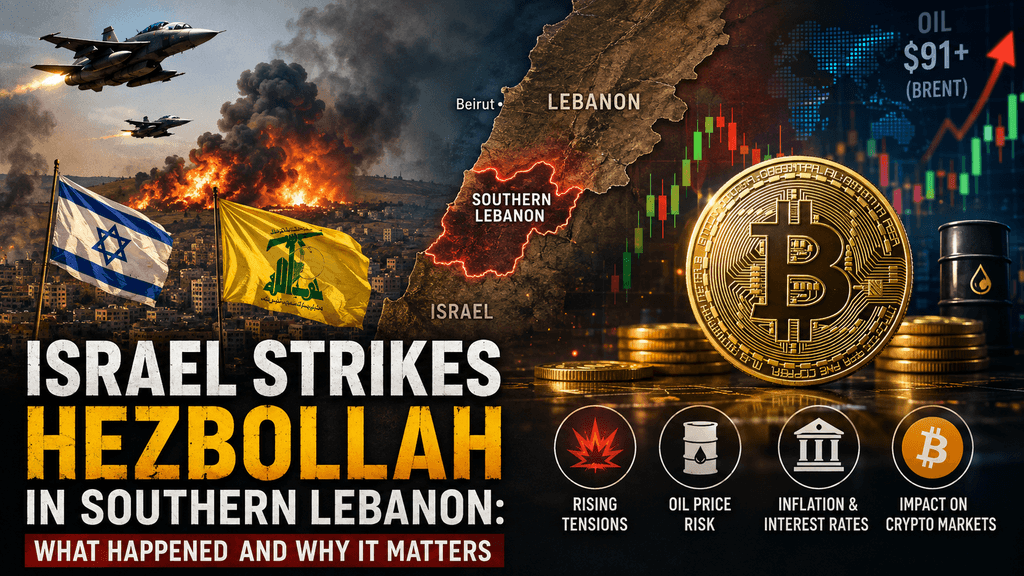
Israel has carried out a new wave of airstrikes in southern Lebanon, once again putting the fragile truce with Hezbollah under pressure. The August 15 attacks killed at least 11 people, according to Lebanon's Health Ministry, making them among the deadliest strikes since fighting eased in June. Israel said the operation targeted Hezbollah infrastructure and killed Ali Samir Al-Haj Hassan, a commander in the group's elite Radwan Force. The Israeli military described the strikes as a response to Hezbollah actions against Israeli troops in southern Lebanon.
For crypto investors, however, the significance of the latest Israel-Hezbollah confrontation extends far beyond Lebanon. A localized exchange of fire may have little lasting impact on Bitcoin. A broader Middle East escalation could be very different, particularly if it pushes oil prices higher, changes inflation expectations, alters the path of U.S. interest rates, or triggers a wider retreat from risk assets. Understanding the event therefore requires looking not only at what happened in southern Lebanon, but also at how geopolitical risk can travel through energy markets, monetary policy and global liquidity before eventually reaching Bitcoin and the wider crypto market.
What Happened in Southern Lebanon?
Israeli strikes hit several areas of southern Lebanon on August 15, including Ansar and Deir al-Zahrani. Lebanon's Health Ministry said at least 11 people were killed, while reports also indicated civilian casualties, including children. Israel said its military was targeting Hezbollah infrastructure inside what it describes as a security zone in southern Lebanon. The operation followed a Hezbollah drone attack that Israel said seriously wounded three Israeli soldiers.
One of the most prominent targets was Ali Samir Al-Haj Hassan, whom the Israeli military identified as a commander in Hezbollah's elite Radwan Force. Israel said the strike in Ansar hit a central Radwan Force headquarters and killed Hassan along with others. The Israeli military also acknowledged that members of Hassan's family were present and harmed in the attack, while saying they had not been the intended targets. Because the identification of Hassan and the description of his role come from the Israeli military, the most accurate formulation is that Israel said it killed the Hezbollah commander, rather than treating every operational claim as independently established fact.
The scale of the casualties matters because the attacks came during a period that was supposed to move Israel and Lebanon away from sustained warfare. A truce had taken effect in June, followed by a U.S.-brokered political framework intended to connect the deployment of Lebanese state forces, the disarmament of non-state armed groups and a phased Israeli withdrawal. The latest strikes therefore represent more than another isolated border incident. They highlight how easily a military exchange can disrupt a political process that has never fully resolved the basic dispute between Israel and Hezbollah.
Why Are Israel and Hezbollah Fighting Again?
The central problem is that the reduction in fighting did not produce a comprehensive political settlement. Israel continues to argue that Hezbollah's military presence near its northern border poses an unacceptable security threat. Hezbollah, meanwhile, rejects demands to surrender its weapons while Israeli forces remain inside Lebanese territory. The result is a sequencing problem in which each side expects the other to make the decisive concession first.
Under the U.S.-brokered framework agreed in late June, the broad objective is for armed groups to be disarmed, Lebanese government forces to assume security responsibility in the south, and Israeli troops to withdraw in phases. Negotiations have included proposals for "pilot zones" where these steps could be tested locally. Israeli forces have already withdrawn from at least one area under that process, but disagreements remain over how disarmament would be verified and how quickly further withdrawals should occur.
The Ceasefire Is Under Pressure
This helps explain why the current situation is so fragile. Israeli Defense Minister Israel Katz said in August that Israel would not complete its withdrawal until Hezbollah was disarmed, while Hezbollah has rejected disarmament while Israeli troops remain in Lebanon. These positions create a circular deadlock: Israel sees disarmament as a condition for withdrawal, while Hezbollah points to Israel's military presence as a reason to retain its weapons.
The latest strikes therefore do not necessarily mean that a new full-scale Israel-Hezbollah war has begun. They do show, however, that the truce remains vulnerable to repeated cycles of attack and retaliation. The danger is not only that either side deliberately chooses a much larger conflict. A major casualty event, a strike on a particularly senior figure or an attack that crosses an assumed red line could also produce escalation through miscalculation.
Why This Matters Beyond Lebanon
Israel and Hezbollah do not operate in an isolated strategic environment. Hezbollah has long been backed by Iran, while the wider Middle East is already dealing with serious military and energy-security tensions involving Iran, the United States and other regional actors. That means investors are unlikely to judge events in Lebanon solely on the basis of how many rockets are launched or how many airstrikes occur. The larger question is whether the confrontation remains geographically contained.
That distinction is critical for financial markets. Lebanon itself is not a major global oil producer, so airstrikes in southern Lebanon do not automatically create an oil-supply shock. The risk comes from regional spillover. A confrontation that draws Iran more directly into events, worsens instability around Gulf energy infrastructure, disrupts the Strait of Hormuz or adds to pressure on Red Sea shipping routes could affect the supply and transportation of energy on a global scale.
This risk is already unusually relevant in 2026. The U.S. Energy Information Administration estimates that oil flows through the Strait of Hormuz have fallen dramatically from pre-conflict levels, while ongoing disruptions have contributed to large global inventory drawdowns. On August 18, Brent crude was trading above $91 a barrel as markets reacted to renewed U.S.-Iran tensions and concerns about supply routes. That is the point at which an apparently localized military story becomes a macro story—and potentially a crypto story.
Why Crypto Traders Should Care
Bitcoin does not have a direct economic link to southern Lebanon. A missile strike does not change Bitcoin's maximum supply, alter the network's consensus rules or directly affect mining output. The connection is indirect. Geopolitical shocks influence the variables that determine how much risk investors are willing to hold, and those variables can strongly affect crypto prices.
The most important transmission mechanism runs through energy and monetary conditions. A broader Middle East escalation can raise the geopolitical risk premium embedded in crude oil. Persistently higher oil and transport costs can feed into inflation expectations. If central banks become more concerned that energy inflation will spill into broader prices, markets may expect interest rates to remain elevated for longer. Higher yields and tighter financial conditions can then reduce the attractiveness of speculative assets and make leverage more expensive.
For crypto investors, the chain can be summarized as geopolitical escalation → oil prices → inflation expectations → interest-rate expectations → dollar and bond yields → global liquidity and risk appetite → Bitcoin and altcoins. The final outcome is not predetermined. If oil barely moves and the confrontation remains contained, Bitcoin may quickly return to trading on crypto-specific factors. If energy markets suffer a sustained shock, the macro effect can become much more important than the original military headline. Current markets illustrate that relationship: on August 18, Brent was above $91 while Bitcoin and Ether were both down about 0.3% amid a broader risk-sensitive session.
Is Bitcoin a Safe Haven During War?
The idea that geopolitical conflict should automatically benefit Bitcoin is attractive but too simple. Bitcoin combines characteristics of several asset categories. Its fixed issuance schedule and independence from any single government support the "digital gold" thesis. Yet its investor base, high volatility and sensitivity to global liquidity can also make it behave like a high-beta risk asset, particularly during the first phase of a market shock.
Bitcoin as Digital Gold
The bullish geopolitical case for Bitcoin begins with scarcity and portability. Bitcoin has no sovereign issuer, can be transferred across borders through a decentralized network and cannot be expanded in response to a fiscal or political crisis. In environments marked by currency instability, capital controls or declining confidence in traditional institutions, those characteristics can make a non-sovereign digital asset more attractive.
There is also evidence that geopolitical stress can increase the practical use of crypto as a mobile financial asset. After U.S. and Israeli strikes on Iran earlier in 2026, blockchain researchers recorded a sharp rise in funds leaving Iranian crypto exchanges. That does not prove Bitcoin is a universal safe haven, but it illustrates why permissionless and internationally transferable assets can become more relevant during political or financial disruption.
Bitcoin Still Trades Like a Risk Asset
The short-term market reaction can be very different. When an unexpected conflict causes investors to seek cash, reduce leverage or protect portfolios, Bitcoin can be sold alongside equities and other volatile assets. Crypto markets are highly liquid, operate around the clock and contain significant leveraged trading activity. Those characteristics make them useful for quickly expressing risk sentiment, but they also make them vulnerable to liquidation cascades when volatility spikes.
Bitcoin's behavior during the wider Middle East conflict in 2026 shows why rigid labels are unreliable. Reuters reported in March that Bitcoin had edged higher after U.S. and Israeli strikes on Iran and reached nearly $74,000 during one stage of the conflict, even though it remained substantially lower for the year. In other periods, crypto weakened as investors adopted a more defensive posture. The practical conclusion is that Bitcoin's reaction may depend less on the existence of war itself than on what the conflict does to liquidity, inflation, interest rates and the dollar.
Oil Could Be the Key Market Signal
Crypto traders following Israel and Hezbollah may learn more from Brent crude than from the first few minutes of Bitcoin price action. Oil provides one of the clearest mechanisms through which a Middle East conflict can move from geopolitics into the global economy. If an escalation remains confined to Lebanon, the supply effect may be limited. If it increases the probability of disruption elsewhere in the region, the oil market can reprice that risk quickly.
The Strait of Hormuz is especially important. Before the current conflict, roughly one-fifth of global petroleum liquids consumption moved through the waterway, according to the U.S. Energy Information Administration. In 2026, flows have already been severely disrupted, leaving the global energy system more sensitive to further shocks. A worsening security environment that threatens tanker traffic or additional production could therefore add another risk premium to crude prices.
For Bitcoin, the important question is what happens after oil moves. A short-lived spike may generate little more than temporary volatility. A persistent rise is more significant because it can affect consumer prices, inflation expectations and bond markets. If investors begin to expect tighter monetary conditions because energy inflation is proving difficult to contain, the environment can become less supportive for highly liquidity-sensitive assets. That is why the oil chart can sometimes matter more to Bitcoin traders than the military headline itself.
Bitcoin, Gold and the Dollar Could React Differently
One mistake during geopolitical shocks is assuming that every supposed "safe-haven" asset should move in the same direction. In reality, Bitcoin, gold, the U.S. dollar and oil represent different exposures. Gold has a long history as a store of value, the dollar benefits from its role at the center of the global financial system, oil directly reflects energy-supply risks, while Bitcoin still sits between monetary hedge and speculative risk asset.
| Asset | Initial Escalation | If Conflict Becomes Prolonged |
| Bitcoin | Can fall in a liquidity-driven risk-off move | Depends heavily on liquidity, rates and monetary narrative |
| Gold | Often attracts safe-haven demand, but not always | May benefit from prolonged uncertainty if high rates do not overwhelm demand |
| U.S. Dollar | Can strengthen as investors seek liquidity | Depends on relative growth and Fed expectations |
| Oil | Sensitive to immediate supply-risk headlines | Can remain elevated if production or shipping is disrupted |
| Altcoins | Often more vulnerable than Bitcoin | Particularly sensitive to declining liquidity and leverage |
Recent market behavior reinforces the need for nuance. Gold has regained some safe-haven demand in August, but earlier in the year it also suffered heavy selling as the Iran conflict increased inflation fears and investors prioritized liquidity. Reuters reported on August 17 that gold had rebounded toward $4,400 after a major war-related decline earlier in the year. Even traditional havens can behave unexpectedly when inflation, interest rates and liquidity are moving simultaneously.
Bitcoin is therefore best viewed as an asset whose role can change across different phases of the same crisis. In the immediate shock phase, liquidity and leverage can dominate. Later, if the crisis evolves into concerns over currencies, government debt or the credibility of monetary systems, the "digital gold" narrative can become more relevant. Traders should focus on the environment rather than assume that geopolitical risk is mechanically bullish or bearish for BTC.
Three Scenarios Crypto Investors Should Watch
The most useful way to think about the latest Israel-Hezbollah confrontation is not to predict one outcome with certainty, but to separate the possible paths ahead. The crypto impact becomes progressively larger as the conflict moves from a contained Lebanon-centered confrontation toward a wider regional energy shock.
| Scenario | What It Could Look Like | Likely Crypto Impact |
| Contained tensions | Limited strikes and retaliation, truce survives | Mostly short-term volatility; macro and crypto-specific drivers regain control |
| Israel-Hezbollah escalation | More sustained airstrikes, rockets and drones; ceasefire weakens | Higher risk premium, pressure on altcoins, greater BTC volatility |
| Regional spillover | Deeper Iranian involvement or additional disruption to Gulf/Red Sea energy routes | Strong risk-off potential initially; oil, inflation and monetary policy become major BTC drivers |
Scenario 1: Tensions Stay Contained
In the least disruptive scenario, Israel continues occasional strikes against Hezbollah positions while Hezbollah's response remains limited enough to avoid a return to full-scale warfare. Diplomatic negotiations continue, even if slowly, and the basic framework for Lebanese deployment and eventual Israeli withdrawal remains intact. Under those conditions, markets may treat the August strikes largely as a regional security event rather than a new global macro shock.
For crypto, this would probably mean that attention quickly shifts back toward monetary policy, institutional flows, regulation and broader risk sentiment. Bitcoin may react to headlines, but the effect would likely be temporary unless energy markets begin to signal otherwise.
Scenario 2: Israel-Hezbollah Fighting Intensifies
The second scenario would involve a clear breakdown in restraint: more frequent Hezbollah rocket or drone attacks, heavier Israeli airstrikes and a growing number of high-value targets. A prolonged exchange could increase political pressure on both sides and make implementation of the June framework much harder.
Bitcoin could initially trade with other risk assets in this environment, while smaller cryptocurrencies would likely be more exposed to falling risk appetite and deleveraging. Oil might gain an additional geopolitical premium even without direct supply disruption because markets would have to assign a higher probability to regional contagion. A rising BTC dominance ratio alongside falling total crypto capitalization could be particularly revealing, suggesting that investors are moving toward the relatively more liquid part of the crypto market rather than abandoning digital assets equally.
Scenario 3: Conflict Spreads Across the Region
The most consequential scenario is one in which Israel-Hezbollah fighting becomes intertwined with a deeper regional confrontation involving Iran or additional pressure on critical shipping and energy infrastructure. This would matter because energy markets are already dealing with unusually constrained flows through the Strait of Hormuz. Further disruption could push oil higher at a time when markets are highly sensitive to inflation and long-term interest rates.
For crypto, the first reaction could be a classic liquidity shock: leverage is reduced, investors raise cash and volatile assets fall. What happens afterward is less obvious. If the crisis eventually weakens confidence in currencies, fiscal policy or conventional financial systems, Bitcoin's scarce-asset narrative could regain strength. The crucial distinction is between the initial risk-off phase and any later monetary-hedge phase. They should not be treated as the same trade.
What Crypto Traders Should Watch Next
The next useful signal will not necessarily come from the Bitcoin chart. Traders should watch whether Hezbollah's response changes materially in scale, whether Israeli operations expand beyond the current pattern of targeted strikes, and whether the political framework involving Lebanese forces and Israeli withdrawals continues to function. Evidence that the truce mechanism is still operating would reduce the probability that the August attacks develop into a broader conflict.
At the market level, Brent crude, the Strait of Hormuz, U.S. Treasury yields, the dollar and gold provide a better macro dashboard than any single crypto indicator. Oil can reveal whether traders are pricing additional supply risk; yields show whether markets are interpreting that risk mainly as inflationary; the dollar can reflect demand for liquidity; and gold indicates how traditional safe-haven demand is behaving. Inside crypto, Bitcoin dominance is worth watching alongside BTC itself. If Bitcoin holds up better than smaller tokens during a risk-off episode, it may signal a flight to relative quality within crypto, even if the overall market remains under pressure.
This framework also prevents traders from overreacting to every geopolitical headline. A new strike does not automatically change Bitcoin's medium-term outlook. What matters is whether the event changes energy supply, inflation, financial conditions or investor behavior in a durable way.
What This Means for Bitcoin
The latest Israeli strikes in southern Lebanon are important because they expose how fragile the Israel-Hezbollah truce remains. But for Bitcoin investors, the central issue is not whether conflict is inherently bullish or bearish for crypto. The more important question is whether the confrontation remains localized or becomes part of a wider Middle East escalation capable of changing global energy and financial conditions.
If tensions remain contained, Bitcoin may soon return to trading primarily on interest-rate expectations, liquidity, institutional demand and crypto-specific developments. If the conflict spreads, the transmission mechanism becomes much more important: higher oil prices can increase inflation concerns, reshape rate expectations, move bond yields and the dollar, and ultimately change demand for risk assets. Bitcoin may initially behave like a volatile risk asset and only later benefit from its hard-asset narrative.
For crypto investors, then, the most useful approach is not to trade the word "war." It is to watch what the conflict changes in the markets that ultimately determine global liquidity.
FAQs
Is Hezbollah a Government or a Military Group?
Hezbollah is both an armed organization and a political force in Lebanon. It has maintained a military structure outside the conventional Lebanese armed forces while also participating in Lebanon's political system. This dual role is one reason the question of disarmament is so politically difficult: it is not simply a military issue, but also part of a broader dispute over sovereignty, political power and Lebanon's relationship with Israel and Iran.
Does Lebanon Produce Much Oil?
Lebanon is not a major global oil producer, which means fighting in southern Lebanon does not directly remove large volumes of crude from the world market. The energy risk comes from geography and regional escalation. If conflict involving Israel and Hezbollah contributes to wider instability involving Iran, Gulf producers or major maritime routes, oil prices can react even though Lebanese production itself is not globally significant.
Why Is the Strait of Hormuz Important to Crypto Markets?
The Strait of Hormuz connects major Persian Gulf oil exporters with global markets and has historically handled roughly one-fifth of the world's petroleum liquids consumption. (EIA) A serious disruption can raise energy prices and inflation expectations. Those changes can influence central-bank policy, bond yields and global liquidity—the same macro variables that often affect Bitcoin and other crypto assets.
Can Crypto Markets Trade 24/7 During Geopolitical Crises?
Yes. Bitcoin and most major cryptocurrencies trade continuously, including weekends and holidays when many traditional stock and bond markets are closed. As a result, crypto can sometimes become one of the first highly liquid global markets to react to an unexpected geopolitical event. That does not mean Bitcoin provides a reliable forecast of how equities will trade when they reopen, but its around-the-clock market can provide an early indication of shifts in risk appetite.
Which Crypto Assets Are Most Sensitive to Risk-Off Markets?
Smaller altcoins are generally more exposed to a sharp deterioration in risk appetite than Bitcoin because they tend to have lower liquidity, higher volatility and greater sensitivity to speculative capital. During a broad deleveraging event, Bitcoin may also fall, but capital can simultaneously rotate away from smaller tokens and toward BTC. This is why Bitcoin dominance can sometimes rise even while the total crypto market is declining.
🔥 KuCoin Offers A More Stable Option in A Volatile Market
If you worry about the frequent ups and downs in the market, and pursue a more stable option to earn money passively, KuCoin is the right place to come:
Simple Earn: Deposit and withdraw tokens anytime, earning stable returns.
Kucoin Earn: Earn stable profits with professional asset management.
Hold to Earn: Earn rewards by holding assets in Funding, Trading, Margin, Futures, Mining, and Unified Accounts.
Staking: Unlock the earning potential of on-chain assets.
Advanced Investments: Advanced Investments offer a variety of structured products to help your money grow in any market.
Shark Fin: Principal Protection and Guaranteed Gains
Dual Investment: Buy low and sell high with transparent return calculations.
Snowball: High yields, with price protection.
Discount Buy: Buy crypto at discount prices.
KCS Loyalty: Level up to enjoy exclusive perks by staking ≥ 1 KCS.
KuCoin Wealth: Discover future value and begin your smart investing journey.
KCS Benefits: Hold and stake KCS to access benefits across the platform.
KCS Staking 2.0: Participate in KCS on-chain governance to earn yield.
Disclaimer: This content is for informational purposes only and does not constitute investment advice. Cryptocurrency investments carry risk. Please do your own research (DYOR).