

How Do RWAs Integrate into DeFi? Risks & Opportunities in 2026
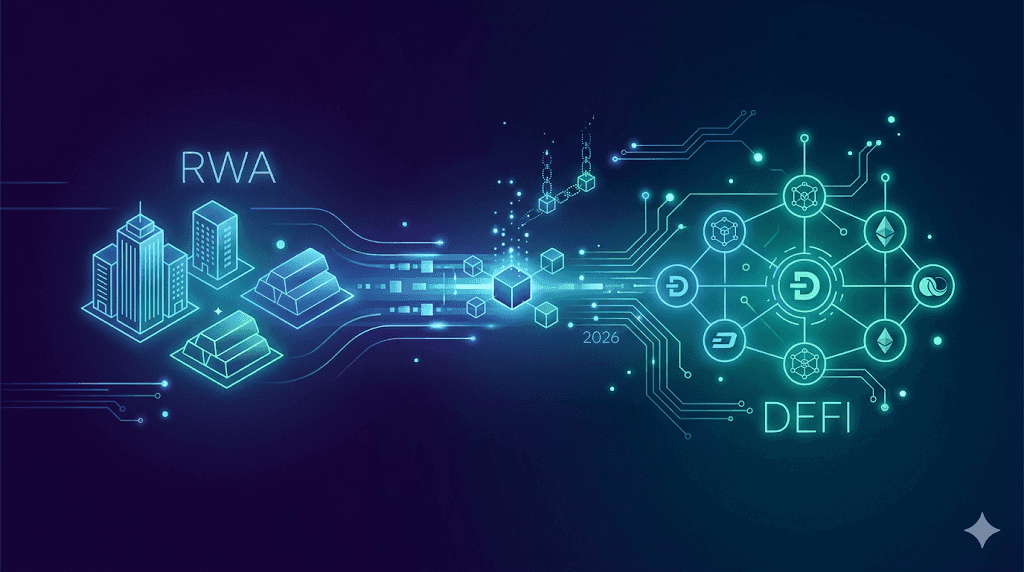
Real-world assets (RWAs) integrate into decentralized finance (DeFi) protocols by utilizing legal wrappers and blockchain oracles to mint digital tokens that represent physical or traditional financial assets, introducing trillions in institutional liquidity while exposing on-chain ecosystems to real-world regulatory and centralization risks. As of late April 2026, this fusion is the primary driver of global DeFi growth, successfully bridging the gap between volatile cryptocurrency yields and the stable returns of traditional finance (TradFi). By locking government bonds, real estate, or private corporate credit in audited, off-chain custodial vaults, protocols can issue yield-bearing digital tokens directly onto decentralized ledgers.
To fully grasp how this transformation is reshaping the modern financial landscape, you must understand three core pillars:
RWA tokenization process — The methodical conversion of physical or financial asset rights into digital blockchain tokens.
DeFi oracle networks — Decentralized data feeds that transmit real-time off-chain asset prices to on-chain smart contracts.
Yield-bearing stablecoins — Digital fiat representations that distribute interest generated from underlying tokenized government treasuries to holders.
The Core Mechanics of RWA Integration
RWA integration relies on a dual-layer architecture combining off-chain legal entities with on-chain token minting smart contracts to ensure that digital tokens hold legally binding value. According to an April 2026 analysis published in the Frontiers in Blockchain journal, protocols must first establish a recognized legal structure to hold the physical asset, which then allows the corresponding smart contract to issue a proportional amount of digital tokens on a network like Ethereum or Arbitrum. This ensures that the digital token is not merely a synthetic price tracker, but an actual bearer instrument representing a fractional ownership claim on the underlying asset.
The integration workflow generally follows a strict sequence: asset origination, legal wrapping, custody and auditing, and finally, on-chain token issuance. Once the token is minted, it can be deployed across the DeFi ecosystem—used as collateral for borrowing stablecoins, deposited into automated market makers (AMMs) for liquidity provision, or held in decentralized autonomous organization (DAO) treasuries to generate passive yield. However, this process requires constant synchronization between the real-world vault and the blockchain ledger, a task that relies entirely on specialized infrastructure bridging the off-chain and on-chain environments.
Legal Wrappers and Special Purpose Vehicles (SPVs)
Legal wrappers and Special Purpose Vehicles (SPVs) act as the mandatory bridge connecting decentralized protocols to traditional property rights and court systems. Without an SPV holding the actual treasury bond or real estate deed, an RWA token is legally worthless, existing only as lines of code with no enforceable claim to physical value.
In 2026, the industry standard involves setting up an SPV in a crypto-friendly jurisdiction, such as Switzerland or the British Virgin Islands, whose sole purpose is to hold the physical asset and issue digital shares of that asset to token holders. This legal isolation protects the token holders in the event that the parent protocol faces bankruptcy or regulatory action.
Decentralized Oracles and Proof of Reserve
Decentralized oracles and Proof of Reserve (PoR) systems are the critical data infrastructure that updates DeFi protocols with the real-time valuation and audited status of off-chain assets. Because blockchains are closed systems that cannot natively query external bank accounts or real estate databases, they rely on oracle networks like Chainlink to feed this information into the smart contracts.
According to a March 2026 report on DeFi vulnerabilities, if an oracle fails to accurately report the depreciating value of an off-chain asset, the DeFi protocol may become undercollateralized, leading to systemic bad debt. Consequently, modern RWA protocols now utilize continuous, cryptographic Proof of Reserve audits to verify that the off-chain custody accounts match the on-chain token supply exactly.
The Massive Opportunities of On-Chain RWAs
The integration of RWAs offers the massive opportunity of introducing sustainable, non-crypto-correlated yields into the decentralized finance ecosystem. Based on the April 2026 Global RWA Market Report by AMINA Bank, the tokenized treasury and private credit sectors grew by over 300% in the last year, providing DeFi users with a stable baseline return that remains completely independent of Bitcoin and Ethereum market volatility (AMINA Bank, 2026).
Prior to the RWA boom, DeFi yields were primarily generated through circular token emissions, speculative leverage, and trading fees—all of which collapse during a bear market. By importing the risk-free rate of U.S. Treasuries, DeFi protocols now possess a durable financial foundation that can survive crypto-native liquidity crunches.
This influx of traditional yield fundamentally alters protocol treasury management. DAOs and lending platforms can now diversify their balance sheets by holding tokenized bonds instead of relying solely on volatile governance tokens or non-yield-bearing stablecoins. This capital efficiency ensures that idle capital is constantly generating revenue, which can be passed down to retail users in the form of higher savings rates or lower borrowing costs.
Unlocking Trillions in Illiquid Markets
RWA protocols unlock trillions of dollars in traditionally illiquid markets by fractionalizing high-barrier ownership and enabling 24/7 global secondary trading. Historically, investing in commercial real estate, fine art, or corporate private credit required massive upfront capital, accredited investor status, and a willingness to lock up funds for years due to a lack of secondary markets.
By tokenizing these assets, a $50 million commercial building can be divided into 50 million tokens priced at $1 each, allowing retail investors globally to gain fractional exposure and trade their shares instantly on decentralized exchanges without intermediaries or multi-day settlement delays.
Democratizing Access to Premium Financial Instruments
Tokenization democratizes global access to premium traditional finance instruments that were previously walled off by geography and legacy banking restrictions. In emerging markets where citizens suffer from hyperinflation and limited access to U.S. dollar-denominated assets, RWA tokens provide an economic lifeline. According to the April 2026 briefing by the Federal Reserve Bank of Kansas City, nearly 48.8% of stablecoin and RWA utility is now concentrated in cross-border wealth preservation, allowing unbanked individuals in developing nations to purchase fractional U.S. Treasuries directly from their smartphones. This circumvents the slow, fee-heavy correspondent banking network.
Sector Focus: Tokenized Treasuries and Private Credit
Tokenized U.S. Treasuries and private corporate credit are currently the undisputed leaders of the RWA sector, dominating the ecosystem because they offer the most reliable and scalable forms of on-chain yield. As of mid-April 2026, institutional giants like BlackRock and Franklin Templeton have captured the lion's share of the market, with BlackRock's BUIDL fund serving as the primary collateral layer for dozens of decentralized derivatives and stablecoins. Treasuries are favored because their valuation is highly transparent, highly liquid, and easily verified by blockchain oracles, making them the perfect low-risk collateral for smart contract lending engines.
Private credit, conversely, offers higher yields by connecting on-chain capital pools with real-world businesses seeking debt financing. Protocols in this sector aggregate stablecoin deposits from thousands of DeFi users and lend them out to off-chain institutions, such as carbon project developers, real estate developers, or emerging market fintechs. While this introduces a higher degree of default risk, it showcases the true disintermediation power of DeFi—removing the traditional banking middleman so that lenders and borrowers can capture the full spread of the interest rate.
Key Risks and Vulnerabilities in RWA Protocols
The primary risk of RWA integration is the reintroduction of centralization and trust-based vulnerabilities into an explicitly trustless DeFi environment. According to the April 2026 security analysis by the NDSS Symposium, unlike purely digital assets like Ethereum, RWAs require users to place absolute trust in off-chain custodians, traditional auditors, and legacy legal systems, creating multiple single points of failure that smart contracts cannot mitigate. If the physical bank holding the protocol's cash goes bankrupt, or if the legal entity holding the real estate deed is sued, the corresponding on-chain tokens instantly lose their backing, regardless of how secure the blockchain code is.
This trust gap breaks the core ethos of decentralized finance. In traditional DeFi, code is law, and liquidations are enforced by immutable mathematics. In RWA DeFi, liquidations and asset recovery rely on court orders, debt collectors, and legal enforcement—processes that take months or years, not seconds. This temporal mismatch creates a severe liquidity risk: if a borrower defaults on an off-chain private credit loan, the DeFi protocol cannot instantly liquidate the physical collateral to pay back its on-chain depositors, potentially leading to a catastrophic bank run on the protocol.
Smart Contract and Oracle Exploits
Smart contract bugs and oracle manipulation remain the most immediate technical threats to RWA collateralized loans and tokenized asset swaps. If an oracle feed is poisoned or experiences a reporting delay during a volatile macroeconomic event, the smart contract might incorrectly price an RWA token, triggering unfair liquidations or allowing attackers to drain liquidity pools. The complexity of translating off-chain corporate actions, such as bond maturity, coupon payments, or stock splits, into on-chain smart contract execution introduces massive surface areas for logical exploits that profit-driven attackers continually target.
Regulatory and Jurisdictional Ambiguity
Regulatory ambiguity poses a systemic existential threat to RWA protocols, as governments maintain the authority to freeze, seize, or sanction the underlying off-chain assets at any time. Because the physical assets exist within specific national jurisdictions, they are fully subject to local securities laws, Anti-Money Laundering (AML) regulations, and Know Your Customer (KYC) requirements.
In 2026, many regulators have mandated that RWA tokens can only be held by whitelisted, KYC-verified wallet addresses, which severely limits their composability within permissionless DeFi ecosystems. If a protocol fails to comply, regulators can simply order the centralized custodian to invalidate the backing of the non-compliant tokens.
Overcoming the Trust Gap with 2026 Technology
The DeFi industry is actively combating the RWA trust gap by deploying advanced Zero-Knowledge (ZK) proofs and continuous intent-alignment monitoring to verify off-chain data without sacrificing user privacy or decentralization. Based on April 2026 research from Informatica, hybrid formal verification tools like VeriChain are now used to audit the complex interactions between legal SPV data feeds and on-chain minting logic, achieving a 98.3% accuracy rate in detecting potential manipulation vectors. These systems mathematically prove that the rules of the off-chain custody agreement match the execution rules of the smart contract.
Furthermore, the rise of Decentralized Validator Networks (DVNs) has improved the security of cross-chain RWA transfers. Instead of relying on a single off-chain entity to verify that a tokenized treasury is fully backed, modern protocols require consensus from multiple independent data providers before any tokens can be minted or burned.
While these technological advancements cannot eliminate the physical risk of holding real-world assets, they significantly reduce the technical risk of the bridging infrastructure, providing institutions with the cryptographic guarantees they require to deploy billions of dollars into DeFi.
| RWA Sector Category | Market Dominance (April 2026) | Primary DeFi Opportunity | Primary Structural Risk |
| Tokenized Treasuries | 65% of Total TVL | Stable, Non-correlated Yield | Custodian Freezes / Sanctions |
| Private Credit | 22% of Total TVL | High-Yield Corporate Lending | Off-chain Default & Illiquidity |
| Real Estate | 8% of Total TVL | Fractionalized Ownership | Slow Legal Asset Recovery |
| Commodities (Gold, etc.) | 5% of Total TVL | Inflation Hedging | Physical Storage Audits |
The Future of DeFi Composability with RWAs
The ultimate trajectory of RWA integration is full composability, where tokenized real estate, equities, and bonds interact seamlessly within permissionless automated market makers and lending markets. In the current April 2026 landscape, we are seeing the emergence of "RWA-backed stablecoins," where the fiat peg is maintained not by cash in a bank, but by short-duration tokenized treasuries held directly on-chain. This allows the stablecoin issuer to capture the treasury yield and distribute it directly to the stablecoin holders, creating a highly competitive alternative to traditional, non-yielding digital dollars.
As the underlying legal frameworks continue to standardize globally, the friction between permissioned RWA tokens and permissionless DeFi protocols will decrease. Innovations in decentralized identity (DID) and on-chain KYC passports allow users to prove their regulatory compliance without revealing their personal data to every protocol they interact with. This ensures that RWAs can flow freely through decentralized exchanges, cross-chain bridges, and algorithmic lending pools while remaining fully compliant with international financial laws.
Should You Trade RWA Tokens on KuCoin?
Trading RWA tokens on KuCoin provides the essential liquidity and institutional-grade security required to navigate the complexities of tokenized real-world assets without dealing with the friction of decentralized, permissioned protocols. While the broader DeFi ecosystem struggles with on-chain KYC bottlenecks and fractured liquidity, KuCoin offers a streamlined environment where you can access the most promising RWA sectors instantly.
You can capitalize on this massive financial transition through three core strategies:
-
Access Premium Tokenized Assets: Utilize the platform to Buy Bitcoin and exchange it for emerging RWA governance tokens, gaining direct exposure to the protocols bridging TradFi and DeFi.
-
Liquid Market Execution: Leverage high-tier Spot Trading pairs to trade RWA-related assets with minimal slippage, bypassing the low liquidity pools often found on decentralized AMMs.
-
Secure Yield Strategies: Maximize your portfolio’s capital efficiency by deploying assets into KuCoin Earn, capturing passive yield safely without exposing your principal to experimental oracle exploits or vulnerable off-chain custodians.
In a 2026 market where regulatory compliance and asset backing are paramount, trading on a globally trusted exchange like KuCoin ensures you have access to vetted, fully audited RWA projects. It acts as the ultimate bridge, allowing you to capture the yield and stability of the physical world with the trading efficiency of the digital economy.
Conclusion
Real-World Asset (RWA) integration represents the most significant evolutionary leap for decentralized finance in 2026, permanently bridging the gap between isolated digital economies and the multi-trillion-dollar traditional financial system. By utilizing Special Purpose Vehicles and decentralized oracles, protocols have successfully digitized everything from U.S. Treasuries to private credit, unlocking unprecedented liquidity, democratizing access to premium assets, and injecting sustainable, non-crypto-correlated yields into the blockchain ecosystem.
However, this integration introduces severe, unavoidable trade-offs. The promise of trustless finance is fundamentally compromised by the reliance on centralized custodians, traditional legal enforcement, and vulnerable data feeds. The risks of off-chain defaults, oracle manipulation, and regulatory freezes are real and immediate, demanding rigorous Proof of Reserve audits and hybrid formal verification to keep the ecosystem secure.
Despite these hurdles, the institutional momentum driven by giants like BlackRock proves that on-chain RWAs are not a passing trend, but the foundational architecture of future capital markets. For forward-thinking investors, navigating this new paradigm via secure, high-liquidity platforms like KuCoin is the key to capturing the upside of the tokenized real-world economy while effectively managing its inherent physical risks.
FAQs
What is the purpose of an SPV in RWA DeFi integration?
A Special Purpose Vehicle (SPV) is a distinct legal entity created solely to hold the physical asset and issue corresponding digital tokens. It legally bridges the off-chain asset to the on-chain smart contract, ensuring token holders have valid property rights while isolating them from the parent company's financial risks.
Why are tokenized U.S. Treasuries dominating the RWA market in 2026?
Tokenized Treasuries dominate because they offer a highly liquid, easily verifiable, and relatively risk-free baseline yield. In a volatile crypto market, DeFi protocols and DAOs use these treasury tokens as stable collateral that generates steady passive income.
How do decentralized oracles introduce risk to RWA protocols?
Oracles are third-party data feeds that update smart contracts on the value of off-chain assets. If an oracle is manipulated, hacked, or experiences a delay, the DeFi protocol may incorrectly price the RWA, leading to unfair liquidations, bad debt, or the draining of liquidity pools.
What happens to my RWA tokens if the off-chain custodian goes bankrupt?
If the legal wrapper and SPV are structured correctly, the assets are "bankruptcy-remote," meaning the custodian's creditors cannot claim them, and your tokens remain backed. However, if poorly structured, a custodian bankruptcy could render the on-chain tokens entirely worthless.
How do RWA tokens handle KYC and regulatory compliance on-chain?
Many RWA tokens are programmed with permissioned smart contracts that check a user's wallet against an on-chain whitelist before allowing a transfer. This ensures that only users who have passed KYC/AML checks can hold or trade the tokenized asset, complying with local securities laws.
Disclaimer:This content is for informational purposes only and does not constitute investment advice. Cryptocurrency investments carry risk. Please do your own research (DYOR).