

A Comparative Analysis of the Four Oil Crises: Causes, Characteristics, and Global Impacts
2026/06/07 08:00:00
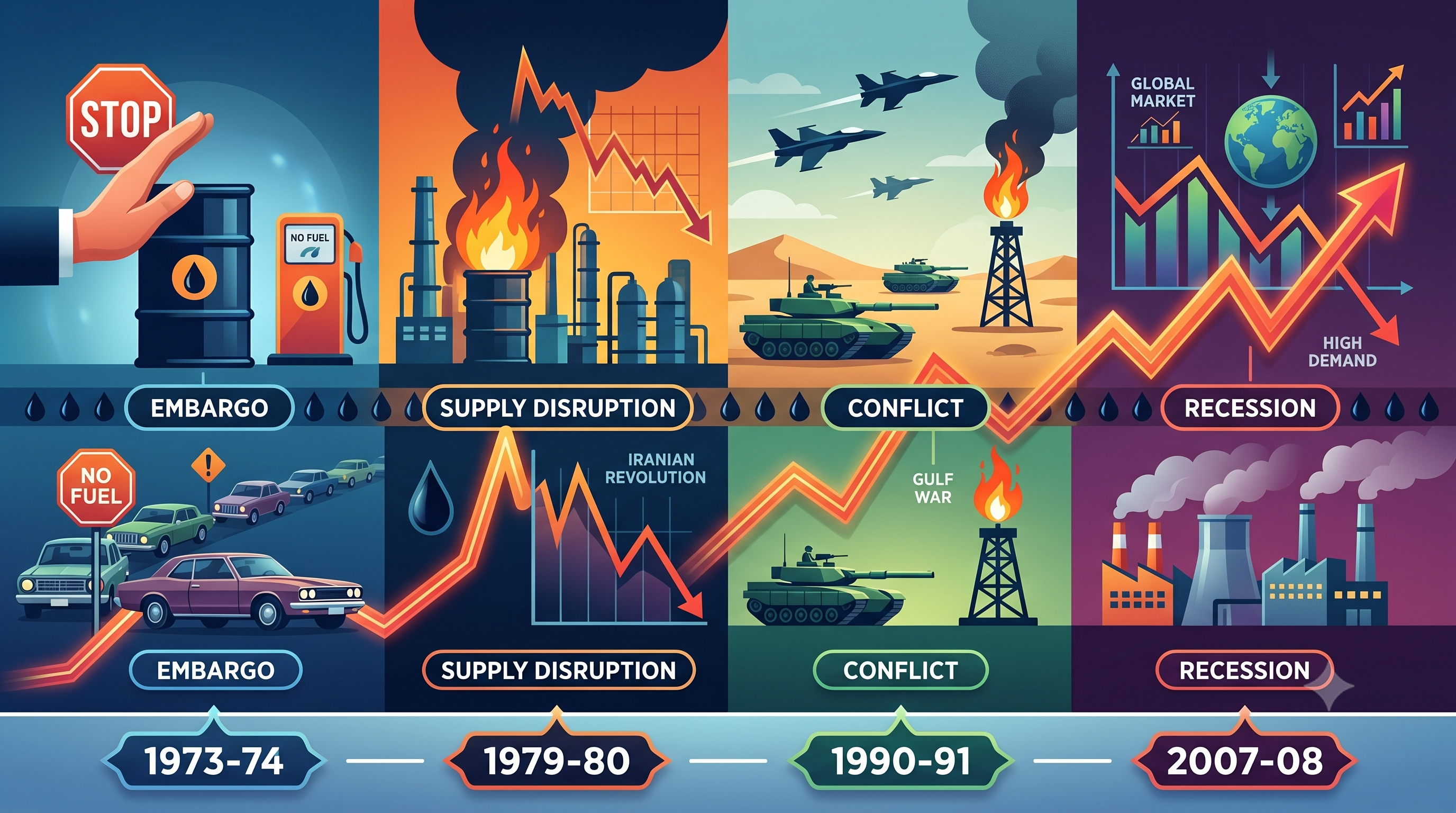
A comparative analysis of the four major oil crises: the 1973 Arab oil embargo, the 1979 Iranian Revolution oil shock, the 1990 Gulf War oil crisis, and the 2007–2008 oil price surge. Learn their causes, characteristics, global impacts, and key lessons for energy security.
Oil crises have shaped the modern global economy more than almost any other energy event. Because oil is essential for transportation, manufacturing, agriculture, shipping, aviation, and daily consumer life, a sudden increase in oil prices can quickly affect inflation, trade, economic growth, and international relations.
The four major oil crises often discussed in modern economic history are the 1973–1974 oil crisis, the 1979–1980 oil crisis, the 1990–1991 oil crisis, and the 2007–2008 oil crisis. Each crisis created pressure on global markets, but each had different causes and characteristics.
The 1973 crisis was caused by the Arab oil embargo after the Yom Kippur War. The 1979 crisis followed the Iranian Revolution and the decline in Iranian oil output. The 1990 crisis was triggered by Iraq’s invasion of Kuwait. The 2007–2008 crisis was different because it was driven mainly by rising global demand, tight supply, limited spare capacity, and financial-market pressure.
A comparative analysis of these four oil crises helps explain how energy shocks affect the world economy, why oil-importing countries are vulnerable, and why energy security remains a major policy issue today.
Historical Background of Global Oil Crises
Oil became the foundation of modern industrial growth during the twentieth century. It replaced coal in many transport and industrial uses and became essential for cars, aircraft, ships, factories, and military power. As economies became more dependent on oil, global stability became closely linked to the stability of oil supply.
Before the 1970s, many Western countries enjoyed relatively cheap and stable oil. However, the 1973 crisis changed this assumption. It showed that oil-producing countries could use energy exports as political and economic power. Since then, oil markets have been shaped by a mix of geopolitics, supply-demand imbalance, producer decisions, wars, sanctions, and financial expectations.
The four oil crises show that an oil crisis can emerge from different sources. Sometimes the cause is war. Sometimes it is revolution. Sometimes it is an embargo. Sometimes it is rapid demand growth combined with tight supply. However, the result is often similar: higher prices, inflation pressure, slower economic growth, and stronger debate about energy security.
The 1973–1974 Oil Crisis: The Arab Oil Embargo
The 1973–1974 oil crisis was the first major modern oil crisis. It began after the Yom Kippur War, when Egypt and Syria attacked Israel in October 1973. In response to Western support for Israel, Arab oil-producing countries reduced production and imposed an oil embargo on several countries, including the United States.
The main cause of the crisis was geopolitical. Oil was used as a political weapon to pressure Western governments. This made the crisis more than a normal market shortage. It was a deliberate supply restriction connected to international conflict.
One of the most important features of the 1973 oil crisis was the sudden rise in prices. Federal Reserve History notes that the production cuts nearly quadrupled the price of oil from $2.90 per barrel before the embargo to $11.65 per barrel in January 1974.
The impact was severe. Oil-importing countries faced rising fuel prices, higher production costs, and inflation. Many economies experienced stagflation, a difficult condition where inflation rises while economic growth slows. Consumers faced higher energy bills, businesses faced higher costs, and governments had to rethink their dependence on imported oil.
This crisis also strengthened the role of OPEC in global markets. It showed that oil-producing countries could influence the world economy by controlling supply. After 1973, many countries began to build strategic petroleum reserves, promote fuel efficiency, and search for alternative energy sources.
The 1979–1980 Oil Crisis: The Iranian Revolution
The second major oil crisis occurred in 1979 and 1980. It was caused by the Iranian Revolution, which overthrew the Shah of Iran and brought major political change to one of the world’s largest oil-producing countries.
Iran was a key oil exporter, so political instability quickly affected global oil supply. During the revolution, strikes and disruption reduced Iranian oil production sharply. According to Federal Reserve History, Iranian oil output declined by 4.8 million barrels per day by January 1979, equal to about 7% of world production at that time.
The 1979 oil crisis had a different character from the 1973 crisis. It was not mainly caused by a planned embargo. Instead, it was caused by domestic political instability in a major producer. However, market fear made the shock worse. Buyers expected future shortages, and panic buying pushed prices higher.
The global impact was serious because many countries were still dealing with the effects of the first oil crisis. Higher oil prices increased inflation again. Central banks responded with tighter monetary policy to control inflation, especially in the United States. This contributed to high interest rates and recession pressure in the early 1980s.
The 1979 crisis showed that oil markets are vulnerable not only to international wars but also to internal political changes in major exporting countries. It also showed that expectations, fear, and uncertainty can magnify the impact of a real supply disruption.
The 1990–1991 Oil Crisis: The Gulf War Shock
The third major oil crisis began in 1990 after Iraq invaded Kuwait. Both Iraq and Kuwait were important oil producers, and the invasion immediately disrupted supply from the Persian Gulf region. There was also concern that the conflict could threaten Saudi Arabia and other Gulf producers.
The main cause of the 1990 oil crisis was military conflict. Iraq’s invasion of Kuwait created a sudden supply shock and raised fears of a wider Middle East war. The U.S. Energy Information Administration states that after the invasion, nearly all of Kuwait’s and Iraq’s oil production was taken offline, causing a sudden crude oil price run-up.
The 1990 crisis was sharp but relatively short compared with the 1973 and 1979 crises. Prices rose quickly after the invasion, but international military action and emergency supply responses helped restore market confidence. The crisis ended more quickly once the Gulf War coalition pushed Iraqi forces out of Kuwait.
The global impact included higher fuel prices, inflation pressure, weaker consumer confidence, and economic uncertainty. The crisis also contributed to pressure on economies already moving toward the early 1990s slowdown.
Geopolitically, the Gulf War oil crisis confirmed the strategic importance of the Persian Gulf. It showed that oil supply security was directly linked to military security, regional stability, and global diplomacy. For many countries, especially oil-importing economies, the crisis reinforced the need to protect energy routes and diversify supply sources.
The 2007–2008 Oil Crisis: Demand Growth and Market Pressure
The fourth major oil crisis occurred in 2007 and 2008. Unlike the earlier three crises, it was not mainly caused by an embargo, revolution, or war. Instead, it was driven by rapid global demand growth, tight supply, limited spare production capacity, a weaker U.S. dollar, and financial-market activity.
During the 2000s, emerging economies such as China and India grew rapidly. Their demand for oil increased as industrial output, construction, transportation, and consumer activity expanded. At the same time, global oil supply struggled to grow fast enough. Spare capacity was limited, making the market sensitive to disruptions and expectations.
James Hamilton’s Brookings paper on the 2007–2008 oil shock explains that the price run-up had similarities with earlier oil shocks but was strongly connected to demand growth and limited supply expansion.
The key characteristic of the 2007–2008 oil crisis was that it was largely demand-led. Earlier crises were mainly caused by sudden supply disruptions. By contrast, the 2007–2008 crisis showed that strong global demand can also create an oil shock when supply is tight.
The global impact was broad. Higher oil prices increased the cost of transportation, shipping, aviation, food production, and consumer goods. Many households spent more on fuel, while businesses faced higher operating costs. Inflation pressure increased in many countries.
However, the crisis changed direction when the global financial crisis reduced demand. Oil prices fell sharply as economic activity weakened. This showed how closely oil prices are connected to global growth expectations.
Comparative Analysis of the Four Oil Crises
The four oil crises shared one major result: they all caused serious pressure on the global economy. However, their causes and patterns were different.
The 1973 crisis was a political embargo. The 1979 crisis was caused by revolution and domestic instability. The 1990 crisis was triggered by military invasion. The 2007–2008 crisis was driven mainly by market fundamentals, including rising demand and tight supply.
The first three crises were primarily supply shocks. A supply shock occurs when oil production or exports are suddenly reduced. The 2007–2008 crisis was more of a demand-and-capacity shock, where strong consumption met limited production flexibility.
The duration also varied. The 1973 and 1979 crises had long-term structural effects on inflation, energy policy, and global politics. The 1990 crisis was shorter because military and diplomatic action helped stabilize supply expectations. The 2007–2008 crisis rose dramatically but ended with the collapse in demand during the global financial crisis.
Comparison Table of the Four Oil Crises
| Oil Crisis | Main Cause | Main Characteristic | Global Impact |
| 1973–1974 Oil Crisis | Arab oil embargo after the Yom Kippur War | Politically driven supply restriction | Stagflation, higher inflation, stronger OPEC influence |
| 1979–1980 Oil Crisis | Iranian Revolution | Supply disruption and panic buying | Inflation, recession pressure, tighter monetary policy |
| 1990–1991 Oil Crisis | Iraq’s invasion of Kuwait | Sudden Gulf supply shock | Short-term price spike, Gulf War intervention, economic uncertainty |
| 2007–2008 Oil Crisis | Rapid demand growth and tight supply | Demand-led price surge | Higher transport and food costs, inflation pressure, market volatility |
The comparison table shows that each oil crisis had a different cause but similar global effects. The 1973, 1979, and 1990 crises were mainly linked to political conflict and supply disruption, while the 2007–2008 crisis was driven by strong demand and tight supply. Together, these crises increased inflation, slowed economic growth, and highlighted the importance of energy security.
Major Causes Behind the Four Oil Crises
Geopolitical Conflict
Geopolitical conflict was a major cause of oil crises. The 1973 crisis was linked to the Arab-Israeli conflict, while the 1990 crisis began after Iraq invaded Kuwait. Both events showed how regional wars can quickly affect global oil markets.
Political Instability in Oil-Producing Countries
Political instability can also reduce oil supply. The 1979 Iranian Revolution disrupted production in one of the world’s key oil-exporting countries, creating fear of shortages and higher prices.
Supply and Demand Imbalance
Not every oil crisis is caused by war. The 2007–2008 crisis was mainly driven by fast-growing global demand, tight supply, limited spare capacity, and market uncertainty.
Key Characteristics of Each Oil Crisis
The 1973 oil crisis was highly political. Its main feature was the use of oil as a diplomatic weapon during the Arab oil embargo.
The 1979 oil crisis was driven by instability and fear. It combined real supply loss from Iran with panic buying in global markets.
The 1990 oil crisis was sudden and military-driven. It was caused by the disruption of oil supply from Iraq and Kuwait after Iraq’s invasion of Kuwait.
The 2007–2008 oil crisis was market-driven. It was mainly shaped by strong global demand, tight supply, and limited production capacity.
Each crisis required a different policy response. Geopolitical crises needed diplomacy and security planning, while demand-led crises required investment, efficiency, and long-term energy planning.
Global Economic Impacts of the Oil Crises
Oil crises affect the global economy through several channels. The first is inflation. When oil prices rise, the cost of transportation, production, and energy increases. These costs are often passed to consumers through higher prices for goods and services.
The second impact is slower economic growth. Higher energy costs reduce household spending power and increase business expenses. This can reduce investment, consumption, and employment.
The third impact is pressure on trade balances. Oil-importing countries must spend more money on energy imports, while oil-exporting countries receive higher revenue. This can shift global capital flows and affect currency markets.
The fourth impact is monetary policy pressure. Central banks may raise interest rates to control inflation. However, higher interest rates can also slow growth, creating a difficult policy challenge.
Political and Geopolitical Impacts
Oil crises can change international relations. The 1973 crisis strengthened OPEC’s influence and showed that energy exporters could reshape global politics. The 1979 crisis made Iran a central focus of energy security concerns. The 1990 crisis led to major military intervention in the Gulf region. The 2007–2008 crisis increased debate about long-term oil dependence.
Oil crises also pushed countries to develop energy security strategies. These included strategic petroleum reserves, diversified import sources, fuel-efficiency standards, nuclear energy, renewable energy, and domestic energy production.
For oil-importing countries, the main geopolitical lesson was clear: dependence on unstable supply routes creates national security risk. For oil-exporting countries, oil crises showed the power and danger of relying heavily on energy revenue.
Social and Consumer-Level Effects
Oil crises affect ordinary people directly. When fuel prices rise, transportation becomes more expensive. Food prices may also rise because agriculture and shipping depend heavily on fuel. Heating, electricity, and consumer goods can also become more costly.
Low-income households are often affected more severely because they spend a larger share of income on basic needs such as transport, food, and energy. In some crises, consumers faced fuel shortages, long lines at petrol stations, and changes in daily travel behavior.
Oil crises also changed consumer preferences. After the 1970s oil shocks, many consumers became more interested in smaller cars and fuel efficiency. Businesses also became more aware of energy costs in logistics and production.
Why the Four Oil Crises Still Matter Today
The four oil crises remain relevant because the global economy still depends heavily on energy stability. Even as renewable energy grows, oil remains important for transportation, aviation, shipping, petrochemicals, and industrial activity.
Modern oil markets also face new risks. These include geopolitical tensions, sanctions, climate policy, underinvestment in production, shipping-route disruptions, and changing demand from emerging economies. The history of oil crises helps governments and businesses prepare for future shocks.
Understanding the four oil crises also helps explain why energy transition is not only an environmental issue. It is also an economic security issue. Reducing overdependence on a single energy source can make economies more resilient.
How Oil Crises Affect the Crypto Market
Oil crises can affect the crypto market by increasing inflation, interest-rate pressure, and global market uncertainty. When oil prices rise, investors often reduce exposure to risk assets, including Bitcoin and altcoins. However, some traders may also view Bitcoin as a possible inflation hedge during periods of currency weakness. Overall, oil shocks can increase crypto volatility and make macro factors more important for market direction.
Conclusion
The four oil crises show how deeply oil is connected to the global economy and international politics. The 1973 crisis showed that oil could be used as a political weapon. The 1979 crisis showed how revolution in a major producer could disrupt global markets. The 1990 crisis showed how war in the Persian Gulf could threaten energy security. The 2007–2008 crisis showed that rapid demand growth and tight supply could create a major oil shock even without a military conflict.
Although each crisis had different causes, all four produced similar effects: higher prices, inflation pressure, economic uncertainty, and renewed focus on energy security. They also pushed governments and businesses to think more seriously about strategic reserves, efficiency, alternative energy, and supply diversification.
In the modern world, the lessons of these four oil crises remain important. Energy systems must be resilient, flexible, and diversified. Oil shocks are not only historical events; they are warnings about the risks of dependence, geopolitical instability, and market imbalance.
Frequently Asked Questions
-
How do oil crises affect the global economy?
Oil crises increase fuel, transport, and production costs. This can lead to inflation, slower economic growth, weaker consumer spending, and pressure on businesses. In financial markets, inflation also raises questions about whether assets such as Bitcoin can still act as an inflation hedge.
-
Which oil crisis had the strongest political impact?
The 1973–1974 oil crisis had a major political impact because it strengthened OPEC’s influence and showed that oil could be used as a diplomatic weapon.
-
What lessons can be learned from the four oil crises?
The main lesson is that countries need stronger energy security. Strategic reserves, diversified energy sources, fuel efficiency, and renewable energy can help reduce the impact of future oil shocks. Similar concerns remain relevant today, especially when markets react to shipping-route risks such as the Strait of Hormuz and its impact on crypto market volatility, while investors and policymakers also monitor macro indicators such as the PMI index and its role in shaping market expectations.
Disclaimer: This article is for informational purposes only and is not financial advice. Cryptocurrency investments are highly volatile and carry risk. Readers should do their own research before making any investment decisions.