

Coldcard Bitcoin Hack: New Investigation Lead Emerges as 1,082 BTC Remains Unmoved
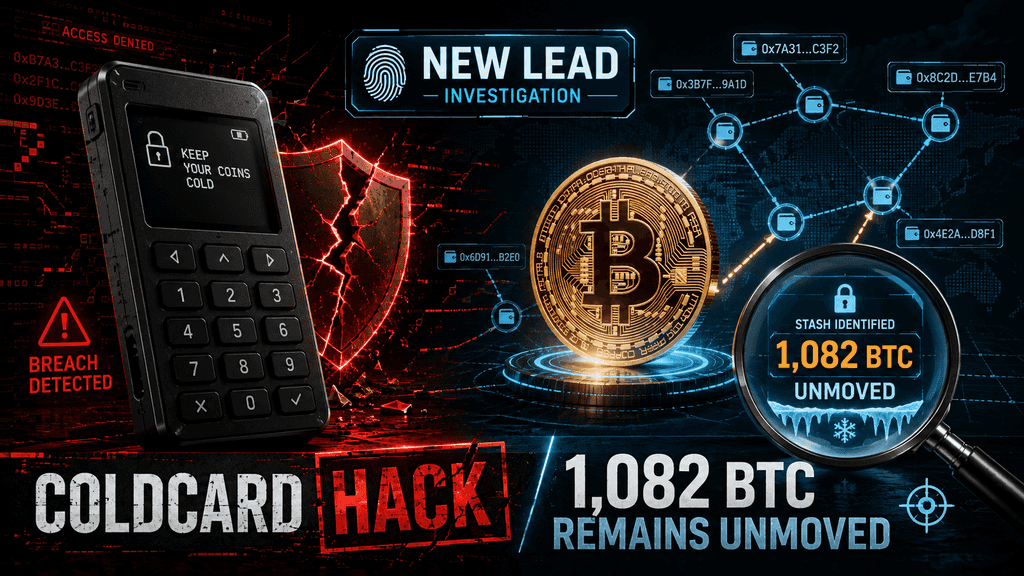
A major investigation into the Coldcard Bitcoin wallet exploit has taken an unusual turn. During the first and largest attack wave on July 30, 2026, roughly 1,082.65 BTC was swept from about 1,196 addresses in just 41 minutes. The attacker never needed to steal a physical Coldcard, infect a computer or trick victims into revealing their seed phrases. Instead, a firmware flaw weakened the randomness used to generate certain wallet seeds, making some private keys potentially reproducible offline.
Now investigators may have something the Bitcoin blockchain itself cannot provide: an off-chain trail. Block engineer Clay Garrett said the operator behind the initial sweep used a paid account at a well-known blockchain-services provider while querying source addresses. Internal service logs reportedly matched the attack workflow with unusual precision, and relevant information was passed to authorities. Meanwhile, the largest first-wave tranche has remained conspicuously unmoved. The combination raises a compelling question for the crypto industry: if investigators can see the stolen Bitcoin and may have a lead on who took it, why is recovering the money still so difficult?
What Happened in the 41-Minute Coldcard Sweep?
The first major sweep began on July 30 and lasted only about 41 minutes. Galaxy Research mapped 1,082.65 BTC leaving roughly 1,196 addresses between 01:10 and 01:51 UTC. The transactions were spread across several Bitcoin blocks and displayed characteristics that strongly suggested automation rather than normal users independently moving their savings. The attacker used a fixed fee rate of around 30 satoshis per virtual byte, substantially above prevailing fees at the time, and the transactions generally left no normal change outputs.
The timing made the incident even more significant. The sweep occurred roughly 30 hours before Coinkite publicly warned users about the Coldcard seed-generation vulnerability. That suggests the first operator had either independently discovered the weakness or acquired enough knowledge to exploit it before the wider Bitcoin community understood what was happening. The addresses also spanned different Bitcoin address formats, consistent with a system that was deriving candidate keys and scanning multiple wallet paths rather than targeting one narrowly defined group of users.
| Wave 1 Detail | Reported Data |
| Date | July 30, 2026 |
| Attack window | ~41 minutes |
| Addresses drained | ~1,196 |
| Bitcoin swept | 1,082.65 BTC |
| Timing vs. public warning | ~30 hours earlier |
| Transaction pattern | Highly automated |
| Main proceeds | Consolidated into a few addresses |
The speed of the attack is important because it changes how the theft should be understood. This was probably not a conventional intrusion in which a hacker broke into one wallet after another. The transaction pattern is more consistent with an operator who had already reconstructed or collected the necessary private keys and then activated an automated sweeping tool once the target set was ready.
Why Does the Unmoved 1,082 BTC Matter?
After the first wave, most of the proceeds were rapidly consolidated into a small number of destination addresses. Early investigations identified four principal holdings containing approximately 562 BTC, 398 BTC, 90 BTC and 32 BTC. Those first-wave balances remained unmoved during subsequent monitoring, even as later attackers began moving portions of funds stolen in other waves.
For people accustomed to traditional financial crime, this creates an unintuitive situation. Bitcoin’s public blockchain makes the stolen coins extraordinarily visible. Investigators can watch an address, see its balance and immediately detect a new outgoing transaction. But visibility does not provide control. Bitcoin has no administrator capable of reversing a confirmed transaction, and there is no issuer with the technical authority to freeze a BTC address simply because investigators have identified it as containing stolen funds.
That is why traceable does not mean recoverable. The blockchain may show precisely where a large portion of the stolen Bitcoin sits, but only someone who possesses the relevant private keys can spend it. For investigators, the opportunity often comes later, when an attacker attempts to turn pseudonymous Bitcoin into fiat currency, another asset or services provided by businesses that collect identifying information.
A Paid Blockchain Account Could Be the Biggest Investigative Break
The most important investigative development came not from a new Bitcoin transaction but from infrastructure used outside the blockchain. Garrett said investigators noticed an unusual pattern in the first-wave sweeps and concluded that the operator appeared to be using a paid account at a well-known blockchain-services provider to query source addresses and perform related activity. When the provider reviewed its own records, the number, sequence and timing of requests reportedly aligned closely with the suspected attack workflow. Block then shared relevant information with authorities.
That matters because a commercial account can create a very different type of evidence from a Bitcoin address. Depending on how the provider operates, an account could potentially be associated with billing information, login records, IP addresses, API usage history or other metadata. None of those specific records has been publicly confirmed in this case, so it would be premature to claim investigators already possess the attacker’s identity. What has been established publicly is that the use of centralized infrastructure may have created a subpoena-able trail that would not otherwise exist on-chain.
The distinction is critical. Reports that the attacker “left a digital trail” should not be interpreted as confirmation that the FBI or another agency has formally identified or arrested a suspect. The safer conclusion is that investigators may now have an unusually strong lead on the operator behind Wave 1. In operational-security terms, the attacker may have hidden behind pseudonymous Bitcoin addresses while exposing more identifying information through a conventional paid service.
How Was a Cold Wallet Hacked Without Ever Being Touched?
The Coldcard incident was not a failure of Bitcoin’s cryptography. It was a failure in the process used to create some of the secrets that Bitcoin cryptography protects. A hardware wallet normally begins by obtaining high-quality entropy—unpredictable random information—which is then used to create a seed. That seed generates private keys, and those private keys generate Bitcoin addresses. If the initial randomness is strong, observing the resulting addresses does not allow an attacker to work backward and discover the private keys.
The Problem Started With Seed Generation
Coinkite’s technical postmortem traced the issue to changes introduced in 2021 while Coldcard was integrating libsecp256k1 and related MicroPython components. A complex series of bugs prevented the intended hardware random-number generator from contributing randomness in certain firmware versions. In affected circumstances, the process relied too heavily on a software fallback instead. Coinkite said later Coldcard generations added other entropy sources that reduced the severity of the problem, but they did not restore the intended 128-bit security target in affected firmware.
The practical consequence was that a seed that appeared perfectly ordinary to its owner could exist inside a much smaller search space than expected. Security researchers concluded that an attacker able to sufficiently constrain variables such as device-specific information, timing state and previous random-number-generator calls could generate candidate seed streams offline. That dramatically changes the economics of an attack: instead of attempting the essentially impossible task of brute-forcing a properly generated Bitcoin seed, an attacker can search a restricted set of plausible seeds.
Predictable Seeds Can Lead Directly to Spendable Keys
Once candidate seeds are generated, the attacker can derive their corresponding Bitcoin addresses and compare them with public blockchain data. If a candidate produces an address that contains real BTC, the attacker has effectively reconstructed the private key needed to spend those coins. No phishing email, malware implant or physical access to the Coldcard is necessary.
The attack flow can therefore be summarized as weak entropy → candidate seeds → derived addresses → blockchain balance checks → matching private keys → valid Bitcoin transactions. The final transaction is cryptographically legitimate from the Bitcoin network’s perspective because it carries a valid signature. Bitcoin itself has no way to know that the person producing that signature derived the private key through a firmware weakness rather than receiving it legitimately.
This is also why air-gapping alone could not prevent the theft. Keeping a private key offline protects it from many forms of extraction. It cannot make a predictable key unpredictable after it has already been created.
Why Did One Vulnerability Turn Into Multiple Attack Waves?
Wave 1 was only the beginning. A second and third wave followed, targeting additional balances and using changing transaction structures. By August 2, researchers had identified roughly 1,367 BTC stolen from 4,585 addresses across the first three waves. A possible fourth wave later pushed estimated losses toward 1,816 BTC from more than 5,200 addresses.
The changing patterns suggested that the Coldcard incident was no longer necessarily the work of a single operator. Galaxy Research estimated by August 7 that at least 15 separate attackers may have been exploiting the weakness independently. Once information about the flaw entered the public domain, technically capable actors could study the vulnerable seed-generation process, build their own search tools and compete to sweep any remaining funded wallets before owners could migrate their BTC.
| Attack Phase | Main Characteristic | Why It Matters |
| Wave 1 | 1,082.65 BTC in ~41 minutes | Largest, highly coordinated sweep |
| Waves 2–3 | Different collection patterns | Suggest changing strategies or operators |
| Later attacks | Public vulnerability information available | More opportunistic exploitation became possible |
| By Aug. 7 | At least 15 suspected attackers | “The Coldcard hacker” is likely an oversimplification |
| By Aug. 14 | At least 1,778 BTC confirmed stolen | Total impact far exceeded Wave 1 |
The distinction matters for both journalism and law enforcement. Even if investigators eventually identify the operator associated with the paid blockchain-services account, that would not necessarily solve the entire Coldcard theft campaign. By August 14, Galaxy said at least 1,778 BTC had been stolen, with roughly 1,531 BTC still sitting unmoved in attacker-controlled addresses while about 246 BTC had been moved, much of it into CoinJoin transactions.
Can Investigators Ever Recover the Stolen Bitcoin?
Recovery is possible, but knowing where the money is does not automatically create a mechanism for taking it back. The clearest route would be for investigators to identify an attacker and gain lawful control of the private keys holding the stolen BTC. Another possibility arises if the coins eventually enter a regulated exchange or other centralized service capable of freezing an associated customer account in response to legal orders.
The attacker may therefore have a strong reason to leave the largest balances untouched. Moving large amounts of heavily monitored BTC creates fresh forensic evidence. Transactions can reveal relationships between address clusters, while using an exchange, OTC desk or other centralized service may introduce account information or compliance checks. Even mixing strategies create observable transactions before the trail becomes harder to follow. Bitquery’s independent analysis found that much of the Coldcard-related BTC it traced remained stationary, although at least one smaller holding later entered a CoinJoin.
This creates an unusual asymmetry: stealing the Bitcoin may have been technically straightforward once the weak seeds were reconstructed, but safely monetizing tens of millions of dollars in publicly tracked BTC is a different challenge. The longer the first-wave addresses stay motionless while investigators develop off-chain leads, the more the attacker faces a choice between keeping wealth that cannot easily be used and moving it in ways that could reveal additional information.
What the Coldcard Hack Means for Hardware Wallet Security
The Coldcard incident challenges a simplified idea of self-custody. “Not your keys, not your coins” remains an important warning about handing control of Bitcoin to third parties, but owning a private key does not eliminate all custody risk. It transfers much of that risk into the hardware, firmware, software libraries and key-generation processes the owner relies on. Galaxy summarized the lesson similarly: removing a third-party custodian does not remove custody risk; it changes where that risk sits.
“Your Keys” Is Only Part of the Security Model
A hardware wallet can be viewed as a chain of assumptions. The device hardware must work as intended. Firmware must correctly call secure components. The random-number-generation system must deliver adequate entropy. Libraries must implement cryptographic functions correctly. Only then can secure offline storage and transaction signing provide the protection users expect. If the seed-generation stage fails, excellent security at later stages cannot restore the entropy that was missing at creation.
That does not mean hardware wallets or self-custody are fundamentally unsafe. It means users and wallet makers may need to think beyond whether a device is air-gapped or whether its source code is public. Independent review of entropy paths, reproducible builds, multiple randomness sources, safer upgrade practices and clear procedures for regenerating compromised seeds may become more prominent parts of hardware-wallet security discussions after Coldcard.
The incident has even produced an unusual market response. CoinDesk reported that some Bitcoin holders moved funds toward exchanges during the crisis—the opposite of the migration toward self-custody that followed failures such as FTX. That does not establish that centralized custody is inherently safer, but it shows how deeply a key-generation failure can undermine confidence in a product category designed specifically to eliminate online custody risk.
What Should Coldcard Users Do Now?
The most important point from Coinkite’s security guidance is that updating firmware does not repair a seed that was already generated with insufficient entropy. Users whose seeds were created on affected firmware without adequate additional randomness are instructed to upgrade first, create an entirely new seed on corrected firmware and move their Bitcoin to addresses generated from that new seed. Coinkite specifically advises sending a small test transaction before migrating the remaining balance.
For Mk3 devices, Coinkite says seeds generated on firmware 4.0.1 or later without at least 50 independent, private dice rolls should be treated as at risk. For affected Mk4, Mk5 and Q firmware, the company recommends upgrading to corrected releases before generating a replacement seed. Seeds created with at least 50 fair, independent and private dice rolls are treated differently under Coinkite’s guidance because those rolls introduce an independent entropy source.
Simply importing the old seed into another Coldcard, Ledger, Trezor or software wallet would not address the underlying problem. The vulnerability follows the seed, not the physical device. Users should also avoid entering seed phrases into online “vulnerability checker” websites; exposing a seed to an untrusted online service would create an entirely new security risk.
What Happens Next in the Coldcard Investigation?
The most important trigger is movement from the major first-wave addresses. A significant outgoing transaction would immediately provide investigators with fresh information about the attacker’s laundering strategy and could reveal whether the operator intends to use CoinJoin, centralized services, cross-chain infrastructure or another route. Later-wave attackers have already demonstrated that some stolen BTC can move, so the continued inactivity of the largest holdings is increasingly notable.
The second trigger is formal law-enforcement action. Public reporting currently supports the existence of an investigative lead tied to a paid blockchain-services account; it does not support a claim that the Wave 1 operator has been formally identified, charged or arrested. A subpoena, indictment, asset seizure or official confirmation of a suspect would therefore represent a much larger development than the current inference based on provider logs.
Finally, attention will increasingly shift toward Coinkite’s liability and the broader response from hardware-wallet manufacturers. The technical cause of the Coldcard failure is becoming clearer. What remains uncertain is who first discovered and exploited it, how much of the stolen Bitcoin can eventually be recovered, and whether the incident leads to new standards for auditing wallet entropy and seed-generation systems.
Conclusion
The Coldcard hack has evolved from a hardware-wallet security incident into a complex Bitcoin forensics investigation. The first wave alone removed 1,082.65 BTC from roughly 1,196 addresses in about 41 minutes, yet the largest portion of those funds has remained visible and largely untouched. At the same time, the attacker may have made a consequential operational mistake by using a paid blockchain-services account, potentially giving investigators an off-chain trail that Bitcoin addresses alone could never provide.
Still, neither development guarantees recovery. An unmoved Bitcoin balance cannot be frozen by the network, and an investigative lead is not the same as an identified or arrested suspect. The case instead illustrates two different sides of crypto security: attackers must protect their own operational anonymity just as carefully as users must protect their keys.
More broadly, Coldcard demonstrates that self-custody security begins before a private key is ever stored offline. If the randomness used to create that key is flawed, even an untouched cold wallet can be vulnerable. For now, the blockchain shows investigators where much of the stolen Bitcoin sits. The harder question is whether evidence outside the blockchain can reveal who controls it.
FAQs
Was Bitcoin itself hacked in the Coldcard incident?
No. Bitcoin’s cryptography and consensus were not broken. The vulnerability involved the randomness used by certain Coldcard firmware versions to generate wallet seeds.
Can users check whether their seed is vulnerable?
There is no safe public blockchain test that can prove a seed is secure. Users should rely on their Coldcard model, firmware history and Coinkite’s migration guidance rather than entering a seed into an online checker.
Does a BIP-39 passphrase protect an affected seed?
A strong, unique passphrase can add substantial additional entropy, but affected users should still follow the manufacturer’s current security guidance rather than assume a passphrase permanently eliminates the risk.
Are other hardware wallets affected by the same bug?
The disclosed flaw is specific to Coldcard’s affected firmware and seed-generation implementation. It does not establish that Ledger, Trezor or other hardware-wallet products contain the same vulnerability.
Why can’t Bitcoin miners freeze the stolen BTC?
Miners validate transactions according to Bitcoin’s consensus rules. If a transaction contains a valid signature from the correct private key, miners do not have a built-in mechanism to freeze it merely because the coins have been identified as stolen.
🔥 KuCoin Offers A More Stable Option in A Volatile Market
If you worry about the frequent ups and downs in the market, and pursue a more stable option to earn money passively, KuCoin is the right place to come:
Simple Earn: Deposit and withdraw tokens anytime, earning stable returns.
Kucoin Earn: Earn stable profits with professional asset management.
Hold to Earn: Earn rewards by holding assets in Funding, Trading, Margin, Futures, Mining, and Unified Accounts.
Staking: Unlock the earning potential of on-chain assets.
Advanced Investments: Advanced Investments offer a variety of structured products to help your money grow in any market.
Shark Fin: Principal Protection and Guaranteed Gains
Dual Investment: Buy low and sell high with transparent return calculations.
Snowball: High yields, with price protection.
Discount Buy: Buy crypto at discount prices.
KCS Loyalty: Level up to enjoy exclusive perks by staking ≥ 1 KCS.
KuCoin Wealth: Discover future value and begin your smart investing journey.
KCS Benefits: Hold and stake KCS to access benefits across the platform.
KCS Staking 2.0: Participate in KCS on-chain governance to earn yield.
Disclaimer: This content is for informational purposes only and does not constitute investment advice. Cryptocurrency investments carry risk. Please do your own research (DYOR).