

What Is Claude for Financial Advisors? How Anthropic’s AI Could Change Wealth Management
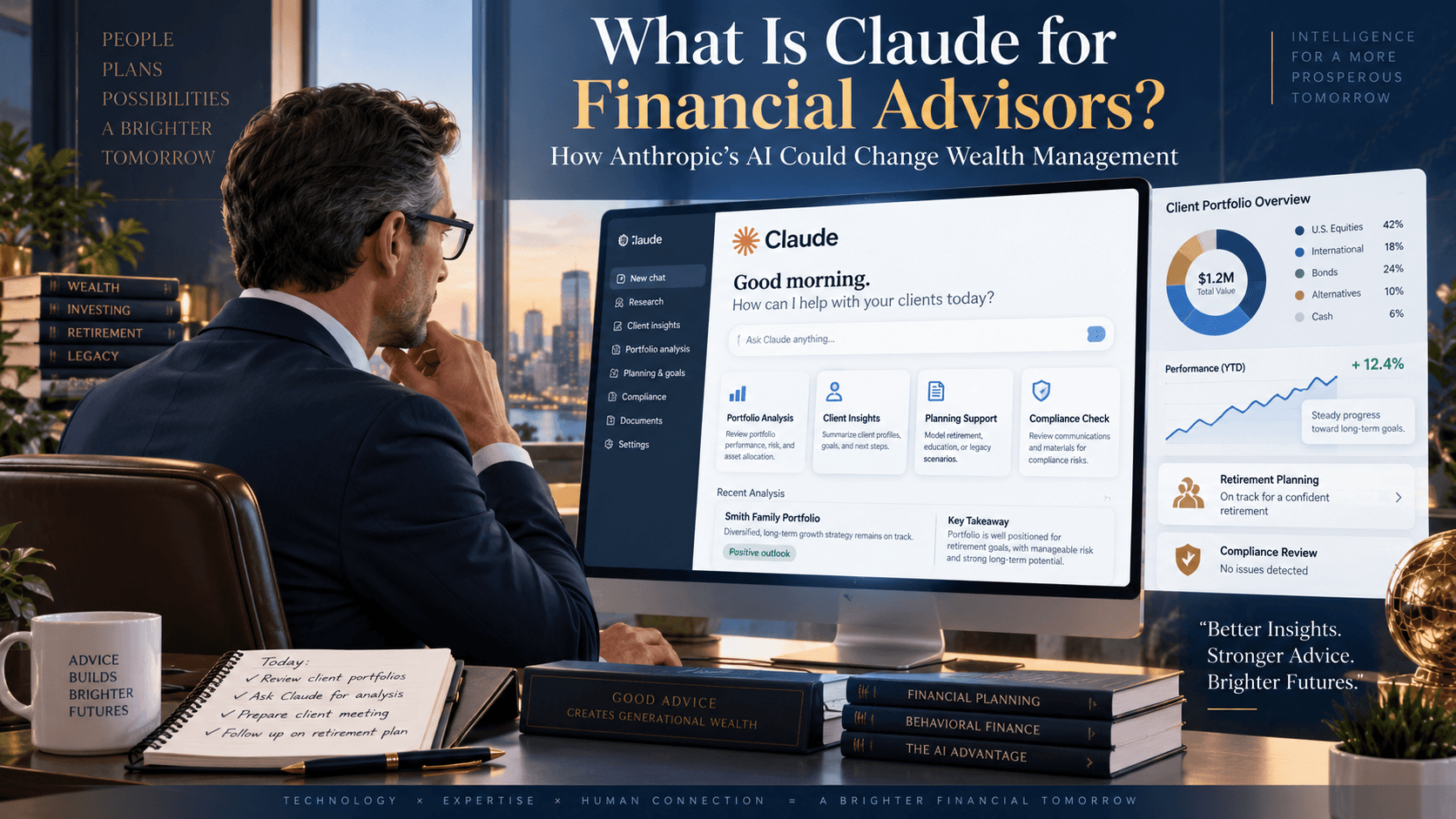
Anthropic is taking Claude deeper into one of the most heavily regulated areas of professional services: wealth management. On September 14, 2026, the company launched Claude for Financial Advisors, a suite of connectors and workflow skills that links Claude with the custodians, portfolio platforms, CRMs, planning tools and investment-data services used by financial advisors. The goal is not to turn Claude into an autonomous stock picker. Instead, Anthropic wants the AI to handle more of the research, preparation and documentation surrounding financial advice so human advisors can spend more time with clients.
For investors, the significance is therefore indirect but potentially substantial. A financial advisor who can retrieve portfolio information faster, review a household’s entire financial picture more efficiently and identify planning issues earlier may be able to deliver more responsive and personalized service. Yet the same technology introduces questions around accuracy, privacy, compliance and automation bias. Claude for Financial Advisors offers a useful glimpse of how AI could reshape wealth management — not necessarily by replacing advisors, but by changing what advisors spend their time doing.
What Is Claude for Financial Advisors?
Claude for Financial Advisors is a specialized collection of financial-data connectors and advisor-focused workflow skills built around Anthropic’s Claude AI. It is designed for registered investment advisers, wealth managers and other financial professionals rather than as a consumer robo-advisor. Anthropic says the product focuses on work that surrounds client relationships: gathering information, preparing for meetings, reviewing portfolios, drafting follow-up material and documenting advisor activity. According to research cited by Anthropic, a typical advisory practice spends only about one-sixth of its time in actual client meetings, with much of the remainder devoted to preparation, planning and administrative work.
The product is already available through Claude’s plugin environment. Firms can connect selected systems during setup rather than moving their entire technology stack onto a new platform. That distinction is important: Anthropic is not trying to replace every portfolio-management or CRM system advisors already use. It is positioning Claude as an intelligent layer that can work across those systems and bring relevant information into one conversational workflow. For registered investment advisers, Anthropic recommends its Enterprise offering because it includes audit logs that can support recordkeeping requirements.
How Does Claude for Financial Advisors Work?
Traditional wealth-management technology is highly fragmented. A single advisor may use one system for custody, another for portfolio accounting, a CRM for client history, separate tools for alternative investments, financial planning software, estate documents, tax analysis and email. Answering what sounds like a simple question about a client can therefore require logging into several platforms and reconciling information manually. Claude for Financial Advisors attempts to sit above that stack and let the advisor query authorized data using natural language.
The integrations are permission-aware rather than a single universal database. For example, Charles Schwab can expose custodial information such as balances, positions, transactions, cost basis, alerts and money-movement status; Addepar can provide governed portfolio intelligence; iCapital can surface alternative-investment holdings; Wealthbox can provide CRM context; and Wealth.com can bring estate and tax information into the workflow. Claude can then combine the information a firm has authorized it to access while the underlying specialist
platforms remain the systems of record.
| Connected System | Examples of Data Claude Can Use | Potential Advisor Use |
| Charles Schwab | Balances, positions, transactions, cost basis and alerts | Client reviews and account monitoring |
| Addepar | Governed public and private portfolio data | Portfolio analysis and complex household questions |
| iCapital | Alternative holdings, NAV, commitments and capital activity | Alternatives review |
| Wealthbox / Zocks | CRM records, meeting history and client context | Meeting preparation and follow-up |
| Wealth.com | Estate documents, tax information and balance-sheet context | Estate and tax planning |
The result is less about asking a generic chatbot, “What should this client invest in?” and more about asking, “What has changed in this household since our last review, and what should I examine before the meeting?” That distinction is central to Anthropic’s strategy.
What Can Financial Advisors Do With Claude?
Portfolio Reviews and Client Meetings
One of the most immediate use cases is reducing the amount of manual work involved in preparing for a client review. Anthropic has built skills around situations such as meeting preparation, portfolio drift and alternative-investment summaries. An advisor could use Claude to assemble account information, relevant client history and portfolio changes into a single briefing before a meeting instead of reviewing each system separately. Addepar’s new Claude connector is particularly notable because it allows users to ask complex portfolio questions in plain language while grounding answers in Addepar’s governed data and permission model. Addepar stresses that the initial integration is focused on information retrieval and analysis; it does not execute transactions or alter portfolio data.
Estate and Tax Planning
Estate and tax planning show why specialized financial integrations may matter more than simply giving an AI model more general knowledge. Wealth.com, Anthropic’s launch partner for estate and tax planning, allows advisors to work with executed estate documents and quantitative tax tools from within Claude. Its document system can return page-level citations when answering questions about trusts and other estate documents, while its tax calculations use a deterministic engine based on published federal and state tax data.
The larger opportunity is therefore not just faster summarization. It is the possibility of letting an AI reason across a client’s actual portfolio, planning documents and account structure while preserving the specialist systems that provide the underlying data and calculations. For complex households with public securities, private investments, trusts, retirement accounts and tax considerations, that could substantially reduce the time spent assembling a complete financial picture.
How Could Claude Help Investors?
The most likely benefit for investors is better advisor capacity rather than direct AI-generated investment advice. If meeting preparation that previously took hours can be compressed into a much shorter workflow, advisors may have more time for portfolio discussions, behavioral coaching and planning decisions. Claude could also make it easier to detect issues that might otherwise wait until an annual review — such as an asset allocation drifting away from its target, a mismatch between beneficiary designations and an estate plan, or an alternative-investment commitment that changes a household’s liquidity needs.
The second potential benefit is personalization at scale. Wealth management becomes difficult as client information spreads across multiple systems and grows more complex over time. AI can help consolidate that context before the advisor makes a decision. However, faster information processing should not be confused with guaranteed investment performance. Claude cannot make incomplete records complete, and sophisticated analysis can still be wrong if the model misinterprets information or important context is missing.
That distinction is especially important because Anthropic explicitly keeps regulated decisions in human hands. Investment recommendations, client communications, compliance determinations and other regulated activities remain subject to human review and approval. Claude can prepare a brief or draft an analysis; the advisor remains responsible for deciding what should actually be communicated or acted upon.
Why Do the Financial Integrations Matter?
The long list of partners may initially look like ordinary enterprise-software marketing, but it reveals something important about the future of financial AI. A powerful language model alone does not know the current cost basis of a client’s position, the provisions inside an executed trust, the latest private-fund capital call or the restrictions attached to a specific account. To be useful in professional wealth management, AI needs access to trusted data, validated calculations, permissions and context.
Claude for Financial Advisors therefore integrates with companies including BlackRock, Charles Schwab, Addepar, Envestnet, iCapital, Orion, Wealthbox, Wealth.com and Zocks. Existing Claude connectors also include platforms such as Microsoft 365, Salesforce, DocuSign, FactSet, S&P Global and Morningstar. BlackRock, for example, brings portfolio-construction resources and institutional analytics through Advisor Center, while Schwab provides custodial account data.
This suggests that the competitive advantage in financial AI may eventually depend as much on which high-quality systems an AI can access securely as on which company has the most capable foundation model. In regulated finance, the best answer is not merely one that sounds intelligent; it must also be based on the right data, delivered to the right user and capable of being reviewed.
Anthropic and OpenAI Are Competing for Wall Street
Claude for Financial Advisors arrives in the middle of a broader race to embed generative AI inside professional finance. Just four days before Anthropic’s September 14 launch, OpenAI introduced ChatGPT for Financial Services, with an initial focus on investment banking and equity research. Reuters reported that OpenAI developed the offering with firms including Morgan Stanley and Evercore and integrated financial information from providers such as LSEG, PitchBook and Daloopa.
The two launches show how frontier AI companies are moving away from a one-size-fits-all chatbot strategy toward products designed for specific regulated workflows.
| Platform | Current Emphasis | Typical Workflows |
| Claude for Financial Advisors | Wealth management and financial advice | Client preparation, portfolio reviews, planning, documentation and compliance workflows |
| ChatGPT for Financial Services | Investment banking and equity research | Research, financial modeling, deal materials and investment-analysis workflows |
| iCapital | Alternative holdings, NAV, commitments and capital activity | Alternatives review |
| Wealthbox / Zocks | CRM records, meeting history and client context | Meeting preparation and follow-up |
| Wealth.com | Estate documents, tax information and balance-sheet context | Estate and tax planning |
The boundaries will almost certainly overlap over time, but the strategic direction is already clear. The next phase of competition may be less about which chatbot gives the most impressive standalone answer and more about which AI becomes deeply embedded in a financial institution’s existing data, governance and workflow systems.
What Are the Biggest Risks?
AI Can Still Be Wrong
Connecting Claude to authoritative financial data can reduce one important source of error, but it does not eliminate model risk. An AI may correctly retrieve a portfolio value and still draw the wrong inference from it, misunderstand the relationship between accounts or produce an explanation that omits an important constraint. In wealth management, the difference between retrieving the right facts and making the right judgment is substantial.
Incomplete Data Can Create Misleading Conclusions
The model can only analyze what the connected systems contain. If a client amended a trust but the updated document was never uploaded, transferred assets to an outside account or changed a beneficiary in a system the advisor cannot access, the AI may form an incomplete picture. Source citations can help an advisor verify what an answer is based on, but they cannot reveal information that was never entered into the system.
Privacy and Compliance Raise the Stakes
Financial-advisor systems contain some of a household’s most sensitive information: asset values, tax records, family relationships, estate plans and private-investment details. Firms therefore need strict permission controls, governance policies and auditability. Anthropic’s compliance skill can flag client-facing content for additional review based on user-configured criteria, while Enterprise audit logs are intended to support recordkeeping. These controls reduce operational risk, but they do not transfer legal responsibility from the firm to the AI provider.
Will Claude Replace Financial Advisors?
The current product is designed around the opposite assumption: that the advisor remains responsible for the relationship and the final decision. The activities most exposed to automation are the ones that already consume large amounts of time without necessarily requiring deep human judgment — searching records, summarizing documents, reconciling information, drafting notes and preparing meeting materials. Those tasks matter, but they are different from understanding how a client reacts during a market crash, navigating a disagreement between family members or deciding whether a technically optimal financial strategy is appropriate for a particular person.
This makes AI-augmented advisors a more plausible near-term outcome than fully autonomous financial advisors. A professional who can retrieve a complete household picture in minutes may be able to spend more of the meeting discussing goals, uncertainty and trade-offs rather than checking numbers. The competitive pressure on the industry may therefore be less “AI will replace financial advisors” and more “advisors who use AI effectively may operate with a productivity advantage over those who do not.”
Anthropic’s product design reinforces that interpretation. Its tools prepare analysis and stage administrative actions, while client communications, recommendations and compliance conclusions remain subject to review.
Could AI Make Wealth Management More Accessible?
One of the more interesting implications is whether AI could help advisory firms serve clients who are currently uneconomical under traditional service models. Anthropic cites the 2026 Retirement Confidence Survey from the Employee Benefit Research Institute, which found that 43% of workers said they did not know where to go for good financial or retirement-planning advice. The same survey found that 48% of workers believed technology or AI would help manage their finances in the future.
If AI reduces the amount of preparation and administration required per household, an advisor may theoretically be able to serve more clients without proportionally increasing headcount. Anthropic explicitly argues that time saved on paperwork could be redirected toward existing clients or households a practice previously lacked capacity to serve.
That does not guarantee that advisory fees will fall or that personalized advice will suddenly become universally available. Firms may use productivity gains to increase margins rather than expand access, and complex regulatory requirements still impose costs. But AI could lower one of the structural barriers to broader advice: the large amount of professional time required to gather and organize information before an advisor can even begin providing guidance.
What Claude Could Mean for the Future of Wealth Management
The longer-term shift may be from manual information gathering to continuous financial intelligence. Historically, advisors have used separate tools and periodically assembled the data required for a review. Claude for Financial Advisors points toward a model in which an AI layer can query multiple authorized systems, surface changes and prepare an integrated view whenever the advisor needs it. Over time, the advisor’s work could shift away from locating information and toward interpreting what the information means.
That evolution could also change what clients expect. If AI makes it possible to review financial circumstances more frequently, the once-a-year portfolio meeting may become less central. Advisors could potentially respond more quickly to changes in taxes, cash flow, portfolio positioning, estate planning or major life events while reserving the human relationship for judgment and decision-making.
The firms that gain the most may not be those that automate every possible task. Wealth management is built on trust, and excessive automation could undermine the very relationship clients are paying for. The more durable model may be one in which AI handles information-intensive work while human professionals remain accountable for the decisions where context, ethics and judgment matter most.
🔥 Beyond the Headlines: What KuCoin 5.0 Means for You
Market news moves fast — but where you act on it matters just as much. This October, KuCoin launches KuCoin 5.0, transforming KuCoin into a rebuilt platform. Here's what actually changes for you:
-
One account for everything. Older platforms split your money across separate "spot," "margin," and "futures" accounts and expected you to understand why. KuCoin 5.0's unified account removes that entirely — deposit once, and everything is simply there.
-
Stocks, indices, and commodities. KuCoin 5.0 expands beyond crypto into global markets. When crypto chops sideways and equities rally (or the reverse), you rotate in minutes instead of opening a brokerage account and waiting days for fiat rails.
-
Real-world assets (RWA). Tokenized exposure to traditional assets like commodities, right inside your crypto account. One of the fastest-growing segments in global finance is no longer reserved for institutions — you access it from the same balance you trade with.
-
Earn while you learn. Not ready to trade? KCUSD lets your stablecoins earn daily, auto-compounding interest. The lowest-stress way to put your idle deposit to work for 4% yield.
-
An AI assistant in plain language. Ask questions, get market context, understand what you're looking at — built into the platform, no jargon required.
-
An app that doesn't overwhelm. Faster, cleaner, and consistent — intuitive from the first tap, not after a tutorial.
-
Safety you can check, not just trust. A MiCAR-licensed EU entity, Proof of Reserves you can verify yourself, and internationally certified security (SOC 2 Type II, ISO 27001:2022).
Create your account in minutes — and start on the platform built for where crypto is going, not where it's been.
Conclusion
Claude for Financial Advisors is not an AI portfolio manager that replaces the person sitting across from an investor. It is better understood as an attempt to make Claude an intelligent layer across the software, portfolio data and planning systems that financial advisors already use. By reducing time spent on meeting preparation, data retrieval, documentation and routine analysis, Anthropic hopes advisors can devote more attention to clients while serving increasingly complex financial needs.
Whether that ultimately improves wealth management will depend on more than AI capability. Firms still need accurate data, strong access controls, effective compliance processes and professionals willing to challenge AI-generated conclusions. If those safeguards keep pace, the biggest change may not be that investors start taking financial advice from a chatbot. It may be that their human advisors increasingly rely on AI behind the scenes — and clients begin expecting faster, more informed and more personalized advice as a result.
FAQs About Claude for Financial Advisors
Is Claude for Financial Advisors Available Now?
Yes. Anthropic launched Claude for Financial Advisors on September 14, 2026. Eligible financial firms can access the advisor-focused plugin and connect supported tools through Claude’s plugin environment.
Which Claude Plan Is Recommended for RIAs?
Anthropic recommends Claude Enterprise for registered investment advisers. Enterprise includes audit logs and administrative controls that can help firms support recordkeeping, governance and compliance requirements.
What Is MCP in Claude for Financial Advisors?
MCP stands for Model Context Protocol. It is a standard that allows Claude to connect with approved external tools and data sources while respecting access permissions. Financial platforms such as Addepar and Wealth.com use MCP-based integrations to bring their data and capabilities into Claude workflows.
Can Claude Show Where an Estate-Planning Answer Came From?
Yes, when the connected platform supports source citations. Wealth.com, for example, says its document-intelligence system can provide page-level references to estate documents, allowing advisors to verify the source behind Claude’s response.
Can Claude Automatically Trade a Client’s Portfolio Through Addepar?
Not through the current Addepar integration. The initial connector is designed for portfolio analysis and information retrieval, not for executing trades or changing portfolio data. Any investment action remains subject to the firm’s normal trading and approval processes.
Disclaimer: This article is for informational purposes only and does not constitute investment advice. Crypto assets can be highly volatile, and market conditions, token liquidity and project developments may change rapidly. Readers should conduct their own research and assess their risk tolerance before making financial decisions.