

Cashmere Unveils Mountain and CSM Token Roadmap as Goat LP Expands
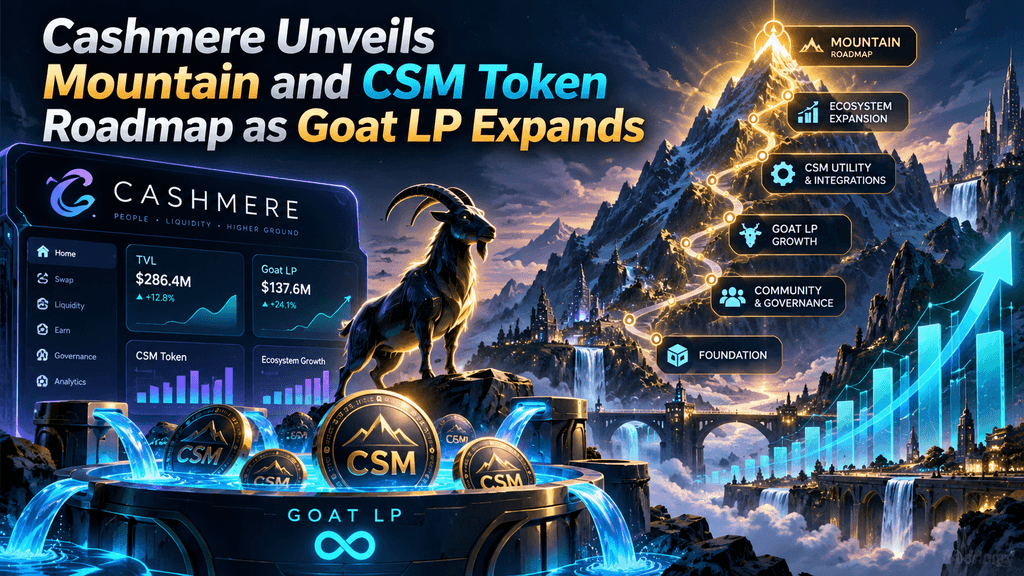
Cashmere Labs Outlines Expansion of Its Autonomous Monetary Infrastructure
Cashmere Labs has articulated a comprehensive and strategic expansion of its Autonomous Monetary Infrastructure, transitioning from the current capabilities of cross-chain stablecoin mobility into a more sophisticated suite of automated liquidity tools, a novel issuance system, and the introduction of a native token. On the significant date of October 19, 2026, the dedicated team published an extensive and detailed roadmap that prioritizes the opening of Goat LP to all users, the launch of the innovative Mountain product on the Robinhood Chain, and the introduction of the Cashmere ($CSM) token. These pivotal steps are positioned alongside the already established Cashmere Bridge, which currently supports zero-slippage stablecoin transfers across an impressive 16 different chains, as well as the Goat Street collection, which consists of 6,666 unique NFTs.
The announcement strongly emphasizes that, as of now, no official CSM token exists and that all described plans remain subject to change, pending further documentation and thorough audits, and confirmations through official channels. The central development focuses on Mountain as the primary vehicle for the ongoing issuance of CSM through Barns, along with the optional permanent binding of Goat Street NFTs. This innovative approach creates direct utility links across Cashmere’s existing products while simultaneously preparing for an anticipated airdrop and eventual launchpad. This carefully structured framework aims to deepen user participation on the Robinhood Chain without altering the fundamental non-custodial design principles that have characterized prior tools.
Goat LP Moves From Internal Testing to Public Automated Liquidity Tools
Goat LP is now internally complete and scheduled to open to every user. It operates exclusively on Robinhood Chain (chain ID 4663) and manages Uniswap v3 and v4 positions while leaving each position as a standard Uniswap NFT inside the user’s own wallet. The product supplies analytics covering pools, positions, wallets, PnL relative to holding, fees, gas, and rewards at no cost. Manual tools allow creation, deposits, withdrawals, collection, range moves, and compounding, including one-token zaps. Automation covers auto-compound, auto-range, and auto-exit executed by a project-run keeper within user-set limits. Gas for automated actions is paid by the protocol. Fees are explicit: auto-compound takes 10 percent of fees added back into the position; auto-range charges 0.15 percent of the amount moved per adjustment; auto-exit charges 0.15 percent once upon closure. Contracts are non-upgradeable, with a Cashmere-controlled Safe holding ownership rights that include a 24-hour public delay for adding keepers, pairs, or price sources. The team labels Goat LP experimental software and advises starting with small amounts while reviewing risks before committing larger capital.
These features position Goat LP as a practical extension of Cashmere’s focus on reducing operational friction for liquidity providers on Robinhood Chain. Because positions never leave the user’s wallet and every manual transaction is decoded and checked in the app before signing, the design preserves self-custody while automating repetitive tasks such as fee compounding and range adjustments. The fee structure is transparent and displayed before confirmation, and automation permissions can be granted per position or across all positions for continuous auto-range. Documentation at docs.cashmere.exchange details every contract address, role, and fee calculation, allowing users to verify behavior on-chain. This public release forms the immediate next step before Mountain, giving the community a live tool that can later interact with broader ecosystem incentives once $CSM issuance begins.
Mountain Introduces Barns as the Core Issuance Mechanism for CSM
Mountain will launch at app.cashmere.exchange on Robinhood Chain after code completion, testing, and an external audit. The system revolves around Barns, soulbound NFTs that begin with one stall and can expand to a maximum of ten. Additional stalls are obtained through Stall Permits purchased with CSM or by allocating Goat Street NFTs. Once issuance activates, every eligible stall receives a continuous share of newly issued CSM every second. The total issuance is distributed proportionally across all participating stalls, so growth in the number of stalls and bound goats increases overall participation while diluting each individual share. Barns therefore function as the foundational layer of Mountain’s issuance engine rather than a passive collectible.
This design creates a progressive commitment structure. Users decide how many stalls to operate and whether to allocate Goat Street assets, directly linking capital and existing holdings to ongoing token distribution. Because Barns are soulbound, they cannot be transferred once created, aligning long-term participation with issuance rights. The continuous per-second distribution model differs from discrete reward epochs, providing a steady stream that scales with system activity. Full mechanical details, including exact permissions and risk disclosures, will appear in documentation before the Barn sale, ensuring participants can evaluate the system before committing ETH or NFTs.
Goat Street NFTs Gain Permanent Binding Utility Inside Mountain
Goat Street NFTs receive a new functional role under Mountain. A holder may permanently bind a goat to the system, after which the NFT earns its own share of the $CSM issuance and may occupy a stall inside a Barn. Binding is irreversible: once completed, the goat cannot be sold or returned. The process remains optional, allowing owners to retain liquidity or secondary-market optionality if they prefer. This connection converts the existing 6,666-piece collection into active mining licenses within the new issuance framework while preserving the original revenue-sharing mechanics of Goat Street itself.
Permanent binding therefore represents a deliberate trade-off between tradability and long-term issuance participation. Holders who value secondary liquidity can leave goats unbound; those seeking direct $CSM exposure accept the permanence. Because the collection already distributes real revenue from marketplace royalties and entry fees into user-chosen assets (ETH or tokenized equities native to Robinhood Chain), the addition of Mountain issuance expands rather than replaces existing utility. Weight calculations based on rarity multipliers (1.00× to 7.20×) and tenure levels (up to 3.00× after 150 days) remain independent of the new binding path, so both revenue claims and potential issuance shares can coexist for unbound goats.
Four-Stage Launch Sequence for Mountain and CSM
Mountain’s rollout follows a defined sequence. Stage 1 opens Barn applications to anyone, with priority for Goat Street holders and early Cashmere Goat NFT holders in guaranteed and whitelist categories. Stage 2 distributes 1,000 founding Barns through reserved allocation at 0.125 ETH for approved addresses, whitelist first-come-first-served at 0.25 ETH, and a public auction that starts at 1.5 ETH and declines to 0.25 ETH. Public buyers pay the final clearing price, with any difference refunded manually by the team. The exact sale date will be announced separately. Stage 3 opens CSM trading on the official Uniswap v4 ETH/CSM pool; users must verify the contract address exclusively through official channels because fake tokens already circulate.
An earlier Anvil deployment is cancelled due to technical incompatibility with Mountain. Stage 4 activates issuance after the launch window, at which point Barns and bound goats begin receiving $CSM. This staged approach allows controlled distribution of the initial Barn supply while establishing a verified trading venue before continuous issuance starts. Priority mechanisms reward existing community members without excluding new participants. The public auction’s declining-price structure and refund mechanism reduce the risk of overpaying relative to the final clearing level. Cancellation of the prior Anvil deployment removes compatibility and potential fee-extraction risks, concentrating liquidity on the official Uniswap v4 pool. Issuance remains inactive until explicitly enabled, preventing premature distribution.
CSM Tokenomics Center on Controlled Supply and Ongoing Issuance
The planned maximum supply of $CSM is 666,000,000 tokens, reducible only through burns. Allocation is divided into three categories: 66.6 million (10 percent) reserved as Base Camp for protocol liquidity in the official pool; 166.5 million (25 percent) allocated to the Team and Treasury Safe under vesting; and 432.9 million (65 percent) distributed through Mountain’s Barn and Goat issuance mechanism. The 65 percent portion is not pre-minted; tokens are issued only as the system operates. A planned base issuance rate (currently redacted) is multiplied by a Season multiplier that ranges from 0.20 to 1.25 and begins at 1.00. The base rate itself can only be lowered. At launch, the pool tax is planned to start at 90 percent and decline during the first hour of trading.
These parameters emphasize gradual distribution over quick circulation. The majority of supply enters the market only through active participation in Mountain, tying token availability to system usage rather than fixed unlock schedules. Vesting on the team and treasury allocation further spaces out potential selling pressure. The one-way reduction of the base issuance rate and the adjustable Season multiplier provide levers for long-term calibration once live data is available. Launch tax mechanics aim to moderate early volatility, though exact parameters and risk disclosures will be published before trading begins. Users are reminded that the token address must be confirmed solely via official channels.
Airdrop Targeting Specific Participant Groups With Clear Exclusions
Beyond Mountain, Cashmere plans an airdrop for three groups: Barn Raising participants, Goat Street activators, and Cashmere early adopters. Wallets that have listed Goat Street NFTs for sale on OpenSea at the relevant snapshot time will be excluded. Eligibility criteria, allocation formulas, and the snapshot process will be detailed in a later announcement. This structure rewards demonstrated commitment through Barn purchases, activation of existing goats, and prior platform engagement while filtering out pure listing activity.
The exclusion of currently listed goats creates a practical incentive for holders to delist if they wish to remain eligible, reinforcing a preference for active rather than speculative positioning. Because the airdrop sits after the Barn sale and issuance activation, participants can evaluate the full system before relying on any future allocation. Exact numbers and claim mechanics remain pending, consistent with the team’s stated approach of publishing complete rules before key events.
Integration of Existing Bridge and Goat Street Into the Expanded Stack
Cashmere Bridge continues to deliver zero-slippage stablecoin transfers across its current set of 16 chains, providing the mobility layer that underpins the broader ecosystem. Goat Street already distributes real on-chain revenue, marketplace royalties plus half of entry fees, into ETH or native Robinhood Chain tokenized equities according to each holder’s chosen allocation and weight. Mountain and Goat LP add issuance and automated liquidity management without displacing these functions. Together, the products form a connected set of tools rather than isolated features, all centered on Robinhood Chain, while the bridge maintains multi-chain reach.
This modular construction allows users to engage at different levels: pure bridging, revenue-sharing NFT holding, automated LP management, or full Mountain participation. Because each component retains its non-custodial character and publishes contract addresses and mechanics, participants can verify interactions independently. The shared goal of expanding utility on Robinhood Chain provides coherence without forcing every user into every product.
Security and Documentation Commitments Before Key Milestones
Mountain code has been written and tested; an external audit is required before launch. Goat LP contracts are non-upgradeable and controlled by a Safe with delayed public actions for sensitive changes. Full Mountain rules, contract mechanics, Treasury Safe permissions, tax controls, issuance parameters, and permanent-binding implications will be published at docs.cashmere.exchange prior to the Barn sale. Users are instructed to treat any unofficial token labeled Cashmere or CSM as potentially fraudulent and to rely exclusively on official X announcements and documentation for addresses and dates.
These commitments reduce information asymmetry at critical moments. Publishing comprehensive documentation before the sale allows prospective Barn buyers to review risks, permissions, and economic parameters in advance. The non-upgradeable design of Goat LP and the planned audit for Mountain align with a preference for verifiable, immutable core logic. Ongoing public communication via the official @CashmereLabs account remains the primary source for updates, minimizing reliance on secondary channels.
Cashmere’s Long-Term Development Plans Beyond Initial Releases
After Mountain and the initial airdrop, the team intends to develop agentic LP farming and a Cashmere launchpad. These additions would extend the ecosystem past bridging, liquidity automation, and issuance into more advanced yield strategies and project onboarding. Exact timelines and mechanics remain under development and will be detailed as progress occurs. The overall direction continues to emphasize practical utility for users already interacting with Cashmere products on Robinhood Chain and across the bridge network.
Agentic farming would logically build on the automation already present in Goat LP, while a launchpad could create additional demand and fee flows that potentially feed back into existing revenue-sharing mechanisms. Because these items sit further along the roadmap, the current focus remains on the near-term sequence of Goat LP public access, Barn distribution, token launch, and issuance activation.
Practical Considerations for Participants Evaluating Involvement
Users interested in Goat LP can begin with small positions once the public release occurs, reviewing fee displays and risk documentation before scaling. Prospective Barn participants should monitor official channels for the application window and sale date, noting priority pathways for existing Goat holders. Holders of Goat Street NFTs must weigh the permanent nature of binding against continued secondary-market flexibility and existing revenue claims. All parties should verify every contract address and announcement solely through official sources, given the presence of fake tokens.
Documentation updates at docs.cashmere.exchange will supply the definitive mechanical and risk details ahead of major events. Participation decisions ultimately rest on individual assessment of the published parameters, audit results, and live system behavior once issuance begins. The staged rollout provides multiple entry points with increasing levels of commitment, allowing users to engage proportionally to their risk tolerance and existing holdings.
Official Communication Channels and Verification Practices
All important dates, eligibility lists, launch announcements, and the sole official $CSM contract address will be prominently featured first on the @CashmereLabs X account. Comprehensive documentation is available at docs.cashmere.exchange, which will host the complete and detailed Mountain ruleset before the highly anticipated Barn sale. It is crucial to disregard any token that uses the Cashmere or CSM name unless it has been confirmed through these official channels.
This centralized verification approach has been specifically designed to protect users from the numerous fake tokens that have already been observed in the market. Maintaining a consistent reliance on primary sources remains the most reliable and effective method for tracking progress and avoiding incorrect contract interactions as the roadmap advances from Goat LP public access through Mountain and beyond. By doing so, users can ensure they are making informed decisions based on accurate and verified information.
🔥 Beyond the Headlines: What KuCoin 5.0 Means for You
Market news moves fast — but where you act on it matters just as much. This October, KuCoin launches KuCoin 5.0, transforming KuCoin into a rebuilt platform. Here's what actually changes for you:
-
One account for everything. Older platforms split your money across separate "spot," "margin," and "futures" accounts and expected you to understand why. KuCoin 5.0's unified account removes that entirely — deposit once, and everything is simply there (only available to VIPs for now).
-
Stocks, indices, and commodities. KuCoin 5.0 expands beyond crypto into global markets. When crypto chops sideways and equities rally (or the reverse), you rotate in minutes instead of opening a brokerage account and waiting days for fiat rails.
-
Real-world assets (RWA). Tokenized exposure to traditional assets like commodities, right inside your crypto account. One of the fastest-growing segments in global finance is no longer reserved for institutions — you access it from the same balance you trade with.
-
Earn while you learn. Not ready to trade? KCUSD lets your stablecoins earn daily, auto-compounding interest. The lowest-stress way to put your idle deposit to work for 4% yield.
-
An AI assistant in plain language. Ask questions, get market context, understand what you're looking at — built into the platform, no jargon required.
-
An app that doesn't overwhelm. Faster, cleaner, and consistent — intuitive from the first tap, not after a tutorial.
-
Safety you can check, not just trust. A MiCAR-licensed EU entity, Proof of Reserves you can verify yourself, and internationally certified security (SOC 2 Type II, ISO 27001:2022).
Create your account in minutes — and start on the platform built for where crypto is going, not where it's been.
FAQs
What is the current status of the Cashmere Bridge, and how many chains does it support?
The Cashmere Bridge is live and supports zero-slippage stablecoin transfers across 16 chains. It forms the mobility foundation of the ecosystem and continues to operate independently of the new Mountain and Goat LP products. Users can continue transferring native stablecoins without slippage while the additional tools expand participation options on Robinhood Chain.
How does Goat LP handle user positions and fees?
Goat LP leaves every Uniswap v3 or v4 position as a standard NFT inside the user’s wallet. Automation features (auto-compound, auto-range, and auto-exit) are executed by a keeper that pays gas, with fees of 10 percent of compounded fees or 0.15 percent of moved or exited amounts. The product is labeled experimental, and documentation provides full contract and fee details for verification before use.
What exactly is a Barn in the Mountain system?
A Barn is a soulbound NFT that starts with one stall and can expand to ten. Stalls receive proportional shares of newly issued CSM every second once issuance is activated. Additional stalls can be added via Stall Permits bought with CSM or by allocating Goat Street NFTs. Because Barns cannot be transferred, they represent a long-term commitment to the issuance mechanism.
Can Goat Street NFTs still be sold after binding to Mountain?
No. Binding is permanent and irreversible. Once a goat is bound, it cannot be sold or returned and instead receives its own share of $CSM issuance while potentially occupying a stall. Binding remains optional, so holders who prefer secondary-market liquidity can leave their goats unbound.
What are the planned allocation percentages for the CSM token?
The maximum supply is set at 666 million tokens. Ten percent (66.6 million) is reserved for protocol liquidity, 25 percent (166.5 million) is allocated to the Team and Treasury Safe under vesting, and 65 percent (432.9 million) is issued over time through Mountain’s Barn and Goat mechanism. The 65 percent portion is not pre-minted.
Who is eligible for the planned airdrop and who is excluded?
The airdrop targets Barn Raising participants, Goat Street activators, and Cashmere early adopters. Wallets that have listed Goat Street NFTs for sale on OpenSea at the relevant time will be excluded. Exact eligibility rules, allocations, and the snapshot process will be announced later through official channels.
Disclaimer: This content is for informational purposes only and does not constitute investment advice. Cryptocurrency investments carry risk. Please do your own research (DYOR).