

Bitcoin and the US Dollar: How DXY, Liquidity and Fed Policy Really Affect BTC?
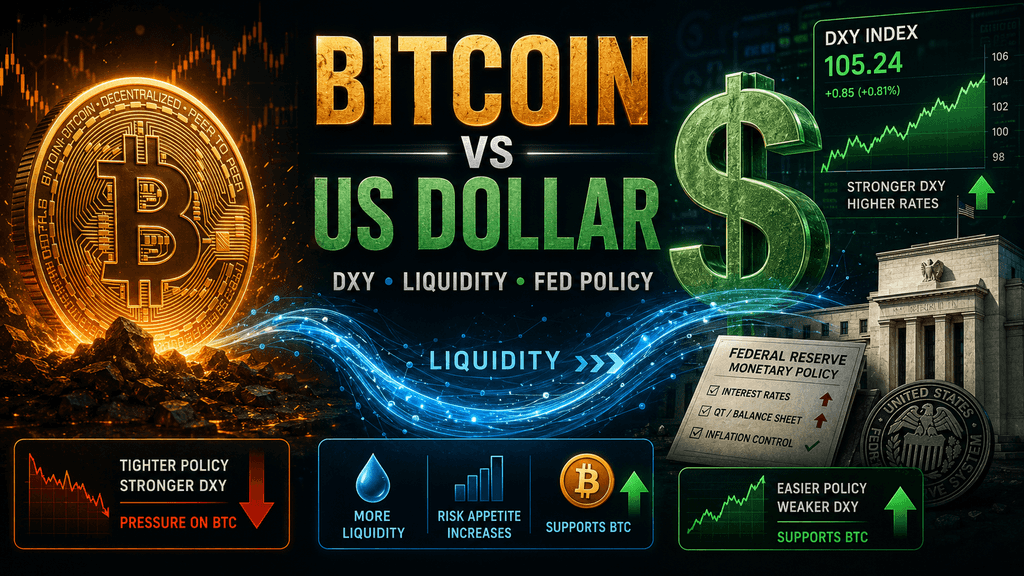
Bitcoin's relationship with the US dollar is often described as simple: when the dollar weakens, BTC rises, and when the dollar strengthens, Bitcoin comes under pressure. In reality, the connection is much more complex. DXY, Federal Reserve interest rates, real yields, M2 money supply and global liquidity can all influence Bitcoin, but none of these indicators works as a reliable standalone price signal. Bitcoin increasingly trades at the intersection of traditional macroeconomics and crypto-specific market forces, meaning institutional demand, ETF flows, leverage and investor positioning can sometimes matter more than movements in the dollar itself. That distinction has become especially important in August 2026. The US Dollar Index has moved close to a three-month low, monetary-policy expectations have shifted as investors assess weaker economic data, and changes in Treasury-market conditions have affected yields and financial liquidity. Yet Bitcoin has not always responded immediately or proportionally to those developments. Understanding how DXY affects Bitcoin, how Fed policy influences risk appetite and why global liquidity matters for BTC can therefore provide a more useful framework than relying on a simple inverse-correlation assumption.
How DXY and US Dollar Strength Affect Bitcoin Price
The US Dollar Index (DXY) is one of the most closely watched macro indicators for Bitcoin because it measures the dollar's strength against a basket of major currencies. In general, a stronger dollar can create a more difficult environment for BTC by tightening global financial conditions, increasing the relative appeal of dollar-denominated assets and reducing investors' willingness to hold higher-risk assets. A weaker dollar can have the opposite effect, especially when it comes alongside falling bond yields and improving liquidity. That relationship is visible again in August 2026. On August 20, DXY was around 98.94 and near a three-month low, after the US Treasury's decision to increase long-dated bond buybacks helped push Treasury yields lower and weakened the dollar. Bitcoin and other risk assets responded positively to the shift, although recent market history shows that DXY alone cannot reliably predict the direction of BTC.
Why a Stronger US Dollar Can Put Pressure on Bitcoin
A rising DXY often reflects tighter monetary conditions, stronger demand for US assets or expectations that American interest rates will remain higher for longer. These conditions can pressure Bitcoin in several ways. Higher US yields make cash and government bonds more competitive relative to non-yielding assets such as BTC, while a stronger dollar can reduce global risk appetite and make dollar-priced assets more expensive for investors using other currencies. The effect can become more pronounced when dollar strength is accompanied by rising real yields and restricted liquidity. The Federal Reserve's current policy remains an important part of this environment: at its July 29, 2026 meeting, the Fed kept the federal funds target range at 3.50% to 3.75%, while three policymakers preferred a quarter-point increase because inflation remained above the Fed's 2% objective. These competing forces help explain why Bitcoin traders increasingly monitor DXY together with Treasury yields, interest-rate expectations and broader financial conditions rather than treating the dollar index as an isolated signal.
Why a Falling DXY Does Not Always Mean Bitcoin Will Rise
Although Bitcoin and the US dollar have often moved in opposite directions, the DXY-Bitcoin correlation is neither fixed nor consistently strong. CME Group research found that cryptocurrencies had a negative correlation with the Bloomberg Dollar Index in 2022 and 2023 that occasionally reached roughly -0.4, but that relationship weakened toward zero during 2025 and early 2026. This means a falling dollar may create a more supportive macro backdrop without automatically producing a Bitcoin rally. Bitcoin can remain weak if spot demand is limited, leverage is being unwound, large holders are selling or investors are reacting to crypto-specific risks. In some periods, Bitcoin's relationship with technology equities and general risk sentiment has been more significant than its relationship with the dollar.
The latest August 2026 moves illustrate why this distinction matters. Earlier dollar weakness did not immediately translate into an equally strong Bitcoin advance, but the market reaction became more pronounced after the Treasury announced larger long-duration bond buybacks on August 19. Long-term Treasury yields fell by as much as about 10 basis points, DXY dropped sharply and Bitcoin rose alongside equities and gold. The episode suggests that investors were reacting not simply to a lower dollar index, but to the combination of falling yields, changing liquidity expectations and easier financial conditions. For Bitcoin analysis, DXY is therefore most useful when viewed together with real yields, Fed expectations, Treasury-market conditions and market liquidity indicators. A weaker dollar can support BTC, but the broader macro environment usually determines whether that support turns into sustained Bitcoin price momentum.
How Fed Interest Rates, M2 and Global Liquidity Influence BTC
Bitcoin's macro environment is shaped by more than changes in the US dollar. Federal Reserve interest rates, money-supply growth and global liquidity conditions influence how much capital is available for risk assets and how expensive it is for investors to obtain that capital. When financing conditions loosen, investors generally have greater capacity to allocate money toward equities, crypto and other higher-volatility assets. Tight monetary conditions can produce the opposite effect. In 2026, these signals have become particularly important because the Fed is balancing persistent inflation risks against signs of softer economic activity, while US M2 and international credit have continued to expand. The result is a mixed environment in which Bitcoin traders need to distinguish between changes in policy rates and broader changes in financial-system liquidity.
How Federal Reserve Interest Rates Affect Bitcoin Demand
The Fed funds rate affects Bitcoin primarily through the cost of capital and investor risk appetite. At its July 29, 2026 meeting, the Federal Reserve kept its target range at 3.50% to 3.75%, although three policymakers voted for a 25-basis-point increase as inflation remained above the central bank's 2% objective. Higher or longer-lasting interest rates can make Treasury securities, cash and other yield-bearing investments more attractive, raising the opportunity cost of holding Bitcoin, which does not produce an underlying interest payment. Conversely, expectations for lower rates can reduce borrowing costs and encourage investors to take more risk. The market response often begins before an actual Fed move, which is why BTC can react strongly to inflation reports, employment data and FOMC communication that changes expectations for the future path of rates. Fed policy therefore matters most through expected financial conditions, rather than through the headline rate decision alone.
Rising US M2 Adds Another Layer to the Bitcoin Liquidity Outlook
Money supply provides a broader perspective on the amount of liquid money circulating through the economy. The latest Federal Reserve data show that US M2 reached about $23.16 trillion in June 2026, up from roughly $23.06 trillion in May and $22.80 trillion in April. This continued expansion has attracted attention from Bitcoin investors because periods of rising money supply can eventually increase the pool of capital available for financial assets. However, M2 should not be treated as a direct Bitcoin price signal. New money may remain in bank deposits, flow into bonds and equities or support consumption rather than immediately entering crypto markets. The timing can also vary substantially between market cycles. For SEO and market analysis, the more useful question is therefore not simply whether M2 is rising, but whether M2 growth is occurring alongside easier credit conditions, improving investor confidence and stronger demand for BTC.
Global Liquidity Is Broader Than US Money Supply Alone
Bitcoin trades continuously across global markets, so global liquidity can matter as much as US monetary conditions. The Bank for International Settlements defines global liquidity around the ease of financing in international markets, including bank lending and bond-market credit. Its latest release, published July 31, 2026 and covering the first quarter, showed that cross-border bank credit remained strong, while foreign-currency credit denominated in US dollars grew 7.3% year over year. Dollar-denominated foreign-currency credit to borrowers outside the United States reached approximately $14.7 trillion, while overall cross-border bank claims expanded strongly during the quarter. These figures do not mean that a fixed portion of global credit will flow into Bitcoin, but they help show whether international financing conditions are expanding or contracting. When global credit, money supply and market liquidity improve together, BTC can benefit from a larger pool of capital willing to move into risk assets; when liquidity contracts, Bitcoin may face pressure even if individual macro indicators appear supportive.
Why Bitcoin Sometimes Ignores a Falling Dollar and Easier Financial Conditions
A weaker US dollar and improving financial conditions can create a more supportive environment for Bitcoin, but they do not guarantee an immediate BTC rally. Bitcoin's short-term price is determined by the balance between new demand and available supply, and crypto-specific forces can temporarily overpower favorable macro signals. This became particularly clear in August 2026. On August 17, the dollar weakened as softer US economic data reduced expectations for another near-term Federal Reserve rate increase, yet Bitcoin's response remained comparatively restrained. Two days later, the reaction became much stronger after the US Treasury announced larger long-duration bond buybacks, sending Treasury yields lower, pushing DXY toward a three-month low and lifting Bitcoin alongside equities and gold. The contrast shows why traders need to look beyond the direction of the dollar and ask whether easier financial conditions are actually creating fresh demand for BTC.
Weak Bitcoin ETF and Corporate Treasury Demand Can Override Macro Tailwinds
One reason Bitcoin can ignore a falling DXY is that its largest sources of marginal demand may be weakening at the same time. NYDIG's July 10, 2026 market review reported approximately $4.9 billion in net outflows from US spot Bitcoin ETFs during Q2 2026, while some digital asset treasury companies slowed the pace of accumulation or faced greater pressure to preserve liquidity. That marked a significant shift from parts of 2025, when ETFs and corporate buyers regularly absorbed large amounts of available Bitcoin and helped tighten market supply. NYDIG also reported that Bitcoin declined 13.4% during Q2 2026 even as technology stocks rallied, reinforcing the idea that BTC was being driven by crypto-specific demand conditions rather than macro sentiment alone.
The same principle applies when the dollar weakens. A softer DXY may improve the broader backdrop for risk assets, but Bitcoin still needs buyers willing to absorb coins being sold by long-term holders, funds, miners or treasury companies. If ETF creations remain weak, stablecoin inflows slow and corporate buying does not return, liquidity can enter financial markets without flowing meaningfully into BTC. In that environment, equities, gold or bonds may capture a larger share of new capital. This is why Bitcoin ETF flows, treasury accumulation, exchange balances and spot-market demand can sometimes be more important for short-term BTC performance than DXY alone.
Leverage, Real Yields and Market Positioning Can Delay a Bitcoin Recovery
Derivatives positioning can also prevent easier macro conditions from translating directly into a stronger Bitcoin price. NYDIG noted in July 2026 that leverage was rebuilding while underlying spot demand remained relatively weak, with positive funding rates and rising open interest appearing without equally strong confirmation from ETF or stablecoin inflows. That structure can leave BTC vulnerable to liquidation-driven volatility because leveraged traders may push prices higher before durable cash-market demand returns. Easier financial conditions can also be uneven: the dollar may fall while real yields remain elevated, Treasury borrowing costs stay high or investors prefer equities and gold. The August 19, 2026 Treasury buyback announcement produced a more favorable combination because long-duration yields fell sharply while the dollar weakened and liquidity expectations improved. Bitcoin's stronger response illustrates that BTC is generally more likely to benefit when falling yields, improving liquidity, healthier leverage and renewed spot demand occur at the same time.
Conclusion
Bitcoin's relationship with the US dollar is best understood as part of a much broader macro and liquidity framework. A falling DXY can support BTC, but it does not automatically create a Bitcoin rally, just as a stronger dollar does not guarantee Bitcoin will decline. Federal Reserve rate expectations, real yields, M2 growth, global credit conditions and overall financial liquidity can all influence the amount of capital available for risk assets, but Bitcoin-specific factors determine how much of that capital actually reaches the crypto market.
The August 2026 market environment shows why this distinction matters. Dollar weakness and improving financial conditions became more supportive for Bitcoin when they were accompanied by lower yields and stronger liquidity expectations, yet ETF flows, corporate treasury activity, leverage and spot demand continued to affect the strength of BTC's response. For investors following the Bitcoin-DXY correlation, the most useful approach is therefore to combine macro indicators with crypto-market data rather than relying on a single signal. The direction of DXY matters, but the broader interaction between Fed policy, global liquidity and real Bitcoin demand is more important for understanding whether a macro shift can develop into a sustained BTC trend.
FAQs
What is the US Dollar Index (DXY) and why do Bitcoin traders watch it?
The US Dollar Index (DXY) tracks the value of the US dollar against a basket of major currencies, including the euro, yen and British pound. Bitcoin traders monitor it because a stronger dollar can coincide with tighter global financial conditions, while a weaker dollar may support demand for risk assets. However, DXY is best used alongside interest rates, liquidity indicators and Bitcoin-specific market data rather than as a standalone trading signal.
Is Bitcoin always negatively correlated with DXY?
No. The Bitcoin-DXY correlation changes over time and can weaken or even disappear during certain market regimes. Bitcoin may trade inversely to the dollar when macro conditions dominate, but ETF flows, leverage, regulatory developments or large-holder activity can become more important. This is why historical correlation should not be treated as a permanent relationship.
What is more important for Bitcoin: DXY or global liquidity?
Global liquidity can provide a broader picture because it reflects the amount and availability of capital across financial markets, while DXY mainly measures the relative value of the US dollar. For longer-term Bitcoin analysis, investors often compare global money supply, credit growth, real yields and central-bank liquidity alongside DXY. Neither indicator consistently predicts short-term BTC price movements on its own.
Does an increase in M2 money supply automatically make Bitcoin rise?
No. Rising M2 money supply indicates that more money is circulating within the economy, but it does not show where that money will be invested. New liquidity may flow into deposits, bonds, stocks, commodities or consumer spending before reaching crypto markets. Bitcoin tends to benefit most when money-supply growth is accompanied by stronger risk appetite and actual demand for digital assets.
How quickly can Bitcoin react to a Federal Reserve rate decision?
Bitcoin can react within seconds or minutes after an FOMC statement because markets rapidly reprice expectations for interest rates and liquidity. However, the larger trend often depends on what the Fed signals about future policy rather than the current rate decision alone. Powell's press conference, inflation projections, economic forecasts and changes in the dot plot can therefore matter as much as the headline rate.
Why do real interest rates matter for Bitcoin?
Real interest rates represent nominal interest rates adjusted for inflation. When real yields rise, investors can earn a stronger inflation-adjusted return from relatively low-risk assets such as US Treasuries, potentially reducing demand for non-yielding assets like Bitcoin. Falling real yields can make alternative assets comparatively more attractive, although BTC still depends on broader market demand and liquidity.
🔥 KuCoin Offers A More Stable Option in A Volatile Market
If you worry about the frequent ups and downs in the market, and pursue a more stable option to earn money passively, KuCoin is the right place to come:

Simple Earn: Deposit and withdraw tokens anytime, earning stable returns.
Kucoin Earn: Earn stable profits with professional asset management.
Hold to Earn: Earn rewards by holding assets in Funding, Trading, Margin, Futures, Mining, and Unified Accounts.
Staking: Unlock the earning potential of on-chain assets.
Advanced Investments: Advanced Investments offer a variety of structured products to help your money grow in any market.
Shark Fin: Principal Protection and Guaranteed Gains
Dual Investment: Buy low and sell high with transparent return calculations.
Snowball: High yields, with price protection.
Discount Buy: Buy crypto at discount prices.
KCS Loyalty: Level up to enjoy exclusive perks by staking ≥ 1 KCS.
KuCoin Wealth: Discover future value and begin your smart investing journey.
KCS Benefits: Hold and stake KCS to access benefits across the platform.
KCS Staking 2.0: Participate in KCS on-chain governance to earn yield.
Disclaimer: This content is for informational purposes only and does not constitute investment advice. Cryptocurrency investments carry risk. Please do your own research (DYOR).