

Bitcoin Falls 2.7% as South Korean Stocks Slide 4% and Brent Crude Tops $111
Middle East Tensions and Tech Sell-Offs Weigh on Global Markets
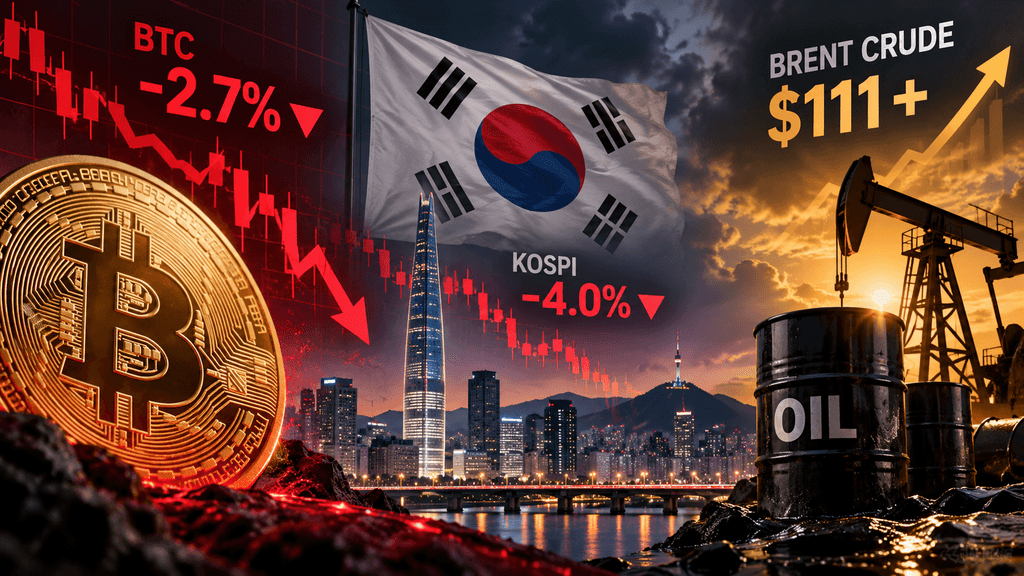
Global risk sentiment cooled sharply on October 22, 2026, as escalating Middle East tensions and mixed technology earnings weighed on financial markets. South Korea’s KOSPI index closed down 3.52% at 5,533.77 after briefly recording losses exceeding 4% during the session, reflecting growing pressure on technology-related shares. Bitcoin also weakened, declining more than 2.7% to trade near $82,200 as investors reassessed exposure to risk-sensitive assets. Meanwhile, Brent crude oil rose approximately 2% and surpassed $111 a barrel following reports of a drone attack on a Saudi Aramco oilfield, raising fresh concerns about potential disruptions to global energy supplies. The simultaneous movements highlighted how geopolitical uncertainty, oil-market volatility, and pressure on artificial-intelligence-linked semiconductor shares can spread across equities, commodities, and digital assets within a single trading day.
The episode reinforces the view that Bitcoin continues to behave like a high-beta risk asset during periods of market stress rather than functioning consistently as a geopolitical hedge. Although some investors view the cryptocurrency as an alternative store of value, its short-term price movements remain sensitive to liquidity conditions, investor positioning, and broader changes in risk appetite. When rising oil prices intensify inflation concerns and technology-sector reassessments trigger equity sell-offs, Bitcoin can face additional selling pressure alongside traditional risk assets. This relationship highlights the importance of monitoring developments across energy markets, technology stocks, and global equities when assessing Bitcoin’s near-term price direction.
Geopolitical Flashpoints Drive Oil Higher and Risk Appetite Lower
Escalating tensions in the Middle East provided the primary catalyst for the day’s market moves. Reports of a drone strike on a Saudi Aramco facility that resulted in casualties, combined with the U.S. State Department’s order for non-emergency diplomatic personnel and families to leave Saudi Arabia, intensified concerns about potential disruptions to oil supplies. Brent crude advanced roughly 2% to trade above $111 per barrel, reaching levels not seen in several months. This rise in energy prices immediately fed into broader inflation expectations, prompting investors to reduce exposure to risk assets. Equity markets across Asia reacted swiftly, and Bitcoin followed with a rapid decline of approximately $1,500 within a short period, falling below $83,000. The sequence demonstrated how physical-market shocks in energy can cascade into financial markets within hours. Data from multiple market reports confirmed the oil price move occurred alongside the equity and crypto weakness, reinforcing the interconnected nature of these asset classes under heightened geopolitical stress.
Investors monitored the situation closely because sustained high oil prices have previously contributed to elevated consumer price readings and shifted rate-path expectations. On this occasion the immediate effect was a broad reduction in risk appetite. Japanese equities, measured by the Nikkei 225, declined around 2.65%, while the MSCI Asia Pacific index fell 1.72% to its lowest close since late July. U.S. equity futures also moved lower, with Nasdaq futures down about 1.5% and S&P 500 futures off 0.8%. The coordinated pressure illustrated that energy-market disruptions remain capable of overriding other positive factors in the short term. Market participants assessed the probability of further supply interruptions and adjusted portfolios accordingly, contributing to the simultaneous pressure observed in both traditional equities and digital assets.
South Korea’s KOSPI Suffers Sharp Reversal After Prior Gains
South Korea’s benchmark KOSPI index delivered one of the more pronounced moves of the session. The index closed down 3.52%, or 201.89 points, at 5,533.77, fully reversing the previous day’s 3.29% advance. Intraday losses reached as much as 4.35% at the lows near 5,485.98. Chipmakers bore the brunt of the selling. Samsung Electronics declined more than 4% and SK Hynix fell more than 5%. The KOSDAQ index also dropped 3.62%. Institutional investors sold a net 462.1 billion won of shares while individual investors provided some offsetting demand. The scale of the decline erased recent gains and pushed the index further below its 52-week high. This performance reflected ongoing investor scrutiny of valuations in artificial-intelligence-related semiconductor names and concerns about competitive pressures.
The sell-off occurred against a backdrop of earlier volatility in the same market. Only a week earlier the KOSPI had experienced even steeper declines driven by similar technology-sector concerns. On October 22 the combination of residual caution around AI capital expenditure returns and the fresh oil-price shock proved decisive. Foreign investors flipped to net buyers late in the session, yet the overall tone remained defensive. The concentration of losses in large-capitalization technology names amplified the index-level impact, given their heavy weighting. Market observers noted that the day’s price action left the KOSPI at levels last seen in the spring, underscoring the rapid shift in sentiment once risk factors aligned.
Bitcoin Tracks Broader Risk-Off Flows Rather Than Acting as a Hedge
Bitcoin’s decline of more than 2.7% to approximately $82,200 aligned closely with the equity-market weakness. The digital asset had traded higher in recent sessions before the risk-off wave hit. The move lower occurred as Asian stock markets opened and oil prices accelerated higher. Trading data showed a relatively swift $1,500 drop within roughly an hour, pushing the price below the $83,000 threshold. This behavior reinforced the observation that Bitcoin currently exhibits strong correlation with risk assets, particularly technology equities, during periods of heightened uncertainty. Gold and silver also weakened on the day, with spot gold down about 1% and silver declining more than 3%, further indicating that traditional safe-haven bids were selective rather than broad-based.
The absence of a strong decoupling from equity markets on this occasion provided a clear data point for investors evaluating Bitcoin’s portfolio role. When oil prices rise sharply on geopolitical news and technology shares come under simultaneous pressure, digital assets have tended to participate in the risk reduction rather than absorb capital fleeing other markets. Price action near $82,200 left Bitcoin well below recent local highs yet still above the multi-week lows seen earlier in October near $80,000. Volume and order-flow patterns suggested liquidations of leveraged positions contributed to the speed of the decline. The episode added to a series of recent sessions in which Bitcoin moved in tandem with Asian technology equities.
Semiconductor Valuations Face Renewed Scrutiny Across Asia
Pressure on memory-chip and AI-related shares formed a common thread across regional equity markets. In South Korea the heavy losses in Samsung Electronics and SK Hynix reflected investor reassessment of the sustainability of elevated capital spending and the competitive landscape. Japanese technology names including SoftBank Group and certain semiconductor equipment makers also posted notable declines. The simultaneous moves pointed to a shared narrative: markets are shifting focus from the scale of AI investment toward evidence of returns and commercialization progress. Mixed U.S. technology earnings added to the caution, with some companies revising capital-expenditure plans lower while others maintained or raised AI-related spending outlooks.
This valuation scrutiny has been building for several weeks. Earlier in October South Korean chipmakers experienced consecutive sessions of heavy selling linked to concerns about Chinese competition and debt associated with AI infrastructure. The October 22 session extended that theme under the additional weight of higher oil prices. The result was a broad reduction in risk exposure within the sector that spilled over into correlated assets. Investors examined guidance on future spending and profitability metrics more carefully, contributing to the risk-off tone that affected both equity indices and Bitcoin. The pattern suggests that any further disappointment on AI monetization could prolong pressure on these high-beta names and their digital-asset counterparts.
Oil Price Surge Amplifies Inflation and Rate Concerns
The advance in Brent crude above $111 per barrel directly raised the prospect of renewed inflationary pressure. Higher energy costs feed into transportation, manufacturing, and consumer prices, potentially complicating central-bank policy paths. Market participants noted that elevated oil prices had already contributed to hotter-than-expected inflation data in prior months. The latest geopolitical developments therefore arrived at a sensitive moment for rate expectations. U.S. Treasury yields showed mixed but generally supportive moves for bonds as investors sought relative safety, with the 30-year yield declining modestly. The dollar experienced limited volatility against the yen near the 157-158 range.
The oil-price reaction also influenced equity valuations through the discount-rate channel. Higher expected inflation and the possibility of tighter policy reduce the present value of future cash flows, particularly for growth-oriented technology companies. Bitcoin, often treated as a growth-sensitive asset, registered corresponding pressure. The combination of physical supply risk and financial-market transmission created a coherent narrative for the day’s declines. Analysts tracking energy markets highlighted that further incidents in the region could extend the oil rally and keep risk assets under pressure in subsequent sessions.
Technology Earnings Provide Mixed Signals for Sentiment
After-hours trading in U.S. technology names offered a mixed picture that did little to reverse the risk-off tone established in Asia. Tesla declined following a reduction in its capital-expenditure forecast. Meta Platforms rose after raising its outlook for AI-related spending. Lam Research fell on weaker-than-expected guidance. These divergent results illustrated the ongoing debate over the returns to large-scale AI investment. Markets appeared more focused on evidence of commercial traction than on the absolute size of spending plans. The mixed reception contributed to caution heading into the broader U.S. equity open.
The earnings dispersion fed back into Asian market sentiment because many regional technology companies are deeply integrated into the same supply chains and capital-expenditure cycles. When U.S. firms signal restraint or weaker guidance, the impact registers quickly in semiconductor and equipment shares listed in Seoul and Tokyo. Bitcoin’s correlation with these technology narratives meant that the mixed results offered little immediate support. Investors continued to treat the digital asset as part of the broader risk complex rather than an independent store of value during the session.
Correlation Patterns Between Equities and Digital Assets Persist
Recent trading sessions have repeatedly shown Bitcoin moving in close alignment with South Korean and broader Asian equity indices during periods of technology-sector stress. On October 22 the correlation was again evident. Declines in the KOSPI and related technology names coincided with Bitcoin’s drop below $83,000. Earlier in the month similar patterns appeared when the KOSPI experienced steeper losses and Bitcoin briefly tested levels near $80,000. These repeated co-movements suggest that institutional and leveraged flows treat the assets as related risk exposures.
The persistence of the correlation carries implications for portfolio construction. Investors seeking diversification may find that Bitcoin currently offers limited insulation from technology-driven equity sell-offs, especially when those sell-offs are amplified by commodity shocks. Data from futures markets and liquidation statistics in prior sessions indicated that leveraged long positions in Bitcoin can accelerate downside moves once risk sentiment turns. The October 22 price action fit this pattern without requiring a direct causal link between any single equity index and the cryptocurrency.
Safe-Haven Assets Show Selective Demand
While equities and Bitcoin declined, traditional safe-haven instruments displayed uneven performance. U.S. Treasury prices rose modestly as yields edged lower. The yen strengthened slightly against the dollar. Gold, however, fell about 1% to around $4,097 an ounce, and silver dropped more than 3%. The divergence indicated that investors were reducing overall risk exposure rather than rotating aggressively into every traditional haven. The oil-price surge itself may have complicated the gold bid, as higher energy costs can influence real-rate expectations and opportunity costs for holding non-yielding assets.
This selective demand pattern is consistent with environments in which inflation fears and growth concerns compete. When oil prices rise on supply risks, the inflationary implication can temporarily outweigh pure risk-off flows into precious metals. Bitcoin’s simultaneous decline aligned more closely with the equity and growth-asset complex than with any haven bid. Market participants therefore continued to monitor both the geopolitical situation and incoming economic data for clearer signals on the relative strength of these competing forces.
Market Structure and Liquidity Conditions Amplify Moves
Liquidity conditions and positioning contributed to the speed of the declines. Bitcoin’s drop of roughly $1,500 in a short window suggested that stop-loss orders and leveraged positions were triggered once key levels were breached. Equity markets in Asia also showed broad participation, with decliners far outnumbering advancers on the Korea Exchange. Institutional selling pressure was measurable and concentrated in large-capitalization names. These structural features can magnify price moves once an initial catalyst appears.
The combination of geopolitical news, oil-price reaction, and technology-sector caution created a coherent risk-off impulse that found ready transmission through existing positions. Futures markets in both equities and cryptocurrencies reflected the shift in sentiment. The absence of strong offsetting buying interest in the early hours of the Asian session allowed the declines to develop momentum. Subsequent sessions will reveal whether the moves represented a temporary adjustment or the start of a more sustained reduction in risk exposure.
Future Context for AI and Energy Themes
The day’s events sit within a broader reappraisal of artificial-intelligence investment cycles and energy-market volatility. Semiconductor shares have faced repeated bouts of selling as investors demand clearer evidence of returns on the massive capital expenditures of recent years. At the same time, Middle East tensions have kept oil prices elevated relative to levels seen earlier in 2026. The intersection of these two themes produced the coordinated pressure observed on October 22. Bitcoin, having recovered from earlier October lows near $80,000, still remains sensitive to shifts in either narrative.
Investors tracking these themes will focus on upcoming data releases, central-bank communications, and further developments in the energy markets. Any escalation that threatens additional oil-supply interruptions could extend pressure on risk assets. Conversely, signs that AI-related spending is translating into measurable revenue growth could stabilize technology valuations and provide support. The October 22 session served as a reminder that both themes remain active drivers of cross-asset correlations.
How Investors Can Apply These Insights to Portfolio Management
Market participants monitoring Bitcoin price action alongside Asian equity indices and energy markets now have an additional data point confirming the current risk-asset character of the cryptocurrency. The simultaneous declines illustrate the value of tracking oil-price developments and semiconductor-sector sentiment as leading indicators for potential digital-asset volatility. Position sizing and leverage considerations become particularly relevant when multiple risk factors align. Liquidity conditions in both spot and derivatives markets can accelerate moves once thresholds are crossed.
The episode also shows the importance of verifying correlations in real time rather than relying on historical averages that may shift with market regimes. On this occasion the correlation between Bitcoin and technology-heavy Asian equities remained elevated under the influence of geopolitical and valuation pressures. Investors adjusting exposure will weigh the probability of further oil-price spikes against the possibility of stabilizing technology earnings in the coming weeks. Continuous monitoring of these intersecting factors remains essential for understanding short-term price dynamics.
Looking Ahead to Key Market Catalysts
Attention now turns to the next set of catalysts that could either reinforce or reverse the risk-off tone. The Bank of Japan meets later in October, and any shift in its policy stance could influence regional currency and equity markets. U.S. economic data and remaining technology earnings will provide further information on growth and inflation trajectories. Developments in the Middle East remain an immediate variable for energy prices. Bitcoin’s ability to stabilize above recent lows or retest higher levels will depend in part on whether these factors produce a sustained reduction in risk appetite or allow risk assets to regain footing.
The October 22 moves demonstrated how quickly sentiment can shift when geopolitical and sector-specific pressures coincide. Market participants will assess whether the declines represented a one-day adjustment or the beginning of a more prolonged period of caution. Cross-asset price action in subsequent sessions will offer additional evidence on the durability of current correlations and the relative influence of oil, technology valuations, and broader macroeconomic expectations.
FAQs
How did the Middle East developments specifically affect oil prices on October 22?
Reports of a drone attack on a Saudi Aramco oilfield that caused casualties, together with the U.S. decision to evacuate non-emergency diplomatic staff from Saudi Arabia, raised immediate concerns about potential supply disruptions. Brent crude responded by rising approximately 2% and trading above $111 per barrel. The move reflected market pricing of heightened geopolitical risk rather than confirmed large-scale production losses at the time of the price spike.
Why did South Korean technology shares fall so sharply relative to other markets?
Samsung Electronics and SK Hynix carry heavy weightings in the KOSPI and have been under pressure for weeks because of investor concerns about AI-related capital expenditure returns, debt levels, and competition from Chinese producers. The fresh oil-price shock and residual caution from earlier sessions amplified the selling, producing declines of more than 4% and 5% respectively and driving the broader index lower by 3.52%.
Does Bitcoin’s decline mean it no longer serves any diversification purpose?
The October 22 session showed Bitcoin moving in the same direction as risk assets, particularly technology equities. This does not eliminate all diversification potential across different market regimes, but it does confirm that under the combination of oil-driven inflation fears and technology-valuation pressure, the asset currently behaves more like a high-beta risk instrument than a consistent safe haven.
What role did U.S. technology earnings play in the Asian market reaction?
Mixed after-hours results, Tesla lowering capital-expenditure guidance, Meta raising AI spending outlooks, and Lam Research issuing weaker guidance, added to existing caution around the returns on AI investment. Because Asian semiconductor companies are closely linked to the same capital-expenditure cycle, the mixed signals reinforced the risk-off tone already established by the oil-price movement.
How significant was the KOSPI’s intraday low relative to recent history?
The index reached a low of approximately 5,485.98, representing a 4.35% decline at the trough, before closing down 3.52%. This level placed the KOSPI near its weakest readings since the spring and fully reversed the prior day’s gains, illustrating the speed with which sentiment can reverse when multiple risk factors align.
Are gold and silver still reliable indicators of risk-off flows?
On this occasion, both metals declined even as equities and Bitcoin fell, suggesting that inflation concerns linked to higher oil prices competed with pure safe-haven demand. The selective nature of the moves indicates that investors were reducing overall risk exposure rather than rotating uniformly into every traditional haven asset.
Disclaimer: This general market information, possibly from third-party, commercial, or sponsored sources, is provided for reference and educational purposes only and does not constitute financial or investment advice, an offer, solicitation, or guarantee. We disclaim liability for its accuracy, completeness, reliability, and any resulting losses. Investments/trading are risky; past performance doesn’t guarantee future results. Users should research, judge prudently, and take full responsibility. For further details, please consult KuCoin’s Terms of Use and Risk Disclosure.