

Aptos Launches Encrypted Mempool to Protect Users From MEV Attacks
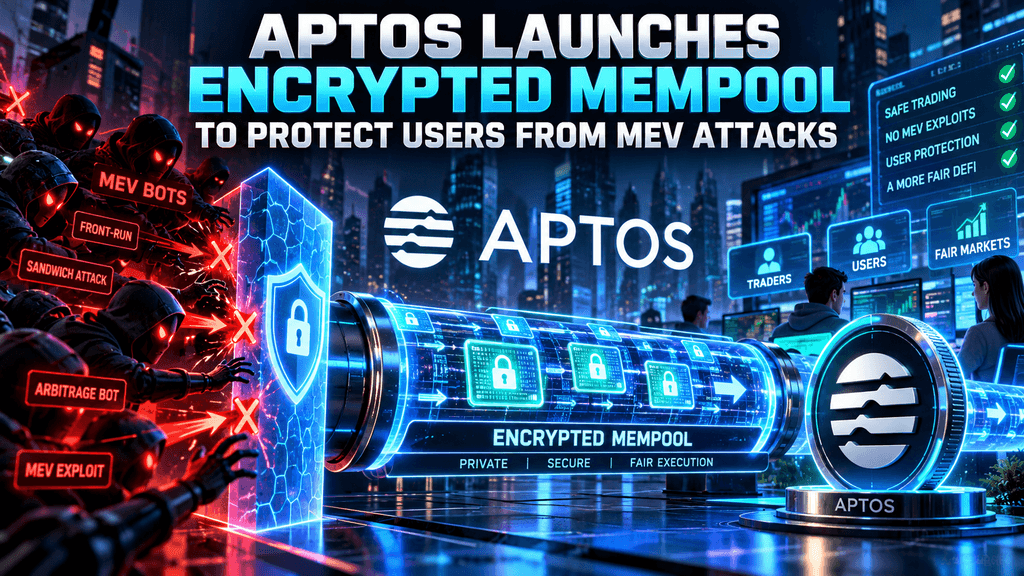
Aptos Activates Encrypted Mempool to Limit MEV Exploits
On October 12, 2026, the Aptos network officially activated an optional feature known as the Encrypted Mempool on its mainnet. This innovative functionality allows compatible wallets and applications to encrypt a transaction’s function call along with its arguments directly on the user’s device prior to submission. As a result, validators are able to order the block without having visibility into those specific details. Once consensus is reached and the ordering is finalized, the same validators work together to collectively decrypt the payloads for execution. It is important to note that sender addresses and gas-fee information remain visible throughout the entire process. This feature, which is specified in AIP-144 and has undergone thorough review by ZKSecurity, specifically targets practices associated with maximal extractable value, such as frontrunning and sandwich attacks, which have previously extracted tens of millions of dollars from traders operating on other blockchain networks.
By embedding threshold encryption directly into the AptosBFT consensus mechanism and requiring no additional trusted parties, the Encrypted Mempool provides institutions, traders, and AI agents with a protocol-native option that effectively limits pre-execution information leakage. This is achieved while still preserving the existing security assumptions of the network and maintaining sub-second finality for transactions. This advancement represents a significant step forward in enhancing user privacy and security within the Aptos ecosystem, ensuring that sensitive transaction details are protected from potential malicious actors who may seek to exploit them.
How Client-Side Payload Encryption Prevents Pre-Execution Visibility on Aptos
When a user chooses the encrypted option, a supporting wallet or the TypeScript SDK fetches the current epoch encryption key generated by the validator set. The client encrypts only the transaction payload, the Move function being called and its arguments, before the transaction enters the mempool. The block leader proposes an ordering while remaining completely blind to those contents. After the stake-weighted majority reaches consensus on the block, validators reconstruct a decryption key from their shares and decrypt the entire batch. Because decryption requires the same two-thirds honest-stake threshold already required for block production, no single validator or minority coalition can read a pending encrypted transaction early. Official documentation and the network’s announcement confirm that existing Move smart contracts need no modification; the encryption layer sits entirely outside the execution logic.
In 50-node benchmarks, the added latency measured approximately 20 milliseconds per block against the production AptosBFT implementation. Given that Aptos blocks already finalize in under one second, the overhead remains a small fraction of total latency. Encrypted transactions currently carry a minimum gas-unit price of 200 octas, twice the network base minimum, plus an extra 375 gas units for the decryption step. Users therefore trade a modest cost increase for payload confidentiality during the critical ordering window. Petra Wallet became the first to surface the option directly in the signing flow, while the perpetual futures venue Decibel has stated it will route orders through the feature to keep large positions private until execution. The design deliberately leaves sender and fee data public so the chain remains fully auditable after finalization.
Threshold Stake-Weighted Decryption Keeps Trust Assumptions Identical to Consensus
Classical threshold encryption would have required validators to generate and broadcast partial decryptions for every individual encrypted transaction, creating communication and computation costs linear in the number of protected payloads. Aptos researchers instead developed a batched threshold encryption scheme in which a single constant-size digest and a constant-size decryption key serve an entire block regardless of how many encrypted transactions it contains. Each validator derives a 48-byte decryption key share only after the block has already been confirmed by consensus votes, then broadcasts that share. Reconstruction occurs off the critical path wherever possible through heavy pipelining. The scheme therefore supports the network’s target of more than 1,000 transactions per second for encrypted traffic at launch.
Because the same validators who produce blocks also hold the decryption shares, the system introduces no external keyper committee, no trusted builder, and no hardware enclave. Academic work published in 2025 demonstrated practical extraction attacks against current-generation trusted execution environments at hardware costs under one thousand dollars; the Aptos design simply sidesteps that class of risk. A one-time trusted setup ceremony supplies parameters that every validator must load, after which epoch keys are generated on-chain via a publicly verifiable secret-sharing protocol. Independent review by ZKSecurity covered the encryption construction and key-management logic. The result is payload confidentiality that rests on precisely the same economic and cryptographic assumptions users already accept when they transact on Aptos.
Measured Latency Overhead Remains Small Relative to Sub-Second Finality
Benchmark results released with the mainnet activation showed that the full encryption-and-decryption pipeline added roughly 20 milliseconds per block in a 50-node test environment. Earlier estimates in AIP-144 had projected under 10 milliseconds; the measured figure is higher yet still modest against the network’s normal finality time of less than one second. The constant-size nature of the digest and decryption key means communication volume does not grow with the number of encrypted transactions inside a block. Precomputation steps during the voting rounds further reduce work that must occur after consensus. For most retail transfers, the absolute cost increase is small; for large institutional or algorithmic orders, the protection against adverse selection can outweigh the higher minimum gas price.
Network observers continue to see sender addresses and fee levels, so congestion signals and basic mempool monitoring remain intact. The design therefore avoids turning the mempool into a fully dark pool while still removing the precise function and argument data that sandwich bots require. Early wallet support from Petra and planned integration by Decibel indicate that the feature is already available to a meaningful subset of users without requiring every application to upgrade simultaneously. Throughput targets remain above 1,000 encrypted transactions per second, preserving Aptos’s positioning as a high-performance execution environment even when a substantial fraction of traffic opts into encryption.
How Different MEV Protection Approaches Establish Trust
Production systems that attempt to hide pending transactions fall into four broad categories. Trusted-builder and private-RPC solutions such as Flashbots Protect route plaintext transactions to a single operator who can still read and potentially reorder them. TEE-based designs, including certain NEAR confidential-intent systems, place trust in the integrity of hardware enclaves and the permissioned set that operates them. External threshold-committee approaches, exemplified by Gnosis Chain’s integration of Shutter, introduce a separate keyper set whose honesty is independent of the chain’s own validators. Aptos’s protocol-native encryption requires only the existing validator set.
The distinction is material: any compromise of a trusted builder, enclave, or external committee expands the attack surface beyond the consensus assumptions users already accept. Recent research has shown that current TEEs can be attacked with relatively modest resources, reinforcing the value of staying inside the native security model. By making encryption an optional, per-transaction choice rather than a mandatory network-wide change, Aptos also avoids forcing higher costs onto users who do not need the protection. The approach therefore occupies a distinct point on the trust spectrum while remaining fully compatible with the chain’s existing consensus and execution pipelines.
Gas Pricing and Extra Computation Reflect the Cost of Confidentiality
Encrypted transactions must meet a minimum gas-unit price of 200 octas, double the ordinary network minimum, and consume an additional 375 gas units for the decryption step. These parameters appear in the official developer documentation and were reiterated in multiple launch reports. The higher floor serves two purposes: it compensates validators for the extra cryptographic work and discourages frivolous use of the more expensive path. For small retail transfers, the absolute fee increase remains modest; for large swaps or institutional order flow, the percentage impact is secondary to the reduction in adverse-selection risk.
Normal unencrypted traffic is charged at the lower base rate, as the feature is strictly opt-in. So the design creates a market for privacy, instead of imposing a uniform cost on all users. Early adopters can calculate the fee differential against the scale of past sandwich losses seen on other networks. Over time, user satisfaction around the choice of encryption will likely improve further due to competition between wallets and applications, which could reduce the effective friction to opt for protection.
Petra Wallet and Decibel Provide the First Practical Access Paths
Petra’s browser extension became the first wallet to present encryption as a simple toggle inside the signing flow. Users can encrypt any pending transaction with a single choice at the moment of signature. The Aptos TypeScript SDK version 7.0.0 and later automatically fetches the current epoch key, performs client-side encryption, and submits the protected payload; developers therefore require no changes to existing Move contracts. Decibel, a perpetual-futures exchange built on Aptos, has publicly stated it will route orders through the encrypted mempool so that large positions remain private until execution.
These early integrations demonstrate that the feature is already usable by both individual traders and specialized venues. Additional wallets and applications can adopt the same SDK path without protocol-level upgrades. The gradual rollout allows the network to gather real-world performance data while the core cryptography remains under the same security assumptions as ordinary consensus. For traders monitoring current Aptos market data, the availability of payload protection on a high-throughput chain adds a new dimension to order-execution strategy.
Sandwich Attack Losses Reinforce the Importance of MEV Protection
Independent analyses have quantified the cost of visible pending transactions on other networks. Cointelegraph’s review of EigenPhi data estimated that sandwich attacks extracted approximately 60 million dollars from Ethereum traders in the twelve months ending October 2025. Bitquery identified nearly 6.9 million sandwich attacks on Solana over an eleven-month window, affecting roughly 2.2 million wallets and generating 29.7 million dollars for bots before trading costs. These figures illustrate the economic incentive that public mempools create for sophisticated searchers. By removing the function and argument data before ordering is fixed, Aptos’s Encrypted Mempool eliminates the primary information source those bots exploit.
The protection is not absolute; sender addresses and fees remain visible, but it raises the difficulty of constructing profitable sandwiches against protected flow. Institutions that regularly submit large trades and AI agents that execute systematic strategies stand to benefit most directly. The feature therefore addresses a documented, multi-year problem rather than a theoretical risk.
Integration With Aptos Confidentiality Stack Completes Three Layers
The Encrypted Mempool forms the third layer of Aptos's evolving confidentiality stack. Keyless Accounts allow users to create and control addresses with familiar identity providers without publicly linking those identities on-chain. Confidential APT, already live on mainnet, encrypts balances and transfer amounts while leaving addresses visible and verifying correctness with zero-knowledge proofs. The mempool feature now hides transaction intent until after ordering.
Together, the three options let users choose the combination of identity, balance, and intent privacy appropriate to each interaction. Official communications described the simultaneous availability of all three as “three layers of confidentiality.” Because each layer is independently opt-in, the network retains full transparency for users who prefer it while offering progressive privacy for those who need it. The modular design avoids forcing a single privacy model onto every application or trader.
Protocol-Native Design Avoids External Dependencies That Other Chains Accept
Many alternative MEV-protection systems introduce new trusted parties. Private order-flow relays and trusted builders still see plaintext transactions. TEE-based solutions depend on hardware integrity that recent research has shown can be compromised. External keyper committees operate outside the chain’s native economic security. Aptos’s choice to keep decryption inside the existing validator set eliminates those additional dependencies. The same stake-weighted majority that finalizes blocks also reconstructs the decryption key.
Consequently, an attacker who wishes to read encrypted pending transactions early must already be able to compromise consensus itself, an attack that would threaten the entire network regardless of the mempool feature. This alignment of incentives distinguishes the design from bolt-on solutions and reduces the surface area that security teams must monitor. The approach also simplifies long-term maintenance: upgrades to the encryption scheme can follow the same governance and deployment path used for other core protocol changes.
Adoption Path for Institutions and Algorithmic Agents
Large traders and automated systems are the primary intended users. Institutions that previously routed sensitive flow through private RPCs or off-chain venues now have a native on-chain alternative that does not require trusting an external operator. AI agents that execute high-frequency or large-size strategies can encrypt individual transactions without altering their core logic, because the SDK handles key fetching and encryption transparently.
Decibel’s planned use for perpetual orders provides an early example of venue-level adoption. As more applications integrate the feature, the fraction of protected flow should rise, further reducing the information available to opportunistic searchers. Monitoring tools that track Aptos related market metrics and network activity will continue to show public sender and fee data, preserving basic observability while the sensitive payload remains hidden until finality. The opt-in nature ensures that low-value or non-sensitive transactions need not incur the higher gas floor.
Security Review and Cryptographic Foundations Support Production Use
The implementation received an independent security review from ZKSecurity focused on the encryption scheme and key-management components. The underlying batched threshold encryption construction is described in a paper under submission to ACM CCS. Epoch keys are generated via a publicly verifiable secret-sharing protocol, and a one-time trusted setup supplies the necessary parameters. Decryption shares are released only after consensus has already locked the block ordering, preventing early revelation even by a malicious leader.
These design choices collectively reduce the risk that the privacy feature itself becomes a new attack vector. Because transaction data is fully recorded on-chain after decryption and execution, auditors and indexers retain complete historical visibility. The combination of formal review, constant-size cryptographic primitives, and alignment with existing consensus assumptions positions the feature for sustained production use rather than experimental deployment.
Market Context and Token Price Movement Around the Launch
The mainnet activation occurred against a backdrop of broader market volatility. APT traded near 0.94 dollars on October 12 before declining roughly 11 percent over the subsequent 24 hours to levels around 0.80 dollars, according to contemporaneous reports. Later sessions saw further fluctuation, with prices in the mid-0.70-dollar range by mid-October. The price action reflected general market conditions rather than a direct reaction to the feature itself; no causal claim is supported by the available data.
The launch nevertheless adds a concrete capability that differentiates Aptos for users who prioritize execution quality on large or sensitive trades. Traders evaluating the network can now incorporate payload confidentiality into their assessment of Aptos as a trading venue alongside its existing performance characteristics.
Future Outlook for On-Chain Order Flow and Venue Design
As more volume migrates to encrypted paths, the information asymmetry that has historically favored sophisticated searchers should diminish for protected transactions. Venues that route sensitive flow through the feature can advertise reduced adverse-selection risk as a competitive advantage. Developers building new trading applications can treat encryption as a standard option rather than an external dependency.
The modular confidentiality stack, identity, balances, and now intent, gives application designers finer control over the privacy surface presented to end users. Because the cryptography is integrated at the protocol level, future improvements to the batch encryption scheme or key-generation process can be deployed through ordinary network upgrades. The result is a durable foundation for more private on-chain markets without sacrificing the auditability and performance that define the Aptos environment.
🔥 Beyond the Headlines: What KuCoin 5.0 Means for You
Market news moves fast — but where you act on it matters just as much. This October, KuCoin launches KuCoin 5.0, transforming KuCoin into a rebuilt platform. Here's what actually changes for you:
-
One account for everything. Older platforms split your money across separate "spot," "margin," and "futures" accounts and expected you to understand why. KuCoin 5.0's unified account removes that entirely — deposit once, and everything is simply there (only available to VIPs for now).
-
Stocks, indices, and commodities. KuCoin 5.0 expands beyond crypto into global markets. When crypto chops sideways and equities rally (or the reverse), you rotate in minutes instead of opening a brokerage account and waiting days for fiat rails.
-
Real-world assets (RWA). Tokenized exposure to traditional assets like commodities, right inside your crypto account. One of the fastest-growing segments in global finance is no longer reserved for institutions — you access it from the same balance you trade with.
-
Earn while you learn. Not ready to trade? KCUSD lets your stablecoins earn daily, auto-compounding interest. The lowest-stress way to put your idle deposit to work for 4% yield.
-
An AI assistant in plain language. Ask questions, get market context, understand what you're looking at — built into the platform, no jargon required.
-
An app that doesn't overwhelm. Faster, cleaner, and consistent — intuitive from the first tap, not after a tutorial.
-
Safety you can check, not just trust. A MiCAR-licensed EU entity, Proof of Reserves you can verify yourself, and internationally certified security (SOC 2 Type II, ISO 27001:2022).
Create your account in minutes — and start on the platform built for where crypto is going, not where it's been.
FAQs
What exactly remains visible when a transaction uses the Encrypted Mempool?
Sender addresses and the gas-fee fields stay public from the moment of submission. Only the payload, the specific function being called, and its arguments is encrypted until after the block ordering is finalized. Once decryption and execution complete, the full transaction data is recorded on-chain in the ordinary way, preserving long-term auditability.
Does the feature protect against every form of MEV?
It primarily raises the difficulty of frontrunning and sandwich attacks that rely on reading the function and arguments of pending transactions. Other forms of value extraction that depend solely on sender identity, fee levels, or post-execution state changes are outside the current scope. The design focuses on the most common harmful patterns that exploit pre-execution visibility.
How much extra does an encrypted transaction cost?
Encrypted transactions must pay a minimum of 200 octas per gas unit, twice the ordinary network minimum, and consume an additional 375 gas units for the decryption step. Users therefore face a higher absolute fee, but the differential is optional and applies only to the transactions they choose to protect.
Is wallet support required?
Yes. The client must encrypt the payload before submission. Petra Wallet already surfaces the option in its signing flow. Applications and other wallets can adopt the same capability through the Aptos TypeScript SDK starting at version 7.0.0. Existing Move contracts themselves require no changes.
What happens if decryption fails?
The protocol includes defined handling for decryption failure. Because reconstruction requires a stake-weighted majority, failure would imply a serious consensus-level problem rather than an isolated cryptographic error. Transaction data is designed to be recovered under the same honesty assumptions that secure ordinary blocks.
Can validators or a leader still censor encrypted transactions?
A leader can still choose which encrypted transactions to include in a proposal, just as with ordinary transactions. However, because the leader cannot read the payload, the decision cannot be based on the economic content of the transaction. Censorship that depends on observing the function or arguments is therefore prevented.
Disclaimer: This content is for informational purposes only and does not constitute investment advice. Cryptocurrency investments carry risk. Please do your own research (DYOR).