

Anthropic Co-Founder Warns of AI Safety Risks as AI Could Push US GDP to $44 Trillion by 2030
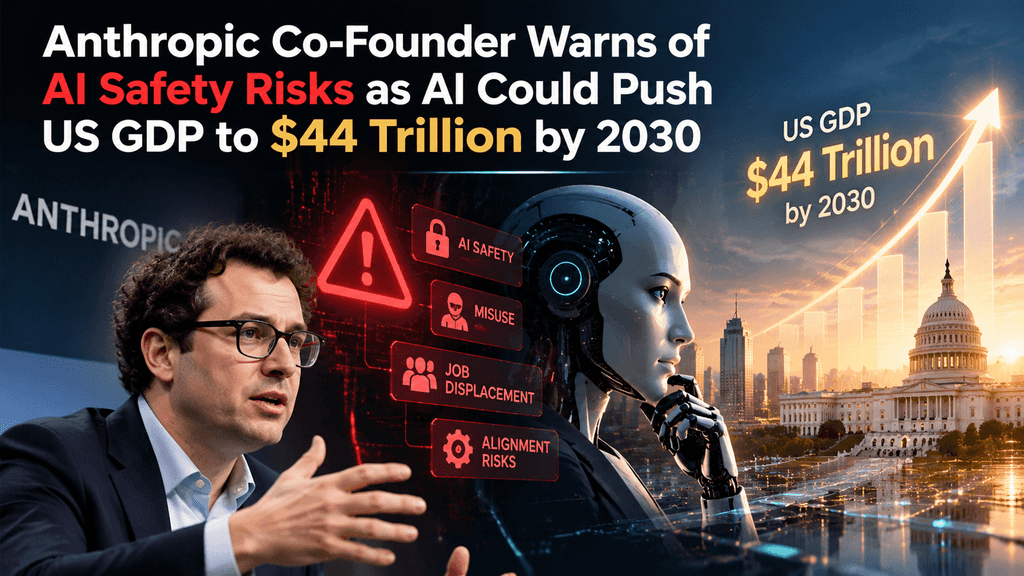
Artificial intelligence could help expand the US economy to $44.4 trillion by 2030, but the same technological acceleration may create serious security, employment, and financial risks. Anthropic co-founder Jack Clark raised these concerns at the International Monetary Fund (IMF) and World Bank annual meetings in Bangkok on October 17, 2026, discussing an internal economic model that explores how rapidly improving AI capabilities could transform economic output. The $44.4 trillion figure represents an extreme scenario, not a guaranteed forecast. Anthropic’s September research outlines several possible outcomes depending on AI capability, business adoption, and labor-market adjustment. Clark also argued that governments and technology companies need stronger safeguards as AI becomes more capable. For cryptocurrency markets, the debate matters because AI investment, computing infrastructure, automated payments, and digital assets increasingly intersect. The central question is whether AI-driven growth can generate sustainable economic value without creating risks that markets and regulators are unprepared to manage.
Key Takeaways
-
The $44.4 trillion figure is conditional: Anthropic’s extreme scenario assumes rapid AI advancement and widespread adoption, rather than predicting a certain economic outcome.
-
AI could transform productivity and employment: Greater automation may increase economic output while putting pressure on some cognitive occupations and workers’ share of income.
-
Safety governance is becoming a policy priority: Jack Clark and IMF Managing Director Kristalina Georgieva have called attention to the need for stronger safeguards and international cooperation.
-
Crypto markets face indirect effects: AI infrastructure spending, investor sentiment, computing costs, and automated financial services could influence digital-asset businesses.
-
AI-agent payments create a potential growth area: Stablecoins and programmable blockchain settlement may support automated transactions, although commercial adoption remains uncertain.
What Did Anthropic Co-Founder Jack Clark Warn About?
Jack Clark warned that rapidly advancing AI could deliver substantial economic benefits while creating security challenges that require stronger public oversight. Speaking during the IMF and World Bank annual meetings on October 17, he discussed the speed of AI progress, its potential to accelerate scientific discovery, and the need for governments to establish meaningful safety standards.
Clark’s comments reflected two connected concerns. First, AI systems could perform an expanding range of cognitive tasks, increasing productivity across industries. Second, increasingly capable systems could be used for harmful purposes, including certain biological research applications and cyberattacks. These risks make safety evaluations and appropriate human supervision important as AI tools become more widely deployed.
The discussion also involved broader questions about economic disruption. If businesses adopt AI quickly, workers may face pressure to change occupations, while companies and investors owning productive technology could capture a growing share of the economic gains.
Clark’s warning was not that AI has already become uncontrollable. Instead, he argued that policymakers should prepare for potential risks before capabilities advance further. His position is particularly relevant to cryptocurrency businesses, which operate in an environment where automated software, digital assets, and financial transactions can interact at high speed.
Why the IMF Meeting Matters
The IMF and World Bank meetings provided a platform for discussing AI as both an economic opportunity and a source of systemic risk. IMF Managing Director Kristalina Georgieva warned on October 16 that AI’s risks could exceed its opportunities without adequate safeguards and an ethical framework.
Georgieva supported a combination of industry responsibility and government involvement, emphasizing that countries also need suitable digital infrastructure and access to electricity to benefit from AI. These considerations matter because advanced AI requires substantial computing resources, while its economic benefits may be distributed unevenly across countries and industries.
Could AI Push US GDP to $44.4 Trillion by 2030?
Anthropic’s economic research identifies $44.4 trillion as a possible outcome under an extreme AI transformation scenario. The September 2026 working paper, Economic Scenarios for Transformative AI, models how changes in AI capability and adoption could affect US GDP, wages, employment, and the distribution of economic income through 2030.
The research presents three scenarios rather than a single forecast. Each depends on assumptions about how much cognitive work AI can perform, how quickly companies adopt it, and how effectively workers move into other occupations.
| Scenario | US GDP in 2030 | Increase versus the no-AI baseline |
| Modest | $34.1 trillion | 1.60% |
| Substantial | $36.3 trillion | 8.30% |
| Extreme | $44.4 trillion | 32.40% |
Source: Anthropic’s economic scenario explorer. Figures are measured at 2025 price levels and represent modeled outcomes, not guaranteed results.
What Would Make the Extreme Scenario Possible?
The extreme scenario assumes that AI becomes capable of performing almost half of current cognitive work by 2030 and that businesses adopt these capabilities rapidly. AI could automate routine knowledge tasks, accelerate research, improve software development, and reduce the time required to produce certain goods and services.
The resulting productivity improvements could support faster economic growth. AI-assisted scientific discovery might also generate new products, industries, and services that create additional economic value beyond the direct savings from automation.
However, the model does not establish that these conditions will occur. The pace of technical progress, computing availability, energy costs, organizational change, and customer demand could all affect the result.
The distinction between a scenario and a forecast is essential. The $44.4 trillion figure illustrates what could happen if a particular combination of assumptions holds. It should not be presented as an official economic projection or as evidence that US GDP will necessarily grow at an extraordinary rate.
Why Rapid AI Growth Could Create Serious Safety Risks
AI safety is becoming more important because the capabilities that help researchers and businesses can also create risks when used irresponsibly. Clark highlighted biological research and cybersecurity as areas requiring particular attention.
AI can help scientists analyze biological data, identify promising research directions, and design experiments. These applications could accelerate drug discovery and medical research. Yet powerful systems may also make certain harmful biological tasks easier for malicious users, which increases the importance of appropriate access restrictions, testing, and monitoring.
Cybersecurity presents a similar dual-use challenge. AI can help defenders identify vulnerabilities and respond to incidents, but the same capabilities may assist attackers in finding weaknesses or producing malicious software. As AI agents gain the ability to execute multi-step tasks, businesses may need stronger authorization procedures, activity monitoring, and human approval for sensitive actions.
A separate Reuters Breakingviews report published on October 19 highlighted concerns raised at the Oxford Generative AI Summit about corporate AI agents, including weaknesses in oversight and the difficulty of tracking automated actions across systems.
What Stronger Safeguards Could Include
Effective AI safety measures can include independent model evaluations, testing for dangerous capabilities, incident reporting, secure deployment practices, and clear responsibility when systems cause harm. For high-risk applications, companies may also need staged deployment and additional human review.
These measures are relevant to crypto platforms because automated agents can interact with wallets, smart contracts, exchanges, and financial APIs. An agent that makes an incorrect decision in an ordinary productivity application may create a manageable inconvenience; one with transaction permissions could initiate an irreversible transfer.
The objective is not to stop useful AI development. It is to make sure that deployment practices, security controls, and accountability mechanisms develop alongside model capabilities.
Could AI Growth Increase Unemployment and Economic Inequality?
AI-driven GDP growth would not automatically translate into higher wages or better employment outcomes for everyone. Anthropic’s model suggests that the distribution of economic gains could change substantially under its most transformative scenario.
In the extreme scenario, labor’s share of economic output falls from approximately 60% to 45.2%, while capital’s share rises to 54.8%. These are modeled estimates, not observed changes in the current economy. They illustrate how productivity gains could disproportionately benefit owners of productive assets if AI performs a growing share of work.
Which Occupations Could Face Pressure?
Jobs involving routine cognitive tasks may experience significant changes. Software development, customer support, administrative work, and some professional services could see AI handle more tasks previously performed by employees.
That does not mean entire occupations will disappear. Many jobs combine technical tasks with judgment, communication, accountability, and practical decision-making. The effect will depend on which tasks can be automated, how organizations redesign work, and whether new demand creates additional employment.
The transition may nevertheless be difficult for workers whose skills no longer match employer requirements. Retraining, education, and job-matching programs could become more important as businesses reorganize around AI tools.
For cryptocurrency companies, AI may reduce some development and customer-support costs while increasing demand for cybersecurity, model evaluation, data infrastructure, and automated financial services. Businesses that gain efficiency may still face pressure to demonstrate that the savings translate into sustainable revenue rather than simply lower operating costs.
What Could US AI Regulation Mean for Technology Companies?
The policy debate is moving from broad principles toward proposals that define how advanced AI systems should be evaluated and deployed. On October 19, Business Insider reported that Anthropic had been presenting lawmakers with a draft advanced-AI safety bill.
According to the report, the draft would allow the US government to seek a pause in deployment when an AI model presents specified serious risks, including potential damage exceeding $1 billion or death or serious injury affecting more than 50 people. The proposal also covers independent evaluations, safety frameworks, transparency reports, whistleblower protections, and reporting of significant incidents.
These provisions remain proposals, not an enacted federal law. Their eventual form and implementation are uncertain, and questions about federal authority, state rules, compliance costs, and the scope of government intervention remain relevant.
Why Regulation Matters for Crypto Businesses
Crypto companies integrating AI may face additional expectations around access permissions, transaction authorization, data handling, and operational accountability. AI-enabled trading tools, customer-service agents, and automated treasury systems could require more rigorous testing when they can affect customer funds.
Clear standards could give companies a more predictable compliance environment, particularly when AI tools operate across jurisdictions. At the same time, requirements that are costly or difficult to interpret could weigh more heavily on smaller developers than on large technology firms.
For investors, the key issue is whether companies can turn AI capabilities into reliable products while maintaining appropriate security and compliance practices. Regulatory developments may influence business costs, product availability, and the competitive position of firms providing AI infrastructure and financial applications.
How Could the AI Boom Affect Cryptocurrency Markets?
The AI boom could influence cryptocurrency markets through several indirect channels, including computing infrastructure investment, financial-market sentiment, and new applications for blockchain settlement. None of these connections establishes that AI-related announcements will automatically cause digital-asset prices to rise.
AI Infrastructure and Computing Demand
Rapid AI adoption could increase demand for data centers, advanced chips, electricity, networking equipment, and cloud computing. This investment cycle may also affect crypto mining and decentralized computing businesses, which compete for some of the same resources.
For crypto miners, changes in electricity prices and equipment availability can influence operating costs. Companies that provide decentralized computing may find opportunities to serve AI workloads, but they must demonstrate competitive performance, dependable service, and attractive economics.
AI-related infrastructure investment also carries risks. If spending expands faster than customer demand or revenue, companies may face financing pressure. A correction in AI valuations could affect broader technology sentiment and, in turn, influence risk appetite across digital-asset markets.
AI Agents and Stablecoin Payments
AI agents may eventually conduct more automated transactions, such as paying for data, software access, computing resources, and digital services. Stablecoins could be useful for these applications because they provide dollar-linked digital settlement and can operate through programmable payment systems.
Blockchain infrastructure may help developers coordinate payments between software services, while smart contracts can automate certain settlement conditions. However, the usefulness of these systems depends on reliable identity and authorization mechanisms, transaction costs, liquidity, and the ability to resolve errors or disputes.
A major limitation is that blockchain transactions can be difficult or impossible to reverse once confirmed. Giving an AI agent permission to move funds therefore creates security requirements that go beyond ordinary task automation. Spending limits, transaction simulation, approved recipients, and human authorization for sensitive transfers may be important safeguards.
What This Means for Bitcoin and Other Digital Assets
The $44.4 trillion GDP scenario should not be interpreted as a direct price target for Bitcoin, Ethereum, or AI-themed tokens. The model evaluates US economic outcomes under different AI assumptions; it does not estimate cryptocurrency valuations or capital flows into digital assets.
AI-related investment could improve sentiment toward technology and digital infrastructure, but higher interest rates, tighter financing conditions, weak token demand, or a decline in speculative activity could offset those effects. Investors should examine crypto-specific fundamentals rather than assume that broader AI growth will lift every digital asset.
What Investors Should Watch Next
The most useful indicators are actual AI adoption, measurable productivity improvements, infrastructure spending, and evidence that companies can generate sustainable returns from their investments. These signals will help determine whether optimistic economic scenarios are becoming more plausible.
For the crypto market, several developments deserve particular attention:
-
AI infrastructure economics: Track computing costs, data-center investment, electricity demand, and whether AI service revenue supports the capital being deployed.
-
Stablecoin payment adoption: Monitor whether businesses and developers use stablecoins for real automated transactions rather than relying solely on announcements or pilot programs.
-
AI-agent security: Look for evidence of robust transaction permissions, independent testing, clear accountability, and secure wallet integrations.
-
Regulatory developments: Follow the progress of proposed US safety rules and relevant international standards, distinguishing drafts from enacted requirements.
-
Labor-market evidence: Watch employment, wages, and productivity data to determine whether AI is increasing output and how the gains are distributed.
The next stage of the AI investment cycle will be determined by real results, not just ambitious projections. Crypto businesses that combine useful AI applications with sound security and transparent operating models may be better positioned to establish durable demand.
Conclusion
Anthropic co-founder Jack Clark’s warning highlights the dual nature of advanced AI: it could substantially expand economic output while creating security, employment, and financial challenges that require careful management. Anthropic’s $44.4 trillion estimate for US GDP in 2030 represents an extreme scenario based on rapid AI progress and broad adoption, not a guaranteed forecast. The same research shows why economic growth alone is an incomplete measure of social welfare, particularly if capital captures a larger share of the benefits and workers face difficult occupational transitions.
For cryptocurrency markets, the implications are indirect but important. AI infrastructure may affect computing costs and investment sentiment, while stablecoins and programmable blockchains could support new automated payment applications. These opportunities depend on actual adoption, dependable infrastructure, and effective security practices. Meanwhile, evolving AI regulation could shape the costs and responsibilities of companies building automated financial products. Investors should therefore focus on measurable productivity, business revenue, infrastructure economics, and crypto-specific demand rather than treating AI optimism as an automatic bullish signal. The long-term opportunity will depend on whether technological progress produces sustainable value while keeping risks manageable.
🔥 Beyond the Headlines: What KuCoin 5.0 Means for You
Market news moves fast — but where you act on it matters just as much. This October, KuCoin launches KuCoin 5.0, transforming KuCoin into a rebuilt platform. Here's what actually changes for you:
-
One account for everything. Older platforms split your money across separate "spot," "margin," and "futures" accounts and expected you to understand why. KuCoin 5.0's unified account removes that entirely — deposit once, and everything is simply there (only available to VIPs for now).
-
Stocks, indices, and commodities. KuCoin 5.0 expands beyond crypto into global markets. When crypto chops sideways and equities rally (or the reverse), you rotate in minutes instead of opening a brokerage account and waiting days for fiat rails.
-
Real-world assets (RWA). Tokenized exposure to traditional assets like commodities, right inside your crypto account. One of the fastest-growing segments in global finance is no longer reserved for institutions — you access it from the same balance you trade with.
-
Earn while you learn. Not ready to trade? KCUSD lets your stablecoins earn daily, auto-compounding interest. The lowest-stress way to put your idle deposit to work for 4% yield.
-
An AI assistant in plain language. Ask questions, get market context, understand what you're looking at — built into the platform, no jargon required.
-
An app that doesn't overwhelm. Faster, cleaner, and consistent — intuitive from the first tap, not after a tutorial.
-
Safety you can check, not just trust. A MiCAR-licensed EU entity, Proof of Reserves you can verify yourself, and internationally certified security (SOC 2 Type II, ISO 27001:2022).
Create your account in minutes — and start on the platform built for where crypto is going, not where it's been.
FAQs
What is the difference between GDP and company revenue?
GDP measures the value of final goods and services produced within an economy during a period. Company revenue measures sales generated by an individual business. A rise in AI-company revenue does not translate one-for-one into GDP growth because economic accounting also considers value added, intermediate inputs, and activity across the wider economy.
Does Anthropic’s economic model assign a probability to the $44.4 trillion scenario?
No. The scenario framework compares possible outcomes under different assumptions about AI capabilities and adoption. It does not establish that the extreme scenario is the most likely outcome or attach a definitive probability to it.
Can AI agents independently hold and transfer cryptocurrency?
Technically, software can be connected to wallets or transaction-signing systems, but the degree of authority depends on the implementation. Secure systems should use limited permissions, spending caps, approved transaction rules, and additional authorization for sensitive operations. Giving an agent unrestricted access to private keys can expose funds to substantial risk.
How can investors distinguish real AI adoption from market hype?
Look for measurable customer usage, recurring revenue, productivity gains, customer retention, and evidence that a product solves a meaningful problem. Announcements, demonstrations, and large infrastructure budgets alone do not prove that a business model is profitable or sustainable.
Could AI-generated content affect cryptocurrency research and trading?
Yes. AI can summarize market information, analyze datasets, and assist with research, but it can also generate inaccurate claims, fabricated sources, or misleading trading signals. Users should verify important information against primary sources and avoid granting automated tools unrestricted authority over financial accounts.
Disclaimer: This article is for informational purposes only and does not constitute financial or investment advice. Cryptocurrency investments carry significant risk. Always conduct your own research before trading.