

Anthropic's $2 Trillion IPO Faces Uncertainty as AI Stocks Sell Off
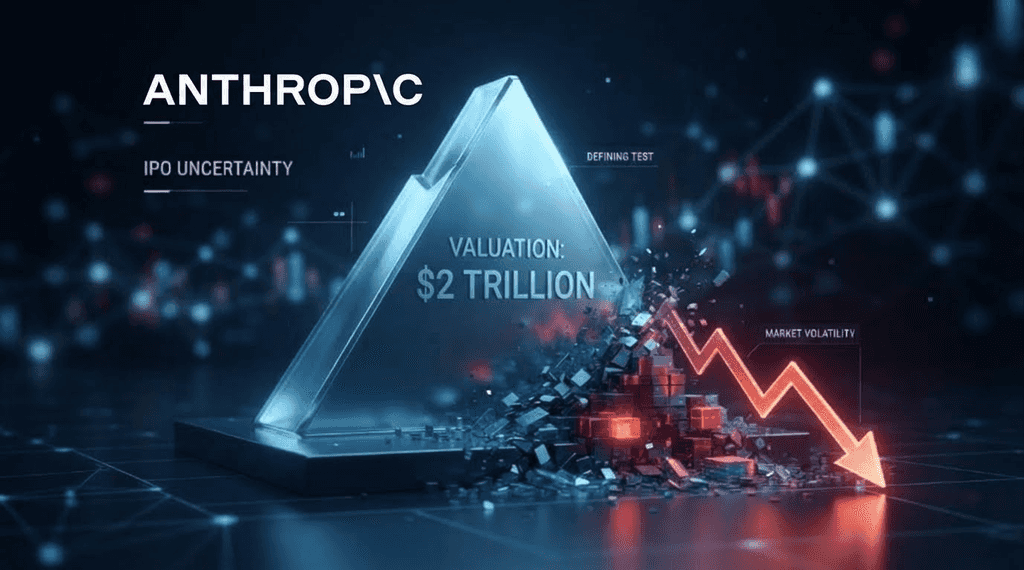
Anthropic, the artificial intelligence research laboratory and developer of the Claude model family, is confronting valuation headwinds as it prepares for an initial public offering (IPO) on United States public exchanges. Underwriting syndicates led by Morgan Stanley, Goldman Sachs, JPMorgan Chase, and Citigroup have explored an Anthropic IPO valuation of up to $2 trillion. If executed at that level, the transaction would surpass SpaceX’s $1.77 trillion market debut in June 2026 to become the largest corporate listing in financial history.
However, the timing of the offering coincides with a pronounced repricing across public technology markets. Over recent weeks, a broader AI stock sell-off has compressed equity multiples across semiconductor manufacturers, specialized cloud platforms, and data center operators. Institutional asset managers are increasingly shifting their focus from top-line revenue velocity to capital expenditure discipline, contractual cloud obligations, and sustainable free cash flow generation.
With confidential details from the Anthropic draft S-1 filing now circulating among institutional allocators, questions surrounding the durability of a $2 trillion valuation have emerged, placing the pricing and timeline of this landmark public offering under close market scrutiny.
Inside the Leaked Draft S-1 Prospectus
Anthropic submitted a confidential draft Form S-1 registration statement to the Securities and Exchange Commission (SEC) in June 2026. Subsequent disclosures reviewed by Reuters and The Wall Street Journal reveal rapid commercial revenue expansion alongside substantial non-cash accounting charges and multi-billion-dollar infrastructure commitments.
Top-Line Revenue Trajectory
Anthropic’s financial statements reflect rapid enterprise adoption driven by its Claude enterprise subscriptions, application programming interface (API) licensing, and developer tooling such as Claude Code:
-
Full-Year 2025 Performance: Generated approximately $4.6 billion in recognized annual revenue, exiting December 2025 with an annualized revenue run rate of roughly $9.0 billion.
-
First Half of 2026 (H1): Generated $16.3 billion in revenue, up roughly 14-fold from $1.1 billion in the first half of 2025, comprising $4.73 billion in Q1 and over $11.5 billion in Q2 2026.
-
Run-Rate and Q3 Acceleration: By the end of July 2026, the company's annualized revenue run rate reached approximately $65 billion. In an October 2026 pre-IPO investor update, Anthropic further disclosed that Q3 2026 revenue rose 45% sequentially to $16.8 billion.
-
Forward Projections: Internal models shared with institutional underwriters outline a year-end 2026 run-rate target of up to $110 billion and a 2028 revenue projection of $190 billion to $200 billion, contingent on sustained enterprise seat expansion and developer monetization.
This trajectory supported Anthropic’s Series H funding round in May 2026, which secured $65 billion in primary capital at a $965 billion post-money valuation, led by Altimeter Capital, Dragoneer Investment Group, Greenoaks, and Sequoia Capital.
Analyzing the $80.7 Billion Net Loss
While top-line growth accelerated, the draft prospectus disclosed an $80.7 billion net loss for the first half of 2026. For institutional equity analysts, separating accounting adjustments from operating expenses is essential when evaluating Anthropic's financial profile:
Non-Cash Financial Charges (~$72 Billion)
Approximately $72 billion of the H1 2026 accounting loss stemmed from non-cash fair-value adjustments tied to convertible notes, preferred share conversion features, and related financial instruments. Under standard accounting rules, when a private company’s implied valuation rises sharply, climbing to $965 billion in May 2026, the appreciation of its convertible liabilities must be marked to market as a non-cash charge against earnings.
Operational Cash Burn vs. Q3 Margin Inflection
Excluding non-cash charges, Anthropic recorded an underlying H1 2026 loss of roughly $8.7 billion, driven by nearly $9.0 billion spent on compute and infrastructure during the six-month period (exceeding the $7.3 billion spent in all of 2025). However, in October 2026, management informed prospective investors that surging Q3 revenue ($16.8 billion) allowed the company to achieve its first quarter of positive free cash flow and an adjusted operating margin above 11%.
AI Equity Sell-Off and P/S Multiple Compression
The broad enthusiasm that supported generative AI infrastructure valuations between 2023 and early 2026 has transitioned into stricter scrutiny of capital efficiency and debt loads.
Pullbacks in AI Hardware and Specialized Infrastructure
Publicly traded companies tied to the artificial intelligence buildout experienced notable volatility in October 2026:
-
Specialized Cloud Operators: CoreWeave (CRWV), a prominent provider of high-density GPU infrastructure, saw its shares decline roughly 30% over a two-week span in October 2026 as secondary yields on its senior unsecured bonds briefly touched 15%.
-
Semiconductor and Memory Suppliers: Memory manufacturer Micron experienced a monthly pullback of roughly 17% amid institutional debate over future supply-demand balances in high-bandwidth memory (HBM).
-
International Market Sentiment: On October 20, 2026, the KOSDAQ trading debut of South Korean AI cloud and data center provider Elice fell more than 30% on its first day despite heavy institutional oversubscription during book-building, underscoring secondary market caution toward capital-intensive AI offerings.
Price-to-Sales (P/S) Valuation Multiple Scrutiny
At a proposed IPO valuation of $2 trillion, public market investors are asked to underwrite an implied valuation multiple of roughly 31x Anthropic's July 2026 annualized revenue run rate ($65 billion), or between 21x and 29x estimated forward twelve-month revenue.
In a macroeconomic environment where benchmark interest rates remain elevated, pricing a mega-cap listing above 20x forward sales leaves a narrow margin for execution error. Although Q3 revenue grew 45% quarter-over-quarter, that represented a natural deceleration from Q2's 147% sequential jump—a moderation that institutional investors are weighing carefully when evaluating a $2 trillion price tag.
Structural Balance-Sheet Risks: The $518B–$750B Compute Obligation
Beyond secondary market volatility, institutional investors reviewing the draft S-1 have focused heavily on the scale of Anthropic's long-term infrastructure commitments and governance structure.
Take-or-Pay Cloud and Silicon Commitments
Initial disclosures from the draft prospectus revealed at least $518 billion in long-term cloud and data center commitments over roughly a decade across six major partners—with updated October filings indicating total planned compute outlays could reach up to $750 billion.
Roughly 80% of the baseline $518 billion obligation is structured under binding, non-cancellable "take-or-pay" agreements that must be paid regardless of actual usage:
-
Broadcom (Custom Silicon & Infrastructure): Approximately $161.2 billion in chip-related lease and hardware commitments.
-
Google Cloud Platform (Alphabet): Computing and TPU hosting commitments of at least $111.1 billion through 2033.
-
Amazon Web Services (AWS): Long-term cloud and Trainium infrastructure obligations totaling approximately $110 billion.
-
Microsoft Azure & Additional Partners: Multi-year cloud capacity reservations of $31.4 billion with Microsoft, alongside additional data center and compute agreements.
These contracts legally obligate Anthropic to pay hundreds of billions of dollars over the coming decade, regardless of whether end-user demand for Claude models matches internal forecasts. If enterprise software spending moderates or algorithmic breakthroughs drastically reduce the compute required for model training and inference, Anthropic remains bound by these fixed infrastructure liabilities.
The Cloud Co-Opetition Dilemma
A key risk factor highlighted in the draft S-1 is the dual role played by Anthropic’s largest cloud suppliers and strategic shareholders.
Amazon is Anthropic's largest outside shareholder with an approximate 21% equity stake following roughly $33 billion in capital commitments, while Alphabet holds roughly 14% to 15%. At the same time, Amazon, Alphabet, and Microsoft are direct competitors in the enterprise foundation model market:
-
Alphabet distributes its proprietary Gemini model family across Google Cloud while competing for enterprise AI workloads.
-
Amazon develops its internal Nova model series while hosting competing models on its Bedrock platform.
In its filing, Anthropic explicitly warned that hyperscalers increasingly view the lab as a direct competitor rather than merely a cloud customer, noting that its business could be adversely affected if third-party compute access is "curtailed, repriced, or terminated".
Revenue Concentration and Dual-Class Governance
The S-1 draft also disclosed that between 20% and 25% of Anthropic’s commercial revenue was generated by just two customers. High customer concentration creates top-line sensitivity if a major enterprise client diversifies workloads toward rival models or open-weight alternatives.
From a governance perspective, Anthropic’s seven co-founders, led by CEO Dario Amodei and President Daniela Amodei, plan to retain 50.1% of total post-IPO shareholder voting power through a dedicated legal vehicle named Founder LLC. While this structure is designed to safeguard the company's Public Benefit Corporation (PBC) mission and long-term AI safety commitments, it gives public shareholders limited voting influence over board composition or capital allocation.
Frontier AI Lab Valuations vs. Public Cloud Incumbents
Evaluating Anthropic's target valuation requires comparing its business model against established public technology giants. Incumbent hyperscalers such as Alphabet and Microsoft typically trade at single-digit to low-double-digit forward revenue multiples, own their physical data center footprints, and generate tens of billions of dollars in quarterly free cash flow.
By contrast, while Anthropic reported an impressive 85% gross margin and initial positive free cash flow in Q3 2026, it remains heavily reliant on leased infrastructure, recently tapped a $15 billion credit facility led by Blackstone, and carries over half a trillion dollars in off-balance-sheet compute commitments. For public market allocators, justifying a valuation between $1.5 trillion and $2 trillion requires high conviction that Anthropic can sustain its rapid growth toward $200 billion in annual revenue by 2028.
Timing and Regulatory Requirements
Under SEC rules, a company that has submitted a confidential draft registration statement must publicly file its Form S-1 on the EDGAR system at least 15 days prior to commencing a formal IPO roadshow.
having delayed an initial early-October listing window to finalize debt facilities and update Q3 financial disclosures, Anthropic faces key strategic choices as it targets a potential November 2026 or post-election market debut:
Valuation Range Calibration: Institutional discussions have increasingly centered on a valuation debate between $1.5 trillion and $2 trillion. Pricing toward the more conservative end of that range could attract broader long-only institutional demand and support healthier secondary trading post-listing.
Timeline Flexibility: If volatility across semiconductor and cloud infrastructure equities persists, management retains the option to extend its timeline into late 2026 or early 2027, allowing the company to demonstrate multiple consecutive quarters of positive free cash flow.
Benchmarking the AI Sector: With rival OpenAI reportedly pursuing private funding above a $1.4 trillion valuation ahead of its own prospective listing, Anthropic’s IPO pricing will serve as a primary valuation benchmark for the entire generative AI ecosystem.
Conclusion
Anthropic’s prospective public offering represents a defining valuation test for the artificial intelligence sector. While the company’s surge to $16.8 billion in Q3 2026 revenue and its transition to positive free cash flow demonstrate exceptional enterprise demand for the Claude model family, recent pullbacks in AI infrastructure stocks and scrutiny over its $518 billion to $750 billion in long-term compute commitments have introduced valuation discipline. How public markets price Anthropic’s debut will set a lasting precedent for how institutional capital values frontier technology and heavy infrastructure obligations.
FAQs
What is the expected Anthropic IPO valuation?
Underwriters led by Morgan Stanley, Goldman Sachs, JPMorgan Chase, and Citigroup have explored a potential listing valuation of up to $2 trillion, which would surpass SpaceX's $1.77 trillion debut in June 2026, though institutional debate currently spans between $1.5 trillion and $2 trillion amid broader AI stock volatility.
Why is Anthropic's $2 trillion IPO facing uncertainty?
The offering faces valuation scrutiny due to a recent sell-off across AI hardware and cloud infrastructure stocks, investor sensitivity to high price-to-sales multiples, customer concentration (roughly 20%–25% of revenue from two clients), and massive long-term compute obligations ranging from $518 billion to $750 billion.
How much revenue does Anthropic generate?
According to its draft S-1 and investor disclosures, Anthropic generated $4.6 billion in full-year 2025 revenue (exiting 2025 at a $9 billion annualized run rate), $16.3 billion in the first half of 2026, and $16.8 billion in Q3 2026 alone, reaching a $65 billion annualized run rate by late July 2026.
What caused Anthropic's $80.7 billion net loss in H1 2026?
Approximately $72 billion of the $80.7 billion H1 2026 net loss consisted of non-cash accounting charges tied to fair-value adjustments on convertible notes and financial instruments following its valuation surge to $965 billion. Excluding non-cash items, underlying operating losses were roughly $8.7 billion, driven by nearly $9 billion in H1 compute spending, before turning free-cash-flow positive in Q3 2026.
Disclaimer
This general market information, possibly from third-party, commercial, or sponsored sources, is provided for reference and educational purposes only and does not constitute financial or investment advice, an offer, solicitation, or guarantee. We disclaim liability for its accuracy, completeness, reliability, and any resulting losses. Investments/trading are risky; past performance doesn’t guarantee future results. Users should research, judge prudently, and take full responsibility. For further details, please consult KuCoin’s Terms of Use and Risk Disclosure.