

AI Data Center Debt vs. U.S. Treasury Bonds: Could Big Tech Borrowing Push Yields Higher?
Introduction
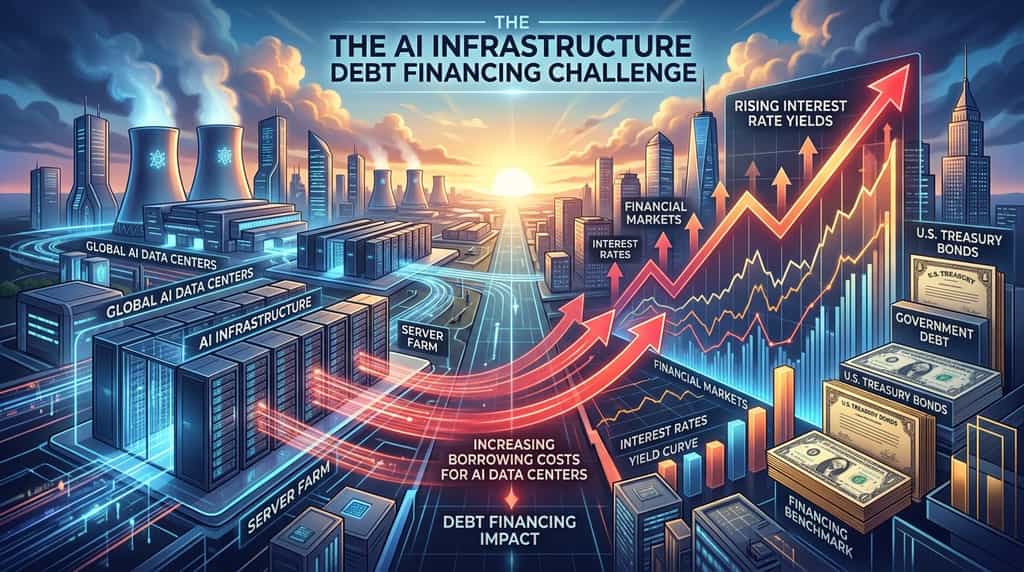
The artificial intelligence boom is creating a new financing question for investors: as technology companies borrow more to build data centers, could their demand for capital put upward pressure on U.S. Treasury yields? The risk is plausible, but not automatic. If AI infrastructure companies issue more bonds and compete with the U.S. government for investor funds, borrowing costs across parts of the bond market could rise. The eventual impact on Treasury yields will depend on investor demand, the scale and timing of new debt issuance, Federal Reserve policy, and expectations for economic growth and inflation.
Recent corporate financing illustrates how quickly AI infrastructure can require large amounts of capital. In a September 28, 2026, announcement filed with the U.S. Securities and Exchange Commission, Hut 8 disclosed a $1.07 billion senior secured revolving credit facility to support its energy and digital infrastructure business, including AI data center development.
The key question is not whether AI borrowing will replace government borrowing, but whether the combined demand for financing will change bond-market pricing. Investors should understand the difference between corporate credit risk, Treasury supply, and interest-rate expectations before treating AI debt growth as a signal for bond yields or cryptocurrency markets.
How Could AI Company Borrowing Put Pressure on U.S. Treasury Bonds?
AI company borrowing could put pressure on Treasury bonds if technology firms absorb more investor capital and leave investors requiring higher yields to purchase additional government debt. This is a possible market mechanism, not a guaranteed outcome: corporate bonds and Treasuries have different risk profiles, and investors do not allocate capital based on yield alone.
Building AI infrastructure requires substantial upfront spending on data centers, computing equipment, power supply, cooling systems, and network capacity. Companies can finance these projects with operating cash flow, equity, bank credit, corporate bonds, customer prepayments, or project-level financing. When internal cash flow cannot cover the full investment plan, borrowing becomes one way to fund expansion while limiting immediate equity dilution.
The recent Hut 8 financing demonstrates the scale of funding arrangements available to infrastructure operators. According to the company's September 28 SEC-filed announcement, its $1.07 billion revolving credit facility provides committed bank liquidity, with borrowing costs initially set at the Secured Overnight Financing Rate (SOFR) plus 175 basis points. The facility is not itself a Treasury bond issuance, but it illustrates how AI-related infrastructure can add to demand for financing across the wider credit market.
The effect on Treasury yields depends on how this borrowing interacts with the supply of government securities. If investors have a relatively fixed amount of capital to allocate, greater corporate issuance could make them more selective about the yields they demand from Treasuries. But if AI investment attracts new savings, international capital, or strong demand for corporate debt, the effect on government borrowing costs could be limited. Treasury yields also respond to inflation expectations, monetary policy, fiscal outlooks, and demand for safe and liquid assets.
Why Is AI Infrastructure Creating a Growing Need for Debt Financing?
AI infrastructure is capital-intensive because companies must commit large amounts of money before every data center or computing investment generates revenue. Demand for AI services may be growing, but operators still need to pay for land, electricity, equipment, construction, and long-term capacity commitments before they can fully monetize the assets.
Financing structures vary by company. Large technology platforms may fund infrastructure from operating cash flow and existing balance-sheet resources. Specialized data center developers may rely more heavily on bank facilities, secured borrowing, project finance, or agreements tied to future customer payments. Some companies also issue equity, although doing so can dilute existing shareholders. These financing routes are not interchangeable: each creates a different balance of interest expense, collateral requirements, maturity risk, and shareholder impact.
A September 30, 2026, filing by AIB Data Centers, available through the SEC's official filing system, described a data center capacity agreement with Nebius covering 50 megawatts of critical IT capacity under an initial 12-year term. The filing discussed customer prepayments, project-level debt, and preferred equity as parts of the development funding plan. This example shows that AI infrastructure funding can combine several capital sources rather than relying exclusively on public corporate bonds.
Debt becomes more consequential when companies borrow against expectations of future AI demand. If utilization, pricing, or customer commitments fall short of expectations, cash flow may not cover interest and principal obligations as comfortably as planned. If projects perform well, long-term customer contracts and recurring revenue may support debt service. The credit-market question is therefore whether expected cash flows justify the amount, cost, and maturity of the financing being raised.
How Does Treasury Bond Supply Affect Yields When Corporate Borrowing Rises?
Treasury yields can rise when investors require greater compensation to absorb additional government debt, but AI company borrowing is only one possible influence on that process. The Treasury market is shaped by federal financing needs, monetary policy, inflation expectations, and demand from banks, pension funds, insurers, households, and global investors.
When the U.S. government spends more than it collects in revenue, it generally finances the gap by issuing Treasury securities. Technology companies issuing bonds add to the supply of competing investment opportunities, but they do not directly increase federal debt. The two channels are connected through investors' portfolio choices rather than through a shared issuer.
The U.S. Department of the Treasury's quarterly refunding materials provide official information on government financing plans, auction policy, and debt management. Investors can compare these releases with corporate financing announcements to assess the broader supply of debt. Treasury issuance and corporate borrowing should be tracked separately because their timing, maturities, and purposes can differ substantially.
The relationship also depends on the type of Treasury security being considered. Short-term Treasury yields are particularly sensitive to expectations for Federal Reserve policy and near-term interest rates. Longer-term yields also reflect expectations for future inflation, economic growth, and the compensation investors require for holding duration risk. An increase in AI-related corporate issuance would not necessarily move every point on the Treasury yield curve by the same amount.
What Would Higher Treasury Yields Mean for Technology Stocks and AI Investment?
Higher Treasury yields can pressure technology stock valuations by raising the discount rate used to value future cash flows. The effect is often more pronounced for companies whose expected profits are weighted toward the distant future, because those cash flows lose more present value when discount rates increase.
AI-related companies face a second potential pressure: financing costs. Businesses that rely on borrowing to build data centers or acquire computing capacity may have to pay more to refinance existing debt or fund future projects if market yields and credit spreads rise. That can reduce project returns, delay construction, or encourage firms to rely more heavily on customer financing and operating cash flow.
The impact will not be uniform across the technology sector. Established companies with strong cash generation may be better positioned to fund capital expenditure internally. Smaller infrastructure operators and firms with limited recurring revenue may be more sensitive to higher debt-service costs. Even among well-capitalized companies, investors need to distinguish between debt used to fund assets with contracted revenue and borrowing based primarily on uncertain future demand.
Higher yields can also influence the relative attractiveness of equities. When government bonds offer higher returns, investors may require stronger expected earnings growth before paying elevated valuations for technology stocks. That does not mean technology shares must fall whenever yields rise; strong earnings, productivity gains, and better-than-expected demand can offset some of the pressure. The relevant question is whether future cash flow improves enough to justify the company's valuation and funding needs.
Could AI Borrowing Affect Bitcoin and Other Crypto Markets?
AI-related borrowing could influence Bitcoin and broader crypto markets indirectly through interest rates, liquidity, and investor risk appetite. The connection is not direct: AI infrastructure debt does not mechanically create selling pressure in BTC price, and a rise in Treasury yields does not guarantee a decline in cryptocurrency prices.
When Treasury yields rise, some investors may find government securities more attractive relative to volatile assets. Higher market interest rates can also tighten financial conditions by raising the cost of credit and reducing the appeal of speculative positions. If the move reflects stronger inflation concerns or a more restrictive monetary outlook, crypto assets could face additional pressure as investors reassess risk exposure.
However, Bitcoin's price depends on multiple factors, including market liquidity, institutional demand, regulation, network adoption, derivatives positioning, and broader macroeconomic expectations. A rise in Treasury yields driven by stronger economic growth could have a different market effect from a rise driven by inflation fears or increased government financing needs. The reason behind the yield move matters as much as the move itself.
Crypto investors should therefore avoid treating AI borrowing as a standalone BTC trading signal. Instead, monitor Treasury yields alongside the dollar, equity-market conditions, central-bank expectations, and crypto-specific flows. Any trading decision should account for volatility and the possibility that several market forces may be moving in different directions at the same time.
Beyond the Headlines: What KuCoin 5.0 Means for You
Market news moves fast — but where you act on it matters just as much. This October, KuCoin launches KuCoin 5.0, transforming KuCoin into a rebuilt platform. Here's what actually changes for you:
-
One account for everything. Older platforms split your money across separate "spot," "margin," and "futures" accounts and expected you to understand why. KuCoin 5.0's unified account removes that entirely — deposit once, and everything is simply there (only available to VIPs for now).
-
Stocks, indices, and commodities. KuCoin 5.0 expands beyond crypto into global markets. When crypto chops sideways and equities rally (or the reverse), you rotate in minutes instead of opening a brokerage account and waiting days for fiat rails.
-
Real-world assets (RWA). Tokenized exposure to traditional assets like commodities, right inside your crypto account. One of the fastest-growing segments in global finance is no longer reserved for institutions — you access it from the same balance you trade with.
-
Earn while you learn. Not ready to trade? KCUSD lets your stablecoins earn daily, auto-compounding interest. The lowest-stress way to put your idle deposit to work for 4% yield.
-
An AI assistant in plain language. Ask questions, get market context, understand what you're looking at — built into the platform, no jargon required.
-
An app that doesn't overwhelm. Faster, cleaner, and consistent — intuitive from the first tap, not after a tutorial.
-
Safety you can check, not just trust. A MiCAR-licensed EU entity, Proof of Reserves you can verify yourself, and internationally certified security (SOC 2 Type II, ISO 27001:2022).
Create your account in minutes — and start on the platform built for where crypto is going, not where it's been.
Conclusion
The expansion of AI infrastructure is creating substantial financing needs for technology companies, and debt is one of several tools they can use to fund data centers, computing equipment, and power capacity. If corporate borrowing grows while the U.S. government continues issuing large amounts of Treasury securities, investors may need higher yields to absorb the combined supply of debt. However, the relationship is not automatic. Investor demand, credit risk, monetary policy, inflation expectations, and the availability of alternative financing all influence bond-market pricing.
The distinction between Treasury yields and corporate credit spreads is especially important. AI borrowing could increase the cost of financing for technology companies without producing an equivalent rise in government bond yields. If Treasury yields do increase, technology valuations and AI infrastructure investment may face additional pressure through higher discount rates and financing costs.
For crypto investors, the potential impact on Bitcoin is indirect and depends on broader liquidity and risk sentiment. AI borrowing should therefore be monitored alongside Treasury yields, credit conditions, economic data, and crypto-market indicators rather than treated as an independent BTC trading signal. The most useful approach is to follow verifiable financing data and assess the reasons behind changes in market yields.
FAQs
1. What is the difference between Treasury bonds and corporate bonds?
Treasury bonds are issued by the U.S. federal government to finance government needs, while corporate bonds are issued by companies to fund operations, investment, or refinancing. Corporate bonds generally carry issuer-specific credit risk and may offer higher yields to compensate investors for that risk.
2. What happens to existing bond prices when market yields rise?
Existing fixed-rate bond prices generally fall when market yields rise, because their coupon payments become less attractive compared with newly issued bonds. Longer-maturity bonds are usually more sensitive to interest-rate changes than otherwise similar shorter-maturity bonds.
3. Does a large corporate credit facility mean a company has borrowed the full amount?
No. A revolving credit facility generally provides access to funds up to a specified limit, subject to its terms and conditions. The amount available is not necessarily the amount drawn, so investors should review company disclosures for actual borrowings and outstanding obligations.
4. Can AI investment reduce inflation over time?
Potentially. If AI improves productivity and reduces the cost of producing goods and services, it could ease some inflationary pressures over time. However, infrastructure construction also increases demand for power, equipment, labor, and financing, which may create cost pressures in the near term. The net effect depends on how productivity gains compare with investment demand.
5. Are rising Treasury yields always bearish for Bitcoin?
No. Higher yields can reduce the relative appeal of risk assets or reflect tighter financial conditions, but Bitcoin's price also responds to liquidity, demand, regulation, and crypto-specific developments. Investors should consider the cause of a yield move rather than assuming that every increase will lead to lower BTC prices.
Disclaimer: This article is for informational purposes only and does not constitute financial, legal, or investment advice. Always conduct your own research before interacting with digital assets.