

Robinhood Chain Hits $2.66M 24-Hour Revenue Milestone, Surpassing Ethereum and Hyperliquid
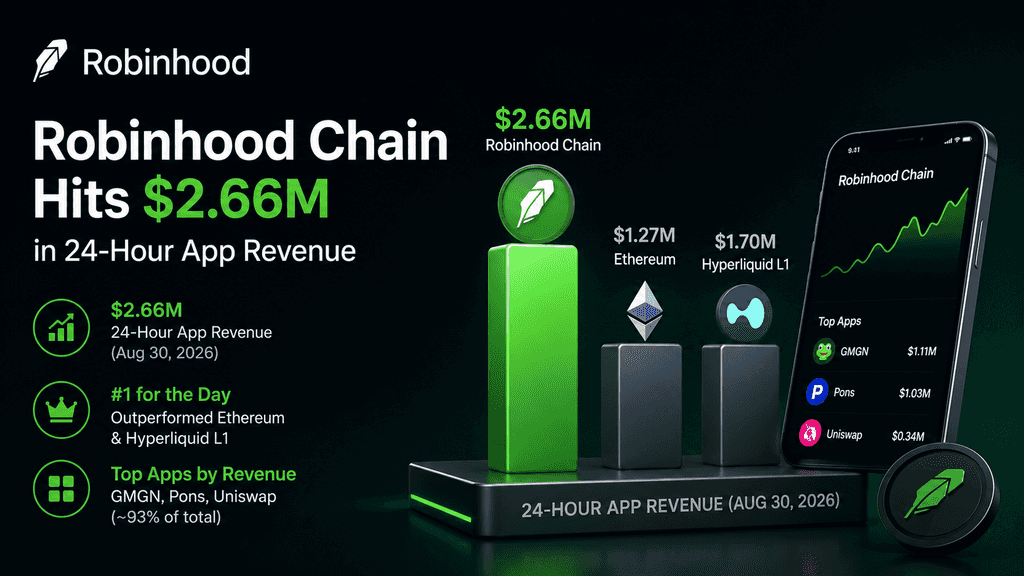
Robinhood Chain achieved a historic financial benchmark on August 30, 2026, when its ecosystem recorded $2.66 million in 24-hour application revenue according to DeFiLlama analytics. This daily figure temporarily surpassed the application fee revenue generated by established blockchain giants, including the Ethereum mainnet ($1.27 million) and Hyperliquid L1 ($1.7 million). Built as an Ethereum Layer-2 network utilizing Arbitrum Orbit technology, Robinhood Chain has demonstrated rapid growth since its mainnet launch on July 1, 2026. This milestone highlights how consumer finance platforms can leverage built-in retail distribution to rival crypto-native protocol monetization.
Key Takeaways
-
Record-Breaking Revenue: Robinhood Chain recorded $2.66 million in daily application revenue on August 30, 2026, temporarily outperforming Ethereum mainnet ($1.27M) and Hyperliquid L1 ($1.7M) over the same 24-hour window.
-
Core Drivers: Three primary applications—GMGN ($1.11M), Pons ($1.03M), and Uniswap—accounted for approximately 93% of the total network app revenue during the surge.
-
Distribution Power: Robinhood leverages its existing retail user base to eliminate Web3 onboarding friction, routing mainstream capital directly into on-chain fee-generating products.
-
Context Matters: The milestone represents a metric-specific, 24-hour snapshot; 30-day cumulative metrics confirm Ethereum ($52.03M) and Hyperliquid ($53.6M) maintain broader long-term revenue leadership over Robinhood Chain ($23.23M).
What Triggered Robinhood Chain's $2.66 Million Revenue Surge?
Robinhood Chain’s record 24-hour app revenue was driven primarily by three decentralized applications—GMGN, Pons, and Uniswap—which collectively accounted for approximately 93% of the total network app revenue. According to tracking metrics from DeFiLlama published on August 31, 2026, trading activity across decentralized exchanges (DEXs) and memecoin trading terminals on the Layer-2 network experienced unprecedented transaction volumes.
GMGN led individual decentralized application revenue on Robinhood Chain, generating roughly $1.11 million in retained trading fees during the 24-hour period. Pons followed closely behind, contributing approximately $1.03 million in application revenue. Meanwhile, Uniswap protocol deployments—which integrated with Robinhood Chain at launch across its v2, v3, and v4 automated market maker (AMM) pools—handled high volumes of both traditional crypto token swaps and tokenized equities.
How Does DeFiLlama Calculate Application Revenue Versus Network Revenue?
Application revenue measures the net fees retained by decentralized protocols after distributing allocations to liquidity providers, referrers, and network validators. According to DeFiLlama methodology guidelines published in late 2026, app revenue specifically tracks end-user payments at the smart contract level, providing an accurate picture of application-level economic monetization rather than raw blockchain gas fees.
Robinhood Chain’s underlying Layer-2 network gas fee revenue was estimated separately by DeFiLlama at approximately $963,612 for the same 24-hour period. While network gas fees reflect raw blockspace demand paid to sequencers, application revenue highlights where end-users actively spend capital to interact with financial services, trading terminals, and yield mechanisms.
| Metric (August 30–31, 2026 Window) | Robinhood Chain | Hyperliquid L1 | Ethereum Mainnet |
| 24-Hour App Revenue | $2.66 Million | $1.70 Million | $1.27 Million |
| Primary Revenue Source | GMGN, Pons, Uniswap | Perpetual Derivatives | Base Settlement & DeFi |
| Target Audience | Retail Finance & Tokenized RWAs | Crypto-Native Traders | Institutional & Multi-Chain |
| Network Architecture | Arbitrum Orbit L2 | App-Specific L1 | Layer-1 Base Chain |
Why Does Distribution Matter More Than Layer-1 Infrastructure for Revenue?
Direct consumer access enables retail financial platforms to bypass traditional Web3 onboarding friction, turning user bases into instant liquidity and fee revenue. According to financial platform reports released in August 2026, Robinhood eliminates complex barriers such as self-custody wallet creation, seed phrase management, manual token bridging, and third-party gas procurement by embedding Layer-2 rails directly into its familiar mobile application interface.
Traditional decentralized applications rely on crypto-native users discovering protocols through Web3 wallets, decentralized application browsers, and community channels. Conversely, Robinhood Chain connects established retail investment accounts to on-chain infrastructure. When new trading features, tokenized stock pools, or memecoin markets are introduced, retail capital moves into on-chain products with zero user-side technical configuration.
How Has Robinhood Chain Scale Compare to Other Layer-2 Networks?
Robinhood Chain reached 100 million total transactions faster than any previous EVM-compatible Layer-2 network following its July 1, 2026 release. Statements from Robinhood Crypto in late August 2026 confirmed that cumulative trading volume across stock token decentralized exchanges on the network had surpassed $1.5 billion within eight weeks of operation.
This rapid scaling illustrates how retail brokerages can outpace standalone crypto networks in user adoption velocity. By integrating real-world asset (RWA) trading—such as 24/7 tokenized shares of Apple, Nvidia, and Alphabet—alongside native decentralized finance tokens, Robinhood Chain creates continuous, multi-asset trading activity.
How Does Robinhood Chain Compare to Ethereum and Hyperliquid Over Longer Timelines?
A single-day revenue spike does not indicate that Robinhood Chain has permanently surpassed Ethereum or Hyperliquid in overall market dominance. According to 30-day cumulative dashboard metrics from DeFiLlama as of August 31, 2026, Hyperliquid L1 generated $53.6 million in monthly app revenue, while Ethereum mainnet recorded $52.03 million. Over that same 30-day window, Robinhood Chain generated $23.23 million.
While Robinhood Chain’s 30-day performance represents a 201% week-over-week increase, longer-term data shows that established crypto networks maintain broader, multi-sector economic volume. The comparison highlights specific structural differences across top blockchain ecosystems:
-
Ethereum Mainnet: Remains the foundational settlement layer for institutional crypto, high-value stablecoin transfers, decentralized lending protocols, and Layer-2 rollups. Its revenue is spread across thousands of independent protocols rather than concentrated trading apps.
-
Hyperliquid L1: Operates as a dominant decentralized perpetual futures exchange, producing consistent, recurring fee income driven by high-leverage professional derivatives traders.
-
Robinhood Chain: Functions as a retail-focused execution chain, where revenue experiences sharp, event-driven spikes around volatile trading events, new tokenized asset launches, and retail trading trends.
Is This Daily Revenue Milestone Sustainable?
Financial analysts note that daily application revenue spikes driven by speculative retail activity or specific protocol trading volume can experience sharp fluctuations. For Robinhood Chain to maintain long-term revenue leadership, its daily fee generation must transition from short-term retail trading surges toward recurring institutional and tokenized asset settlement.
What Does This Milestone Mean for the Future of Real-World Assets (RWAs) and DeFi?
The convergence of mainstream financial brokerages and Ethereum Layer-2 technology establishes a new model for tokenized real-world assets and decentralized finance integration. According to research published by Standard Chartered digital assets division in July 2026, combining institutional-grade brokerage liquidity with automated market makers creates an efficient infrastructure for trading 24/7 equity derivatives and tokenized financial instruments.
Robinhood Chain’s design enables tokenized equities—such as stock tokens backed by underlying traditional shares—to trade continuously outside traditional equity market operating hours. When retail traders execute stock token trades on Uniswap deployment pools built on Robinhood Chain, the protocol captures yield and transaction fees around the clock, expanding the total addressable fee market beyond standard Wall Street operating hours.
Are Other Fintech Platforms Launching Proprietary Blockchain Networks?
Major fintech corporations and brokerages are increasingly launching proprietary blockchain environments to capture application fees and retain user transactions. Market data from August 2026 shows that platforms including Coinbase (Base), Kraken (Ink), and Robinhood (Robinhood Chain) are converting their traditional user bases into active on-chain participants.
This transition transforms competition across the crypto sector. Rather than competing solely on Layer-1 transaction throughput or gas fees, blockchain networks must now compete on user distribution, regulatory compliance frameworks, and seamless consumer onboarding.
Should You Invest/Trade Crypto and Tokenized Assets on KuCoin?
KuCoin provides a comprehensive, secure, and liquidity-rich environment for trading top-tier cryptocurrencies, Layer-2 tokens, and decentralized finance assets. As blockchain ecosystems like Ethereum, Arbitrum, and emerging brokerage networks expand, KuCoin delivers professional-grade trading tools, competitive fee structures, and broad asset availability for global investors.
Why Choose KuCoin for Layer-2 and DeFi Trading?
-
Extensive Asset Selection: Access hundreds of spot and futures trading pairs, including native Layer-2 scaling tokens (ETH, ARB), decentralized exchange governance tokens (UNI), and emerging DeFi assets.
-
Low Fee Architecture: Benefit from competitive maker/taker fee tiers, spot trading fee discounts through KuCoin Token (KCS) holdings, and optimized futures transaction costs.
-
Advanced Trading Infrastructure: Utilize high-speed order execution engines, grid trading bots, automated dollar-cost averaging (DCA) tools, and institutional-grade risk management systems.
-
Global Liquidity and Depth: Execute large-scale trades with tight bid-ask spreads across deep spot and perpetual contract order books.
-
Industry-Leading Security: Safeguard digital assets with multi-tier encryption, cold-storage custody solutions, and verified 1:1 Proof of Reserves (PoR) transparency.
Take advantage of global crypto market trends by creating an account on KuCoin today. Explore advanced trading features, discover promising Layer-2 projects, and trade digital assets with confidence.
Conclusion
Robinhood Chain’s $2.66 million daily application revenue milestone on August 30, 2026, marks a pivotal moment in the evolution of blockchain monetization. By temporarily outperforming the 24-hour app revenues of Ethereum mainnet ($1.27 million) and Hyperliquid L1 ($1.7 million), the Arbitrum Orbit-powered Layer-2 network proved that consumer distribution can generate massive on-chain economic activity. Driven largely by trading volume across applications like GMGN, Pons, and Uniswap, the spike underscores how bridging retail finance with decentralized applications creates immediate fee generation.
While 30-day cumulative metrics confirm that Ethereum ($52.03 million) and Hyperliquid ($53.6 million) maintain broader long-term revenue dominance compared to Robinhood Chain ($23.23 million), this single-day achievement demonstrates a fundamental shift in crypto market structure. Established fintech brokerages and mainstream trading platforms are no longer just external on-ramps—they are becoming powerful Layer-2 ecosystem operators capable of moving billions in trading volume. As tokenized real-world assets and 24/7 financial trading mature, seamless distribution will remain a primary driver of blockchain monetization.
Frequently Asked Questions (FAQs)
What is Robinhood Chain?
Robinhood Chain is an EVM-compatible Ethereum Layer-2 blockchain network launched on July 1, 2026, by Robinhood Markets. Built using the Arbitrum Orbit technology stack, it is designed to settle tokenized real-world assets, stock tokens, and decentralized finance transactions directly for consumer finance users.
How does Robinhood Chain generate application revenue?
Application revenue is generated through transaction fees, automated market maker swap fees, and protocol service charges retained by decentralized applications operating on the network. On August 30, 2026, protocols including GMGN, Pons, and Uniswap generated $2.66 million in combined daily app fees on Robinhood Chain.
Did Robinhood Chain permanently flip Ethereum in total revenue?
No, Robinhood Chain did not permanently surpass Ethereum. The $2.66 million revenue figure was a single 24-hour daily metric spike, whereas Ethereum maintains significantly higher long-term cumulative revenue, total value locked (TVL), and network volume over 30-day and multi-year timeframes.
What applications caused the revenue spike on Robinhood Chain?
The 24-hour revenue spike was primarily driven by three applications: GMGN ($1.11 million), Pons ($1.03 million), and Uniswap protocol pools, which collectively accounted for roughly 93% of the network’s total application revenue during the recorded window.
What is the difference between app revenue and blockchain gas revenue?
App revenue measures the fees collected and retained by individual decentralized applications operating on top of a network. In contrast, blockchain gas revenue measures the native network transaction fees paid directly to sequencers or network validators to process blockspace.
🔥 KuCoin Offers A More Stable Option in A Volatile Market
If you worry about the frequent ups and downs in the market, and pursue a more stable option to earn money passively, KuCoin is the right place to come:
Simple Earn: Deposit and withdraw tokens anytime, earning stable returns.
Kucoin Earn: Earn stable profits with professional asset management.
Hold to Earn: Earn rewards by holding assets in Funding, Trading, Margin, Futures, Mining, and Unified Accounts.
Staking: Unlock the earning potential of on-chain assets.
Advanced Investments: Advanced Investments offer a variety of structured products to help your money grow in any market.
Shark Fin: Principal Protection and Guaranteed Gains
Dual Investment: Buy low and sell high with transparent return calculations.
Snowball: High yields, with price protection.
Discount Buy: Buy crypto at discount prices.
KCS Loyalty: Level up to enjoy exclusive perks by staking ≥ 1 KCS.
KuCoin Wealth: Discover future value and begin your smart investing journey.
KCS Benefits: Hold and stake KCS to access benefits across the platform.
KCS Staking 2.0: Participate in KCS on-chain governance to earn yield.
Disclaimer
The information provided on this page may originate from third-party sources and does not necessarily represent the views or opinions of KuCoin. This content is intended solely for general informational purposes and should not be considered financial, investment, or professional advice. KuCoin does not guarantee the accuracy, completeness, or reliability of the information, and is not responsible for any errors, omissions, or outcomes resulting from its use. Investing in digital assets carries inherent risks. Please carefully evaluate your risk tolerance and financial situation before making any investment decisions. For further details, please consult KuCoin’s Terms of Use and Risk Disclosure.