

KuCoin Ventures Weekly Report: Weak Jobs Ease Rate-Hike Expectations as Elevated Long-End Yields Keep Crypto Markets Divergent [图片]

1. Weekly Market Highlights
Crypto and Traditional Finance Accelerate Two-Way Integration: Stablecoins Enter Bank Settlement as Crypto-Native Trading Mechanisms Extend into Regulated Markets
Last week, developments around financial infrastructure — including stablecoin settlement, derivatives clearing, and longer-duration continuous trading — became increasingly prominent, as the integration between Crypto and traditional finance moved further into underlying market mechanisms. Citi and Coinbase expanded their partnership to further integrate stablecoins into corporate collections and bank settlement workflows, while Lloyds and Visa completed a stablecoin-based cross-border settlement pilot. On the trading side, Coinbase secured registration as a Derivatives Clearing Organization (DCO) with the U.S. Commodity Futures Trading Commission (CFTC), while Robinhood announced plans to introduce perpetual futures for eligible U.S. users and further extend equity trading hours.
Stablecoins are first becoming more directly embedded in traditional financial flows. On September 28, Citi and Coinbase announced an expanded partnership: Coinbase will use Citi’s Virtual Account Wallet to provide corporate clients with fiat account capabilities, allowing incoming fiat funds to be automatically converted into stablecoins. Citi’s institutional clients, meanwhile, will be able to accept stablecoin payments through Spring by Citi, with Coinbase providing the payment infrastructure and Citi completing the fiat settlement. Compared with simply offering stablecoin trading, the partnership more directly connects bank accounts, fiat-to-stablecoin conversion, and corporate payments.
Two days later, Lloyds Banking Group and Visa completed a seven-day live pilot, settling a total of $750,000 in cross-border payment obligations using USDC. Funds reached Visa in less than one hour, including during weekends. The pilot focused on back-end settlement between a bank and a payment network rather than consumer payments themselves, while also testing fund flows across both public and private blockchain environments. Although still limited in scale, the pilot suggests that stablecoin usage is moving beyond transfers within Crypto platforms and into real cross-border settlement processes within traditional financial institutions.
This also shifts the recent focus of stablecoin development from “who will issue” toward “who will use them and which financial flows they will enter.” However, the market remains largely at the partnership and pilot stage. Citi and Coinbase have not yet disclosed actual payment volumes, while the scale of the Lloyds and Visa pilot also remains relatively limited. The more important question going forward is whether stablecoins can generate sustained usage across corporate payments, treasury management, and cross-border settlement, rather than simply completing technical validation.
Trading infrastructure reflects integration in the opposite direction. On September 28, the CFTC approved Coinbase Clearing LLC’s registration as a Derivatives Clearing Organization (DCO), allowing it to clear fully collateralized futures, options on futures, and swaps. Combined with its existing Futures Commission Merchant (FCM) and Designated Contract Market (DCM) registrations, Coinbase has now built a U.S.-regulated derivatives framework spanning brokerage, trading, and clearing. Coinbase is also positioning the clearing system as a USDC-centric clearinghouse, with plans to support USDC collateral and 24/7 settlement, bringing stablecoin-based funding and round-the-clock operating mechanisms commonly associated with Crypto markets further into regulated derivatives infrastructure.
Robinhood is pursuing a similar direction at the product and trading-hours level. On September 29, the company announced plans to introduce perpetual futures for eligible U.S. users and to further expand weekend equity trading early next year, moving toward a trading model closer to 24/7 availability. The products remain at the planned-launch stage, but mechanisms such as perpetual futures and round-the-clock trading — historically more common in Crypto markets — are gradually entering the product architecture of traditional brokerage platforms.
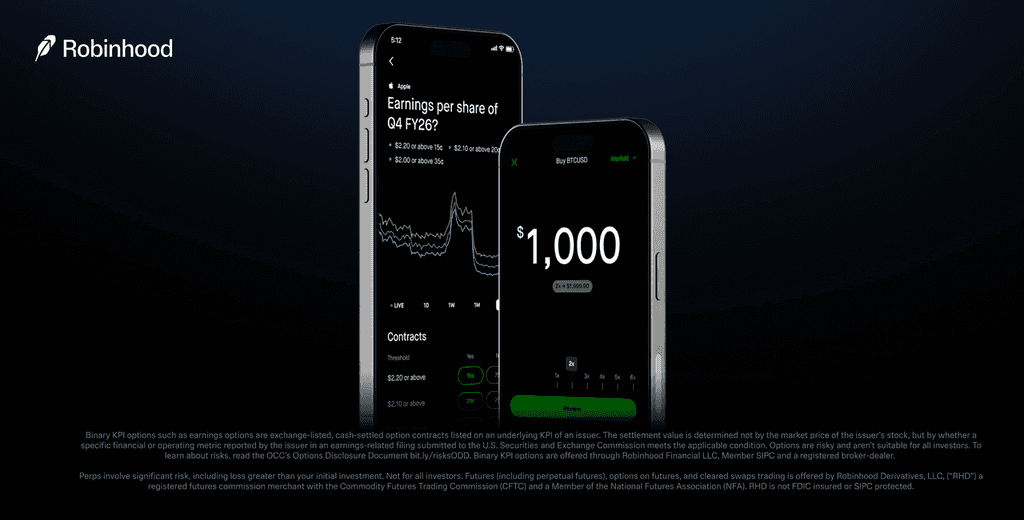
Source: Robinhood official website
From an industry-structure perspective, the next stage of competition may no longer be simply about whether institutions “offer Crypto products,” but whether stablecoin settlement, round-the-clock trading, and new derivatives mechanisms can be reliably embedded into existing financial systems. Traditional financial institutions need to address the interaction between payment networks, clearing, compliance, and risk management, while Crypto platforms entering regulated markets must also adapt to corresponding capital, clearing, and investor-protection requirements.
Accordingly, rather than focusing on the number of new partnerships or product announcements, the more meaningful indicator going forward will be whether sustained usage data begins to emerge — including corporate payment and settlement volumes across Citi/Coinbase and Lloyds/Visa, the clearing products and volumes handled by Coinbase Clearing, and the actual launch and user adoption of Robinhood’s perpetual futures and weekend equity trading. These indicators may offer a clearer view of whether the integration between Crypto and traditional finance remains at the product and technical pilot stage, or is progressing toward real adoption at the infrastructure level.
2. Weekly Selected Market Signals
Weak Employment Data Pushes Down Near-Term Rate-Hike Expectations, but Long-End Yields Remain Elevated as Crypto Markets Stay Structurally Divergent
The most notable shift in macro markets last week was that weaker U.S. employment data once again reduced expectations for further near-term rate hikes, although this repricing did not fully transmit to long-end Treasury yields. The key complexity in the current environment is that policy-rate expectations are becoming marginally less hawkish while long-term funding costs remain elevated at the same time. This has given risk assets some breathing room, but the market has yet to enter a broad liquidity-driven rally.
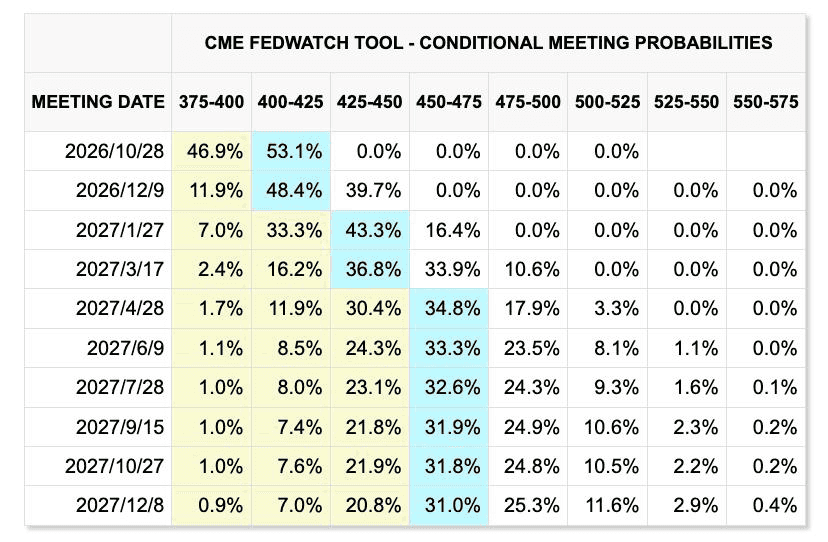
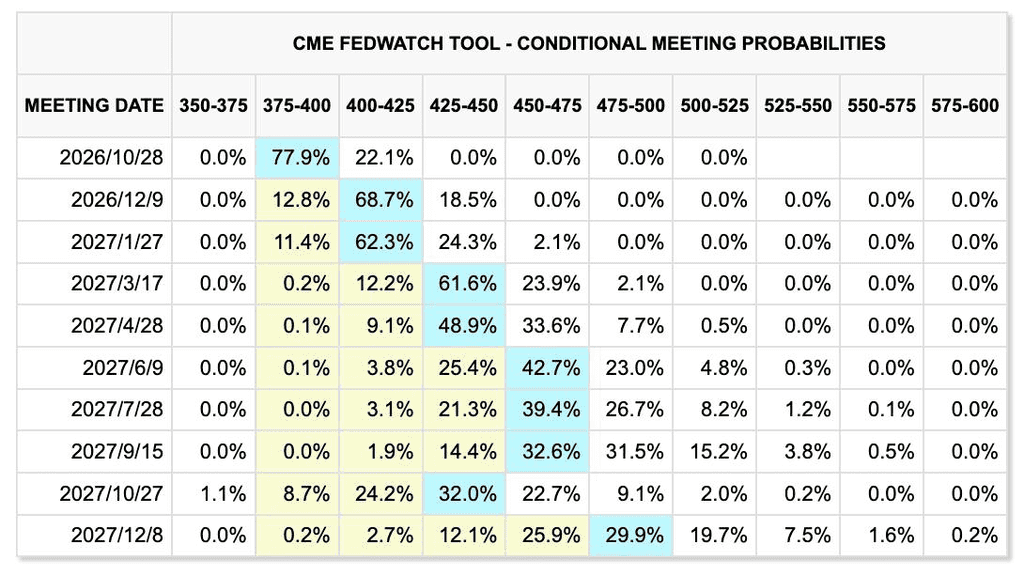
Changes in market pricing over the past two weeks (previous week shown first, current week second)
Source: CME FedWatchTool
U.S. nonfarm payrolls increased by only 29,000 in September, while the unemployment rate edged up to 4.2%. Employment figures for July and August were revised down by a combined 60,000, while average hourly earnings rose just 0.1% month-on-month and 3.0% year-on-year, pointing to continued cooling in the labor market. Inflation remains clearly above the Federal Reserve’s 2% target, although monthly core PCE growth was only 0.2%.
The weak nonfarm payrolls report reduced market expectations for further tightening. According to the latest CME FedWatch data, the market is currently pricing no additional rate hike at the October 28, 2026 FOMC meeting. Further out, however, market pricing still reflects the possibility of one more rate hike by year-end. This suggests that expectations for the future policy path remain fluid, and managing downside risks to economic growth may increasingly become one of the Federal Reserve’s key policy considerations.
U.S. equities rebounded sharply on Friday following the employment report, although on a weekly basis the S&P 500 still fell 0.27%, the Dow Jones Industrial Average declined 1.26%, and the Nasdaq Composite gained 0.45%. More notable was the reaction in the bond market: the 10-year U.S. Treasury yield briefly climbed to a multi-year high of around 5.34% during the week, fell sharply after the jobs report, and then rebounded to around 5.28%.
This points to a degree of divergence in the market’s trading logic: weaker employment data has reduced the urgency for the Federal Reserve to continue hiking rates in the near term, but long-end yields remain constrained by factors including energy prices, inflation risks, fiscal financing needs, and term premia. Friday’s rally in risk assets therefore appeared to reflect primarily a repricing of lower October rate-hike probabilities, while broader financial conditions have yet to ease materially.
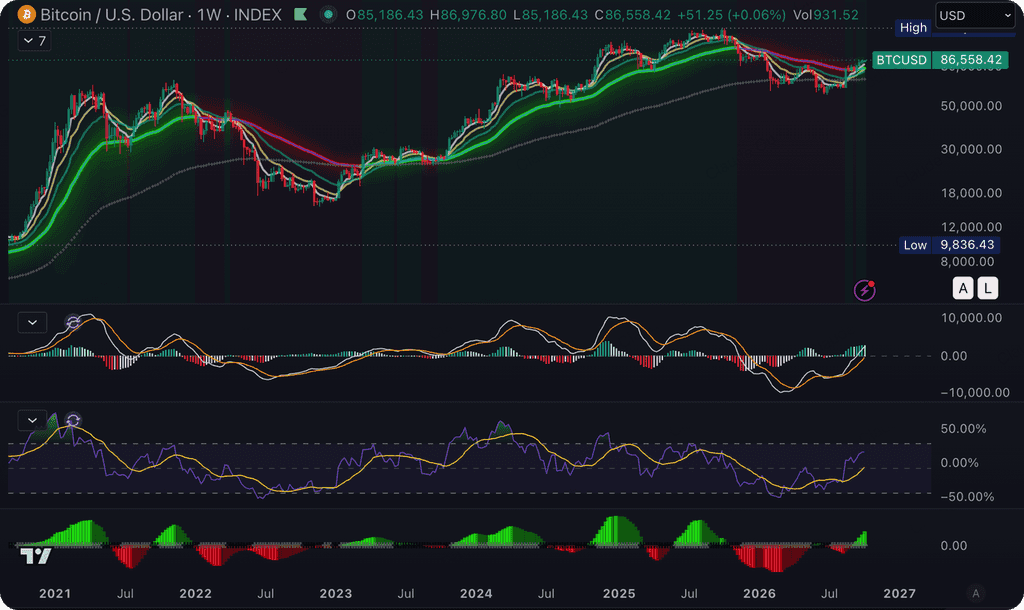
Source: TradingView
In crypto secondary markets, overall volatility remained relatively limited. By the end of the week, Bitcoin was trading around $85,000, while ETH fluctuated around $2,700, with total crypto market capitalization broadly unchanged. At the same time, Bitcoin dominance edged up to 58.9%, while only around 15 of the top 50 crypto assets posted weekly gains, indicating relatively weak market breadth.
BTC has remained above the $80,000 range despite elevated Treasury yields and a relatively strong U.S. dollar, suggesting that its funding conditions remain comparatively stable; however, this resilience is still largely concentrated in Bitcoin itself. After the employment data prompted markets to reduce near-term rate-hike expectations, ETH and most altcoins did not experience a corresponding expansion in beta, suggesting that the marginal improvement in the macro backdrop has yet to translate into a broad recovery in crypto risk appetite.
Crypto Assets and ETFs: BTC Remains Resilient, but Risk Appetite Has Yet to Broaden
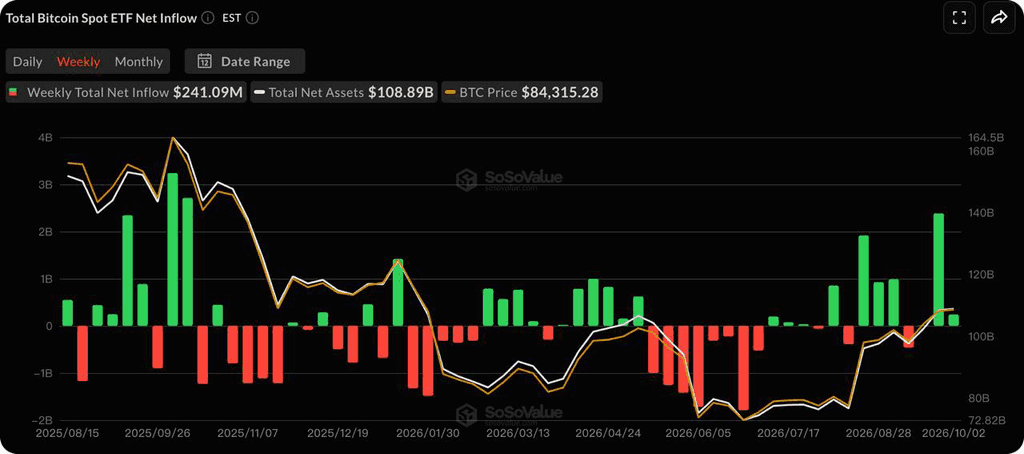
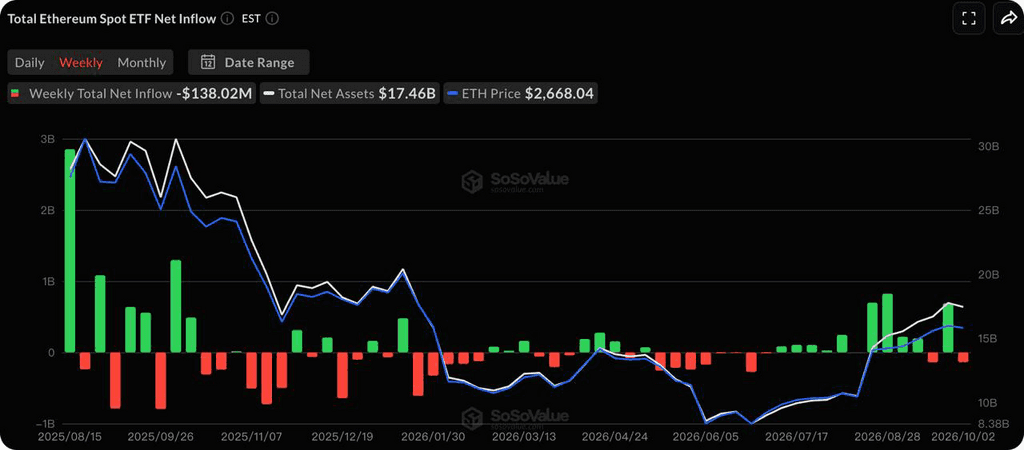
Source: SoSoValue
According to SoSoValue data, U.S. spot Bitcoin ETFs recorded approximately $241 million in weekly net inflows, bringing total net assets to around $108.89 billion. Over the same period, spot Ethereum ETFs recorded approximately $138 million in net outflows.
The direction of flows has shown some divergence between the two assets. With long-end interest-rate pressure still elevated, ETF flows continue to favor BTC, while ETH has yet to attract sustained incremental inflows. This is broadly consistent with the renewed rise in Bitcoin dominance in secondary markets and suggests that institutional capital remains concentrated in larger-cap assets rather than rotating meaningfully into higher-beta exposures.
Stabalecoin Supply Continues to Expand, While On-Chain Dollar Liquidity Has Not Contracted Materially
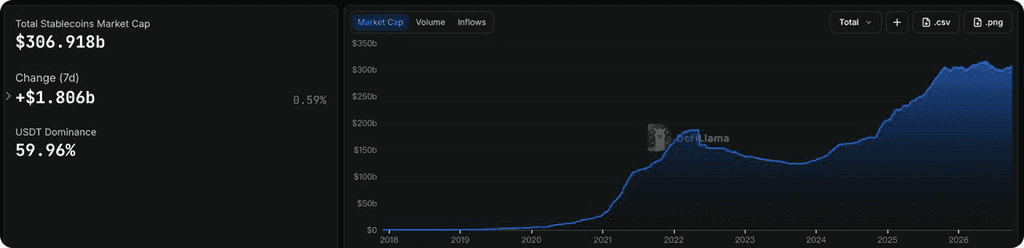
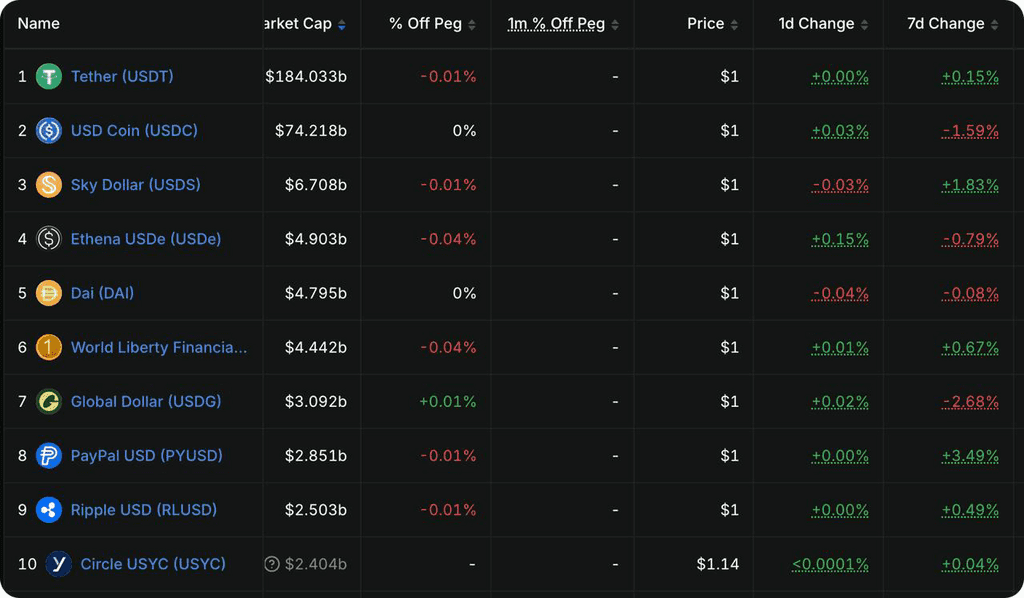
Source: DeFiLlama
According to DeFiLlama data, total stablecoin market capitalization stood at approximately $306.9 billion, increasing by around $1.8 billion, or 0.59%, over the past seven days.
Overall on-chain dollar supply therefore remains in a gradual expansion phase, although the distribution of incremental liquidity remains uneven. Stablecoin supply has not contracted materially alongside fluctuations in risk assets, continuing to provide a degree of underlying liquidity support for the crypto market. However, the current pace of growth is still insufficient on its own to support a broad, market-wide liquidity-driven rally.
Key Events to Watch This Week
The U.S. economic calendar is relatively light this week, with market attention likely to focus more on the September FOMC minutes, services-sector activity, and inflation expectations.
-
October 5: U.S. September ISM Services PMI;
-
October 6: August international trade data;
-
October 7: Minutes from the September 15–16 FOMC meeting, with markets likely to focus on policymakers’ discussions around inflation, the labor market, and the conditions required for any further rate hikes;
-
October 9: Preliminary University of Michigan Consumer Sentiment and inflation expectations for October.
Long-end Treasury yields and energy prices may remain more important to monitor than any single economic data release. U.S. September CPI will be released the following week on October 14. With few major inflation releases scheduled before then, whether the 10-year Treasury yield can sustainably retreat from around 5.3% may directly influence the valuation environment for technology equities and crypto assets.
Primary Market Funding Update
Source: RootData
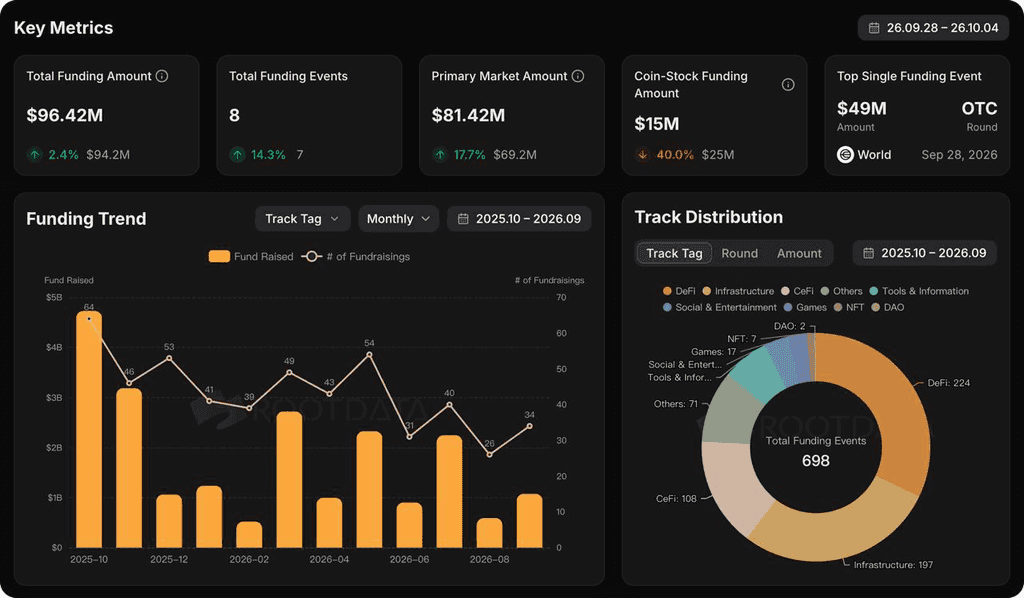
In the primary market, investment activity remains concentrated in exchanges and trading infrastructure, as well as stablecoin payment and account infrastructure, while traditional financial institutions and strategic corporate investors continue to account for a relatively high share of participation.
One of the more representative deals last week was Jeeves’ $110 million Series C1 equity financing, led by CoinFund, with participation from AllianceBernstein, a16z, Coinbase Ventures, GIC, ParaFi, and others. Jeeves sits at the intersection of stablecoin financial infrastructure and fintech, using stablecoins to connect corporate accounts while providing locally issued corporate cards across multiple markets, cash management, invoice OCR, and expense approval workflows. The company has disclosed approximately $1.5 billion in annualized stablecoin payment volume. During the same period, cross-border payment infrastructure provider Walapay raised a $4.6 million seed round, with stablecoins similarly serving as the settlement layer between bank accounts and local payment networks across different regions.
Overall, the primary market remains in a low-level recovery phase. Capital is still concentrated among a relatively small number of projects with stronger resource backing, higher perceived execution certainty, or clearer exit pathways, while the fundraising environment for smaller and mid-sized projects remains cautious.
Disclaimer This general market information, possibly from third-party, commercial, or sponsored sources, is not legal, compliance, financial, or investment advice, an offer, solicitation, or guarantee. We make no express or implied representations or warranties regarding its accuracy, completeness, or reliability, and disclaim liability for any resulting losses. Investments/trading are risky; past performance doesn't guarantee future results. Users should research, judge prudently, and take full responsibility. Please consult professional legal, tax, or financial advisors if necessary.