

KuCoin Ventures Weekly Report: A New Phase for Stablecoins as Markets Reassess Rates and AI Returns

1. Weekly Market Highlights
Stablecoin Regulation Moves from Legislation to Implementation: OCC Finalizes GENIUS Act Rules as Bank Digital Money Products Begin to Differentiate by Function
Last week, U.S. stablecoin regulation moved further from a legislative framework into the implementation stage. On October 21, the Office of the Comptroller of the Currency (OCC) issued its final rules implementing the GENIUS Act, becoming the first major federal payment stablecoin regulator to complete its implementing framework. The rules will take effect on January 18, 2027. One day later, major U.S. digital financial platform SoFi launched SoFi Earn (SOFIE), a tokenized deposit product for consumers, alongside its existing stablecoin SoFiUSD, creating a two-layer structure in which deposits are used to earn yield while stablecoins support on-chain circulation. The two developments are not directly causal, but taken together, they illustrate how clearer regulatory boundaries around stablecoins are beginning to coincide with more distinct functional roles across bank-issued digital money products.
The OCC’s final rules translate the relatively high-level stablecoin framework established under the GENIUS Act into more specific regulatory requirements, covering reserve assets, redemption, risk management, audit and supervision, custody, registration, capital, and operational support for payment stablecoin issuers. The GENIUS Act became law in July 2025, and once the rules take effect, payment stablecoin issuance in the U.S. will move further into a licensing and ongoing supervision framework. Requirements related to BSA/AML and OFAC sanctions compliance will still be addressed through subsequent rulemaking.
The treatment of stablecoin yield arrangements is particularly relevant to industry business models. The GENIUS Act continues to prohibit issuers from paying interest or yield directly to users solely for holding, using, or retaining payment stablecoins. However, the OCC’s final rules removed the proposed framework’s “rebuttable presumption” of noncompliance for certain third-party reward arrangements, meaning such structures will instead be assessed on a case-by-case basis. This does not amount to a broad exemption for Stablecoin Rewards offered by exchanges or other third parties, and the OCC retains the ability to take action against arrangements that effectively circumvent the yield prohibition.
At the same time, the GENIUS Act explicitly excludes bank deposits — including Tokenized Deposits — from the definition of a Payment Stablecoin. Although both can appear as digital representations of U.S. dollars, their legal status is different: a Tokenized Deposit remains a commercial bank deposit, simply recorded in tokenized form, while a Payment Stablecoin is a separately issued digital asset backed by reserve assets and designed for redemption. As a result, eligible tokenized deposits can pay interest and may qualify for deposit insurance under the same framework as traditional bank deposits, while a Payment Stablecoin itself is not a bank deposit and its issuer remains subject to the GENIUS Act’s restrictions on yield.
SOFIE, launched by SoFi this week, provides a relatively straightforward example of this distinction in practice. Each SOFIE represents a $1 deposit at SoFi Bank, currently offers a 4.40% APY, and is covered by FDIC deposit insurance within applicable limits. When users want to purchase Crypto or transfer funds on-chain, they can convert SOFIE 1:1 into SoFiUSD and then move funds 24/7 through blockchain networks. SoFi has therefore separated the two functions across different products: SOFIE primarily serves as a vehicle for holding funds and earning yield, while SoFiUSD is designed for payments and on-chain circulation.
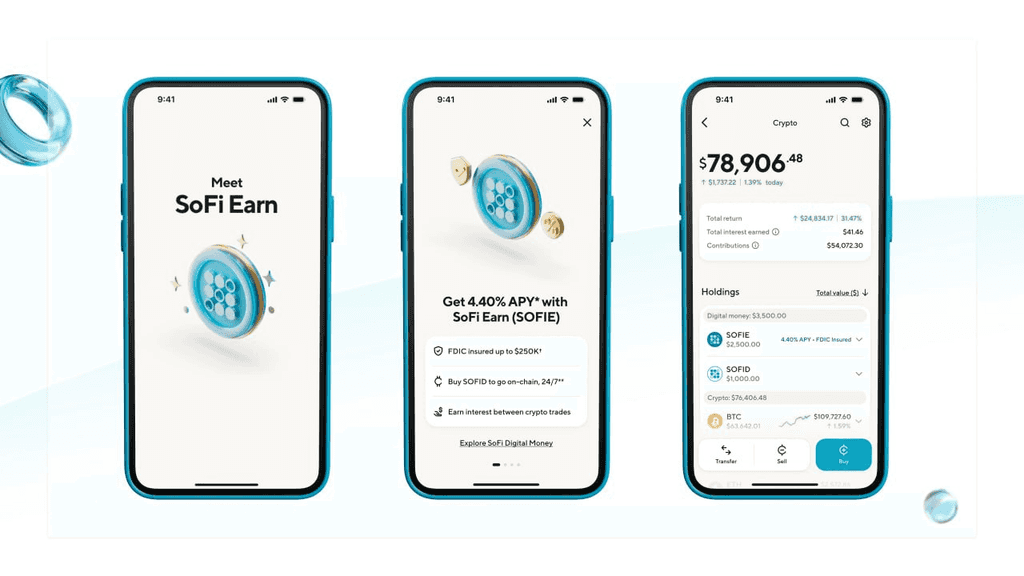
Source: SoFi official website
This product structure suggests that Stablecoins and Tokenized Deposits may not be simple substitutes. For banks, the former may be better suited for payments, settlement, and cross-platform fund transfers, while the latter can preserve the traditional characteristics of deposits, including interest, deposit insurance, and account-based banking relationships. As digital asset infrastructure becomes more integrated into the banking system, competition may increasingly shift beyond simply “who can issue a stablecoin” toward how financial institutions design the movement of funds across storage, yield, payments, and circulation using different forms of digital money.
Accordingly, as the GENIUS Act moves into implementation, the focus is likely to shift gradually from legislative progress toward actual business models: the product structures adopted by the first approved payment stablecoin issuers, how regulators treat third-party reward arrangements in practice, and whether more banks adopt a two-layer model similar to SoFi’s “Tokenized Deposit + Stablecoin” structure. Regulation is increasingly defining which functions different forms of digital money can perform, while product competition may move beyond standalone stablecoin issuance toward how user funds flow across deposits, yield generation, payments, and on-chain circulation.
2. Weekly Selected Market Signals
Tightening Expectations and Pressure on AI Investment Returns Weigh on Crypto Markets
Last week, the market’s focus on US interest rates increasingly reflected pressures from both inflation and growth. Elevated energy prices continued to constrain monetary policy flexibility, while concerns over AI capital expenditure and investment returns prompted some investors to shift from equities into Treasuries. According to a Goldman Sachs report, the US 10-year Treasury yield fell approximately 17 basis points on October 22, dropping back below 5% as longer-duration Treasuries attracted renewed safe-haven demand. However, the decline in yields primarily reflects shifting growth expectations and portfolio allocations; it does not yet establish that inflationary pressures have eased or that the tightening cycle has ended.
Source: CME FedWatchTool
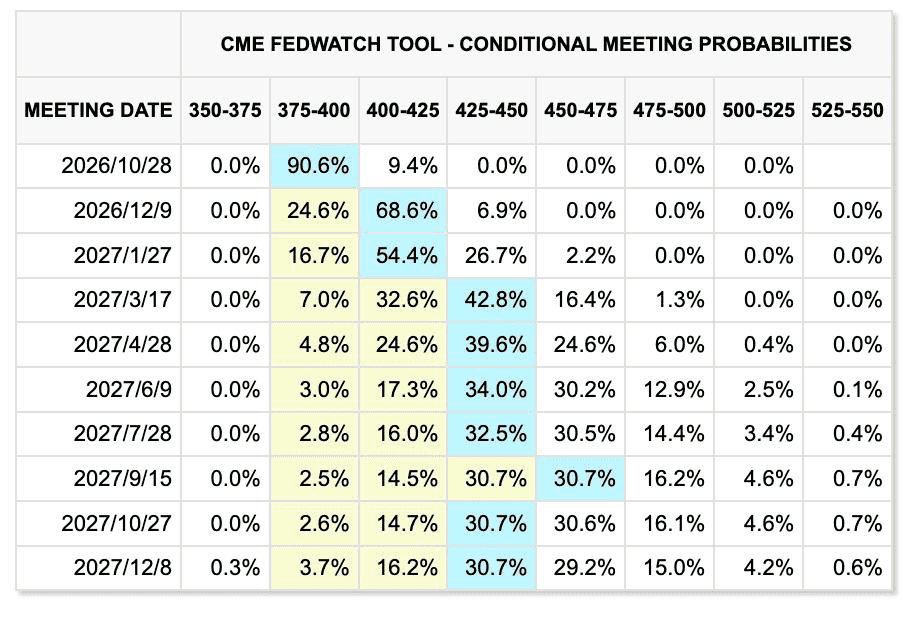
The Federal Reserve raised its federal funds target range to 3.75%–4.00% in September. Based on market pricing, rates are highly likely to remain unchanged in October. By the December FOMC meeting, however, markets assign a 69.4% probability to a target range of 4.00%–4.25% and a 6.9% probability to 4.25%–4.50%. Taken together, the probability of at least one rate hike by the December meeting remains 76.3%. Expectations for the upcoming meeting are relatively settled, but markets continue to price in meaningful tightening through year-end and into next year.
This suggests that markets still anticipate a gradual tightening path. If energy-driven inflation persists while expectations for AI investment returns weaken, investors could face an environment of growth concerns alongside elevated funding costs, constraining any recovery in risk-asset valuations.
In traditional markets, all three major US equity indices closed lower on October 23: the Dow Jones Industrial Average, S&P 500 and Nasdaq Composite fell 1.24%, 0.52% and 0.21%, respectively, on the day. Some semiconductor stocks rebounded, but financials and industrials remained under pressure, indicating that the sell-off extended beyond technology. During Asian trading on October 26, gold fell below $4,000, while Brent crude eased to approximately $115 but remained elevated. Asset prices are being shaped simultaneously by funding costs, energy risks and corporate earnings expectations; safe-haven demand has not translated into uniform gains across defensive assets.
Source: TradingView
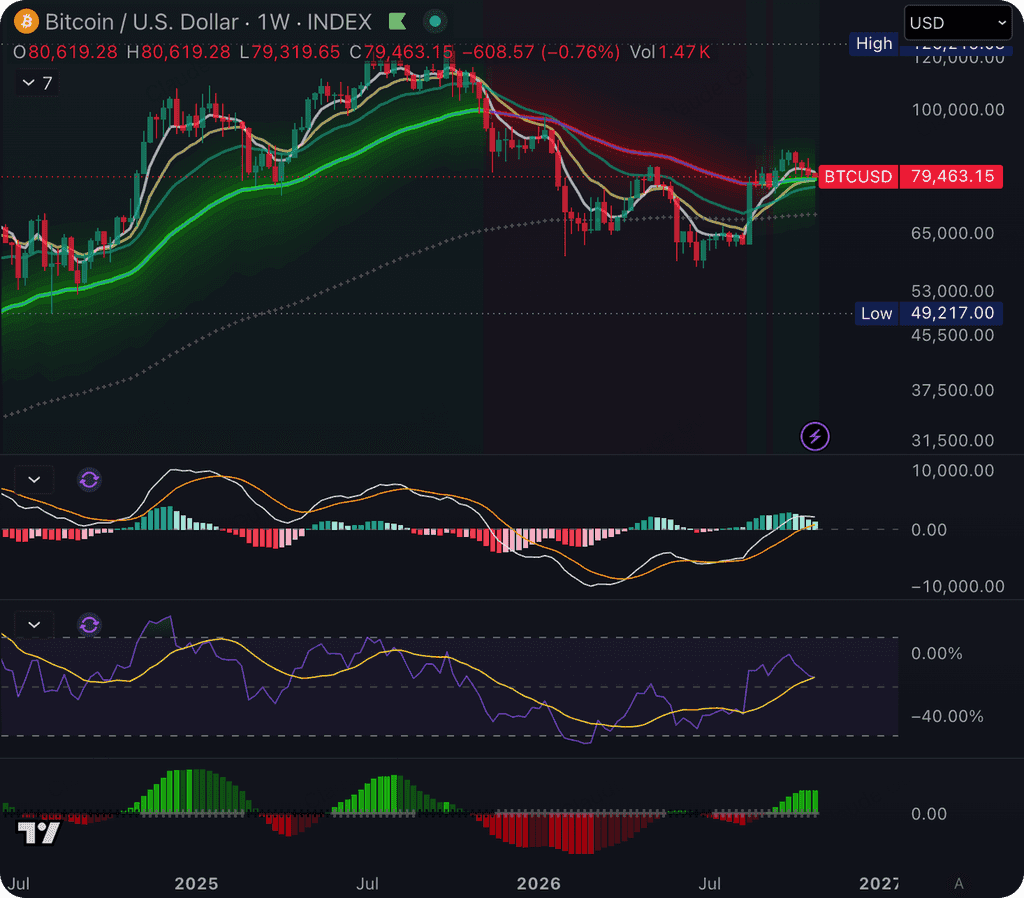
Crypto markets remained weak. As of the morning of October 26, BTC had fallen back below $80,000 and ETH below $2,400. The weekend decline was accompanied by leveraged-position liquidations: reports indicated that more than $550 million in crypto positions were liquidated over the relevant 24-hour period, including approximately $466 million in long positions. This points to significant long-side deleveraging during the sell-off, which may further amplify short-term volatility.
Source: SoSoValue
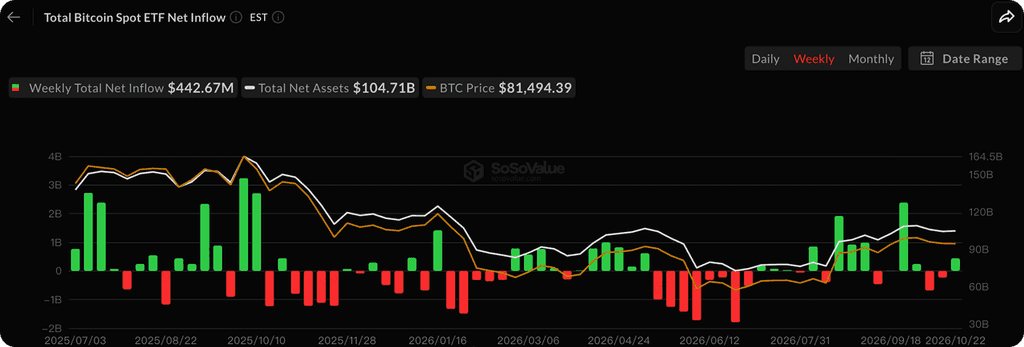
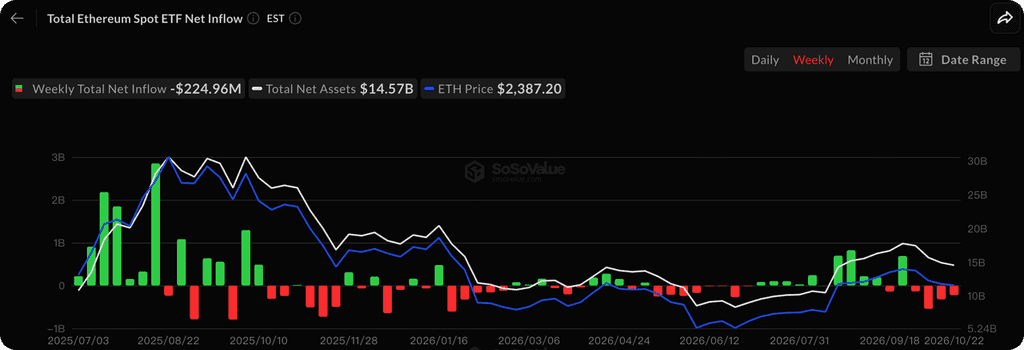
According to SoSoValue, spot BTC ETFs recorded approximately $443 million in weekly net inflows, with total net assets of around $104.71 billion. ETH ETFs continued to experience net outflows, although the pace of withdrawals slowed. Overall, buying through ETFs persists, but its scale and consistency have not been sufficient to offset selling pressure elsewhere in the market. The key indicators to watch are whether ETF inflows continue, leveraged liquidations subside, and more durable spot buying emerges around the $80,000 level for BTC.
Stablecoins: On-Chain Dollar Supply Contracts Modestly
Source: DeFiLlama
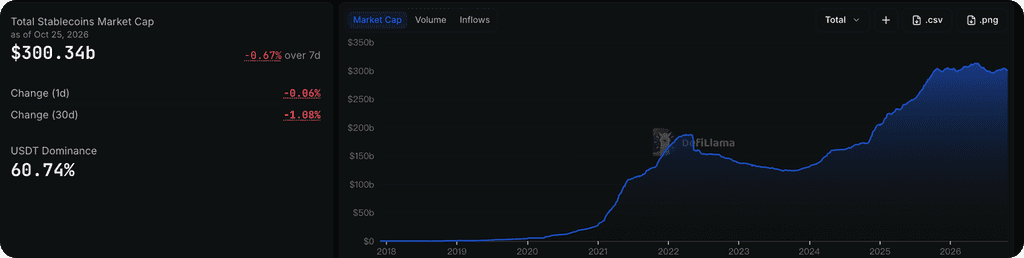
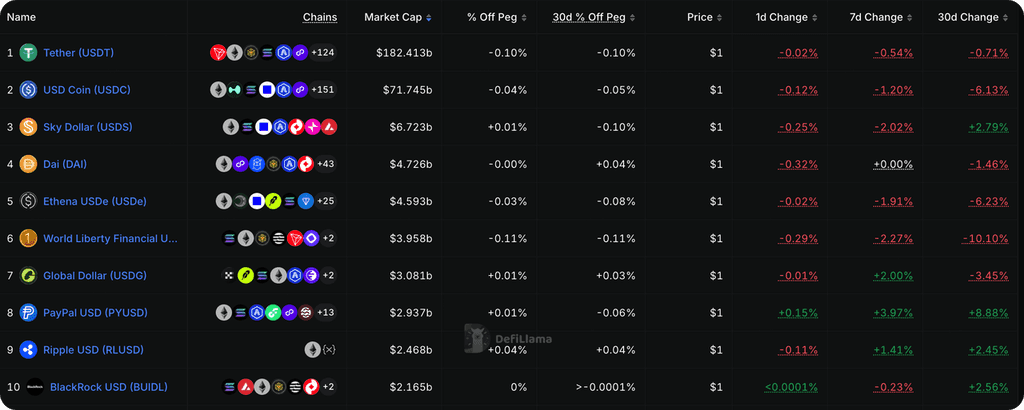
According to DeFiLlama, total stablecoin market capitalization stood at approximately $300.34 billion as of October 25, down 0.67% over the preceding seven days, equivalent to a decline of roughly $2.03 billion. Over the past 30 days, supply fell 1.08%. Alongside the recent correction in crypto assets, this contraction in on-chain dollar supply suggests that a broad-based return of fresh capital has yet to materialize. A sustained expansion in total stablecoin supply remains an important signal to watch.
Key Events to Watch This Week
This week will test both monetary policy expectations and the outlook for AI-related earnings. According to market data, approximately 179 S&P 500 companies, representing 36% of the index’s constituents, are scheduled to report earnings.
-
October 28: The Federal Reserve announces its interest rate decision, followed by a press conference at 2:30 p.m. The focus will be on policy guidance through year-end.
-
October 28, after market close: Alphabet and Microsoft report earnings. Investors will assess whether rising AI expenditure is translating into clearer revenue and cash-flow returns.
-
October 29: The US releases its advance estimate of third-quarter GDP and September Personal Income and Outlays report. Core PCE inflation and consumer spending resilience will be key.
-
October 29, after market close: Amazon reports earnings, providing another test of how AI capital expenditure aligns with revenue growth and free cash flow.
For large technology companies, attention will increasingly center on capital expenditure, revenue realization and free cash flow. An earnings beat alone may not be enough to ease valuation pressure.
Primary Market Funding Update
Source: RootData
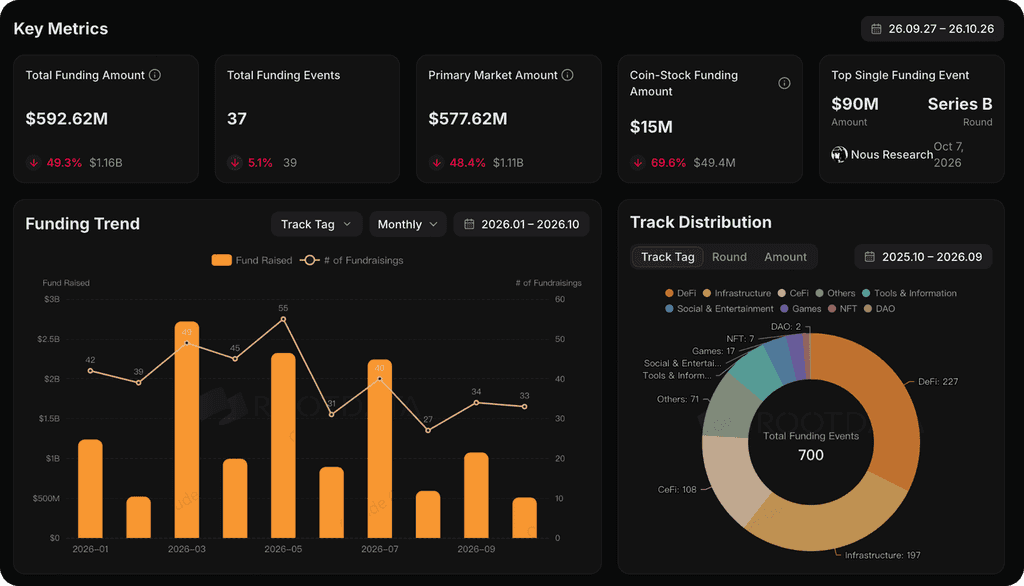
According to RootData, the crypto industry recorded 37 funding events totaling approximately $593 million between September 27 and October 26, including around $578 million in primary-market financing. Compared with the platform’s previous comparison period, total funding declined 49.3%, while the number of funding events fell just 5.1%. Funding activity continues, but average deal sizes have contracted significantly, with fewer large transactions lifting the overall total. Recent transactions involving Tether, Robinhood and ether.fi are particularly worth highlighting.
Peso and Mural: Tether Expands Across Retail and Business Payments.Tether led the pre-seed round for Bolivian fintech Peso, which enables everyday USDT spending through local bank QR payment systems, merchant acceptance and in-app payments. Meanwhile, Tether led Mural’s $15 million Series A to support its provision of accounts, cross-border payments and currency conversion services to fintech platforms. Since launching its API in 2025, Mural has processed $2.1 billion in cumulative payment volume. These investments span consumer and merchant services as well as business payment infrastructure, demonstrating that Tether is expanding practical USDT use cases through local distribution channels and business integrations. Stablecoin competitive advantages are consequently extending into merchant acceptance, fiat on- and off-ramp networks, and enterprise integrations. Once established, these relationships are generally harder to replicate than issuance scale alone.
Erebor: Connecting On-Chain Capital with Business Banking. Robinhood’s RVI fund disclosed a $30 million purchase of preferred stock in Erebor. Erebor received its US national bank charter in February, has grown its deposit base to more than $7 billion, and supports stablecoin deposits and withdrawals on networks including Sui. Its appeal lies in connecting business accounts, treasury management and on-chain settlement: AI, hard-tech and crypto companies still need bank accounts and credit services to support their financial operations. Banks that can serve both corporate deposit needs and round-the-clock on-chain payments have an opportunity to build lasting customer relationships as stablecoin adoption expands.
Zeal: ether.fi Competes to Become Users’ Everyday Financial Account. ether.fi acquired selected assets from Zeal and introduced an in-app migration path for its users. Combined with ether.fi’s existing yield, collateralized borrowing and payment card services, the transaction expands its customer acquisition channels and connects asset holdings, yield generation and everyday spending. Enabling users to perform these activities within a single account gives the platform a better opportunity to retain funds and expand revenue streams into payments and lending. The transaction also illustrates how competition among crypto financial applications is broadening from individual yield offerings to the overall account experience.
The common logic behind these investments is to build services around existing financial needs and convert users and transaction volumes into recurring revenue. This may indicate that the next phase of competition in crypto finance will increasingly depend on who controls the use cases for capital and the customer relationship. Connecting deposits, yield, borrowing and payments gives platforms an opportunity to retain funds for longer and generate revenue by meeting multiple needs for the same customer. This is why banking services, wallet consolidation and payment distribution channels warrant continued attention.
About KuCoin Ventures
KuCoin Ventures, is the leading investment arm of KuCoin Exchange, which is a leading global crypto platform built on trust, serving over 40 million users across 200+ countries and regions. Aiming to invest in the most disruptive crypto and blockchain projects of the Web 3.0 era, KuCoin Ventures supports crypto and Web 3.0 builders both financially and strategically with deep insights and global resources.
As a community-friendly and research-driven investor, KuCoin Ventures works closely with portfolio projects throughout the entire life cycle, with a focus on Web3.0 infrastructures, AI, Consumer App, DeFi and PayFi.
Disclaimer This general market information, possibly from third-party, commercial, or sponsored sources, is not legal, compliance, financial, or investment advice, an offer, solicitation, or guarantee. We make no express or implied representations or warranties regarding its accuracy, completeness, or reliability, and disclaim liability for any resulting losses. Investments/trading are risky; past performance doesn't guarantee future results. Users should research, judge prudently, and take full responsibility. Please consult professional legal, tax, or financial advisors if necessary.