

Circle Internet Group (CRCL) Rallies Above $72 Amid Arc Momentum
Key Takeaways
-
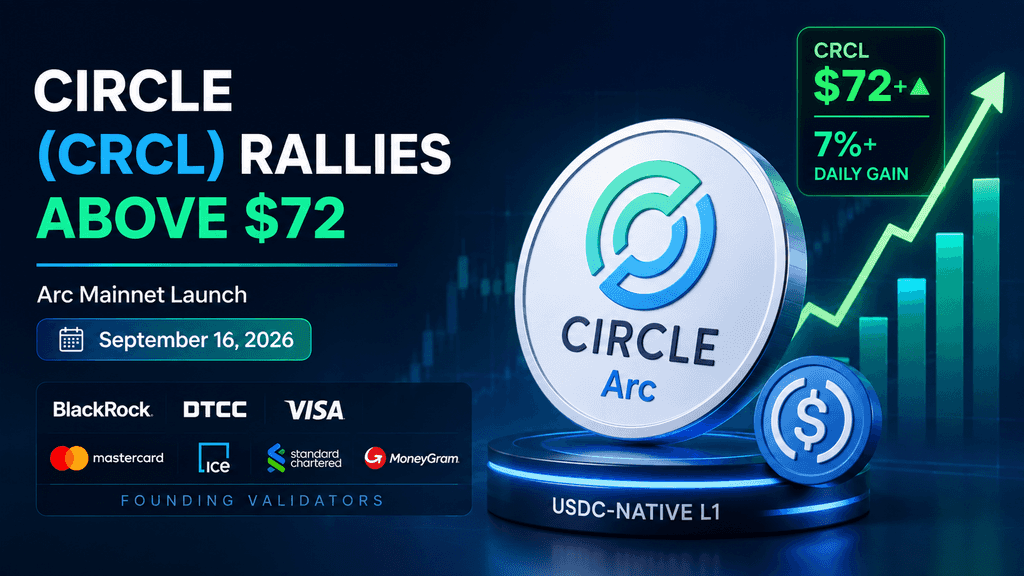
Stock Performance: Circle Internet Group (NYSE: CRCL) rallied above $72 in August 2026, marking a significant multi-week high driven by enterprise blockchain developments.
-
Arc Mainnet Date: Circle officially set September 16, 2026, as the public mainnet launch date for its purpose-built Layer-1 blockchain, Arc.
-
Institutional Validators: Traditional finance powerhouses—including BlackRock, DTCC, Visa, Mastercard, ICE, Standard Chartered, and MoneyGram—have joined as founding network validators.
-
USDC-Native Architecture: Arc eliminates network gas token volatility by using USDC directly for transaction fee settlement, lowering financial friction for institutional cross-border flows.
-
Asset Tokenization Expansion: Major institutional applications, such as BlackRock’s BUIDL tokenized fund and DTCC asset tokenization services, are preparing for direct deployment on the Arc blockchain.
-
Market Outlook: The convergence of regulated stablecoin infrastructure and institutional adoption position Circle and USDC ecosystem markets for expanded global liquidity.
Circle Internet Group Inc. (NYSE: CRCL) has surged past $72 per share after posting a single-day gain exceeding 7%, driven by mounting institutional enthusiasm for its upcoming Layer-1 blockchain, Arc, and strong second-quarter 2026 earnings. The rally reflects a structural pivot in market sentiment as Circle transitions from a pure-play stablecoin issuer into a comprehensive blockchain infrastructure provider. According to market data from Bybit released in August 2026, CRCL shares broke above resistance at $72.00, buoyed by accelerating network adoption and a return to net profitability. Based on Circle’s official second-quarter 2026 financial report published on August 5, 2026, the company generated $701 million in total revenue and reserve income while expanding USDC circulation to $73.3 billion. Investors are increasingly pricing in the commercial potential of Arc, which features an institutional validator cohort comprising BlackRock, Visa, and Mastercard ahead of its scheduled September 16, 2026 mainnet launch
What Caused Circle Internet Group (CRCL) Stock to Surge Above $72?
Circle Internet Group (CRCL) rallied above $72 because stronger-than-expected fiscal second-quarter 2026 financial metrics and accelerated institutional adoption of USDC restored investor confidence following earlier summer consolidation. The stock's 7% single-day advance was catalyzed by Circle swinging back to net profitability after absorbing significant initial public offering charges in the prior year. According to market data published by Bybit on August 11, 2026, CRCL trading volume spiked as institutional buyers accumulated shares near the $66.00 to $68.00 support zone, pushing the stock through key technical resistance levels. Based on Circle's August 5, 2026 earnings filing with the U.S. Securities and Exchange Commission (SEC), total revenue and reserve income grew 7% year-over-year to $701 million, demonstrating resilient cash flow generation even during periods of fluctuating interest rate environments.
Strong Fiscal Q2 2026 Financial Results Drive Market Sentiment
Circle's return to quarterly profitability provided the primary fundamental catalyst for the stock's upward momentum. Based on financial statements published in Circle’s Q2 2026 earnings release on August 5, 2026, the company reported net income from continuing operations of $48 million, representing a $530 million improvement compared to the net loss of $482 million recorded in Q2 2025. The prior year’s massive loss was heavily distorted by $591 million in non-cash IPO-related stock-based compensation charges following the company's NYSE debut. According to the same August 2026 financial disclosures, Circle achieved an Adjusted EBITDA of $143 million for the quarter, reflecting an 8% year-over-year increase and maintaining a strong Adjusted EBITDA margin of approximately 50%. Operating expenses fell by 56% year-over-year to $254 million due to normalized equity compensation, proving to analysts that core business unit economics remain robust.
Surging USDC Circulation and Record On-Chain Transaction Volume
Accelerating global demand for digital dollar settlement expanded Circle’s underlying reserve balance and platform utility during the second quarter of 2026. According to official operational updates released by Circle on August 5, 2026, USDC in circulation reached $73.3 billion at the end of Q2 2026, marking a 19% year-over-year expansion. On-chain transaction volume for USDC reached an all-time high of $14.8 trillion during the three-month period, reflecting a 151% increase compared to the $5.9 trillion recorded in Q2 2025. Based on research published by Simply Wall St on August 6, 2026, average daily on-chain volume for USDC annualized at $163 billion, underscoring the stablecoin’s role as primary liquidity infrastructure across decentralized finance and cross-border settlement channels. This expanding operational scale directly increases Circle’s interest-earning asset base, providing a stable earnings floor while new business lines scale.
How Is the Upcoming Arc Blockchain Mainnet Influencing CRCL Stock Momentum?
The upcoming mainnet launch of Arc on September 16, 2026, is driving CRCL stock momentum by expanding Circle's addressable market from stablecoin issuance into high-margin Layer-1 blockchain transaction processing and enterprise software fees. Investor enthusiasm has intensified as market participants recognize that Arc allows Circle to capture transaction fee value that was previously ceded to alternative Layer-1 networks like Ethereum and Solana. Based on technical disclosures from Circle’s developer updates in August 2026, Arc’s public testnet has processed over 500 million transactions across nearly 3 million unique wallet addresses since its release. Furthermore, Circle successfully closed an ARC token presale raising $242 million from institutional investors during Q2 2026, with revenue recognition tied to upcoming operational milestones that management expects to achieve throughout late 2026.
Institutional Validator Cohort Secures Institutional Backing
Arc has secured unprecedented institutional credibility by assembling a founding validator network composed of the world's largest financial and technology companies. According to Circle's press release on August 5, 2026, the founding third-party validator cohort for Arc includes BlackRock, The Depository Trust & Clearing Corporation (DTCC), Visa, Mastercard, Standard Chartered, Intercontinental Exchange (ICE), SBI Group, Global Payments, MoneyGram, Sumitomo Corporation, and Galaxy. Based on analysis from Zacks Investment Research published on August 7, 2026, this validator architecture solves the primary compliance and security concerns that previously prevented Tier-1 financial institutions from deploying public blockchain infrastructure. By requiring trusted, regulated entities to validate blocks and maintain network integrity, Arc establishes an enterprise-grade settlement environment tailored specifically for capital markets and institutional treasury operations.
Native USDC Gas Token Architecture Solves User Experience Friction
Arc removes transaction cost unpredictability by utilizing USDC directly as the native gas token for network fees, eliminating the need for users to hold volatile secondary cryptocurrencies. According to technical documentation published by Yellow.com on August 13, 2025, Arc is fully Ethereum Virtual Machine (EVM) compatible, allowing developers to deploy existing smart contracts without rewriting code bases. Based on developer updates released by Circle in August 2026, using USDC as a native gas token provides deterministic, sub-second transaction finality with fees denominated directly in digital dollars. This design choice removes foreign exchange volatility from operational budgets, making automated micropayments, enterprise billing, and algorithmic treasury rebalancing vastly simpler for corporate integration compared to legacy networks that require native utility tokens like ETH or SOL.
What Role Do Tokenized Assets and Enterprise Integrations Play in Circle's Strategy?
Tokenized real-world assets (RWAs) and enterprise treasury integrations form the central pillar of Circle’s long-term strategy to diversify earnings away from interest rate-dependent reserve yields. By positioning Arc as the premier execution venue for tokenized securities, private credit, and foreign exchange, Circle aims to capture steady software-as-a-service and transaction routing revenues. Based on statements from Circle’s management during their August 5, 2026 earnings presentation, the company raised its full-year guidance for non-reserve revenue to $310 million–$330 million, up significantly from prior estimates of $150 million–$170 million. This guidance upgrade reflects accelerating enterprise contract wins and licensing fees associated with Circle’s growing suite of Web3 infrastructure services.
BlackRock BUIDL Deployment and DTCC Tokenization Partnerships
Major global asset managers and clearinghouses are actively deploying capital assets onto the Arc blockchain to streamline trade clearing and liquidity management. According to Circle's Q2 2026 business highlights published on August 5, 2026, BlackRock is preparing to deploy its USD Institutional Digital Liquidity Fund (BUIDL) natively on Arc to enable instant collateral settlement and repo market transactions. Based on the same official disclosure, The Depository Trust & Clearing Corporation (DTCC) is building infrastructure on Arc to enable the tokenization and fractional ownership of traditional assets custodied within The Depository Trust Company (DTC). According to financial reporting by Stock Titan on August 5, 2026, Bank of New York Mellon (BNY) has simultaneously expanded its custodial partnership with Circle, integrating USDC liquidity into its global FX and collateral management platforms.
Privacy Features and Programmable Finance Agent Stack
Arc integrates native privacy capabilities and artificial intelligence agent tooling to support complex, automated financial interactions without sacrificing regulatory compliance. According to product specifications released by Circle in August 2026, Arc features opt-in zero-knowledge privacy controls that allow institutional counterparties to keep transaction details confidential while proving regulatory compliance to auditors. Based on Circle's Q1 and Q2 2026 developer announcements, the platform includes a dedicated "Agent Stack" featuring tools such as the Circle Command Line Interface (CLI), Agent Wallets, and an Agent Marketplace. These developer tools enable artificial intelligence agents to autonomously hold, transfer, and invest USDC capital across permissionless protocols, laying the foundation for machine-to-machine commerce and micro-settlement ecosystems.
What Are the Primary Financial and Market Metrics for Circle (CRCL) in 2026?
Circle Internet Group's financial profile in 2026 is characterized by expanding revenue, positive net income, high operating margins, and continuous growth in stablecoin supply metrics. Based on official quarterly filings submitted to the SEC, Circle's financial turnaround is highlighted by a shift from heavy stock-based compensation losses following its June 2025 initial public offering toward strong operating cash flows. The company's market capitalization has recovered sharply alongside its share price, reflecting investor appreciation for its high-margin business model.
| Metric Category | Q2 2025 Performance | Q2 2026 Performance | Year-over-Year Growth (%) |
| Total Revenue & Reserve Income | $658.1 Million | $701.3 Million | 0.066 |
| Net Income / (Loss) | ($482.1 Million) | $48.2 Million | +110.0% (Swing to Profit) |
| Adjusted EBITDA | $132.5 Million | $143.1 Million | 0.08 |
| Adjusted EBITDA Margin | 20.10% | 50.30% | +30.2 Percentage Points |
| USDC Circulation | $61.6 Billion | $73.3 Billion | 0.19 |
| Quarterly On-Chain Volume | $5.9 Trillion | $14.8 Trillion | 1.508 |
| Operating Expenses | $577.3 Million | $254.0 Million | -56.00% |
According to financial analysis published by Trefis on August 7, 2026, Circle’s revenue model remains highly efficient, with distribution and transaction costs holding steady at $412 million in Q2 2026 despite massive increases in on-chain transaction volume. Based on data from Zacks Investment Research published in August 2026, Circle’s balance sheet carries strong cash reserves following its $1.05 billion IPO raise, providing substantial capital runway to fund ongoing research and development for Arc, AI payment agent tools, and international licensing expansions without requiring dilutive secondary equity financing.
How Does Arc Position Circle Against Competing Blockchain Infrastructure?
Arc positions Circle as a direct institutional competitor to traditional payment rails like Visa and Mastercard, as well as general-purpose Layer-1 blockchains like Ethereum, Solana, and Avalanche. Unlike consumer-oriented blockchains that prioritize speculative trading throughput, Arc is engineered specifically to meet institutional requirements for gas price predictability, legal finality, and identity compliance. Based on market commentary from Barchart published on August 5, 2026, Arc represents a strategic move by Circle to build an end-to-end proprietary technology stack, capturing both the asset layer (USDC) and the execution layer (Arc).
| Architectural Feature | Circle Arc Blockchain | General Purpose L1s (Ethereum/Solana) | Traditional Payment Nets (Visa/SWIFT) |
| Native Gas Currency | USDC (Fiat-Stable) | Volatile Tokens (ETH / SOL) | Fiat Currency via Banking Rails |
| Settlement Speed | Sub-Second Finality | Variable (Seconds to Minutes) | 1 to 3 Business Days |
| Validator Structure | Regulated Financial Institutions | Decentralized Public Nodes | Centralized Proprietary Servers |
| Privacy Architecture | Opt-In Zero-Knowledge | Fully Transparent or Unregulated | Fully Private / Proprietary Silos |
| EVM Compatibility | Full EVM Native | Network Dependent | None (Legacy APIs) |
| Fee Structure | Fixed USD Cent Fractions | Volatile Gas Prices | Percentage + Fixed Merchant Interchange |
According to research from Yellow.com published in August 2025, traditional payment processors and fintech giants are rapidly introducing custom blockchain solutions to capture digital asset flows. For instance, payment firm Stripe partnered with Paradigm to develop the Tempo network, while trading platform Robinhood launched its tokenization Layer-2 network in mid-2025. Based on competitive benchmarking by Simply Wall St in August 2026, Circle’s Arc distinguishes itself from competitors through its native USDC integration, pre-established regulatory permissions across global jurisdictions, and direct backing from world-class institutional clearing houses like the DTCC.
What Risks Could Threaten Circle's Upward Price Trajectory?
Circle’s upward stock momentum faces potential headwinds from central bank benchmark interest rate cuts, regulatory implementation shifts, and intense competitive pressure within the stablecoin market. While market sentiment around CRCL remains bullish due to Arc momentum, investors must evaluate macro and structural risk factors that could impact the company's valuation. Based on independent equity risk evaluations published by Simply Wall St on August 6, 2026, Circle's heavy reliance on reserve interest income exposes its core revenue model to monetary policy easing cycles.
Interest Rate Sensitivities and Reserve Income Yield Dynamics
Federal Reserve interest rate decisions directly dictate the yield Circle earns on its multi-billion-dollar USDC reserve fund. According to financial analysis from Trefis published on August 7, 2026, Circle’s Q2 2026 revenue of $701 million slightly missed Wall Street consensus estimates of $718 million due to lower short-term yields on Treasury bills held in the USDC Reserve Fund. Based on SEC disclosures from Circle's Q2 2026 report, over 85% of Circle’s current total revenue originates from reserve interest yield. Consequently, a rapid, aggressive series of interest rate cuts by global central banks would compress Circle’s net interest margins, requiring new software revenue from Arc and the Circle Payments Network (CPN) to scale faster to offset reserve yield declines.
Execution Risks and Market Competition in Stablecoin Infrastructure
Delays in Arc's mainnet rollout or slower-than-expected commercial onboarding could trigger valuation compression for CRCL stock. Based on analysis from Simply Wall St published on August 6, 2026, Circle faces growing competition from alternative stablecoin issuers and bank-backed tokenized deposit initiatives, such as the Open USD consortium and proprietary commercial bank settlement rails. Additionally, because Circle's $242 million in ARC token presale proceeds depend on achieving specific commercial milestones before revenue can be fully recognized, any technical or regulatory impediments during the September 16, 2026 mainnet deployment could negatively impact financial results in subsequent quarters.
How to Buy and Trade Circle (CRCL) and Related Crypto Assets on KuCoin?
KuCoin provides a secure, high-liquidity cryptocurrency trading platform that allows global users to trade USDC, access stablecoin yield products, and position themselves ahead of major blockchain infrastructure shifts like Arc. While CRCL equity trades on the New York Stock Exchange, crypto traders can access the broader Circle ecosystem and related Layer-1 tokens directly on KuCoin.
To trade USDC pairs and ecosystem tokens on KuCoin, follow these simple steps:
-
Create and Verify Your Account: Visit the official KuCoin website or download the KuCoin app. Register using your email address or mobile number, and complete Identity Verification (KYC) to unlock full trading limits and deposit capabilities.
-
Deposit Funds into Your Account: Navigate to the "Assets" section and select "Deposit." You can transfer fiat currency via bank transfer, credit card, or deposit existing crypto assets such as USDT or Bitcoin directly into your KuCoin Funding Account.
-
Navigate to Spot Trading: Go to the "Trade" tab and select "Spot Trading." Search for your desired USDC trading pair, such as BTC/USDC, ETH/USDC, or KCS/USDC.
-
Execute Your Order: Choose your preferred order type—Limit Order, Market Order, or Stop-Limit Order. Enter the quantity of USDC or base currency you wish to buy or sell, review the details, and click "Buy" or "Sell" to execute your trade instantly.
-
Utilize KuCoin Earn for Passive Yield: Earn yield on your digital dollar holdings by navigating to the "Earn" section on KuCoin. Select USDC flexible or fixed savings products to generate daily interest while maintaining liquidity for future market opportunities.
Conclusion
Circle Internet Group (CRCL) has demonstrated powerful financial and technical execution, propelling its share price above $72 as investors price in the transformative potential of its Layer-1 blockchain, Arc. The company’s fiscal second-quarter 2026 financial results confirmed a decisive return to profitability, generating $701 million in revenue and $48 million in net income while driving USDC circulation to $73.3 billion. Arc represents a monumental evolution in Circle’s corporate narrative, converting the company from an interest rate-sensitive stablecoin issuer into a full-stack financial technology network. Backed by a premier institutional validator cohort including BlackRock, DTCC, Visa, and Mastercard, Arc’s September 16, 2026 mainnet launch is set to establish new standards for enterprise payment settlement, tokenized real-world assets, and programmable finance. While interest rate sensitivities and competitive risks remain key considerations, Circle’s expanding product suite positions it at the center of institutional Web3 adoption.
FAQs
What is Circle Arc, and when is its mainnet launching?
Arc is Circle’s enterprise-grade, EVM-compatible Layer-1 blockchain that uses USDC as its native gas token for transaction fees. The network features sub-second finality, opt-in zero-knowledge privacy controls, and a validator set composed of major financial institutions. Arc’s public mainnet is officially scheduled to launch on September 16, 2026.
Why did Circle (CRCL) stock surge above $72 in August 2026?
CRCL stock surged past $72 due to a combination of strong fiscal Q2 2026 financial results, positive guidance upgrades for non-reserve revenue, and accelerating momentum surrounding the Arc blockchain mainnet launch. Circle reported $701 million in Q2 revenue and a return to net profitability with $48 million in net income, boosting investor sentiment across public markets.
Who are the founding institutional validators for the Arc blockchain?
The founding third-party validator cohort for Arc includes leading global financial institutions and technology corporations: BlackRock, The Depository Trust & Clearing Corporation (DTCC), Visa, Mastercard, Standard Chartered, Intercontinental Exchange (ICE), SBI Group, Global Payments, MoneyGram, Sumitomo Corporation, and Galaxy.
How does using USDC as a native gas token benefit Arc users?
Using USDC as a native gas token eliminates price volatility associated with network transaction fees, allowing enterprise users to pay predictable, sub-cent settlement costs directly in digital dollars. This design simplifies accounting, automated treasury operations, and smart contract development by removing the requirement to purchase or hold volatile utility tokens.
How can I trade USDC and participate in the Circle ecosystem on KuCoin?
You can trade USDC on KuCoin by creating an account, completing KYC verification, and depositing fiat or crypto funds. KuCoin offers extensive spot trading pairs for USDC, along with KuCoin Earn savings programs that allow users to generate passive interest yields on their USDC holdings.