

Bitcoin Hits $87,000, Ethereum Tops $2,800: Nearly $1B ETF Inflows, Short Squeeze and SEC Tokenization News
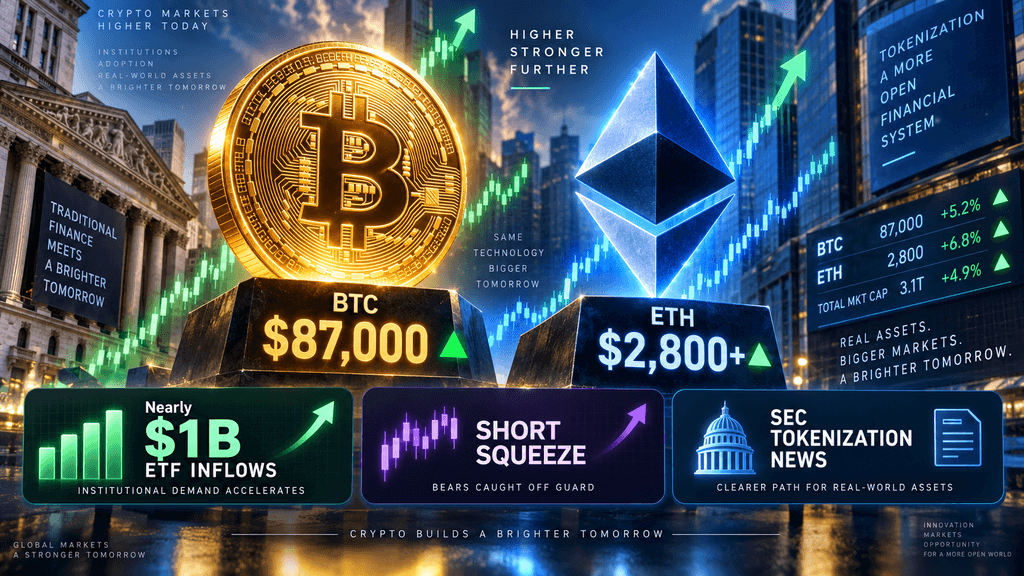
Bitcoin climbed above $87,000 while Ethereum briefly broke through $2,800, extending a sharp recovery across the crypto market as institutional buying, ETF inflows, derivatives liquidations and improving macro conditions converged. U.S. spot Bitcoin ETFs recorded nearly $1 billion in net inflows in a single session, while spot Ethereum ETFs attracted close to $270 million, adding fresh evidence that institutional demand was returning to the two largest cryptocurrencies.
The rally was also intensified by a large Bitcoin short squeeze that forced leveraged bearish positions out of the market as prices accelerated higher. At the same time, falling U.S. Treasury yields, stronger technology stocks and new SEC rules covering certain tokenized securities helped improve sentiment toward digital assets and blockchain-based financial infrastructure. The key question now is whether Bitcoin and Ethereum can turn this rapid rebound into a more sustainable trend as traders watch ETF flows, spot demand, derivatives positioning and the wider macro environment.
Why Bitcoin Hit $87,000 and Ethereum Topped $2,800 in the Latest Crypto Rally
Bitcoin climbed above $87,000 while Ethereum briefly moved past $2,800, extending a broad crypto market rebound driven by renewed institutional demand, improving risk sentiment and heavy short liquidations. The move came as U.S. spot crypto ETFs attracted fresh capital and traders increased exposure to major digital assets after weeks of volatile price action. Bitcoin's breakout also helped lift sentiment across the wider digital asset market, with investors closely watching whether the rebound could develop into a more sustained recovery. The simultaneous strength in BTC and ETH also gave the move broader market significance because both assets play an important role in overall crypto liquidity and sentiment.
The rally was not tied to one catalyst alone. Bitcoin benefited from stronger ETF buying and a technical breakout, while Ethereum gained support from rising ETH ETF inflows and broader demand for large-cap cryptocurrencies. Falling Treasury yields and strength in U.S. Technology stocks also helped create a more supportive backdrop for risk assets. Together, these factors encouraged investors who had remained cautious during the previous downturn to reassess their exposure to crypto. The combination of institutional flows, improving macro conditions and derivatives positioning made the rally more complex than a simple technical bounce.
Bitcoin Breaks Above $87,000 as Buying Momentum Strengthens
Bitcoin's move through $87,000 followed a sharp increase in buying pressure as spot Bitcoin ETFs recorded close to $1 billion in daily net inflows. The breakout also forced bearish traders to unwind short positions, adding another source of demand as prices moved higher. Breaking through previous resistance strengthened short-term market momentum and brought BTC back into a price region that had not been sustained for months. The combination of spot-market demand and forced short covering helped turn a gradual recovery into a much faster move. The speed of the breakout also showed how quickly market structure can change when strong spot demand meets heavily positioned derivatives markets.
The next test is whether Bitcoin can hold the gains after the initial surge. The $85,000 to $87,000 region is becoming an important area for traders because a successful defense of this zone could help establish a stronger technical base. A rapid drop back below recently reclaimed levels, however, would suggest that part of the rally was driven by temporary positioning rather than lasting demand. Trading volume, spot-market activity and follow-through buying will therefore be important signals in determining whether the breakout can continue. Traders will also be watching whether buyers continue stepping in during pullbacks, since repeated demand near reclaimed support can indicate that market confidence is becoming more durable.
Ethereum Tops $2,800 as ETH ETF Demand Returns
Ethereum briefly crossed $2,800 as spot Ethereum ETFs recorded roughly $270 million in net inflows, highlighting a renewed increase in institutional exposure to ETH. The move followed Bitcoin's breakout but also reflected stronger Ethereum-specific demand, with investors watching whether ETH can convert the $2,800 region from resistance into support. The rise in ETF flows showed that institutional interest during the rebound was not limited to Bitcoin, giving Ethereum another source of buying pressure. Stronger participation in ETH also matters for the wider market because Ethereum remains central to DeFi, stablecoins and many tokenized-asset applications.
A sustained move above $2,800 could bring the psychologically important $3,000 level back into focus, but Ethereum still needs to show that buyers are willing to remain active at higher prices. If ETH repeatedly fails to hold above the breakout area, the market could return to consolidation before attempting another advance. Network activity, institutional flows and the strength of the wider altcoin market may also influence Ethereum's next major move. The behavior of ETH relative to Bitcoin will also be closely watched because improving relative strength could suggest that capital is broadening beyond BTC into other major crypto assets.
Risk-On Markets Add Support to the Bitcoin and Ethereum Rally
Broader financial conditions also helped support the Bitcoin and Ethereum price rally. U.S. Treasury yields eased while major technology stocks strengthened, improving investor appetite for higher-risk assets. Lower bond yields can make growth-oriented investments relatively more attractive, particularly when investors become more confident that financial conditions may be stabilizing. Crypto often reacts strongly to these shifts because liquidity and risk appetite remain important drivers of short-term market behavior. When equities and digital assets strengthen at the same time, it can indicate that investors are becoming more comfortable taking on additional risk across multiple markets.
At the same time, strength across equity markets reinforced the broader risk-on environment surrounding digital assets. The sustainability of the crypto rally will still depend on whether those conditions remain supportive rather than reversing abruptly. A renewed rise in yields, stronger inflation pressure or weaker equity markets could quickly change sentiment, while continued improvements in liquidity could give Bitcoin and Ethereum more room to extend their recovery. This makes macroeconomic data and bond-market movements important secondary indicators alongside crypto-specific metrics such as ETF flows and derivatives positioning.
Nearly $1 Billion in Bitcoin ETF Inflows Drives Institutional Demand as ETH ETFs Surge
Institutional activity strengthened sharply during the latest crypto rebound as U.S. spot Bitcoin ETFs recorded about $998.95 million in net inflows on September 21, one of the strongest daily totals in nearly a year. The surge showed that Bitcoin's advance was supported by substantial spot-market demand rather than derivatives activity alone. At the same time, spot Ethereum ETFs attracted roughly $270 million, suggesting that larger investors were increasing exposure across more than one major digital asset. The synchronized inflows into both BTC and ETH products gave the rally a broader institutional component and reduced the impression that the move was being driven only by speculative trading.
BlackRock, ARK and Fidelity Lead the Bitcoin ETF Buying
BlackRock's IBIT led Bitcoin ETF inflows with approximately $381.4 million, followed by ARK 21Shares' ARKB with about $289.1 million and Fidelity's FBTC with roughly $238.8 million. Together, these products accounted for the majority of the day's net inflows, highlighting how concentrated institutional demand was among the largest U.S. spot Bitcoin ETFs. The September 21 session also stood out because it represented the strongest daily Bitcoin ETF inflow since October 2025. The concentration of flows in several large funds also showed where institutional demand was most visible during the session.
Measured in Bitcoin rather than dollars, the buying was equally significant. Spot ETFs collectively absorbed roughly 11,500 BTC during the session, creating a meaningful source of demand while Bitcoin was pushing through important resistance levels. When ETFs attract new capital, the associated acquisition of Bitcoin can reduce immediately available supply, particularly during periods when exchange liquidity is relatively thin. However, ETF flows can change substantially from one session to the next, making sustained multi-day demand more important than a single large inflow. Several strong sessions in succession would provide a clearer indication that institutional allocation is becoming more persistent rather than reflecting a temporary burst of demand.
Ethereum ETFs Add Nearly $270 Million as Institutional ETH Demand Strengthens
Ethereum also benefited from stronger institutional participation, with U.S. spot Ether ETFs recording around $269.98 million in net inflows on September 21, their strongest daily result since October 2025. BlackRock's ETHA and Fidelity's FETH were among the leading contributors, showing that fresh capital was flowing into ETH alongside Bitcoin rather than remaining concentrated entirely in BTC. The simultaneous rise in Bitcoin and Ethereum ETF demand added a stronger institutional foundation to the wider crypto recovery and suggested that investors were becoming more comfortable increasing exposure across multiple large-cap digital assets. Continued ETH ETF inflows could also become an important signal for whether institutional participation broadens beyond Bitcoin during the next phase of the market cycle.
Bitcoin Short Squeeze Triggers Massive Liquidations and Accelerates the BTC and ETH Rally
The latest Bitcoin short squeeze added significant momentum to the crypto market rebound as rising prices forced bearish traders to close leveraged positions. Liquidation data captured during the move showed hundreds of millions of dollars in short positions being wiped out across major exchanges, with Bitcoin and Ethereum accounting for a large share of the losses. This created a feedback loop in which higher prices triggered forced buying, helping BTC extend its breakout while ETH gained additional momentum as derivatives markets rapidly repriced. The process also increased volatility because each new round of liquidations added pressure to an already fast-moving market.
Short Liquidations Intensify as Bitcoin Breaks Higher
As Bitcoin pushed through key resistance levels, traders holding leveraged short positions faced increasing pressure from exchange liquidation mechanisms. Market snapshots during the rally showed short liquidations climbing into the hundreds of millions of dollars, with one later estimate placing total crypto short liquidations near $785 million over a 24-hour period. Bitcoin represented a substantial portion of those liquidated positions, indicating that many traders had been positioned for another market decline before the reversal gathered strength. The scale of the liquidations also showed how crowded bearish positioning had become before prices moved sharply in the opposite direction.
A short squeeze can accelerate an existing rally because bearish positions are automatically or voluntarily closed as prices rise. That process effectively creates additional buying, which can push the market higher and trigger another round of liquidations among traders using excessive leverage. In Bitcoin's case, this dynamic helped amplify an already improving spot-market move. Once the most vulnerable short positions have been cleared, however, the forced buying begins to fade, making organic demand increasingly important for maintaining momentum. This is why traders often compare liquidation data with spot volume and open interest to judge whether a rally still has healthy underlying support.
Ethereum Liquidations Add Momentum to the Broader Crypto Rally
Ethereum experienced a similar derivatives-driven boost as ETH moved toward and briefly above $2,800. Rising Ethereum prices forced traders betting against ETH to reduce or close leveraged positions, contributing to broader liquidations alongside Bitcoin. Because BTC and ETH dominate crypto derivatives trading, sharp moves in both assets can quickly affect perpetual futures, funding rates and positioning across the wider altcoin market. The resulting volatility can spread beyond the two largest cryptocurrencies as leveraged traders adjust exposure across multiple markets at the same time.
The next phase will depend on whether the BTC and ETH rally can continue after liquidation-driven demand begins to normalize. Sustained upside would require healthier spot participation, continued institutional interest and balanced derivatives positioning rather than relying primarily on traders being forced out of bearish bets. Open interest, funding rates and liquidation clusters can therefore help investors judge whether leverage is building too quickly again or whether the market is transitioning toward a more stable advance. A more balanced derivatives market would generally give the rally a stronger foundation than continued price gains driven mainly by forced position closures.
SEC Tokenization Rules, Falling Treasury Yields and Market Outlook for Bitcoin and Ethereum
The latest crypto rebound has also been supported by developments outside the immediate Bitcoin and Ethereum markets. The SEC's new tokenization framework has brought renewed attention to blockchain-based financial infrastructure, while lower U.S. Treasury yields have created a more favorable backdrop for risk assets. These developments do not guarantee further crypto gains, but they have helped improve sentiment as investors reassess the relationship between digital assets, traditional markets and onchain finance.
SEC Tokenization Rules Bring Onchain Finance Into Focus
The U.S. Securities and Exchange Commission introduced an Innovation Exemption that gives qualifying tokenized securities venues temporary regulatory relief to facilitate certain forms of tokenized stock trading. The framework does not represent blanket approval for every tokenized equity product, but it provides regulated market participants with a clearer path to experiment with blockchain-based trading infrastructure under defined conditions. The development has increased attention on tokenization because it could help bridge traditional securities markets with programmable settlement and onchain financial systems while maintaining existing regulatory protections.
Falling Treasury Yields Improve the Risk-Asset Environment
Lower U.S. Treasury yields have also helped create a more supportive environment for cryptocurrencies. When bond yields decline, the relative attraction of holding risk-free government debt can weaken, making growth assets and other higher-risk investments more competitive for capital. The pullback in longer-term yields coincided with stronger sentiment across technology stocks and crypto, giving Bitcoin and Ethereum a more favorable macro backdrop. However, renewed inflation pressure or another sharp increase in yields could quickly reduce risk appetite and bring volatility back into digital asset markets.
Bitcoin and Ethereum Outlook After the Latest Breakout
The next challenge is whether Bitcoin and Ethereum can turn recent gains into durable support. For Bitcoin, the $85,000 to $87,000 region remains an important area to monitor, while a sustained move above recent highs could bring the psychological $90,000 level into focus. Ethereum faces a similar test around $2,800, where stronger follow-through could reopen the path toward $3,000. Rather than relying on one catalyst, a more durable advance would likely require a combination of consistent spot demand, balanced leverage, constructive macro conditions and continued institutional participation.
What to Watch Next for Bitcoin and Ethereum
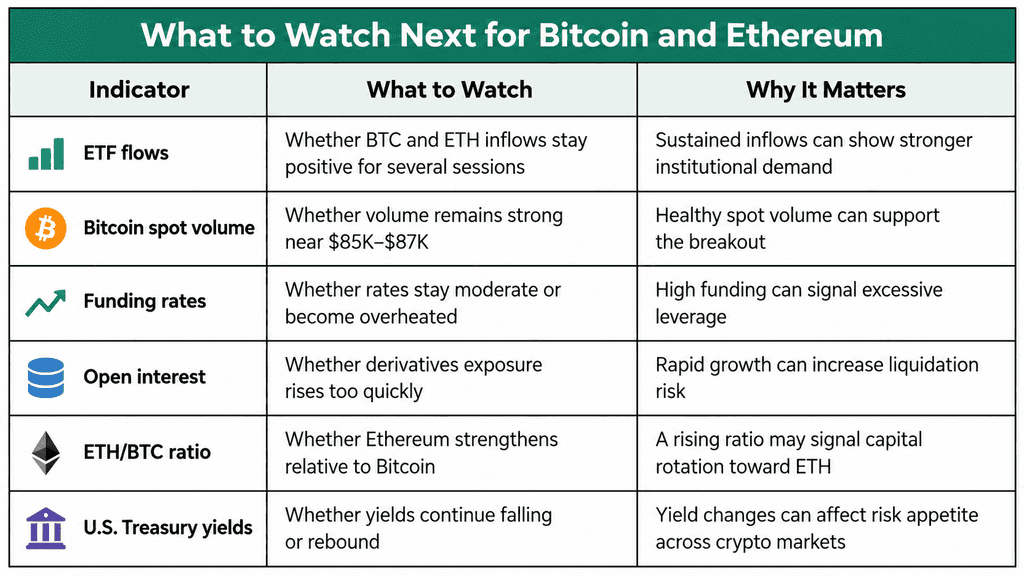
The table below summarizes the key market data and indicators to monitor after Bitcoin’s move above $87,000 and Ethereum’s break above $2,800. These include ETF flows, spot trading volume, funding rates, open interest, the ETH/BTC ratio and U.S. Treasury yields, which can help show whether the rally is supported by sustained demand or increasingly driven by leverage.
Conclusion
Bitcoin's move above $87,000 and Ethereum's break beyond $2,800 show how quickly crypto prices can respond when institutional buying, improving macro conditions and derivatives positioning move in the same direction. Nearly $1 billion of Bitcoin ETF inflows and close to $270 million in Ethereum ETF inflows provided strong spot-market support, while heavy short liquidations amplified the speed of the rebound. The SEC's tokenization framework and falling Treasury yields added broader financial-market context to the move without being the sole drivers of the rally.
The focus now shifts from the breakout itself to whether the market can sustain it. Bitcoin needs to hold recently reclaimed support while Ethereum must prove that demand remains strong around the $2,800 region. Continued ETF participation, healthier derivatives conditions and a stable macro environment could support further gains, while weakening inflows or renewed pressure from yields could increase volatility. For investors, the next phase will be less about the initial surge and more about whether the underlying demand behind it remains intact.
🔥 Beyond the Headlines: What KuCoin 5.0 Means for You
Market news moves fast — but where you act on it matters just as much. This October, KuCoin launches KuCoin 5.0, transforming KuCoin into a rebuilt platform. Here's what actually changes for you:
-
One account for everything. Older platforms split your money across separate "spot," "margin," and "futures" accounts and expected you to understand why. KuCoin 5.0's unified account removes that entirely — deposit once, and everything is simply there (only available to VIPs for now).
-
Stocks, indices, and commodities. KuCoin 5.0 expands beyond crypto into global markets. When crypto chops sideways and equities rally (or the reverse), you rotate in minutes instead of opening a brokerage account and waiting days for fiat rails.
-
Real-world assets (RWA). Tokenized exposure to traditional assets like commodities, right inside your crypto account. One of the fastest-growing segments in global finance is no longer reserved for institutions — you access it from the same balance you trade with.
-
Earn while you learn. Not ready to trade? KCUSD lets your stablecoins earn daily, auto-compounding interest. The lowest-stress way to put your idle deposit to work for 4% yield.
-
An AI assistant in plain language. Ask questions, get market context, understand what you're looking at — built into the platform, no jargon required.
-
An app that doesn't overwhelm. Faster, cleaner, and consistent — intuitive from the first tap, not after a tutorial.
-
Safety you can check, not just trust. A MiCAR-licensed EU entity, Proof of Reserves you can verify yourself, and internationally certified security (SOC 2 Type II, ISO 27001:2022).
Create your account in minutes — and start on the platform built for where crypto is going, not where it's been.
FAQs
Why do Bitcoin ETF inflows matter for the wider crypto market?
Bitcoin ETF inflows can influence the broader crypto market because large purchases by regulated funds increase spot demand for BTC and can improve overall investor sentiment. Strong inflows may also indicate renewed institutional interest in digital assets, which can indirectly support Ethereum and other major cryptocurrencies. Several consecutive sessions of positive flows usually provide a stronger signal than one unusually large trading day.
Are short squeezes always bullish for Bitcoin?
No. A short squeeze can push Bitcoin higher very quickly, but it does not guarantee a lasting uptrend. Once heavily leveraged short positions are closed, the forced buying that helped accelerate the move begins to disappear. A more durable rally normally requires continued spot demand, healthy trading volume, sufficient liquidity and supportive macroeconomic conditions.
How can investors tell whether a crypto rally is driven by spot buying or leverage?
Investors can compare spot trading volume with derivatives indicators such as open interest, funding rates and liquidation data. Rising prices accompanied by strong spot volume and moderate funding rates can indicate broader underlying demand, while rapidly increasing open interest and unusually high funding may suggest that leverage is playing a larger role. Evaluating both markets provides a clearer picture of the quality of a rally.
What does SEC tokenization policy mean for traditional stocks?
SEC tokenization initiatives could allow more regulated experimentation with blockchain-based representations of traditional securities. Tokenization may eventually make areas such as settlement, ownership records and financial infrastructure more programmable, but tokenized securities remain subject to applicable securities laws and regulatory conditions. The technology changes how assets can be represented and traded rather than removing existing investor protections.
Why are U.S. Treasury yields important for Bitcoin and Ethereum?
Treasury yields affect how investors compare risk-free returns with returns available from higher-risk assets. When yields fall, equities and cryptocurrencies can become relatively more attractive to investors seeking growth, especially if financial conditions are also improving. Rising yields can have the opposite effect by increasing the appeal of government debt and tightening overall financial conditions.
What market indicators should traders watch after Bitcoin reaches a major resistance level?
Useful indicators include spot trading volume, ETF flows, open interest, funding rates, liquidation levels and stablecoin liquidity. Traders also monitor whether Bitcoin can hold recently reclaimed support after a breakout. Broader factors such as the U.S. dollar, Treasury yields and equity-market performance can provide additional context about whether crypto strength is being supported by the wider financial environment.
Disclaimer: This article is for informational purposes only and does not constitute investment advice. Crypto assets can be highly volatile, and market conditions, token liquidity and project developments may change rapidly. Readers should conduct their own research and assess their risk tolerance before making financial decisions.