

DTCC Tokenization Service Goes Live: Russell 1000 Stocks, ETFs and US Treasuries
The Depository Trust & Clearing Corporation (DTCC) officially launched its DTCC Tokenization Service on October 28, 2026, enabling eligible financial institutions to bring selected Russell 1000 stocks, exchange-traded funds (ETFs), and U.S. Treasuries onto blockchain networks. Operated by the Depository Trust Company (DTC), the service launched with 34 eligible securities and 20 institutional participants holding signed access agreements. It initially supports the Canton Network and DTCC's private Besu blockchain, allowing tokenized securities to move between registered wallets. While the launch expands blockchain capabilities within traditional financial infrastructure, the approximately $30 trillion in underlying eligible assets does not represent securities already tokenized.
Key Takeaways
-
DTCC Tokenization Service launched on October 28, 2026, enabling eligible financial institutions to tokenize selected Russell 1000 stocks, ETFs, and U.S. Treasuries through DTC's regulated infrastructure.
-
34 securities were eligible at launch, representing part of approximately $30 trillion in underlying assets; that figure is not the amount already tokenized.
-
Registered-wallet transfers can operate around the clock on supported networks, although conversion and related settlement processes still face operational restrictions.
-
Twenty DTC participants signed access agreements; Morgan Stanley subsequently reported tokenizing U.S. equities and Treasuries, providing an early example of actual service use.
-
SEC staff no-action relief is limited, with a three-year framework that includes operational safeguards and restrictions on collateral recognition within DTC's risk controls.
-
Blockchain expansion is planned for 2027, including Stellar in the first half and Solana in the second half, without guaranteed improvements in market liquidity.
What Is the DTCC Tokenization Service, and Which Stocks, ETFs and US Treasuries Are Eligible?
The DTCC Tokenization Service allows eligible financial institutions to create blockchain-based representations of traditional securities held in DTC custody. Rather than replacing existing securities market infrastructure, the system connects conventional asset ownership records with blockchain technology while preserving the legal and economic rights associated with underlying securities. Its initial scope focuses on highly liquid U.S. financial assets, allowing institutions to use tokenized positions within an established regulatory and custody framework. The distinction matters because DTCC is changing how certain entitlements can be recorded and moved, not issuing a new class of freely tradable cryptocurrency.
How Does the DTCC Tokenization Service Bring Traditional Securities On-Chain?
The service allows eligible DTC participants to convert securities held in traditional custody into digital tokens recorded on approved blockchain networks. Each token represents a securities entitlement backed one-to-one by an underlying asset held at DTC. Tokenized securities retain their associated CUSIP identifiers, economic interests, and investor protections. This approach is a form of real-world asset tokenization, in which rights associated with conventional financial assets are represented digitally while the underlying securities remain within established custody arrangements. The blockchain record creates an additional operational representation of a position rather than a second independent claim against the issuer.
The service operates within the existing U.S. securities market infrastructure rather than creating an independent ownership system. DTC maintains official entitlement records and supports reconciliation of blockchain transactions with its traditional systems. A token holder does not automatically become a directly registered shareholder of the issuing company. Instead, the token represents a securities entitlement recorded within DTC's framework, allowing institutions to use digital asset technology without replacing the underlying legal ownership structure. Corporate actions, including applicable distributions and other investor entitlements, therefore continue to depend on the established systems and service procedures that govern the underlying securities.
Which Russell 1000 Stocks, ETFs and US Treasuries Qualify for DTCC Tokenization?
Under the SEC staff no-action letter issued on December 11, 2025, DTC can tokenize specified categories of highly liquid U.S. securities during a three-year period beginning with the service launch. However, the categories permitted under the regulatory framework are broader than the initial selection. DTCC identified 34 securities available for tokenization at launch, representing approximately $30 trillion in underlying assets. That figure describes the potential asset base associated with eligible securities, not the value already converted into blockchain tokens. It also should not be mistaken for the number of financial institutions using the service or the value of completed transactions.
The service initially covers three categories of financial securities:
-
Russell 1000 stocks: Selected equities from the Russell 1000 Index, which tracks large U.S. companies; the initial selection does not include every constituent.
-
Exchange-traded funds (ETFs): Selected funds tracking major market benchmarks, including ETFs linked to broad U.S. equity indices.
-
U.S. Treasury securities: Selected Treasury bills, notes, and bonds, allowing eligible government debt holdings to be represented through tokenized securities entitlements.
DTCC's broader custody infrastructure holds more than $114 trillion in securities, providing substantial institutional scale for the service. However, total assets under DTC custody, the value of securities eligible for tokenization, and the amount actually tokenized are separate measures. Publicly available launch information does not establish that the entire eligible asset base has moved on-chain.
How DTCC Tokenization Works With Major Banks and Blockchain Networks
The DTCC Tokenization Service connects traditional securities infrastructure with blockchain networks through a controlled institutional framework. Instead of enabling unrestricted public transfers, it allows eligible DTC participants to manage tokenized securities using registered digital wallets and approved networks. Financial institutions can integrate these transactions into existing custody and operational systems, while DTC maintains compliance controls and transaction oversight. The multi-network approach is designed to accommodate different institutional requirements without relying on a single blockchain environment. Access therefore rests on an institution's relationship with DTC and its operating permissions, not merely its ability to create a blockchain wallet.
How Are Tokenized Securities Created, Transferred and Redeemed?
Eligible DTC participants initiate tokenization by requesting the conversion of securities positions into digital tokens. After accepting the request, DTC transfers the corresponding securities entitlements from the participant's conventional account into a designated digital omnibus account and issues tokens to registered blockchain wallets. Institutions can subsequently transfer these tokens between authorized wallets or redeem them to restore conventional book-entry positions. The service uses programmable smart-contract controls to support token issuance, transfer restrictions, and certain corrective actions. DTCC's LedgerScan software tracks token movements and helps reconcile blockchain activity with official ownership records. This controlled process is intended to prevent an entitlement from circulating simultaneously as an unrestricted conventional position and as a separate tokenized position.
An important operational distinction concerns transaction availability. Token transfers between DTC-registered wallets on the same blockchain are supported 24/7, while conversions between traditional securities and tokenized positions follow designated business-day processing windows. Institutions must also satisfy wallet registration and compliance requirements. Consequently, continuous blockchain transfers do not mean every associated trading, conversion, payment, or settlement process operates around the clock. The service provides greater flexibility in transferring tokenized entitlements, but completing a financial transaction may still depend on other market infrastructure. For example, a securities transfer recorded outside ordinary market hours is not, by itself, evidence that cash consideration has moved or that all counterparties have completed settlement obligations.
Which Major Banks and Blockchain Networks Support DTCC Tokenization?
DTCC confirmed that 20 DTC participants had signed agreements to access the service at its October 2026 launch, following development involving more than 150 financial and technology firms. Participants include global banks, brokerage companies, custodians, and securities-market intermediaries. Morgan Stanley subsequently reported on November 3 that it had begun using the service to tokenize U.S. equities and Treasuries, although it did not disclose transaction values, specific securities, or the blockchain used. This provides a more concrete indication of institutional activity than an access agreement, but it is not a measure of total industry adoption.
The institutional network includes several important groups:
-
Major banks and financial institutions: J.P. Morgan, Citi, Bank of America, Barclays, BNP Paribas, Morgan Stanley, UBS, and State Street are among firms associated with access agreements.
-
Brokerage and securities firms: Fidelity Investments, Citadel Securities, Apex Clearing, DriveWealth, and Alpaca are among participating organizations.
-
Canton Network: An initial blockchain integration designed for institutional financial applications, including privacy-aware workflows.
-
DTCC's private Besu network: An Ethereum-compatible blockchain environment supporting permissioned securities operations and smart contracts.
These organizations have different roles, and signing an access agreement does not necessarily mean an institution has completed live tokenized transactions. DTCC has also identified digital asset infrastructure providers, including Fireblocks, BitGo, Broadridge, and Blockdaemon, as collaborators supporting the wider ecosystem.
The multi-network model relies on blockchain interoperability, allowing traditional financial systems and approved distributed ledger networks to exchange information and coordinate asset movements. However, support for multiple networks does not automatically permit unrestricted transfers between them. Cross-network activity remains subject to DTC's approved workflows, technical standards, and participant requirements.
DTCC Tokenization Impact on Financial Markets, SEC Regulations and Future Expansion
The launch of the DTCC Tokenization Service could influence how financial institutions manage securities, liquidity, and collateral across traditional and blockchain-based markets. By connecting digital asset infrastructure with established U.S. securities systems, DTCC aims to reduce operational delays and improve capital efficiency. However, the service's broader impact will depend on institutional adoption, regulatory requirements, and the development of interoperable blockchain networks. Its potential benefits should be assessed against actual transaction activity rather than the size of DTC's existing custody business.
How Could DTCC Tokenization Improve Securities Settlement, Liquidity and Collateral Mobility?
Tokenization could make securities more accessible for institutional financing and collateral management by allowing eligible assets to move between financial counterparties with fewer operational delays. During production transactions on July 15, 2026, DTCC and participating firms demonstrated several applications, including U.S. Treasury repurchase agreements, securities lending, collateral pledges, and delivery-versus-payment transactions. These activities showed that tokenized securities could support existing financial operations through blockchain infrastructure. However, successful production transactions do not establish that faster settlement or improved liquidity has been achieved across the wider financial market.
For institutional investors, the potential advantage lies in accessing and repositioning securities without relying entirely on conventional processing schedules. A Treasury security used in a financing arrangement, for example, could potentially be transferred through an approved digital workflow more quickly than through certain traditional operational processes. This may help reduce delays in collateral allocation and improve the use of available assets. Nevertheless, blockchain transfer speed is not equivalent to completed financial settlement, which may still require payment arrangements, counterparty approvals, and other market infrastructure. Measurable improvements in financing costs and capital efficiency will depend on how extensively institutions integrate these capabilities. Liquidity also requires willing counterparties and workable pricing mechanisms; moving ownership records more efficiently cannot create market demand on its own.
What SEC Regulations and Operational Risks Apply to DTCC Tokenization?
The U.S. Securities and Exchange Commission's Division of Trading and Markets issued a no-action letter on December 11, 2025, establishing a limited regulatory framework for DTC's tokenization program. The staff position provides conditional enforcement relief for three years from the service's launch rather than unrestricted approval for tokenized securities trading. The framework preserves existing clearing-agency obligations while requiring controls over securities entitlements, blockchain infrastructure, and operational resilience. Significant expansion beyond the permitted program may require further regulatory engagement. A staff no-action position should not be described as an SEC rulemaking decision or a permanent authorization for tokenized trading across all markets.
The framework includes several requirements that could influence institutional adoption:
-
Collateral recognition: Tokenized entitlements receive no collateral or settlement value when DTC calculates participants' Net Debit Caps and Collateral Monitors, limiting their treatment within DTC's existing risk-management system.
-
Transaction correction: DTC retains intervention capabilities to address erroneous transfers, lost tokens, and certain operational or compliance events.
-
Regulatory reporting: DTC must provide quarterly information to SEC staff covering tokenized asset values, transfer activity, participating institutions, registered wallets, and relevant operational events.
-
Technology resilience: Systems supporting the service must meet specified recovery, operational security, and business-continuity standards.
These safeguards address risks associated with digital securities infrastructure, but they do not eliminate potential cybersecurity incidents, blockchain disruptions, or smart-contract vulnerabilities. Financial institutions must also consider how blockchain systems interact with securities regulations, internal risk policies, and established custody arrangements. The effectiveness of DTCC's tokenization model will depend partly on maintaining reliable asset records and compliance as the service expands. Another distinction is that DTC's collateral treatment does not necessarily determine whether separate, appropriately structured financing arrangements can accept tokenized assets under their own legal and risk requirements.
When Will DTCC Expand Tokenized Securities to Solana, Stellar and Other Blockchains?
DTCC's expansion strategy focuses on connecting additional blockchain networks to regulated securities infrastructure. On May 27, 2026, DTCC and the Stellar Development Foundation announced plans to make DTC-tokenized assets available on Stellar during the first half of 2027. The proposed integration is expected to support asset conversion, lifecycle management, corporate actions, and related reporting. DTCC has also identified Circle's Arc blockchain as a planned integration for 2027, although a precise launch date has not been confirmed. These developments could provide financial institutions with more options for managing tokenized assets across blockchain environments. They remain forward-looking integration targets rather than evidence of live DTCC security tokens moving on those additional networks.
The latest major roadmap update came on November 12, 2026, when DTCC announced plans to connect its Tokenization Service to the Solana blockchain in the second half of 2027. According to DTCC, the integration is intended to support the conversion of eligible DTC-custodied assets into blockchain-based representations and related token lifecycle functions. The announcement reflects a broader effort to improve connectivity between traditional finance and public blockchain infrastructure, but it does not mean DTCC-issued securities are already available on Solana.
DTCC Tokenization Blockchain Networks and 2027 Expansion Timeline
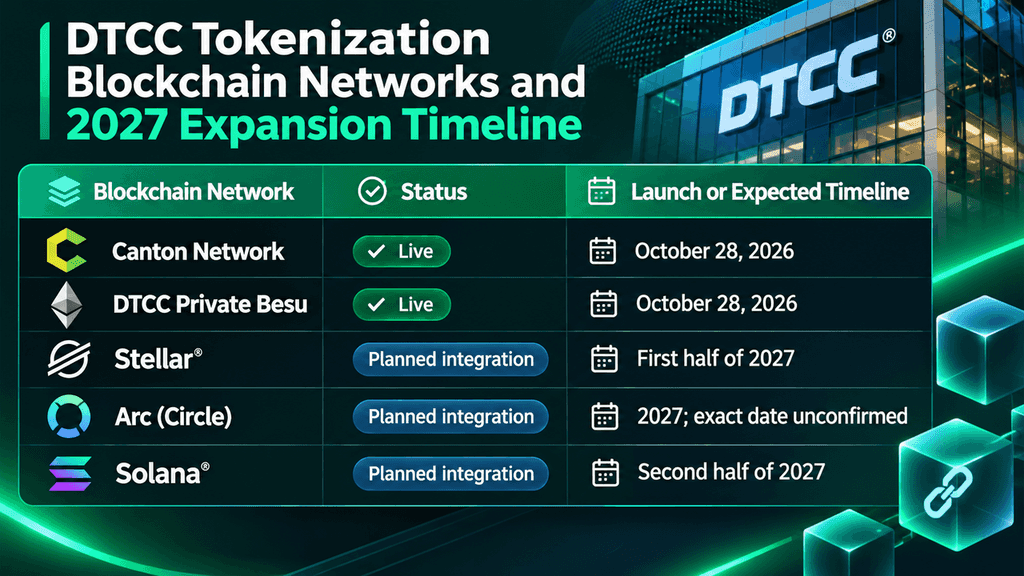
Beyond network connectivity, future development could involve more automated corporate actions, broader securities eligibility, and additional settlement functionality. DTC's regulatory documentation identifies potential enhancements, including certain distributions through tokenized deposits or stablecoins, but these remain prospective capabilities rather than services generally available at launch. Broader adoption will depend on demonstrated transaction activity, institutional demand, operational reliability, and regulatory acceptance rather than blockchain expansion announcements alone.
Conclusion
DTCC's tokenization launch establishes an operational connection between traditional U.S. securities custody and blockchain infrastructure. Its significance extends beyond issuing digital representations of financial assets, potentially allowing institutions to manage securities and collateral with greater operational flexibility. However, the service operates within a limited SEC staff no-action framework, and its broader financial benefits remain unproven. Institutional participation and successful token transfers do not automatically establish improved market liquidity, lower transaction costs, or faster end-to-end settlement.
The next indicators of progress will be actual tokenized asset volumes, institutional transaction activity, and successful integration of additional blockchain networks. Planned Stellar and Solana connections in 2027 could expand the service's reach, but implementation remains subject to technical and regulatory requirements. Measurable institutional adoption, rather than the value of securities eligible for tokenization, will provide the clearest evidence of long-term market impact.
FAQs
Can Investors Vote Using DTCC-Tokenized Shares?
Tokenization is designed to preserve the underlying securities' rights, including applicable voting rights. However, dedicated proxy voting functionality within the Tokenization Service is listed among planned enhancements for 2027 and beyond. The methods for exercising those rights must follow the relevant custody and service procedures.
What Happens if a DTCC-Issued Security Token Is Lost?
DTC maintains administrative controls that allow it to address lost tokens, erroneous transactions, and certain compliance events. Supported smart contracts permit corrective actions, although recovery remains subject to DTC's procedures and applicable requirements. Token recovery should not be assumed to be automatic or available without verification.
Are DTCC-Tokenized Securities the Same as Stablecoins?
No. DTCC-issued securities tokens represent entitlements to underlying stocks, ETFs, or Treasury securities. Stablecoins generally aim to maintain a reference value, often against a currency. Their underlying assets, purposes, and legal structures differ, even when both are recorded on blockchain networks.
How Can Institutions Find Which Securities Are Available for DTCC Tokenization?
Eligible DTC participants can use the Tokenization Service's Eligible Securities screen to identify supported instruments, including issuer names, security identifiers, and asset types. Participants may also request additional eligible securities through their DTCC relationship manager. Eligibility can change as DTCC updates its permitted instrument list and service arrangements.
Disclaimer
This general market information, possibly from third-party, commercial, or sponsored sources, is provided for reference and educational purposes only and does not constitute financial or investment advice, an offer, solicitation, or guarantee. We disclaim liability for its accuracy, completeness, reliability, and any resulting losses. Investments/trading are risky; past performance doesn’t guarantee future results. Users should research, judge prudently, and take full responsibility. For further details, please consult KuCoin’s Terms of Use and Risk Disclosure.