

Dogecoin Hits $0.10 After 15% Rally: Can DOGE Hold the Breakout?
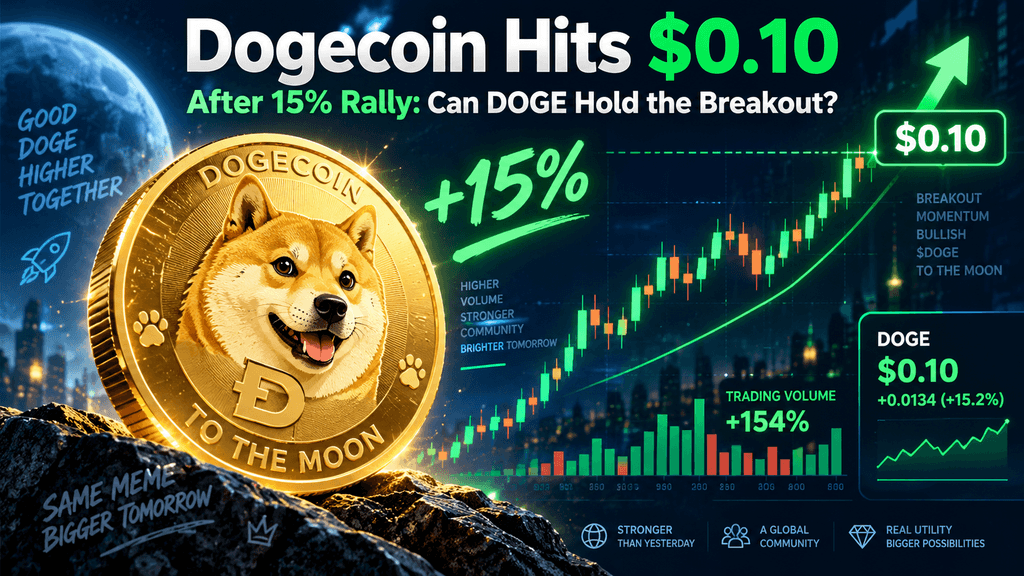
Dogecoin is back above one of its most closely watched psychological levels. On September 22, Dogecoin (DOGE) surged more than 15% to just above $0.10, outperforming every other major cryptocurrency tracked by CoinDesk during a broad crypto rebound. Bitcoin gained roughly 5% and held above $85,600, while XRP rose about 7%, Solana gained 5%, and Ether advanced around 3%. The move brought fresh attention to the meme coin market after weeks of relatively subdued trading.
But the structure behind the rally matters as much as the headline gain. More than $1 billion in crypto positions were liquidated over 24 hours, including $844 million in bearish bets. That means forced buying played an important role in accelerating the market higher. As liquidation pressure begins to fade, Dogecoin faces a more difficult test: can genuine demand replace short covering and keep DOGE above $0.10? The answer may determine whether the latest move becomes the start of a broader trend or another temporary meme coin breakout.
Why Did Dogecoin Jump 15%?
Dogecoin's rally was part of a much wider improvement in crypto market sentiment rather than an isolated DOGE-specific event. Bitcoin rose roughly 5% over 24 hours and held above $85,600 as traders rushed to close bearish positions. According to CoinGlass data cited by CoinDesk, slightly more than $1 billion in crypto positions were liquidated in one day, with $844 million—or around 82%—coming from shorts. Roughly 135,000 traders were forced out of positions, while Bitcoin alone accounted for approximately $608 million of the total liquidations and Ether another $181 million.
Bitcoin Triggered the Short Squeeze
A short squeeze develops when rising prices force bearish traders to buy assets back to close leveraged positions. That buying can push prices even higher, which then forces another layer of shorts out of the market. The result is a feedback loop in which price increases generate additional forced buying. In this case, Bitcoin provided the initial momentum, but higher-beta assets such as Dogecoin reacted more aggressively as capital moved toward riskier corners of the crypto market.
The important point is that the rally did not require Dogecoin's underlying network or payment use case to change overnight. DOGE benefited from a change in market positioning. Bitcoin strengthened, shorts were squeezed, risk appetite improved, and traders rotated into more volatile assets. That explains why Dogecoin could gain three times as much as Bitcoin even though BTC was the main driver of the broader recovery.
Why Did DOGE Outperform Bitcoin?
Dogecoin behaves differently from Bitcoin because the two assets occupy different positions on the crypto risk spectrum. Bitcoin is the largest and most liquid cryptocurrency, and it increasingly serves as the benchmark for overall market direction. DOGE, by contrast, combines strong liquidity with a much more speculative investor base, an active derivatives market, enormous social-media recognition and its status as the original major meme coin. Those characteristics can make it highly sensitive to sudden changes in market sentiment.
The September 22 market action illustrated this high-beta behavior. Bitcoin gained about 5%, while DOGE rose more than 15%. XRP added around 7%, Solana roughly 5%, Ether about 3%, and BNB and TRX between 1% and 2%. The pattern suggests that investors were not simply buying Dogecoin; capital was rotating broadly out along the crypto risk curve, with DOGE receiving one of the strongest boosts.
DOGE Is Still a Meme Coin Bellwether
That role gives Dogecoin a unique place in market cycles. Smaller meme coins can produce much larger percentage gains, but they often lack DOGE's liquidity, exchange availability and global recognition. Dogecoin therefore tends to function as a more established gauge of meme coin risk appetite. When DOGE starts outperforming during a broader market recovery, traders often interpret it as evidence that speculative demand is returning.
However, outperformance should not automatically be interpreted as a fundamental revaluation. DOGE rising three times faster than Bitcoin does not mean its adoption or economic utility improved three times faster. It may simply mean traders are willing to take more risk.
Why Is $0.10 So Important for Dogecoin?
The $0.10 level matters partly because it is easy for traders to recognize. Round numbers such as $0.10, $0.20 and $1 often become psychological reference points, particularly for retail-heavy assets like Dogecoin. When price approaches such levels, they can attract breakout traders, algorithmic strategies, momentum investors and short sellers placing stop orders around obvious technical zones.
For DOGE, moving above $0.10 was therefore more important than simply adding another few percentage points. It changed the visual structure of the chart and created a clear test for whether buyers are willing to defend the breakout. Decrypt reported that DOGE later reached an intraday high around $0.1059 before the initial momentum cooled.
Resistance Must Become Support
A successful breakout is not confirmed merely because an asset trades above resistance for several hours. The stronger pattern is a breakout followed by a pullback in which the former resistance zone attracts buyers and becomes support.
| Scenario | What It Would Look Like | What It Could Suggest |
| Successful breakout | DOGE stays near or above $0.10 on pullbacks | Buyers are defending the new range |
| Momentum continuation | Price rises with healthy spot volume | New demand is replacing short covering |
| Failed breakout | DOGE falls below $0.10 and cannot reclaim it | The move may have been liquidation-driven |
| Leverage reversal | Price falls while long liquidations rise | Speculative positioning became too crowded |
For the current rally, $0.10 is therefore better viewed as a test rather than a destination. The strongest signal would be Dogecoin remaining above the level after volatility and forced buying decline.
The Short Squeeze Cannot Last Forever
Short covering was one of the most powerful forces behind the market rebound, but forced buying has a natural limit: once most vulnerable short positions have been liquidated or closed, that source of demand disappears. CoinDesk reported that the large wave of forced buying that cost bearish traders $844 million had largely run its course by the time DOGE was trading above $0.10. The implication was clear—additional gains would increasingly depend on fresh buyers rather than another cascade of liquidations.
This distinction is crucial for Dogecoin. A liquidation-driven rally can move extremely quickly because traders are not choosing to buy; they are being forced to buy to close losing positions. Spot demand is different. Those buyers are voluntarily committing capital because they expect the asset to hold or increase in value. If spot demand remains strong after the short squeeze fades, the initial liquidation event can become the catalyst for a broader trend. If new buyers do not appear, the rally may lose momentum just as quickly as it gained it.
That means the next stage of the DOGE move is arguably more important than the original 15% jump. The market now needs to answer whether Dogecoin is transitioning from forced buying to voluntary buying.
Is Leverage Helping or Hurting DOGE?
Derivatives data adds another layer to the story. Decrypt reported that Dogecoin open interest jumped roughly 10% in about an hour during the rally, signaling that traders were rapidly opening new leveraged positions as DOGE moved higher. The same report noted that the rally later cooled after DOGE touched $0.1059, illustrating how quickly leveraged momentum can change direction.
Rising open interest is not automatically bearish. If price and open interest increase together, it can show that new participants are entering the market and that traders have confidence in the trend. But leverage magnifies both gains and losses. The more aggressively traders chase a rally using borrowed capital, the more vulnerable the market becomes to a reverse liquidation cascade if prices turn lower.
| Market Signal | Positive Interpretation | Main Risk |
| Price rising | Strong momentum | Buyers may be chasing |
| Open interest rising | New market participation | Excess leverage |
| Positive funding | Traders expect further gains | Long positioning becomes crowded |
| Spot volume rising | More genuine buying | Needs to persist |
| Liquidations falling | Market is normalizing | Forced buying disappears |
A more sustainable DOGE breakout would therefore ideally be supported by rising spot activity rather than a continuously expanding leveraged futures trade. Strong leverage can accelerate a rally, but it is a weak foundation if real buyers do not follow.
Are DOGE ETF Investors Joining the Rally?
Dogecoin's recent price strength creates an interesting contrast with its performance inside traditional investment products. Crypto-native traders may be enthusiastic about DOGE, but exchange-traded investment demand has been considerably less impressive. The clearest example came on September 10, when Bitwise announced that it would close and liquidate the Bitwise Dogecoin ETF, ticker BWOW. The fund's final trading day on NYSE Arca is expected to be October 14, with remaining shareholders scheduled to receive cash following liquidation around October 22.
The closure does not mean investors have rejected Dogecoin itself. It does show that demand for DOGE through a conventional fund wrapper can be very different from demand on crypto exchanges. Many Dogecoin traders already have easy access to DOGE directly and may see little reason to purchase an ETF instead. By contrast, investors using brokerage accounts may want a clearer long-term portfolio role before allocating to a meme coin through a regulated investment product.
Price Momentum Is Not the Same as Long-Term Allocation
That distinction matters when evaluating the $0.10 breakout. Strong exchange volume and active derivatives trading can support short-term price momentum without generating equivalent interest from longer-duration investors. ETF flows, corporate treasury purchases and other traditional investment channels measure a different form of demand.
If Dogecoin begins holding above $0.10 while attracting more persistent capital through both spot markets and longer-term investment channels, the structure behind the breakout would look more diversified. But the current evidence still suggests that crypto-native speculative demand remains a more important driver than traditional asset allocation.
Does X Give DOGE Another Catalyst?
Dogecoin also received an additional narrative boost from developments at X. Decrypt reported that DOGE moved as high as $0.1059 after X announced trading partnerships involving Coinbase, Kraken, Gemini, Moomoo and Interactive Brokers. The announcement reinforced expectations that X is continuing to deepen its relationship with financial markets and trading services.
This matters for DOGE because Elon Musk's long association with Dogecoin has conditioned traders to react whenever X expands into payments or finance. The market often speculates that DOGE could eventually play a role in a broader X financial ecosystem, even though such integration has not been confirmed.
X Trading Is Not DOGE Payment Integration
That distinction should remain clear. X introducing more direct pathways to trading platforms is not the same as X adopting Dogecoin for payments, nor does it establish DOGE as a native currency for the platform. The latest development is best treated as a sentiment catalyst that added to an already strong rally rather than a confirmed change in Dogecoin's utility.
For the current breakout, Bitcoin strength, liquidations and crypto risk appetite still provide the more convincing explanation. The X announcement may have extended momentum, but it did not create the entire rally.
What Could Keep DOGE Above $0.10?
The first condition is continued stability in Bitcoin. Because the current DOGE move emerged from a Bitcoin-led market rebound, a sharp reversal in BTC would undermine one of the strongest sources of support for altcoins and meme coins. If Bitcoin remains above its recent breakout zone, traders are more likely to continue taking risk farther down the market-cap spectrum.
The second condition is a transition toward stronger spot demand. With the short squeeze fading, DOGE needs voluntary buyers to defend $0.10. Rising spot volume combined with more controlled derivatives leverage would be healthier than a rally dominated by futures positioning. At the same time, broader meme coin performance matters. If DOGE rises alongside other major meme assets, it would suggest a sector-wide rotation rather than a single-token spike.
Finally, the way DOGE behaves during pullbacks may offer more information than another vertical rally. A 15% one-day gain is visually impressive, but a controlled retracement that finds buyers around $0.10 would provide stronger evidence that the market has accepted a new price range.
What Could Break the Rally?
The most obvious risk is a Bitcoin reversal. Dogecoin's high-beta behavior works in both directions: it can outperform when crypto sentiment improves, but it can also fall faster when investors move back toward safety. If BTC loses momentum, leveraged DOGE traders may reduce positions quickly.
A second risk is overcrowded leverage. Rising open interest can support momentum while prices climb, but if traders become too heavily positioned on the long side, even a modest correction can trigger forced selling. That would create the opposite of the short squeeze that helped start the current rally: falling prices would liquidate long positions, those liquidations would create more selling, and DOGE could move rapidly back below its breakout level.
The third risk is simply a failed technical break. If DOGE falls under $0.10 and repeatedly fails to reclaim it, the move above the level may increasingly look like a temporary liquidity event rather than the start of a larger trend. In this context, breakout confirmation is more important than breakout excitement.
Can DOGE Turn the Rally Into a Bigger Trend?
There are legitimate reasons for traders to remain interested. Dogecoin has reclaimed $0.10, Bitcoin remains much stronger than it was before the squeeze, and speculative risk appetite has clearly improved across major altcoins. The market has also received an additional sentiment boost from X's expanding trading partnerships. These factors create a supportive environment for DOGE in the short term.
At the same time, the strongest source of forced buying has already weakened. New leveraged positions are entering the market, while longer-term DOGE investment demand remains much less established than short-term trading activity. Bitwise's decision to close BWOW illustrates that distinction particularly clearly.
Dogecoin has therefore achieved a meaningful short-term breakout, but the market has not yet demonstrated that the rally has fully transitioned from liquidation-driven momentum to sustained investment demand. Whether $0.10 becomes support will provide the clearest early answer.
Conclusion: $0.10 Is the Test, Not the Finish Line
Dogecoin's 15% surge above $0.10 was one of the strongest moves among major cryptocurrencies during the latest market rebound. Bitcoin's advance above $85,600 triggered a large short squeeze, with $844 million in bearish crypto positions liquidated and DOGE benefiting disproportionately as traders rotated toward higher-risk assets. X's new trading partnerships provided another source of attention, while growing derivatives activity showed that speculative interest returned quickly.
But DOGE now faces a different test. Forced short covering can push prices through resistance, but it cannot keep buying forever. Holding the breakout will increasingly depend on real spot demand, a stable Bitcoin market and a healthier balance between leverage and organic buying.
For Dogecoin, the next major signal is therefore not another dramatic one-day percentage gain. It is whether investors continue buying after the short squeeze fades—and whether $0.10 can become a level traders defend rather than another resistance zone DOGE briefly crossed.
🔥 Beyond the Headlines: What KuCoin 5.0 Means for You
Market news moves fast — but where you act on it matters just as much. This October, KuCoin launches KuCoin 5.0, transforming KuCoin into a rebuilt platform. Here's what actually changes for you:
-
One account for everything. Older platforms split your money across separate "spot," "margin," and "futures" accounts and expected you to understand why. KuCoin 5.0's unified account removes that entirely — deposit once, and everything is simply there (only available to VIPs for now).
-
Stocks, indices, and commodities. KuCoin 5.0 expands beyond crypto into global markets. When crypto chops sideways and equities rally (or the reverse), you rotate in minutes instead of opening a brokerage account and waiting days for fiat rails.
-
Real-world assets (RWA). Tokenized exposure to traditional assets like commodities, right inside your crypto account. One of the fastest-growing segments in global finance is no longer reserved for institutions — you access it from the same balance you trade with.
-
Earn while you learn. Not ready to trade? KCUSD lets your stablecoins earn daily, auto-compounding interest. The lowest-stress way to put your idle deposit to work for 4% yield.
-
An AI assistant in plain language. Ask questions, get market context, understand what you're looking at — built into the platform, no jargon required.
-
An app that doesn't overwhelm. Faster, cleaner, and consistent — intuitive from the first tap, not after a tutorial.
-
Safety you can check, not just trust. A MiCAR-licensed EU entity, Proof of Reserves you can verify yourself, and internationally certified security (SOC 2 Type II, ISO 27001:2022).
Create your account in minutes — and start on the platform built for where crypto is going, not where it's been.
FAQs
What Is Dogecoin's All-Time High?
Dogecoin reached its historical peak during the 2021 meme coin boom, when DOGE traded above $0.70. The current price remains far below that previous cycle high, so a move above $0.10 should not be confused with a return to all-time-high territory.
Does Dogecoin Have a Maximum Supply?
No. Unlike Bitcoin, which has a fixed maximum supply of 21 million BTC, Dogecoin does not have a hard supply cap. New DOGE continues to be issued through mining at a predictable rate.
How Are New Dogecoins Created?
Dogecoin uses proof-of-work mining and is merge-mined with Litecoin. This allows miners to contribute computational work to both networks, helping secure Dogecoin while receiving mining rewards.
Can Dogecoin Be Used for Payments?
Yes. DOGE can be transferred directly between wallets and is supported by various crypto payment processors and merchants. However, payment adoption and speculative trading demand are separate factors, and greater trading activity does not automatically mean real-world payment use is increasing at the same pace.
What Is the Difference Between DOGE Spot Trading and DOGE Futures?
Spot trading involves buying or selling actual DOGE at the current market price. Futures and perpetual contracts provide price exposure without necessarily requiring ownership of the underlying coins and often allow traders to use leverage. Because leverage can trigger forced liquidations, derivatives markets can amplify both rallies and declines.
Disclaimer: This content is for informational purposes only and does not constitute investment advice. Cryptocurrency investments carry risk. Please do your own research (DYOR).