

Digital Ruble Sparks a Deposit Rate War: What Savers Should Expect in 2026–2028
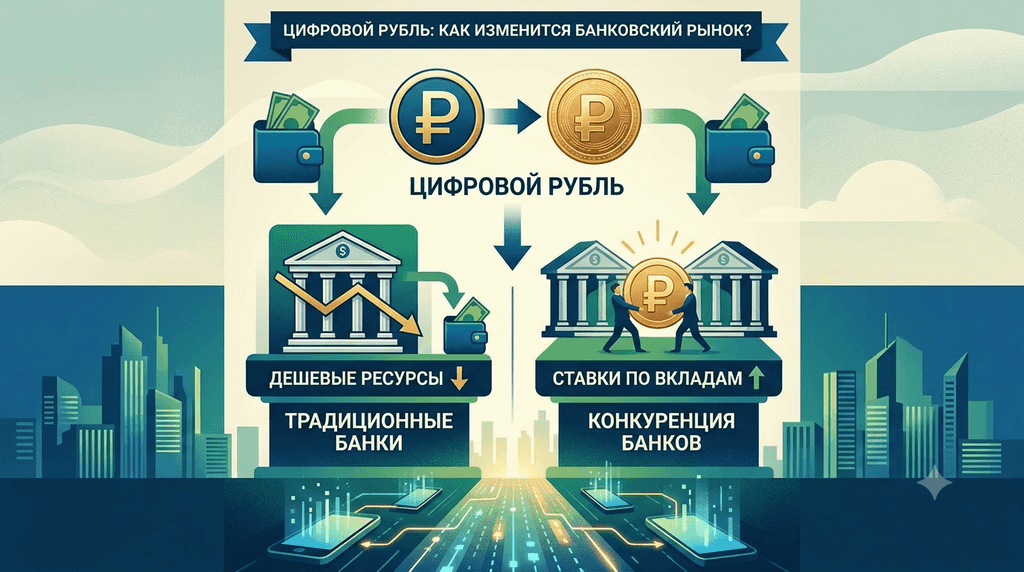
At least 20% of Russia's cash money supply is expected to be replaced by the digital ruble — a forecast shared with TASS by Eduard Kolozhvari, head of the Higher School of Business at Novosibirsk State University of Economics and Management. According to him, this will trigger a genuine battle among banks for client funds: lenders will see the volume of cheap resources on demand accounts shrink, and to hold onto them, banks will start raising deposit rates and improving service conditions.
The reason is simple: the digital ruble earns no interest and cannot be lent out, so every ruble that moves onto the central bank's platform becomes a resource banks can no longer use to issue loans or generate income. Below we break down why this will specifically drive deposit rates higher, when to expect competition to peak, and what it means for those who keep their savings in banks or are eyeing alternative instruments such as cryptocurrency.
Why Will the Digital Ruble Force Banks to Raise Deposit Rates?
The digital ruble strips banks of cheap funding, forcing them to offset the loss of liquidity with higher rates on traditional deposits. According to Eduard Kolozhvari's estimate, at least 20% of the cash money supply is expected to shift into the digital form of the currency, meaning a significant share of funds in current and demand accounts — most of which are interest-free or low-yield — will move onto the Bank of Russia's digital ruble platform.
For banks, demand-account balances have long been one of the cheapest sources of funding: clients kept money there for day-to-day transactions without expecting high returns. As part of these funds migrates into digital wallets held at the central bank, banks lose cheap liquidity and are forced to replace it with more expensive funding — that is, to raise rates on term deposits in order to retain existing clients and attract new ones.
Other financial market experts confirm a similar logic: the eventual emergence of deposits and loans in digital form could further intensify competition in banking services, since it would become easier for clients to compare terms across banks and switch between them without losing access to their funds.
Kolozhvari notes that alongside higher rates, banks will also start developing their service offerings more aggressively — rolling out more convenient apps, cashback programs, and personalized service terms — to compete for clients on quality as well as price.
The scale of the problem for the banking sector can be gauged from historical data: according to Bank of Russia estimates, cheap liabilities such as demand-account balances have on average generated about 25% of the banking sector's pre-tax profit. That's precisely why losing even part of this cheap liquidity pushes banks to find ways to compensate — either by raising deposit yields to attract new funds, or by making other services more expensive.
Can the Digital Ruble Itself Earn Interest or Cashback?
No, the digital ruble held in a digital wallet earns no interest, no cashback, and offers no access to loans or overdrafts. The Bank of Russia has explicitly fixed this rule: a digital wallet is a way of holding money for payments and transfers, not an investment or savings instrument.
According to Yakov&Partners, the digital ruble's primary function in the economy is to serve as a convenient means of payment and transfer, not a savings tool: balances in a digital wallet don't accrue interest, and no cashback is offered on payments. In effect, the digital ruble functions as an electronic equivalent of a paper banknote: whatever amount you put in stays exactly the same — it doesn't grow over time.
The practical takeaway is simple: to make money work and generate returns, it needs to sit in a bank deposit or be invested in other instruments. Funds in a central bank digital wallet are purely a convenient means of payment, not a way to earn.
When Will the Deposit Rate War Begin?
The deposit rate war will build up gradually — from September 2026 through September 2028 — as the digital ruble expands to cover more banks and users. The law on the phased rollout of the digital ruble takes effect on September 1, 2026: starting that date, 21 major banks will begin serving clients in digital rubles, and support for such payments will become mandatory for systemically important retail outlets.
All other commercial banks are required to connect to the Bank of Russia's digital ruble platform no later than September 1, 2028. Competition for client funds will therefore intensify gradually throughout the second half of 2026 and across 2027–2028, as the share of digital rubles in circulation grows and more market participants come online.
Tellingly, banks did manage to secure the right to service the public's digital ruble transactions through their own mobile apps — a role that wasn't part of the original rollout scenarios. This softens the blow to the banking sector, but it doesn't change the underlying trend: some portion of cheap liquidity will inevitably migrate to the central bank's platform, and banks will have to compete harder for what remains.
Alongside the digital ruble, a universal QR code for cashless payments — developed by the National Payment Card System — is also being introduced from September 1, 2026. It's meant to replace the current situation where store checkouts display several different QR codes from different services, and to simplify payments without plastic cards. For retail, this puts the digital ruble in direct competition with traditional card acquiring, adding further pressure on banks' fee income — income that previously helped offset the low yield on demand-account deposits.
Is Switching to the Digital Ruble Mandatory?
No, using the digital ruble is entirely voluntary for citizens — no one is required to receive their salary or pension in this form. Bank of Russia Governor Elvira Nabiullina has repeatedly stressed that every individual chooses for themselves in what form to receive and hold money — cash, a bank card balance, or digital rubles.
If a citizen does end up receiving part of their funds in digital rubles, they can convert them back into ordinary card balances or withdraw them as cash free of charge at any time — the exchange rate is always 1:1, since it's the same national currency in a different technical form. Russian legislation does not provide for any compulsion or automatic conversion of pensions and salaries into digital form.
What Practical Benefits Does the Digital Ruble Offer Ordinary People?
The digital ruble's main practical advantage is completely free transfers between individuals, regardless of amount and without being tied to a specific bank. Unlike the Faster Payments System, which charges a fee once a certain monthly transfer threshold is exceeded, digital ruble transfers remain free for citizens at all times.
The second key advantage is independence from any single lending institution. A digital wallet is opened directly on the Bank of Russia's platform, so even if a servicing bank runs into technical trouble or loses its license, access to funds is preserved through the mobile app of any other participating partner bank connected to the platform.
At the same time, the Bank of Russia has set a top-up limit for digital wallets, expected to be around 300,000 rubles per month — a measure designed to prevent a sudden, panic-driven outflow of deposits from the banking system and to safeguard financial stability during the mass rollout of the new currency form.
How Does the Digital Ruble Differ from Cryptocurrency?
The digital ruble is a state-issued national currency pegged 1:1 to the ordinary ruble, not a decentralized and volatile asset like bitcoin. The key difference lies in the issuer and the nature of the asset: the digital ruble is issued exclusively by the Bank of Russia and is fully backed by the state, whereas cryptocurrencies are issued in a decentralized manner, with prices set by the market and capable of swinging by double-digit percentages in a short period.
In addition, using cryptocurrency for payments inside Russia is prohibited, whereas the digital ruble is an official means of payment equivalent to cash and non-cash money. That said, both instruments are digital by nature, and rising financial literacy around the digital ruble could, according to some experts, simultaneously fuel Russians' interest in cryptocurrency as a higher-yielding, though riskier, alternative to traditional savings.
Some analysts also point to a competitive angle: in their view, the broad rollout of the digital ruble can be seen as something of a state response to the growing popularity of stablecoins like USDT, since both forms of digital money compete for the role of a convenient, fast, and predictable means of settlement. The difference is that the digital ruble is fully regulated and backed by the state, while stablecoins remain outside the legal framework for domestic payments.
Could the Banking Sector Suffer from the Outflow of Funds into the Digital Ruble?
There won't be a sudden collapse of the banking system due to outflows into digital rubles, since the Bank of Russia has already built in safeguards against a panic-driven shift of capital. The main one is the digital wallet top-up limit: an individual cannot transfer an arbitrarily large sum onto the central bank's platform in one go, which technically rules out an instant "bleeding out" of banks.
Even so, this represents meaningful structural pressure on the banking sector: if the cost of attracting deposits rises due to competition for clients, banks will likely have to partially offset the increased expense by moderately raising rates on commercial and consumer loans. In other words, the deposit rate war has a flip side — borrowed money could become more expensive for anyone planning to take out a loan in the coming years.
For smaller regional banks with a limited client base, this pressure could be felt more acutely than for large federal players: the latter have more room to offset lost liquidity through scale, a diversified product lineup, and fee income from other business lines. That's why the most aggressive rate hikes on deposits in the coming years are likely to come from banks actively fighting to expand their client base.
Is It Worth Shifting Savings into Cryptocurrency on KuCoin Amid the Deposit Rate War?
Rising competition among banks for deposits is a good reason to review the structure of your personal savings, but not a reason to abandon diversification into alternative assets altogether. As long as deposit rates keep climbing, the conservative portion of a portfolio can reasonably stay in a bank deposit — especially since term deposit terms are expected to be particularly competitive during the 2026–2028 transition period.
At the same time, the broader rise of interest in digital financial instruments is a good moment to take a closer look at the cryptocurrency market as a higher-yielding, though noticeably riskier, alternative. KuCoin offers spot and futures trading, staking, and other tools for those looking to diversify their savings beyond ruble deposits and state-issued digital currency formats.
A sensible approach is not to pull all funds out of the bank at once, but to split savings between a deposit with a rising rate and a small trial position on a crypto exchange, gradually building experience with volatile assets as financial literacy grows.
This strategy is especially justified during the 2026–2028 transition period: while banks compete for clients and raise their rates, part of your savings can keep working in a deposit with predictable returns, while another part tests riskier but potentially higher-yielding instruments on KuCoin — including spot trades in major cryptocurrencies and passive-income tools like staking.
Join KuCoin 9th Anniversary Trading Campaign
KuCoin is celebrating its 9th anniversary with a special platform campaign filled with exclusive rewards, trading activities, and limited-time offers. Don’t miss the chance to participate and enjoy the benefits as the exchange marks nine years of growth and innovation. Visit the official campaign page now:

Conclusion
The rollout of the digital ruble isn't triggering a collapse of the banking system — it's intensifying competition for client money. According to Eduard Kolozhvari's forecast, an outflow of at least 20% of the cash money supply onto the digital ruble platform will force banks to raise deposit rates and improve service in order to hold on to clients. The digital ruble itself remains a payment tool rather than a savings vehicle — no interest or cashback accrues on its balance.
The process will be gradual: starting September 1, 2026, the first 21 banks and major retail outlets connect to the platform, with the entire banking system required to complete the transition no later than September 1, 2028. Using the digital ruble is voluntary, the wallet top-up limit protects the financial system from sudden shocks, and digital rubles can be exchanged back into ordinary money at any time without any loss of value.
For depositors, this period could prove advantageous — it's worth watching for improving bank offers and comparing terms. And for those looking to spread risk beyond ruble deposits, it may be worth considering alternative instruments as well, including cryptocurrency markets.
FAQs
1. Who is Eduard Kolozhvari, and why trust his forecast?
Eduard Kolozhvari is head of the Higher School of Business at Novosibirsk State University of Economics and Management. His forecast on the deposit rate war was published by TASS and is based on an analysis of banking liquidity structure following the digital ruble's rollout, including the share of cheap liabilities held in demand accounts.
2. Will the digital ruble fully replace cash and non-cash money?
No, the digital ruble is an additional, third form of the national currency, not a replacement for existing forms of money. Cash and non-cash rubles will continue to be used in parallel, and the choice of which form to receive and hold money in remains up to the individual.
3. How does the digital ruble work technically?
Each digital ruble is a unique electronic code stored as a record in a digital wallet on a dedicated platform built by the Bank of Russia. Wallet transactions can be handled through the mobile apps of ordinary commercial banks, without needing to open a separate account directly with the central bank.
4. Will deposits and loans in digital rubles ever exist?
Not yet, but the Bank of Russia is already discussing the possibility of eventually allowing banks to hold digital ruble wallets on their own balance sheets and offer clients deposits and loans in this form. Such a pilot could launch no earlier than 2029 and would mark a separate stage in the development of the financial infrastructure.
5. Can someone be paid their salary or pension entirely in digital rubles without their consent?
No, Russian law does not provide for the forced conversion of salaries or pensions into digital form. Every citizen voluntarily chooses which form — cash, non-cash, or digital — to receive payments and hold savings in, and can change that choice at any time.
Disclaimer : This material is provided for informational purposes only and does not constitute financial, investment, legal, or tax advice. Transactions involving cryptocurrencies and tokenized assets carry substantial risks — including price volatility, limited liquidity, counterparty exposure, and the potential for total loss of invested capital. Readers should conduct their own research and, where appropriate, consult a qualified professional before making any financial decisions.