

Digital Ruble and Russian Banks: Why Commission Losses Could Exceed 100 Billion Rubles a Year
Introduction
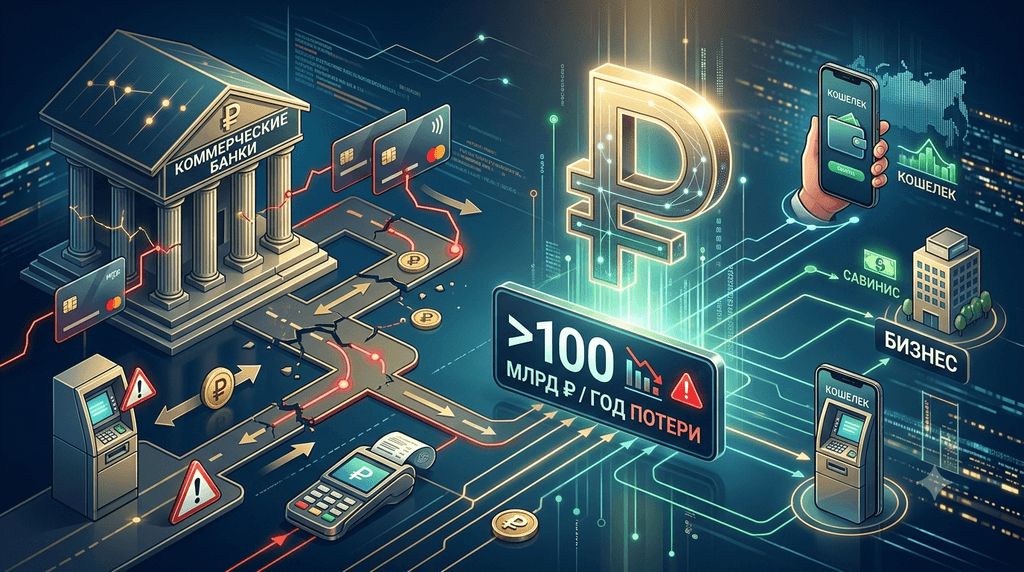
What will happen to the Russian banking system if part of standard card payments shifts to the Bank of Russia platform? According to estimates by the National Rating Agency (NRA), if the digital ruble sees widespread adoption, banks could lose over 100 billion rubles in annual commission revenue. This forecast does not mean money is vanishing from the economy; rather, it represents a redistribution of payment costs from banks to businesses and users. The main drivers of this risk are a reduction in card acquiring and the potential transfer of funds from checking accounts into digital ruble wallets.
Starting September 1, 2026, systemically important banks and large trade companies began implementing the infrastructure for settlements in this new form of national currency. However, the use of the digital ruble by citizens remains voluntary, and its mass adoption, according to the NRA's baseline scenario, will take several years. Therefore, for banks, this is simultaneously a long-term liquidity challenge and an incentive to create new services.
Why Does the Digital Ruble Threaten Russian Banks' Income?
The primary risk stems from the digital ruble's potential to replace a portion of card transactions from which banks collect acquiring fees. In the traditional scheme, a buyer pays with a card, and the acquiring bank, issuing bank, and payment infrastructure divide the commission revenue among themselves. In contrast, digital ruble transactions occur directly on the Bank of Russia platform, making the traditional chain of intermediaries much shorter.
The NRA estimated a potential drop in commission revenue of over 100 billion rubles per year, provided that the digital ruble captures 14% of total cashless transaction volume. This estimate was reported by Kommersant on September 3, 2026, citing the agency's study. Consequently, the 100 billion ruble figure is not a guaranteed loss for each individual bank, but a scenario-based estimate of lost revenue for the entire banking sector.
How Does Acquiring Generate Commissions?
Acquiring generates revenue for banks by servicing cashless payments at retail outlets, online stores, and services. For a merchant, standard card commissions consist of several components, including fees to the acquirer, interchange fees, and payment system expenses. Depending on the industry and contract terms, traditional rates for businesses typically range between 1.5% and 2.5%.
A lower commission structure is envisioned for the digital ruble. According to the Bank of Russia, businesses pay zero commission on digital ruble payments and transfers through the end of 2026, and from 2027 onward, rates are expected to remain among the lowest in the payment market. Implementation materials indicate a benchmark rate of around 0.3% for commercial transactions. Furthermore, the digital model eliminates the traditional revenue split among card issuers and networks.
This rate disparity creates a clear economic incentive. If a store can accept payments without cards and lower its expenses, it realizes direct savings. A bank, on the other hand, loses a portion of its former commission, even if it continues to maintain the client's bank account and provide access to the digital wallet.
| Parameter | Card Payment | Digital Ruble Payment |
| Main Settlement Network | Banks and payment infrastructure | Bank of Russia Platform |
| Commission Burden on Business | Approximately 1.5–2.5%, depending on the agreement | 0% until the end of 2026; low regulator rates thereafter |
| Merchant Benefit | Familiar infrastructure and loyalty programs | Potentially lower payment acceptance costs |
| Risk for Banks | Retained acquiring costs and competition | Reduced card commissions and integration costs |
How Much Money Could Leave the Banking System?
The second channel of pressure is the potential outflow of liabilities from bank accounts into digital wallets. According to the Bank of Russia, as of July 1, 2026, individual holdings in bank accounts exceeded 67 trillion rubles. The NRA suggests that banks could lose at least 10% of their liabilities over five years, meaning the potential scale of redistribution could reach approximately 1–1.5 trillion rubles per year.
It is important to distinguish between commission risk and funding risk. The 100 billion ruble figure represents an estimated annual reduction in commission income at a specific digital ruble adoption rate. Funding outflow is a different metric: it can increase the cost of capital that banks use to fund loans and other assets. When commercial banks retain fewer low-cost demand balances, they must turn to more expensive sources of liquidity.
This dynamic can put pressure on net interest margins. Banks will either need to raise deposit rates to retain clients, restrict the availability and cost of loans, or seek additional sources of commission revenue. Therefore, even moderate adoption of the digital ruble could have broader ramifications than simply losing a commission on a single transaction.
Why a Digital Wallet Is Not Equal to a Bank Deposit
A digital ruble is stored on the Bank of Russia platform, not in a commercial bank account. It is not a deposit and earns no interest for the holder. Furthermore, commercial banks cannot use digital rubles to issue loans. This is a fundamental distinction from funds held in checking or savings accounts.
For users, a digital wallet serves as a convenient payment method, but it does not replace a savings product. Money intended for savings is logically evaluated against deposits based on yield, term, and liquidity terms. In contrast, the digital ruble is primarily designed for payments, transfers, and specific government disbursements.
This absence of interest yields creates a natural barrier against a massive flight of savings. However, a portion of liquid balances used for daily expenses may transition to digital wallets. For banks, this does not imply an immediate loss of all deposits, but rather a gradual shift in liability structure.
How Quickly Will the Digital Ruble Become Mainstream?
The NRA's baseline scenario suggests that within five to seven years, the digital ruble could account for 15–24% of cashless turnover. Across conservative and optimistic scenarios, the range spans from 5% to 30%. These estimates show that the projected 100+ billion ruble loss depends not on the launch itself, but on the future market share of transactions.
During the first one to two years, adoption will likely remain limited. At launch, individuals must open a digital account through the app of a bank connected to the Bank of Russia platform. Users choose whether to receive salaries and pensions in cash, into a standard bank account, or in digital rubles. The Bank of Russia explicitly states that participation is voluntary.
An additional hurdle is changing consumer habits. Card payments are deeply integrated into mobile apps, loyalty programs, subscriptions, and cashback offerings. The digital ruble must prove its value not only through lower fees for merchants, but also via user convenience for shoppers.
The experience of the digital yuan demonstrates that a technological rollout does not guarantee a high transaction share. As noted by Kommersant citing industry experts, even active promotion did not rapidly establish the digital yuan as China's primary payment method. For Russia, this implies that NRA's scenario calculations should be viewed as benchmarks under widespread adoption rather than forecasts of an immediate shock.
What Restrictions Mitigate the Risk of Deposit Outflows?
The primary built-in safeguard is the monthly limit on transferring funds from a bank account into an individual's digital wallet. The Bank of Russia set this limit at 300,000 rubles per month, though existing digital ruble balances can be spent without restrictions. Businesses face no top-up limits.
This mechanism acts as a buffer. A client can transfer funds into digital rubles for daily expenses, but cannot instantly move a large bank balance via standard top-ups. This mitigates the risk of sudden liquidity runs and grants commercial banks time to adjust their products and fee structures.
A second buffer is the absence of interest on digital wallets. To earn a return on reserves, clients still require deposits and savings accounts. Thus, the digital ruble competes primarily with transactional balances and checking account funds rather than long-term deposits.
A third factor is phased onboarding. Starting September 1, 2026, large banks and retailers are required to provide infrastructure, while other market participants will join as they become ready. This gradual implementation reduces the likelihood of a sudden customer exodus.
Who Benefits from the Transition to the Digital Ruble?
Merchants and consumers stand to gain the most. For businesses, lower payment processing fees translate directly into reduced operating expenses. Companies can reallocate these savings toward price reductions, marketing, payroll, or capital investments. For citizens, a major advantage is fee-free payments and transfers.
The Bank of Russia confirmed that payments and transfers remain free for individuals. Businesses enjoy zero fees through the end of 2026, after which rates will remain significantly lower than standard payment market tariffs. Therefore, the reported "losses for banks" are more accurately characterized as a redistribution of income: money previously retained within the financial sector transforms into corporate savings and free consumer services.
The state also gains a more unified settlement framework for targeted budgetary operations. The digital ruble supports peer-to-peer transfers, business transactions, tax payments, and refunds. Over time, programmable payments and smart contracts could streamline recurring operations, particularly in corporate and public sectors.
How Will Russian Banks Protect Their Revenues?
Rather than resisting the digital ruble, banks are likely to offset declining card fees by adapting their business models. The first response is expanding proprietary ecosystems and services that keep clients within the bank's ecosystem regardless of their payment choice.
Key tools will include the Faster Payments System (FPS), banking subscriptions, and personalized offers. Another strategy involves offering high-yield deposit and savings products to retain capital that clients do not plan to spend immediately. Even if the digital wallet becomes a primary payment layer, the bank can maintain its role as the user's primary financial hub.
Traditional card perks will also adapt. Banks may scale back or eliminate cashback and rewards points on digital ruble transactions, as these operations yield lower acquiring margins. Instead, loyalty programs will increasingly attach to subscriptions, ecosystem services, partner merchandise, or value-added tools.
Major banks can also generate revenue through infrastructure integration, treasury management solutions, and smart contracts. The NRA estimates connection costs at 100–300 million rubles per bank. At a 0.1% fee, a bank would need to process 10 billion rubles in volume to recoup a 100 million ruble investment, making infrastructure payback more challenging for smaller institutions.
Why Are Small Banks at Greater Risk Than Large Ones?
Small and medium-sized credit institutions face fixed integration costs alongside lower transaction volumes. With a smaller customer base, digital payment fees will take longer to cover deployment costs. In contrast, major banks can distribute tech investments across millions of users and cross-sell supplementary products.
For smaller banks, leveraging turnkey tech solutions and partner models offers a pragmatic path forward. Shared infrastructure avoids redundant expenses, enabling them to focus on niche specializations, regional clients, and lending operations.
However, smaller banks also possess a defensive buffer. If digital ruble adoption unfolds gradually, they will have time to streamline operations. Furthermore, because digital wallets earn no interest, demand for bank deposits will remain, preserving the core banking model.
How Does the Digital Ruble Shift Payment Competition?
The digital ruble will intensify competition among card payments, the Faster Payments System, and direct settlements on the Bank of Russia platform. Victory will belong not necessarily to the cheapest tool, but to the one best suited to specific tasks.
Merchants prioritize low fees, processing speed, refund handling, and POS integration. Consumers look for convenience, security, rewards, and rapid transfers. Banks aim to retain clients, deposit balances, and fee streams. Consequently, the digital ruble does not eliminate banking services—it shifts the focus from simple transaction routing to managing broader financial relationships.
Should You Invest in or Trade the Digital Ruble on KuCoin?
The digital ruble is not a market cryptocurrency that can be bought or sold on KuCoin. It is an official form of the Russian national currency, issued and tracked directly on the Bank of Russia platform. Therefore, standard crypto trading strategies do not apply: its exchange rate relative to the traditional ruble is fixed and cannot trade as an independent token.
KuCoin users can study the digital ruble as a case study in CBDC development, payment infrastructure, and regulated digital finance. When making cryptocurrency trading decisions, investors should independently evaluate liquidity, volatility, regulatory risks, and project fundamentals. Insights regarding the digital ruble should not be automatically applied to cryptocurrencies or stablecoins.
KuCoin Offers A More Stable Option in A Volatile Market
If you worry about the frequent ups and downs in the market, and pursue a more stable option to earn money passively, KuCoin is the right place to come:
Simple Earn: Deposit and withdraw tokens anytime, earning stable returns.
Kucoin Earn: Earn stable profits with professional asset management.
Hold to Earn: Earn rewards by holding assets in Funding, Trading, Margin, Futures, Mining, and Unified Accounts.
Staking: Unlock the earning potential of on-chain assets.
Advanced Investments: Advanced Investments offer a variety of structured products to help your money grow in any market.
Shark Fin: Principal Protection and Guaranteed Gains
Dual Investment: Buy low and sell high with transparent return calculations.
Snowball: High yields, with price protection.
Discount Buy: Buy crypto at discount prices.
KCS Loyalty: Level up to enjoy exclusive perks by staking ≥ 1 KCS.
KuCoin Wealth: Discover future value and begin your smart investing journey.
KCS Benefits: Hold and stake KCS to access benefits across the platform.
KCS Staking 2.0: Participate in KCS on-chain governance to earn yield.
Conclusion
The digital ruble has the potential to reshape Russia's payment landscape, but the estimated bank losses of over 100 billion rubles per year should be understood as a scenario model rather than an inevitable outcome. The NRA attributes this figure primarily to a drop in card acquiring fees, assuming the digital ruble reaches approximately 14% of cashless transactions. A secondary risk involves potential liability outflows, which could reach at least 10% over five years, raising funding costs and putting pressure on net interest margins.
However, money is not disappearing from the economy—it is being redistributed. Businesses can save on payment fees, while citizens gain access to free transfers and payments. Safeguards such as the 300,000 ruble monthly top-up limit, the absence of interest yields, and the voluntary nature of adoption reduce the likelihood of sudden deposit flight. Mass adoption will also be gradual: the NRA's baseline scenario projects a 15–24% share of cashless turnover within five to seven years.
For banks, the digital ruble entails integration costs, but it also opens opportunities in ecosystem services, treasury solutions, and innovative products. The final impact will depend not only on Bank of Russia regulations, but also on how quickly businesses and consumers realize the tangible benefits of this new form of money.
Frequently Asked Questions
1. Can you receive salaries and pensions in digital rubles?
Yes. According to the Bank of Russia, citizens can choose to receive salaries and pensions in cash, via a standard bank account, or in digital rubles. Transitioning an individual to the digital ruble without their consent is prohibited.
2. Can you hold digital rubles in a deposit account with interest?
No. A digital wallet is not a bank deposit and does not generate interest income. To earn interest, users must place funds into a commercial bank deposit or other savings product.
3. Is there a balance limit on digital ruble wallets?
There is no limit on total wallet balance or usage. The limit applies specifically to monthly transfers (top-ups) from a bank account into a digital wallet, capped at 300,000 rubles per month for individuals.
4. Can the digital ruble replace cash?
Not in the near future. The digital ruble requires a banking app and supporting infrastructure, whereas cash functions without a digital wallet. The Bank of Russia views the digital currency as a complementary form of national money.
5. Can digital rubles be converted into cryptocurrency?
The digital ruble itself is not a cryptocurrency and does not trade as a freely floating token. Converting digital rubles into crypto assets depends on applicable laws, specific platform policies, and authorized payment gateways; a CBDC should not be automatically equated with cryptocurrencies.
Disclaimer : This material is provided for informational purposes only and does not constitute financial, investment, legal, or tax advice. Transactions involving cryptocurrencies and tokenized assets carry substantial risks — including price volatility, limited liquidity, counterparty exposure, and the potential for total loss of invested capital. Readers should conduct their own research and, where appropriate, consult a qualified professional before making any financial decisions.