

DeFi Lending Faces a Price Manipulation Crisis as 32 Exploits Hit in 2026
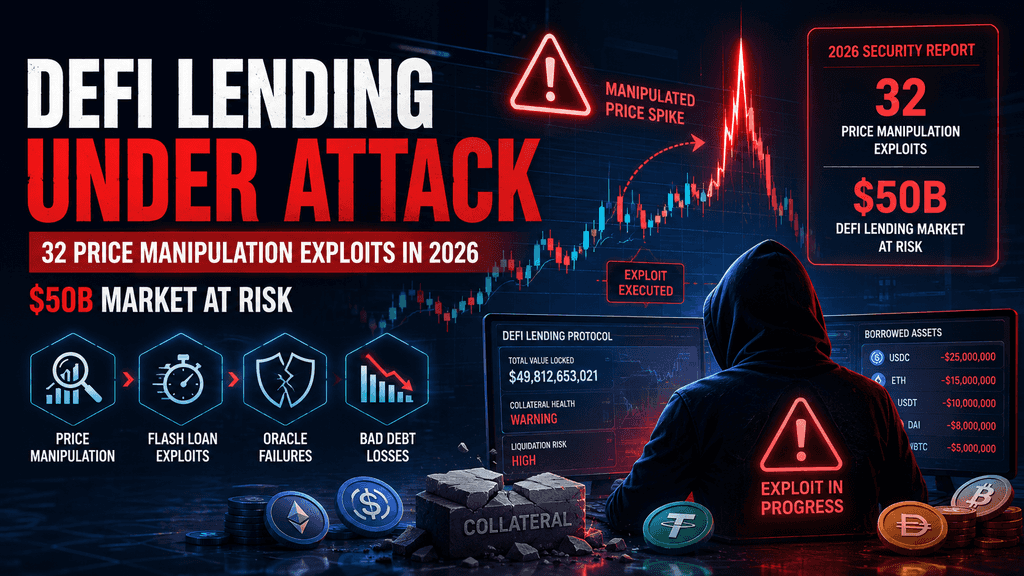
Price manipulation is becoming one of the most persistent security threats facing decentralized finance in 2026. Blockchain intelligence firm TRM Labs has recorded 32 price-manipulation exploits so far this year, more than in any previous full year. The issue came into sharper focus on August 30, when an attacker manipulated the price of Tectonic’s thinly traded TONIC token and borrowed an estimated $75 million from the Cronos-based lending protocol.
The threat matters because DeFi lending is no longer a small experimental market. Lending protocols currently hold roughly $48.8 billion in total value locked, with Aave and Morpho alone accounting for a large share of the sector. Yet the biggest lesson from this year’s attacks is not simply that more money attracts more hackers. Increasingly, attackers do not need to break smart-contract code at all. They can instead attack the economic assumptions behind a lending market — particularly the assumption that collateral can always be valued and liquidated at the price a protocol sees onchain.
Why Are Price Manipulation Attacks Surging in 2026?
The number of price-manipulation incidents has reached a record level. TRM Labs says 32 such exploits have been recorded in 2026, while price manipulation now accounts for roughly one in eight crypto hacks, compared with about one in 17 in 2022. Its broader data also recorded 207 crypto security incidents and $972 million stolen during the first half of 2026. The increase suggests that manipulating economic inputs is becoming a repeatable attack strategy rather than an occasional edge case.
Several structural changes help explain the trend. DeFi lending pools are larger, more assets are being accepted as collateral, permissionless lending markets have expanded, and increasingly complex oracle systems connect protocols to prices across multiple markets. At the same time, lending protocols compete for capital efficiency and user growth. Supporting additional governance tokens, new crypto assets, wrapped tokens and real-world assets can increase borrowing demand, but every new collateral asset also creates another set of assumptions about liquidity, volatility and pricing.
The security question is therefore changing. Traditional smart-contract security asks whether an attacker can force code to behave in an unintended way. Price-manipulation security asks whether an attacker can make the correctly functioning code produce a disastrous result by feeding it economically misleading information. A lending contract can perform every calculation exactly as designed and still suffer major losses if the collateral valuation underlying those calculations is unrealistic.
How Does a Price Manipulation Attack Work?
A lending protocol generally determines borrowing capacity by taking the reported value of a borrower’s collateral and applying a loan-to-value or collateral factor. If a user deposits $1 million of collateral and the permitted LTV is 60%, for example, the system might allow roughly $600,000 of borrowing. This works only if the reported $1 million valuation represents economic value that could realistically be recovered during liquidation.
An attacker targets the gap between reported price and realizable liquidity. Imagine a small token with only $100,000 of meaningful market depth. If an attacker can temporarily drive its quoted price high enough for the protocol to value their holdings at $10 million, a 60% borrowing limit could theoretically create millions of dollars of borrowing capacity. The attacker can then extract USDC, ETH or other highly liquid assets. When the manipulated token returns to its normal price, the protocol is left with collateral that cannot cover the debt.
The attack can be summarized as a dangerous mismatch: the market may be able to absorb only a small amount of collateral, while the lending protocol treats that collateral as capable of supporting a much larger loan. The key question for risk managers is therefore not simply “What is this token’s price?” It is “How much of this token could actually be sold near that price if a large position had to be liquidated?”
What Happened in the $75M Tectonic Exploit?
The Tectonic incident provides one of the clearest examples. On August 30, an attacker targeted TONIC, the governance token of the Cronos-based lending protocol. TRM Labs found that TONIC’s price was driven roughly 100 times higher in about 20 minutes. The attacker then posted the inflated asset as collateral and borrowed harder, more liquid assets from Tectonic’s lending pools. The widely reported amount involved was approximately $75 million, although TRM noted that one separate onchain analysis produced a higher estimate.
What makes the case particularly striking is the underlying liquidity. TONIC had generated only about $305,000 of trading volume during the entire week before the exploit. The roughly $75 million borrowed against it was therefore about 245 times its previous seven-day volume. TRM also noted that only about $25,997 worth of TONIC had been posted as collateral across the whole of August before the incident, despite the token carrying a 20% collateral factor.
| Tectonic Exploit Metric | Approximate Figure |
| TONIC price increase | ~100× |
| Time taken | ~20 minutes |
| Previous 7-day TONIC volume | ~$305,000 |
| Assets borrowed | ~$75 million |
| Borrowed amount vs. weekly volume | ~245× |
The central weakness was therefore not simply that TONIC’s market price moved. It was that a token with extremely limited liquidity was able to create borrowing power vastly greater than the depth of the market supporting its valuation. That mismatch is increasingly becoming one of DeFi lending’s most important security problems.
Why Low-Liquidity Collateral Is So Dangerous
Deeply traded assets are expensive to manipulate. Moving Bitcoin or Ether dramatically across multiple liquid venues requires enormous capital because arbitrageurs and market makers quickly trade against price discrepancies. Long-tail assets behave differently. A governance token, newly launched coin, memecoin or small wrapped asset may trade in only a handful of pools with limited liquidity, making a temporary price distortion much cheaper to engineer.
Risk becomes particularly acute when three characteristics appear together: low liquidity, generous collateral parameters and large borrowing capacity. A high collateral factor allows more debt to be created against each dollar of reported value, while a large borrow cap gives the attacker more assets to extract. If those limits are not calibrated to the collateral’s actual liquidation depth, the protocol may effectively offer an attacker more credit than the market could ever recover from the collateral.
The economic-security test can therefore be simplified to one relationship. If the cost of manipulating collateral is lower than the value an attacker can extract, an exploit may be profitable. A safer design tries to reverse that inequality by limiting borrowing power until the cost of manipulation exceeds any realistic maximum extractable value. That principle is more fundamental than any individual oracle provider or smart-contract implementation.
Why Oracles Are Only Part of the Problem
Price oracles are central to DeFi lending because smart contracts cannot independently know what an asset is worth. But describing every incident as an “oracle attack” hides important differences. In Tectonic, the market price itself was manipulated because TONIC was thinly traded. An oracle can accurately report a manipulated market price and still expose the protocol to losses. Moonwell experienced a similar warning on August 27, when security firms estimated that manipulation of the relatively illiquid MAMO collateral price contributed to an exploit of around $8.7 million. Rhea Lend, meanwhile, recorded an $18.4 million April incident classified by DefiLlama as oracle manipulation using spot-price manipulation.
Bonzo Lend demonstrates a very different failure mode. On July 11, an attacker submitted a manipulated price update for SAUCE on Hedera even though SAUCE’s real market price did not move. Bonzo’s post-mortem says the submitted value was inflated by roughly 12 orders of magnitude. A flaw in the third-party oracle verification path allowed a zero-signature submission to be accepted. Eight seconds after that incorrect price reached the oracle storage, the attacker began borrowing against a small SAUCE deposit. Bonzo reported approximately $9.05 million of maliciously extracted principal. Crucially, Bonzo’s lending contracts themselves behaved as designed given the price they received.
| Risk Type | What Can Go Wrong |
| Market manipulation | A real market price is temporarily pushed to an artificial level |
| Oracle verification failure | False price data is accepted as valid |
| Collateral design failure | Borrowing capacity exceeds realistic market liquidity |
| Wrapper/conversion error | A correct external price is converted into the wrong collateral value |
Edel Finance adds another layer. An attacker manipulated the conversion mechanism between tokenized Google stock GOOGLx and wrapped wGOOGLx, inflating the effective collateral valuation about 78 times and leaving roughly $403,000 in bad debt. Chainlink’s underlying Alphabet price feed was correct; the problem was how the protocol translated that correct price through the wrapper. The lesson is simple: a good oracle cannot make bad collateral safe, and a correct price feed cannot protect a protocol that interprets the price incorrectly.
How Flash Loans Make Price Manipulation Easier
Flash loans can make some price-manipulation strategies dramatically more capital-efficient. They allow a user to borrow large amounts of liquidity without traditional collateral as long as the borrowed funds are returned within the same atomic transaction. An attacker can therefore temporarily obtain large capital, trade aggressively against a shallow liquidity pool, distort a price, exploit a protocol that relies on that price and repay the flash loan before the transaction ends.
Nethermind notes that flash loans are frequently used to execute large price-manipulation attacks because they reduce the amount of capital an attacker must permanently control. But flash loans should not themselves be described as vulnerabilities. They are legitimate DeFi infrastructure used for arbitrage, refinancing and other applications. Bonzo’s July exploit, for example, did not involve a flash loan at all.
The real vulnerability exists when a temporary movement can create enough borrowing power to produce a profit. A protocol designed around robust liquidity assumptions should remain secure even if an attacker can temporarily access large amounts of capital. In that sense, flash loans do not create weak economic design; they expose it.
How Price Manipulation Hurts Ordinary Lenders
A lender does not need to own the manipulated token to suffer from the consequences. Consider a user who deposits USDC into a lending pool. Another participant deposits an illiquid token whose price has been artificially inflated and then borrows that USDC. When the collateral price returns to reality, liquidators may be unable to sell enough of the collateral to repay the outstanding loan.
The difference between the debt and what can actually be recovered becomes bad debt. Depending on a protocol’s design, losses may be absorbed by an insurance or safety fund, protocol treasury, governance system or liquidity providers themselves. The user who deposited a supposedly stable asset can therefore become indirectly exposed to risks originating from a completely different and highly speculative collateral market.
This is one of the most important contagion mechanisms in DeFi lending. Risk does not necessarily remain with the holders of a weak token. Bad collateral can transmit risk into otherwise high-quality lending assets. That makes collateral onboarding a system-wide risk decision rather than a feature that affects only users who choose to own that asset.
Can Large Protocols Like Aave and Morpho Avoid These Attacks?
The stakes increase with the size of the lending market. DefiLlama currently tracks roughly $48.8 billion in lending TVL. Aave accounts for about $17.5 billion and roughly $12.5 billion in active loans, while Morpho holds about $9.5 billion in TVL and $4.8 billion in active loans. These numbers do not imply that either protocol is likely to suffer the same type of exploit, but they illustrate how important lending risk management has become.
Larger and more mature protocols generally use multiple layers of controls, including conservative collateral factors, supply and borrow caps, isolated markets, specialized oracle configurations and asset-specific risk parameters. Permissionless lending architectures can add another dimension by allowing market creators or risk curators to determine which combinations of assets and parameters should exist. This can improve flexibility, but it also shifts more responsibility toward the quality of risk curation.
The competitive advantage in DeFi lending may therefore increasingly come from how safely a protocol can support assets, not simply how many assets it can list. Supporting a long-tail token with attractive borrowing parameters can generate growth, but aggressive parameters become dangerous when borrowing capacity expands faster than the token’s genuine liquidation liquidity.
Can Better Risk Controls Stop Price Manipulation?
The first layer of defense is more resilient pricing. Instead of relying on a single spot price from a shallow liquidity pool, protocols can use multiple independent sources, time-weighted average prices, deviation limits and liquidity-aware price calculations. Each approach involves trade-offs. A longer TWAP can reduce vulnerability to sudden manipulation but may react too slowly during legitimate market crashes, while multiple oracle sources are useful only when those sources are genuinely independent.
The second layer is collateral design. Borrow caps, supply caps, lower LTV ratios and isolated lending markets can prevent a manipulated asset from creating system-wide losses. A token with only modest liquidation depth should not be able to support tens of millions of dollars of immediately withdrawable borrowing. Dynamic parameters that respond to liquidity, volatility or market concentration can provide additional protection as conditions change.
Circuit breakers form the final layer. If an asset suddenly rises 50 or 100 times, if oracle sources disagree sharply or if market liquidity disappears, protocols can temporarily freeze new borrowing, reduce collateral capacity or pause the affected market. The objective does not have to be making manipulation impossible. Financial markets can always be moved under extreme circumstances. The more realistic security goal is to make manipulation economically unprofitable before an attacker can extract meaningful value.
What the Tectonic Rollback Says About DeFi
The response to Tectonic created a second debate beyond lending security. Cronos halted block production within minutes of identifying the incident. By that point, roughly $6 million had reached Ethereum. Validators subsequently restored the chain to a state before the exploit, reversing approximately $68.7 million that had remained on Cronos. As a result, the roughly $75 million headline exploit amount should not be confused with the amount that ultimately escaped the rollback.
From an asset-recovery perspective, the intervention was highly effective: approximately 92% of the reported proceeds had not left Cronos and could be reversed. From a decentralization perspective, however, it raises a harder question. If validators can collectively decide that previously included transactions should be removed, how absolute is transaction finality?
That creates a familiar blockchain trade-off between security and immutability. A more interventionist network may be able to limit catastrophic losses, while users seeking stronger censorship resistance may view the ability to roll back finalized activity as an important governance risk. Tectonic therefore exposed both a DeFi lending problem and a broader question about how different blockchain ecosystems respond when irreversible code meets reversible governance.
Why RWA and Tokenized Assets Could Make the Problem Harder
The collateral landscape is becoming more complex as real-world assets and tokenized securities move onchain. A traditional crypto asset may already require several price feeds and liquidity assumptions. A tokenized stock or other RWA can introduce an even longer chain: the real-world asset has an offchain market price, that price enters an oracle, the asset is represented by an onchain token, the token may then be wrapped or transformed, and the final representation is deposited into a lending protocol.
Each additional layer creates another potential mismatch. The oracle may be stale, the token may trade at a premium or discount to its underlying asset, a wrapper conversion rate may malfunction, or liquidation may be impossible while the traditional market is closed. Edel Finance’s tokenized Google stock exploit showed that even an accurate Chainlink price could not prevent losses when the wrapper mechanism translated that price incorrectly.
This will become increasingly important if DeFi lending expands into tokenized Treasuries, equities, private credit and other RWAs. The difficult question is no longer simply “Can this asset be tokenized?” It is “Can a protocol continuously price, borrow against and liquidate this asset safely under adversarial conditions?” That distinction may determine whether RWA lending can scale without introducing new systemic weaknesses.
What the 32 Exploits Mean for DeFi Lending
The record 32 price-manipulation exploits reported in 2026 point to a broader evolution in DeFi security. Secure smart contracts remain essential, but code security alone is no longer enough. Lending markets now depend on a chain of assumptions involving oracle integrity, collateral liquidity, market depth, wrapper mechanics, liquidation capacity, governance decisions and borrow limits.
That becomes increasingly important as the sector approaches $50 billion in TVL. The larger lending markets become — and the more diverse their collateral becomes — the greater the consequences when an asset’s paper value diverges from what can actually be recovered in the market.
The next generation of DeFi security will therefore depend less on whether code can simply be “hacked” and more on whether a protocol’s economic assumptions can survive an attacker deliberately trying to break them. In lending, the safest price is not necessarily the one displayed on a screen or returned by an oracle. It is the value that can still be realized when everyone tries to exit at once.
FAQs
Is price manipulation the same as an oracle attack?
No. The two can overlap, but they describe different failures. In a market-manipulation attack, an attacker may genuinely move the price on a low-liquidity exchange and an oracle may accurately report that manipulated market price. An oracle attack instead targets the mechanism used to supply or validate the price itself, as seen in the Bonzo Lend incident. A lending protocol therefore needs protection against both unreliable markets and unreliable price infrastructure.
Can a manipulated collateral price cause liquidations for other users?
Yes, depending on how the lending market is designed. Incorrect prices can distort health factors, collateral values and liquidation thresholds across affected positions. A price that is reported too low may trigger unnecessary liquidations, while a price that is too high can allow excessive borrowing and create bad debt. Isolated markets and conservative exposure limits can help reduce the extent to which one manipulated asset affects unrelated users.
Are stablecoin-only lending pools safer?
They can reduce exposure to highly volatile long-tail collateral, but they are not risk-free. Stablecoins can lose their peg, liquidity can disappear, smart contracts can fail and oracle feeds can still provide inaccurate valuations. A lending pool containing only established stablecoins may have a different risk profile from one accepting speculative governance tokens, but users still need to consider issuer, liquidity, protocol and smart-contract risks.
What is bad debt in DeFi lending?
Bad debt is the portion of a loan that remains unpaid after the protocol has recovered as much value as possible from the borrower’s collateral. For example, if a borrower owes $1 million but liquidators can recover only $700,000 from the collateral, the remaining $300,000 becomes bad debt. Protocols may use reserves, insurance funds or other mechanisms to absorb this shortfall, but severe bad debt can ultimately threaten lenders.
Does a smart contract audit protect against price manipulation?
Not necessarily. Audits are important for identifying coding bugs and implementation weaknesses, but price-manipulation attacks often depend on economic assumptions rather than defective contract code. An audited protocol can still be vulnerable if it accepts illiquid collateral with overly generous borrowing limits, relies on a fragile oracle structure or assumes a market has more liquidation depth than it actually does. Effective DeFi security therefore requires both technical auditing and continuous economic risk management.
🔥 KuCoin Offers A More Stable Option in A Volatile Market
If you worry about the frequent ups and downs in the market, and pursue a more stable option to earn money passively, KuCoin is the right place to come:
Simple Earn: Deposit and withdraw tokens anytime, earning stable returns.
Kucoin Earn: Earn stable profits with professional asset management.
Hold to Earn: Earn rewards by holding assets in Funding, Trading, Margin, Futures, Mining, and Unified Accounts.
Staking: Unlock the earning potential of on-chain assets.
Advanced Investments: Advanced Investments offer a variety of structured products to help your money grow in any market.
Shark Fin: Principal Protection and Guaranteed Gains
Dual Investment: Buy low and sell high with transparent return calculations.
Snowball: High yields, with price protection.
Discount Buy: Buy crypto at discount prices.
KCS Loyalty: Level up to enjoy exclusive perks by staking ≥ 1 KCS.
KuCoin Wealth: Discover future value and begin your smart investing journey.
KCS Benefits: Hold and stake KCS to access benefits across the platform.
KCS Staking 2.0: Participate in KCS on-chain governance to earn yield.
Disclaimer: This content is for informational purposes only and does not constitute investment advice. Cryptocurrency investments carry risk. Please do your own research (DYOR).