

What Is Dataline Crypto? $10.6M Funding, AI Data Network, and Token Launch Plans
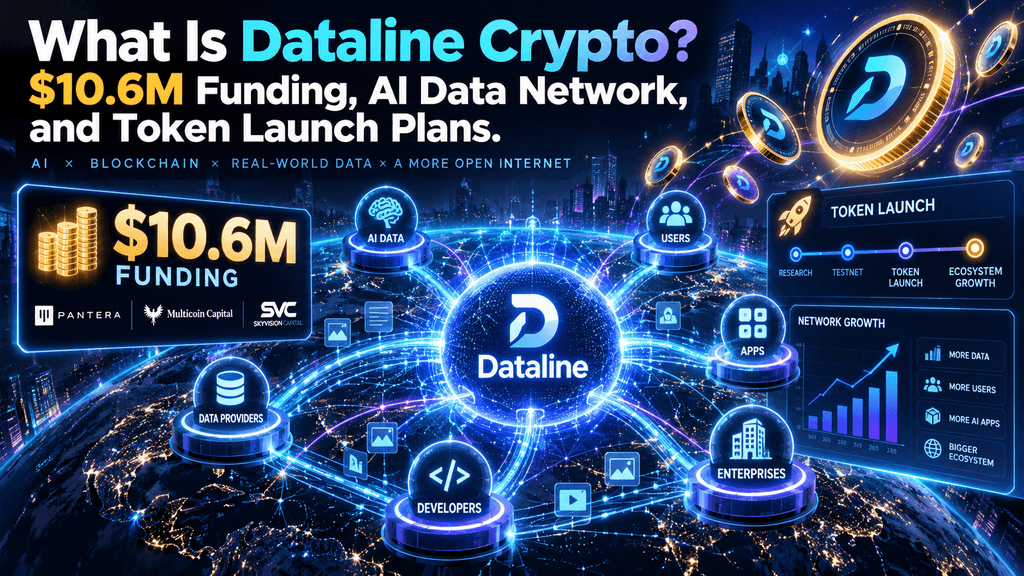
Dataline Crypto is attracting attention after raising $10.6 million to expand its decentralized data network for AI agents and announcing plans for a public DLINE token sale through Uniswap’s auction infrastructure. The funding, disclosed on October 21, 2026, places Dataline among the projects exploring how blockchain infrastructure can support autonomous software agents that need reliable, real-time information to execute tasks. The startup, formerly known as Tearline, aims to connect data providers with AI agents through a unified network that standardizes information and evaluates its quality.
The announcement also raises questions about Dataline’s business model, technology and upcoming token launch. Although the project reports existing data integrations and onchain activity, its public-sale pricing, initial circulating supply and token-unlocking schedule have not been fully disclosed. Understanding Dataline therefore requires looking beyond the $10.6 million funding headline to examine what the network does, how DLINE is expected to function, and what evidence will demonstrate whether the project can turn AI data demand into sustainable adoption.
Key Takeaways
-
Dataline raised $10.6 million: The seed round was co-led by Lattice and Dispersion Capital, with participation from several other investors, according to October 21 reporting.
-
The project targets AI-agent infrastructure: Its decentralized data network aims to provide structured information from onchain and offchain sources.
-
Dataline has reported early activity: The project says it has connected approximately 50 data sources and processed 19.4 million onchain transactions, although these figures have not been independently verified.
-
DLINE is planned, not yet confirmed as a live token: The project intends to conduct a public sale through Uniswap’s Continuous Clearing Auction (CCA) infrastructure.
-
Important token details remain outstanding: Final sale pricing, initial circulation and vesting schedules are essential information for evaluating the launch.
What Is Dataline Crypto?
Dataline is a decentralized data network designed to help AI agents discover, access and evaluate information from multiple sources through a more standardized interface. Rather than requiring every developer to build separate integrations for market feeds, blockchain data and external information services, the project aims to provide a common infrastructure layer for data requests and delivery. Its potential users include developers building autonomous trading agents, prediction-market applications and other software that relies on timely information.
From Tearline to Dataline
The project previously operated under the name Tearline before rebranding to Dataline on May 12, 2026, according to published reporting. The name change accompanied its positioning around data infrastructure for AI agents. Instead of focusing on a single consumer-facing AI product, Dataline aims to support a broader range of applications that need access to structured information.
This distinction matters because AI agents differ from conventional chatbots. A chatbot may produce an answer based on information available to it, while an agent can use data to trigger subsequent actions, such as analyzing market conditions or interacting with a blockchain application. In these cases, inaccurate or outdated information can affect execution, not just the quality of a response.
What Problem Does Dataline Solve?
Developers often need to combine multiple APIs, blockchain indexers and specialized data providers to build an agent that can operate reliably. Each source may use different formats, update schedules and reliability standards. Maintaining those integrations can increase development costs and create inconsistencies when an agent compares information from different providers.
Dataline aims to reduce this complexity by organizing data access and assessing the quality of returned information. However, its potential value depends on whether the network can deliver better reliability, coverage, cost or convenience than existing alternatives. The need for dependable AI data is a plausible market opportunity, but demand for the category alone does not establish that Dataline will capture a meaningful share of it.
Why Did Dataline Raise $10.6 Million?
Dataline’s $10.6 million seed round provides funding to expand its data infrastructure and develop its network for AI-agent applications. The round was disclosed on October 21, 2026, although reporting indicates that the financing itself closed in April. The difference between the closing date and the announcement date is important: this was a disclosure of an earlier financing event, not necessarily a new injection of capital completed in October.
Who Invested in Dataline?
According to The Block, the round was co-led by Lattice and Dispersion Capital. Other reported participants included Symbolic Capital, Coinbase Ventures, Anagram and Robinhood co-founder and CEO Vlad Tenev. The financing was structured as a Simple Agreement for Future Equity (SAFE) accompanied by a token warrant, while the company’s valuation was not disclosed.
A SAFE is an early-stage financing instrument that provides investors with contractual rights to future equity under specified conditions. A token warrant is a separate contractual arrangement involving potential token rights. The exact implications depend on the agreements, so the reported structure does not establish how many DLINE tokens any investor will ultimately receive or when those tokens could become transferable.
Where Could the Funding Go?
The project’s stated direction is to expand data coverage, strengthen data infrastructure and support additional use cases. These priorities are consistent with the needs of a network that must integrate heterogeneous information sources while maintaining useful response times and reliable data delivery. They may also involve improving verification mechanisms and attracting more developers and data providers.
The investor list indicates that Dataline has attracted attention from crypto-focused funds and people associated with financial technology. Nevertheless, funding is an input rather than proof of product-market fit. The more meaningful milestones will be sustained developer adoption, recurring data requests, paying customers and evidence that the network can support its operations economically.
How Does Dataline’s AI Data Network Work?
Dataline’s proposed model connects data providers with AI agents through a shared infrastructure layer. Providers supply information or respond to specific requests, while agents receive data in a standardized format that can be used in automated workflows. The project also describes mechanisms for evaluating information quality, including reliability, recency and consistency.
The process can be understood in three stages: data providers make information available; the network processes requests and evaluates the returned information; and AI agents consume the results when performing their tasks. This approach could simplify integrations for developers who otherwise need to manage multiple data services independently. Its effectiveness, however, depends on the underlying sources, the quality of the evaluation methods and the ability to detect conflicting or outdated information.
Why Data Quality Matters for AI Agents
Consider an AI trading agent that needs to assess a market before executing a transaction. It may require current market prices, liquidity conditions and information about recent blockchain activity. If those inputs are delayed or inconsistent, the agent could make a decision based on conditions that no longer exist. A prediction-market agent faces a related challenge when interpreting event information or checking the status of a market.
Dataline’s approach seeks to make these inputs easier to obtain and evaluate. Yet a confidence score is not a guarantee of correctness. A data source may be wrong, a metric may be unsuitable for a particular task, or several providers may repeat the same underlying error. The network’s value will therefore depend on transparent verification methods, clear source attribution and practical ways to identify and resolve disputes.
What Has Dataline Reported So Far?
Dataline has reportedly connected approximately 50 data sources and processed around 19.4 million onchain transactions. The project has also reported a 96.4% success rate for AI-agent tasks. These figures provide an initial picture of the activity the network claims to have handled, but they should be treated as project-reported metrics rather than independently audited performance data.
Transaction counts alone do not establish the number of unique users, the frequency of paid requests or the value of economic activity supported by the network. Similarly, a task success rate is difficult to interpret without knowing how success is defined, which tasks are included and how results are measured. Future disclosures about recurring usage, service costs, data quality and paying customers would provide a stronger basis for assessing adoption.
Which Blockchains and Applications Does Dataline Support?
Dataline’s reported integrations span several blockchain ecosystems and data-intensive applications. Public reporting has associated the network with BNB Chain, Sui and TON, alongside connections involving Hyperliquid and Polymarket. The project has also been reported to offer free access to developers on Base and Robinhood Chain. These arrangements suggest an effort to serve applications across multiple ecosystems rather than depend on a single blockchain.
The distinction between a blockchain integration and an application partnership is important. A network may be able to retrieve information from a blockchain without operating on that chain, and an application’s data may be accessible without the application becoming a paying customer. Developers should evaluate the scope of each integration, including which data is available, how frequently it updates and whether the service supports their specific use case.
For trading agents, Dataline could help consolidate market information from multiple venues. For prediction-market applications, it could provide structured information relevant to event analysis and market monitoring. These use cases may reduce integration work, but adoption will depend on performance, reliability, pricing and the availability of competing services. A long integration list is a useful starting point, not conclusive evidence of commercial traction.
What Is DLINE and How Will the Token Sale Work?
DLINE is Dataline’s planned native token, intended to support functions such as data access, service payments, staking and incentives for data providers. The project has outlined plans for a public token sale through Uniswap’s Continuous Clearing Auction (CCA) infrastructure, with a launch targeted before the end of 2026. As of October 22, the specific sale date and complete participation terms had not been confirmed in the reporting available.
What Is DLINE Used For?
The proposed design connects the token to network activity rather than positioning it solely as a tradable asset. DLINE may be used to pay for data services, provide access to certain network functions and support staking-based incentives for data providers. The project has also described slashing, a mechanism that can impose economic penalties on participants who violate network rules or fail to meet specified requirements.
These functions could help align data providers with the network’s quality standards. However, their effectiveness will depend on the final rules. For example, the network must define what counts as an invalid submission, how disputes are resolved and whether penalties can be applied consistently. The token’s economic role will also depend on whether users must hold DLINE to access services or can use alternative payment methods.
Why Is Dataline Using Uniswap CCA?
A Continuous Clearing Auction is an onchain auction mechanism designed to help projects distribute tokens and discover a market-clearing price. Rather than simply announcing a fixed sale price, a CCA can use demand during the auction to determine how orders are matched and how tokens are allocated, depending on its parameters. Uniswap has described CCA as infrastructure for token distribution and price discovery.
For Dataline, the planned sale could provide a public mechanism for distributing DLINE and establishing an initial market price. But the use of an auction does not guarantee a fair valuation, sufficient liquidity or a favorable outcome for buyers. The sale’s practical implications will depend on the amount offered, auction duration, bidding rules, settlement arrangements and any eligibility restrictions.
Investors should also distinguish a token launch target from a confirmed sale schedule. Dataline has indicated that more details would follow, but the launch should not be described as completed until the project publishes the final terms and the sale actually takes place.
What Do We Know About DLINE Tokenomics?
DLINE’s tokenomics remain an important area of uncertainty because supply and allocation information needs to be assessed alongside the actual launch terms. Some media reports have described a proposed total supply of one billion tokens and allocations across community rewards, the ecosystem and foundation, launchpad and liquidity, the team, and investors. However, until the project publishes an authoritative tokenomics document, these reported figures should not be treated as a fully confirmed final allocation.
The most important details include how many tokens will be available at the public sale, the initial circulating supply, and the vesting schedules for team and investor allocations. A large total supply does not, by itself, determine whether a token is expensive or cheap. Market valuation depends on price, circulating supply, future unlocks and the demand that supports the token over time.
| Tokenomics metric | Why it matters |
| Total supply | Establishes the maximum or planned number of tokens |
| Public-sale allocation | Determines how many tokens are offered to participants |
| Initial circulating supply | Helps assess the amount available to trade at launch |
| Team and investor vesting | Indicates when additional tokens may enter circulation |
| Utility and staking rules | Clarifies how network activity may generate token demand |
Can Network Usage Support DLINE Demand?
If DLINE is required for data access, service payments or staking, network adoption could create functional demand for the token. But the existence of these proposed utilities does not prove that demand will be sufficient to support a particular market valuation. That depends on the number of active users, the volume of paid requests, the frequency of token use and the availability of alternative payment options.
Unlocks also matter. Tokens allocated to teams, investors or ecosystem programs may enter circulation over time, depending on their contractual restrictions. If new supply grows faster than demand, market prices may face pressure. Until Dataline publishes clear tokenomics and vesting terms, any attempt to calculate its fully diluted valuation or forecast the impact of future unlocks would involve substantial uncertainty.
What Are the Biggest Risks for Dataline Crypto?
Dataline faces three broad challenges: competition, data reliability and uncertainty surrounding its token launch. The AI-agent data market includes existing API providers, blockchain indexing services and other decentralized data networks. Dataline must demonstrate that its approach offers a meaningful advantage in coverage, accuracy, cost or integration convenience. Even if demand for AI data grows, that demand may be captured by established providers or competing networks.
Data quality is another critical issue. AI agents can make consequential decisions based on the information they receive, particularly in trading and financial applications. A system that standardizes data but fails to identify inaccurate or outdated inputs may not solve the underlying problem. Dataline will need to demonstrate that its verification methods work in practice and that developers can understand the limitations of the data they consume.
The token launch introduces a separate set of risks. Sale pricing, initial circulation, liquidity and vesting arrangements can affect market behavior after launch. A successful fundraising round does not guarantee token demand, while a public auction does not guarantee that the resulting price reflects long-term utility. Prospective participants should wait for official terms and independently verify any sale interface or contract address before interacting with it.
What Should Investors Watch Before the DLINE Launch?
The most useful indicators to follow are official token-sale disclosures, evidence of real product adoption and the relationship between network usage and token utility. Dataline’s next announcements should clarify the sale date, allocation, pricing mechanism, initial circulating supply and vesting schedule. Those details will help readers understand the structure of the launch rather than rely on speculation about a potential listing.
Product adoption is equally important. The number of connected data sources is useful, but recurring requests, paying customers and measurable service quality would provide stronger evidence that the network is solving a real problem. Investors should also examine whether data providers have sustainable incentives and whether the network can maintain reliable service as usage grows.
Finally, DLINE’s value proposition should be evaluated against the actual role the token plays in the product. If usage grows but the token is not necessary for payments or access, the connection between network adoption and token demand may be weaker than expected. Clear token rules and transparent product metrics will be more informative than promotional claims alone.
Conclusion: Can Dataline Turn AI Data Demand Into a Real Business?
Dataline’s $10.6 million seed round and planned DLINE token sale place it at the intersection of AI-agent development and crypto infrastructure. The project aims to make data easier for autonomous agents to access, standardize and evaluate, potentially reducing the integration burden for developers working across multiple blockchain ecosystems. Its reported data connections and early activity offer an initial indication of progress, although independent evidence of sustained adoption and revenue remains limited.
The planned token could support payments, data access and provider incentives, but its long-term role will depend on the final tokenomics and whether the network develops genuine demand for its services. Important details, including public-sale pricing, initial circulating supply and vesting arrangements, remain to be confirmed. The most meaningful next steps are therefore not simply the token launch itself, but evidence of recurring usage, reliable data delivery and a sustainable economic model. Dataline has secured funding and outlined its direction; whether it becomes an important AI data provider will depend on what the product demonstrates next.
FAQs
Is Dataline the Same Project as Tearline?
Yes. Published reports identify Dataline as the project formerly known as Tearline, which rebranded on May 12, 2026. The change reflects its current positioning around data infrastructure for AI agents. <Cite refs={["turn522638news2","turn522638search4"]}/>
Is Dataline a Blockchain or a Data Protocol?
Dataline is described as a decentralized data network rather than a standalone Layer 1 blockchain. Its purpose is to connect data providers and applications, although its precise technical architecture should be assessed using the project’s official documentation.
Will Users Need DLINE to Access Every Data Source?
That has not been fully established. Dataline has outlined token-based payments and access as intended functions, but the final rules will determine whether every service requires DLINE or whether alternative payment arrangements are available.
Does Dataline Guarantee That AI Agent Data Is Accurate?
No. Data evaluation can help agents assess reliability, but it cannot guarantee that every source is correct or current. Accuracy depends on source quality, verification methods and the context in which the information is used.
Where Can Readers Verify DLINE Sale Details?
Readers should rely on official Dataline announcements and the verified Uniswap auction interface once the sale is formally announced. Before participating, they should confirm the contract address, sale parameters and eligibility requirements rather than trust unsolicited links or unofficial token listings.
Disclaimer: This article is for informational purposes only and does not constitute financial or investment advice. Cryptocurrency investments carry significant risk. Always conduct your own research before trading.