

Cysic Shifts GPU Network Focus from Blockchain Proofs to AI Inference amid Rising Layer 2 Fees
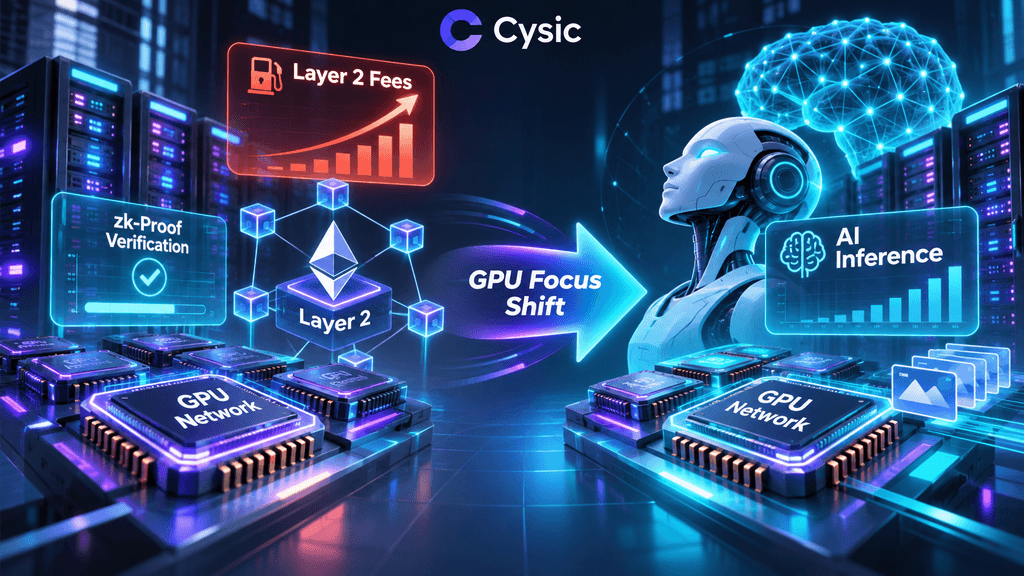
Cysic Redirects GPU Capacity Toward AI Inference as Demand for ZK Proof Generation Declines
Cysic, the decentralized compute network that launched its mainnet on September 24, 2025, has shifted the primary focus of its GPU fleet from generating zero-knowledge proofs for Ethereum Layer 2 networks to supporting AI inference workloads. The move follows a clear drop in demand for proof generation alongside Layer 2 transaction fees that, according to the company, have risen above those on Ethereum itself. Since the mainnet launch, the network has processed more than 13 million transactions and produced more than 10 million zero-knowledge proofs, working with partners including Scroll and Aleo. It currently lists more than 118,000 provers and 200,000 verifiers.
CEO Leo Fan has framed the change as a practical reallocation of existing hardware rather than a full exit from zero-knowledge work, while still targeting sub-eight-second Ethereum block proving. The network’s Proof-of-Compute Layer 1, which is Ethereum Virtual Machine compatible, already coordinates both ZK and AI tasks, giving the pivot a ready technical foundation. Cysic’s reorientation of its GPU capacity toward large-language-model inference reflects measurable changes in Layer 2 economics and GPU market conditions, allowing the network to maintain utilization while continuing selective zero-knowledge development through specialized hardware and its CyAI marketplace.
Key Takeaways
-
Cysic is redirecting GPU resources from L2 ZK proofs to AI inference after demand declined.
-
Layer 2 fees have reportedly exceeded Ethereum mainnet fees, reducing proving economics.
-
Mainnet metrics since September 2025 include over 13 million transactions and 10 million proofs.
-
Venus zkVM and GPU optimizations delivered more than 9 percent proof-time efficiency gains.
-
Custom C1 chip achieves 1.31 million Keccak functions per second for faster proving.
-
CyAI marketplace uses statistical audits for AI tasks rather than full zero-knowledge proofs per job.
Declining ZK Proof Demand Forces Hardware Reallocation Across Decentralized Networks
Demand for zero-knowledge proof generation serving Ethereum Layer 2 networks has fallen sharply during 2026, prompting Cysic to reallocate its GPU capacity. Layer 2 networks rely on these proofs to batch transactions and settle them securely on Ethereum without requiring every participant to re-execute the work. When proof demand softens, the specialized hardware that once generated steady revenue sits underutilized. Cysic’s leadership has linked the decline directly to rising Layer 2 fees that now exceed Ethereum’s own base-layer costs in certain periods, eroding the economic advantage that once made external proving services attractive.
The network’s own data shows substantial earlier activity, more than 10 million proofs produced since the September 2025 mainnet launch, yet current conditions no longer support the same volume of L2-focused work. This move is not unique to one provider; GPU scarcity driven by AI data center demand has raised the opportunity cost of dedicating accelerators solely to cryptographic proving. By redirecting capacity, Cysic preserves hardware utilization while the broader market absorbs excess proving supply. The decision rests on observable fee dynamics and utilization metrics rather than speculative forecasts, allowing the network to adapt without discarding the infrastructure already built for verifiable compute.
GPU Overlap Between Zero-Knowledge Proving and Large Language Model Inference Enables Seamless Transition
Both zero-knowledge proof generation and large-language-model inference place heavy demands on GPU resources, creating a natural technical bridge for Cysic’s pivot. Proof generation involves intensive finite-field arithmetic, multi-scalar multiplications, and number-theoretic transforms that map efficiently onto parallel GPU cores. Inference, by contrast, centers on matrix multiplications and attention mechanisms that also saturate the same accelerators. Because the underlying silicon is already optimized for high-throughput parallel workloads, moving capacity from one task class to the other requires primarily software scheduling changes rather than new hardware acquisition.
Cysic’s Proof-of-Compute Layer 1 already routes jobs of both types, so the coordination layer did not need reinvention. CEO Leo Fan has emphasized that the existing fleet can be pointed at LLM inference without a complete architectural overhaul. This overlap reduces capital risk and shortens the transition timeline. At the same time, the network retains the ability to serve residual ZK demand, preserving optionality. The practical result is higher average utilization of the same physical assets under changing market conditions, a capability that pure ZK or pure AI platforms may lack.
Mainnet Performance Metrics Demonstrate Scale Achieved Before the Strategic Shift
Cysic’s mainnet, live since September 24, 2025, has already accumulated meaningful operational scale that underpins the current reorientation. The network has processed more than 13 million transactions and generated more than 10 million zero-knowledge proofs in roughly thirteen months of operation. Partnerships with Scroll and Aleo contributed to that volume, supporting the network's deployment across partner ecosystems. On the participation side, the system lists more than 118,000 provers and 200,000 verifiers, indicating a sizable registered network of participants even after post-testnet attrition of opportunistic participants.
These figures establish that Cysic is not a nascent experiment but an operating network with a measurable record of network activity. The Proof-of-Compute consensus mechanism translates useful computation, whether ZK or AI, into network scores and incentives, creating continuity across workload types. Having demonstrated the ability to coordinate large numbers of heterogeneous machines for cryptographic work, the same machinery can now schedule inference jobs with comparable reliability. The metrics therefore serve both as proof of past capability and as a foundation for the expanded AI focus.
Venus zkVM and GPU Optimizations Deliver Measurable Efficiency Gains for Residual Proving Work
Cysic continues to refine its proving stack even while shifting primary capacity toward AI. The Venus zkVM combined with targeted GPU optimizations has improved end-to-end proof-time efficiency by more than 9 percent relative to earlier baselines. These gains arise from better scheduling across the full proving pipeline rather than from raw increases in silicon performance alone. By treating proof generation as a connected computation graph and reducing idle time between CPU and GPU stages, Venus extracts more useful work from the same hardware.
The improvements matter for any residual L2 demand and for the longer-term goal of proving full Ethereum blocks in under eight seconds. Efficiency gains also lower the marginal cost of occasional proving jobs, making selective ZK work more viable alongside the dominant AI workload. In a market where AI data centers compete aggressively for the same GPUs, every percentage point of utilization improvement compounds into better economics. The open-source elements of the Venus stack further allow external developers to build on the same optimizations, extending the network’s technical reach beyond its own fleet.
Custom C1 Chip Benchmarks Highlight Hardware Differentiation for Ethereum-Relevant Hashing
Cysic’s custom C1 chip delivers 1.31 million Keccak functions per second, a benchmark that maps directly onto Ethereum’s core hashing requirements. Keccak underpins many cryptographic operations inside the Ethereum ecosystem, so acceleration at this layer translates into faster proof generation for rollups and other protocols that rely on those primitives. Specialized silicon reduces dependence on general-purpose GPUs for the most intensive cryptographic kernels, partially insulating the network from the broader AI-driven GPU shortage. The chip forms part of a broader hardware roadmap that also explores FPGA and early ASIC paths, showing recognition that pure GPU reliance is becoming costlier.
By combining custom accelerators with the existing GPU fleet, Cysic can allocate the most efficient resource to each workload type: ASICs or FPGAs for certain ZK kernels, GPUs for flexible inference, or remaining proofs. This hybrid approach supports both the immediate AI pivot and the longer-term ambition of real-time Ethereum proving. The C1 results provide concrete evidence that the company is investing in differentiated hardware rather than merely rebranding existing capacity.
CyAI Marketplace Introduces Pragmatic Verification for Decentralized AI Inference Workloads
Cysic’s CyAI marketplace handles AI inference requests through a design that prioritizes practicality over full cryptographic proofs for every job. Instead of generating a complete zero-knowledge proof for each inference, CyAI employs random statistical audits and techniques such as Logit Distance Distribution checks to detect model substitution, precision downgrades, or overbilling. Providers compete on price, latency, and measured reliability while customers set budgets and quality thresholds. The marketplace sits inside the broader ComputeFi framework, allowing the same network of machines that once focused on ZK proofs to serve LLM inference for models ranging from open-source options to third-party services.
This lighter verification model lowers overhead compared with pure ZK approaches and makes the service more competitive with centralized APIs, while still providing an auditable trail. Early deployment of CyAI demonstrates that the network can route real inference traffic and settle payments on-chain. The design therefore converts the same decentralized hardware base into a AI inference capacity without requiring every customer to absorb full proving costs.
Layer 2 Fee Dynamics Alter the Economics of External Proof Generation Services
According to Cysic, Layer 2 transaction fees have climbed above Ethereum mainnet fees in recent periods, removing a key economic rationale for external proving services. When L2s themselves become relatively expensive, the incremental cost of specialized proving is harder to justify, and demand for third-party proof generation declines. Earlier industry analyses had shown proof generation accounting for a substantial share of ZK rollup operating costs; any rise in base L2 fees compounds that burden. Cysic’s observation is consistent with a broader tightening of GPU supply as AI data centers absorb available accelerators, raising the opportunity cost of dedicating hardware solely to cryptography.
The fee inversion does not eliminate the long-term value of zero-knowledge technology, but it does change near-term utilization patterns. Networks that can flexibly switch capacity between proving and inference are may have greater flexibility during demand shifts. Cysic’s response, reallocating GPUs while retaining specialized proving capabilities, illustrates one adaptive strategy under these conditions.
Proof-of-Compute Layer 1 Provides Unified Coordination for Mixed Workloads
Cysic operates an EVM-compatible Proof-of-Compute Layer 1 that serves as the coordination layer for both zero-knowledge and AI jobs. The consensus mechanism rewards useful computation rather than pure hashing or staking alone, allowing the same incentive structure to support proving, inference, and potentially training workloads. Developers submit jobs with budget and latency parameters; the network routes them to available GPUs or specialized accelerators and settles results on-chain.
This architecture already existed before the pivot, so the shift to AI inference did not require a new base layer. The dual-purpose design reduces fragmentation and lets providers earn from whichever workload currently offers better returns. Because the chain remains compatible with Ethereum tooling, integration costs for existing applications stay low. The result is a single marketplace for verifiable compute that can absorb changes in relative demand between cryptographic and machine-learning tasks without requiring participants to migrate to separate networks.
Residual Zero-Knowledge Ambitions Persist Alongside the AI Focus
Cysic has not abandoned zero-knowledge development. CEO Leo Fan has reiterated the target of proving full Ethereum blocks in under eight seconds, a capability that would open real-time verification use cases beyond current L2 proving. The Venus optimizations and C1 chip progress directly support that goal by reducing latency and cost per proof. Selective proving for high-value or latency-sensitive applications can continue even while the bulk of GPU capacity serves AI inference.
Maintaining dual capability preserves strategic optionality: if L2 economics or specialized hardware advances restore proven demand, the network can rebalance without starting from zero. The continued investment in proving efficiency also strengthens the CyAI verification layer, since statistical audits and potential future ZK enhancements for AI can share the same research pipeline. In this sense, the pivot is an expansion of the compute surface rather than a binary replacement of one workload by another.
AI Data-Center Demand Tightens GPU Supply and Raises Opportunity Costs for Specialized Workloads
AI training and inference have absorbed a growing share of available high-end GPUs, creating direct competition with zero-knowledge proving for the same silicon. Cysic’s leadership has noted that the industry is effectively bidding against well-funded data center budgets, which raises both the price and the scarcity of accelerators. Under these conditions, leaving GPUs idle or underutilized for declining L2 proves demand becomes increasingly expensive. Redirecting capacity to LLM inference allows the network to capture revenue from the higher-demand workload while the specialized hardware roadmap, FPGAs, ASICs, and the C1 chip progress toward more efficient ZK solutions.
The supply pressure also reinforces the value of decentralized marketplaces that can aggregate otherwise fragmented consumer and professional GPUs. By participating in both markets, Cysic’s providers gain resilience against swings in either AI or cryptographic demand. The broader industry implication is that pure ZK proving networks may face rising capital intensity unless they develop similar flexibility or move aggressively into custom silicon.
Statistical Auditing in CyAI Balances Trust Minimization with Practical Throughput
Full zero-knowledge proofs for every AI inference request would impose latency and cost overhead that many applications cannot absorb. CyAI therefore uses random statistical audits and Logit Distance Distribution testing to verify that providers deliver the claimed model, precision, and billing accuracy. Witnesses sample jobs, and verifiers check for substitution or quality degradation. This approach provides an auditable evidence trail without requiring cryptographic proofs for the entire computation graph of large models.
The design trades absolute cryptographic guarantees for higher throughput and lower cost, making the marketplace competitive with centralized services while still offering greater transparency. Customers retain the ability to set quality and price constraints, and providers compete on measured reliability. The model fits the agent-economy thesis that Cysic has articulated: autonomous agents need verifiable yet efficient inference rather than maximal cryptographic overhead on every token generated. Early live traffic on CyAI demonstrates that the lighter verification layer is operationally viable at network scale.
Hybrid Hardware Strategy Positions the Network for Long-Term Compute Flexibility
Cysic’s roadmap combines general-purpose GPUs with custom accelerators such as the C1 chip and ongoing FPGA and ASIC work. GPUs provide flexible capacity that can switch between inference and residual proving, while specialized silicon targets the mathematical kernels where general-purpose hardware is least efficient. This hybrid approach reduces exposure to pure GPU market cycles and improves the unit economics of whichever workload currently dominates. The same coordination layer can schedule jobs across heterogeneous machines, matching task characteristics to the most suitable hardware.
For AI inference, the network can draw on the broad GPU base; for high-volume or latency-critical ZK work, it can lean on the accelerated kernels. The strategy also supports the ComputeFi vision of turning diverse compute resources into liquid, yield-bearing assets. By avoiding exclusive reliance on any single hardware class, Cysic may improve operational flexibility as both AI and zero-knowledge markets continue to evolve.
How AI Demand Is Reshaping the Decentralized Compute Marketplace
Cysic’s pivot illustrates a structural tension facing decentralized compute networks: the same accelerators that power cryptographic proofs are now in high demand for AI workloads whose economics currently dominate. Networks that can fluidly reallocate capacity, maintain specialized proving options, and offer pragmatic verification for AI jobs are better positioned to retain providers and attract demand. The combination of an EVM-compatible coordination layer, hybrid hardware, and dual marketplaces (ZK and CyAI) gives Cysic a concrete response to that tension.
Whether the model scales further will depend on sustained inference demand, the competitiveness of statistical auditing versus centralized alternatives, and continued progress on custom silicon for residual ZK needs. For the wider ecosystem, the episode underscores that verifiable compute is becoming a multi-workload market rather than a pure cryptography niche. Providers and developers who treat GPUs as flexible assets rather than single-purpose tools will likely adapt more readily to the next shift in relative demand.
FAQs
How does Cysic’s shift affect existing zero-knowledge proof users?
Existing users of Cysic’s proving services can continue to submit jobs; the network has not discontinued ZK capacity. Residual demand is still served, and efficiency improvements from Venus and the C1 chip remain available. The primary change is that the bulk of GPU time is now prioritized for AI inference when utilization and pricing favor that workload. Users requiring low-latency or high-volume proving may need to plan around potential queueing or higher relative costs compared with the earlier peak-demand period.
What verification method does CyAI use instead of full zero-knowledge proofs?
CyAI relies on random statistical audits performed by witnesses and Logit Distance Distribution checks by verifiers. These methods sample jobs to detect model substitution, reduced precision, or incorrect billing without generating a complete cryptographic proof for every inference. The approach reduces overhead while still producing an auditable trail that customers and the protocol can reference in disputes.
Does Cysic plan to abandon Ethereum block-proving goals?
No. CEO Leo Fan has restated the target of proving Ethereum blocks in under eight seconds. Specialized hardware progress and Venus optimizations continue to support that objective even while primary GPU capacity serves AI inference. Real-time proving remains a longer-term capability the network intends to deliver.
How large is the Cysic network in terms of participants and historical activity?
Since the September 24, 2025, mainnet launch, the network has processed more than 13 million transactions and generated more than 10 million zero-knowledge proofs. It currently lists more than 118,000 provers and 200,000 verifiers. These figures reflect both the scale achieved during the ZK-focused phase and the base from which the AI expansion proceeds.
Why are Layer 2 fees relevant to a GPU network’s strategy?
When Layer 2 fees rise relative to Ethereum mainnet fees, the economic margin available for external proof generation narrows. Operators become less willing to pay third-party provers, demand falls, and GPU utilization declines. Reallocating those GPUs to AI inference restores utilization and revenue under the new fee environment.
What role does the Proof-of-Compute Layer 1 play after the pivot?
The Layer 1 continues to coordinate task submission, routing, verification, and settlement for both remaining ZK jobs and new AI inference jobs. Its EVM compatibility and useful-work consensus allow the same incentive and payment rails to support the mixed workload without requiring a separate chain or marketplace.
Disclaimer: This general market information, possibly from third-party, commercial, or sponsored sources, is provided for reference and educational purposes only and does not constitute financial or investment advice, an offer, solicitation, or guarantee. We disclaim liability for its accuracy, completeness, reliability, and any resulting losses. Investments/trading are risky; past performance doesn’t guarantee future results. Users should research, judge prudently, and take full responsibility. For further details, please consult KuCoin’s Terms of Use and Risk Disclosure.