

Cryptocurrency Legalization in Russia in 2026: How to Invest and Why You Cannot Pay With Crypto
2026/08/27 15:18:00
Introduction
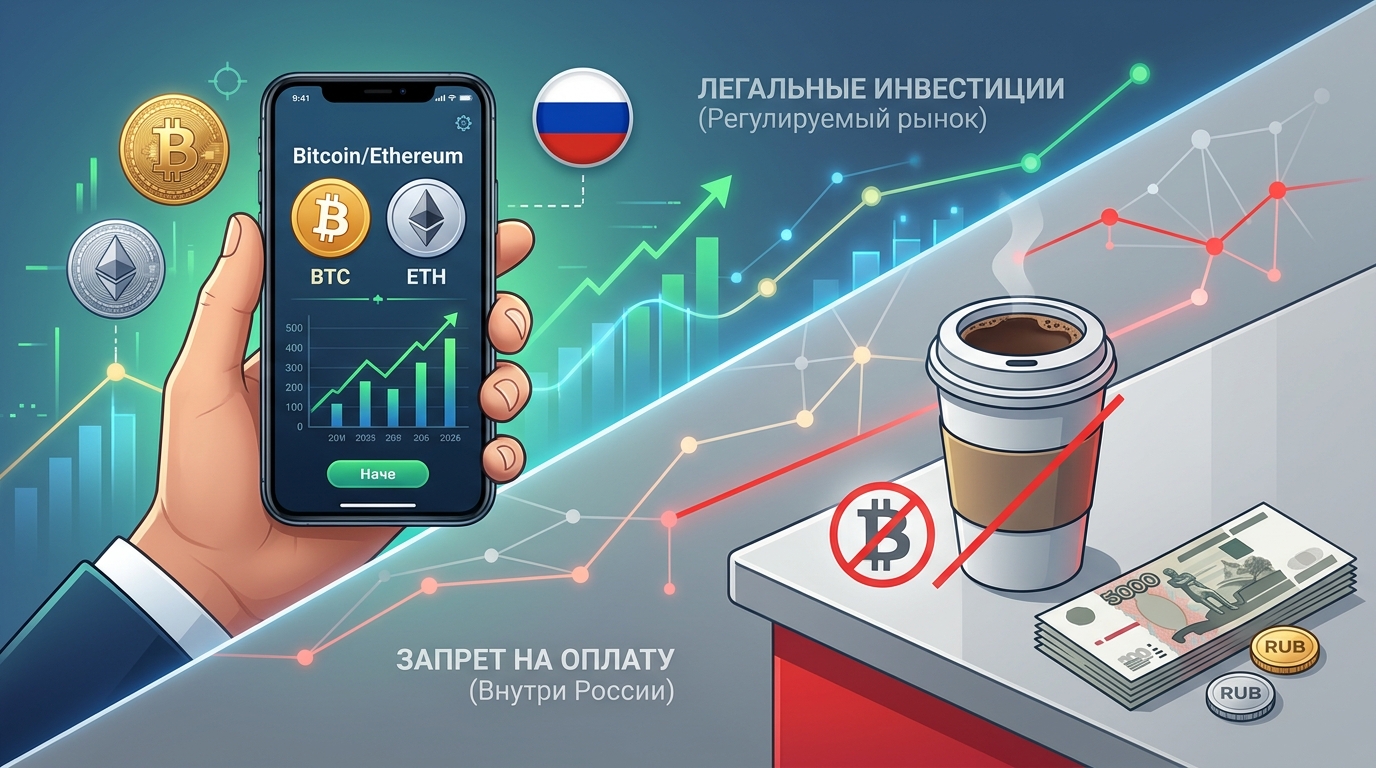
Can cryptocurrency become a legal investment asset while remaining a prohibited way to pay for a cup of coffee? In Russia, the answer from September 1, 2026 will be exactly that. Federal Law No. 282-FZ establishes a regulated market for digital currencies: ownership, recordkeeping, and transactions receive a clearer legal framework, while paying for goods and services with cryptocurrency inside the country remains generally prohibited.
This does not turn Bitcoin, Ethereum, or USDT into a second form of the ruble. The new regime moves the market from uncertainty to a system with intermediaries, admission rules, and customer protections. For investors, the main question is now not only "can I buy cryptocurrency?" but also "which asset, through whom, on what terms, and where can I store it?"
What Has the Law on Digital Currencies Changed in Russia?
The new law legalizes not cryptocurrency as universal money, but its regulated circulation as property and an investment instrument. Law No. 282-FZ, published on August 4, 2026, covers digital currencies, certain foreign digital instruments, mining, digital rights, and the activities of brokers, managers, trading organizers, crypto exchange services, and digital depositories.
The main change is that the market gains institutional infrastructure. The circulation of digital currencies may be organized not by any service, but by participants that comply with the law and the regulatory acts of the Bank of Russia. This is intended to create a clear chain between the buyer, the trading venue, asset custody, and settlement of a transaction.
That is why the word "legalization" needs qualification. Owning a cryptoasset and carrying out transactions with it do not equal unrestricted access to every token, every trading venue, and every transfer method. The Russian approach focuses on controlling channels of circulation, identifying customers, imposing requirements on intermediaries, and rolling out infrastructure in stages. According to Vedomosti on August 27, 2026, the market's final configuration will take shape as secondary legislation and transitional provisions are introduced, rather than appearing all at once.
|
What a market participant gains
|
What remains restricted
|
|
A legal framework for the ownership, recordkeeping, and regulated trading of digital currencies
|
Using cryptocurrency as an ordinary means of payment within Russia
|
|
The ability to work through exchanges, brokers, managers, exchange services, and digital depositories if requirements are met
|
Freely offering any cryptoasset to every investor without checking status and eligibility rules
|
|
Clearer intermediary obligations and customer protection mechanisms when rules are breached
|
A guarantee of returns, protection from volatility, or coverage of risks associated with non-custodial wallets
|
Can You Invest in Cryptocurrency in Russia?
Yes, but cryptocurrency investment in Russia will be based on regulated access rather than the principle of "any asset for any buyer." The law allows transactions through the infrastructure it establishes, but different conditions apply to different investor categories. This is the key difference between the new regime and simply allowing people to buy cryptocurrency on any website.
What Will a Non-Qualified Investor Need?
A non-qualified investor may purchase a digital currency through a broker or another intermediary provided by law only if several requirements are met at the same time. If the investor is an individual, they must pass a suitability test, review a risk notice, stay within the annual limit set by the Bank of Russia, and purchase an asset admitted to public circulation on organized markets.
This is where the most common misconception arises. August publications discussed a proposed annual limit of 300,000 rubles per intermediary, but the law itself does not fix that amount: the Bank of Russia sets the specific threshold. Until the relevant act enters into force, it is more accurate to say that a limit is envisaged for non-qualified investors and that the regulator may establish and revise it, rather than to describe 300,000 rubles as a guaranteed limit.
The testing process is not a mere formality either. Its purpose is to make sure that a client understands the basic features of digital currencies: high volatility, possible loss of liquidity, technological failure risks, the absence of guaranteed returns, and the difference between custody with an intermediary and self-management of keys. A positive result does not mean an asset suits a person's specific financial circumstances. It only opens access to a transaction within the established regime.
Which Cryptoassets Will Be Available for Public Trading?
Ordinary investors will not have access to every digital currency, but only to assets that meet the criteria and are admitted to public circulation. The law links inclusion on the Bank of Russia's list to a large market capitalization, high average trading activity, and a long record of price disclosure on a licensed foreign venue.
This design makes the list of permitted assets more important than well-known names. Even if Bitcoin, Ethereum, or Tether are often mentioned as obvious candidates, none of them should be treated as automatically available to every Russian non-qualified investor until the Bank of Russia publishes its final list. A professional article should distinguish among the law, the regulator's draft proposals, and lists that have already entered into force.
Qualified investors receive broader access to digital currencies on organized markets, including assets not admitted to public circulation. However, they must still use regulated channels and review risk warnings. Qualified investor status expands choice, but it does not remove technological, market, or counterparty risks.
Why Can You Not Pay for Goods and Services With Cryptocurrency in Russia?
Within Russia, cryptocurrency is not becoming a means of everyday payment. Part 6 of Article 1 of the law expressly prohibits accepting digital currencies and digital rights as a means of payment, consideration, or any other arrangement implying payment for goods, information, intellectual property rights, work, or services.
In practice, this means that a cafe should not accept Bitcoin for coffee, an online store should not quote a price in USDT with USDT payment in mind, and a freelancer should not disguise payment for a service as a "digital asset transfer." The economic substance of the transaction matters, not merely the label on a button or contract. Using the words "donation," "gift," or "exchange" does not make a payment lawful if the buyer is in fact transferring cryptocurrency for a good or service.
The prohibition also covers the dissemination of information, including advertising, that offers payment for goods and services with digital currency where that payment does not fall under the statutory exceptions. This is why brands, marketplaces, and content creators need to distinguish educational materials about investing from calls to use cryptocurrency as a means of payment within the country.
What Exceptions Does the Law Provide?
The prohibition is not absolute. The law expressly permits the use of digital currencies and digital rights in settlements under foreign trade contracts between residents and non-residents. Other exceptions include receiving digital currency from mining and mining pools, paying technical network fees, and certain transactions to acquire securities, other digital currencies, or digital rights, provided the law's requirements are met.
The foreign trade exception does not mean that any transfer to a foreign counterparty is automatically lawful or requires no documentation. For such transactions, the contract, business purpose, description of the goods or service, origin of the asset, route of funds, and compliance with currency-control, tax, and anti-money-laundering requirements are critical. Cryptocurrency may be a tool for a cross-border transaction, but it does not eliminate compliance obligations.
How Does Cryptocurrency Differ From the Digital Ruble and Digital Rights?
Cryptocurrency, the digital ruble, and digital rights are regulated differently, so it is incorrect to group them under one label of "digital money." The digital ruble belongs to the state's monetary system. Under the new law, cryptocurrency is recognized as property in digital form that may be used for investment, but it is not a monetary unit of Russia, a foreign state, or an international settlement unit.
Digital rights and digital financial assets should not automatically be called cryptocurrency either. They are rights that arise and are recorded in information systems established by law and may represent monetary claims, rights arising from securities, or other legally defined claims. They follow a different issuance, recordkeeping, and circulation process.
|
Instrument
|
Main role
|
What matters for the user
|
|
Cryptocurrency
|
An investment asset and the subject of regulated transactions
|
It is not a lawful means of paying for goods and services within Russia
|
|
Digital ruble
|
A digital form of the national currency
|
It belongs to the payment system, not to the market for decentralized cryptoassets
|
|
Digital rights and DFAs
|
A digital form of legally established property or financial rights
|
They are issued and circulated under separate rules and are not equivalent to Bitcoin or stablecoins
|
For users, this difference determines not only terminology but also the range of risks. With cryptocurrency, blockchain design, liquidity, volatility, trading-venue rules, and key custody matter. With the digital ruble, the Bank of Russia's payment infrastructure is the key consideration. With digital rights, users need to study the issuance terms, the holder's rights, and the infrastructure in which they are recorded.
How Will Crypto Exchanges, Exchange Services, and Asset Custody Work?
The legal crypto market in Russia is intended to operate through supervised infrastructure, not only through direct transfers between unknown wallets. The law identifies trading organizers, brokers, managers, digital-currency exchange organizations, and digital depositories. The latter may record assets in digital accounts and provide access to address identifiers within the established rules.
For investors, this means that choosing a venue will become a question of more than fees or interface design. It is important to determine whether an intermediary is included in the regulator's relevant register, which assets it admits, how it stores cryptocurrency, which transactions it may suspend, how it documents asset transfers, and where a customer can submit a claim. Regulated custody can add verifiability to transactions, but users pay for that verifiability through stricter identification and control of asset routes.
Transferring cryptocurrency from an address administered by a digital depository to an external address should not be regarded as a completely unrestricted technical action. The law provides separate grounds and conditions for such operations. For an individual, some cases require confirmation that risks have been reviewed and successful completion of testing; additional conditions apply when the destination address is administered by a foreign organization.
This is especially important for owners of non-custodial wallets and accounts on foreign platforms. The new regime does not provide a universal answer for every custody scenario. The assessment depends on who participates in the transaction, where the asset is recorded, how its origin is documented, which infrastructure is used, and which Bank of Russia instructions are in force at the time of the operation.
Which Risks and Obligations Remain for Investors?
Regulation makes a transaction more transparent, but it does not make cryptocurrency a risk-free investment. The law requires participants that organize the circulation of digital currencies to warn clients about heightened risks, including financial losses and failure to receive the expected investment return. An asset's price can change sharply, while a blockchain network, stablecoin, trading venue, or counterparty may face its own problems.
Customer protection under the new regime has specific limits. If a regulated participant breaches transaction terms and requirements, the law provides that a client may demand that the participant repurchase the digital currency at its own expense, compensate losses, and reimburse costs in specified cases. However, this protection is not portfolio insurance. It does not guarantee price appreciation, compensate for the loss of a seed phrase, or automatically extend to an external wallet, foreign platform, or fraudster.
Investors should systematically retain documents on the purchase, sale, withdrawal, deposit, and origin of digital assets. Transaction histories, funding confirmations, wallet addresses, platform reports, and transaction-price information may be needed for tax recordkeeping, source-of-funds checks, communication with a bank, or protection of rights to an asset. The more the market enters a regulated environment, the more important it becomes to prove the full chain of transactions.
Fraud risk also requires separate attention. Market legalization does not mean that every channel bearing the logo of a known service is safe. Do not share confirmation codes, seed phrases, or private keys; verify the domain name; enable two-factor authentication; and do not transfer assets to "support" at the request of someone in a messenger app.
How Can You Trade Cryptocurrency on KuCoin?
Trading cryptocurrency on KuCoin should begin with checking the rules that apply to you and evaluating risk, not with choosing the most volatile token. The new Russian regime regulates resident transactions and infrastructure within the country, so before making a trade, ensure that the chosen funding method, asset, custody arrangement, and transfer are consistent with the current requirements of your jurisdiction and the platform's rules.
If you decide to explore the markets available on KuCoin, begin by registering an account, setting a strong unique password, and enabling two-factor authentication. Then complete the available identity-verification procedures, review fees, the liquidity of the trading pair, and the deposit and withdrawal rules. For a first trade, it is prudent to set an amount whose loss will not disrupt your financial plan, use an asset you understand, and avoid leverage until you understand margin trading and liquidation risk.
KuCoin may be a convenient environment for exploring the crypto market, but the availability of individual services and assets depends on the region and current rules. Do not treat account registration as personalized investment advice or as confirmation that a particular transaction is permitted in your specific circumstances.
KuCoin Offers A More Stable Option in A Volatile Market
If you worry about the frequent ups and downs in the market, and pursue a more stable option to earn money passively, KuCoin is the right place to come:
Simple Earn: Deposit and withdraw tokens anytime, earning stable returns.
Kucoin Earn: Earn stable profits with professional asset management.
Hold to Earn: Earn rewards by holding assets in Funding, Trading, Margin, Futures, Mining, and Unified Accounts.
Staking: Unlock the earning potential of on-chain assets.
Advanced Investments: Advanced Investments offer a variety of structured products to help your money grow in any market.
Shark Fin: Principal Protection and Guaranteed Gains
Dual Investment: Buy low and sell high with transparent return calculations.
Snowball: High yields, with price protection.
Discount Buy: Buy crypto at discount prices.
KCS Loyalty: Level up to enjoy exclusive perks by staking ≥ 1 KCS.
KuCoin Wealth: Discover future value and begin your smart investing journey.
KCS Benefits: Hold and stake KCS to access benefits across the platform.
KCS Staking 2.0: Participate in KCS on-chain governance to earn yield.
Conclusion
Cryptocurrency legalization in Russia in 2026 means a shift to a regulated investment model, not recognition of cryptoassets as a second ruble. From September 1, Law No. 282-FZ creates rules for circulation, recordkeeping, and transactions through exchanges, brokers, exchange services, and digital depositories. At the same time, it retains the core prohibition on paying for goods and services with cryptocurrency within the country.
For retail investors, the most important conclusion is straightforward: market access will depend on client category, testing, risk disclosure, the Bank of Russia's limit, and the status of the chosen digital currency. A non-qualified investor should not assume that every popular token is automatically available, while a qualified investor should not confuse broader access with the absence of risk.
Special rules apply to foreign trade, mining, network fees, and certain digital-asset transactions, but these exceptions do not turn cryptocurrency into an ordinary payment method in Russia. Monitor the Bank of Russia's lists, intermediary status, and secondary regulations. Use transparent infrastructure, keep records of your transactions, and make decisions with the understanding that the crypto market remains high risk.
Frequently Asked Questions
1. Can You Hold Cryptocurrency Purchased Before September 1, 2026?
Yes, the new law does not prohibit the mere ownership of digital currency purchased earlier. However, transactions involving the asset, its recording in regulated infrastructure, and its transfer may depend on the asset's origin, the chosen intermediary, transitional rules, and subsequent acts of the Bank of Russia. Keep records of acquisition and fund movements.
2. Do You Need to Pay Tax When Selling Cryptocurrency?
Tax consequences depend on the nature of the transaction, the person's status, and documented expenses. Do not interpret the new law on digital currencies as an exemption from tax obligations. Keep records of purchase and sale values, retain documents, and seek advice from a Russian tax professional if necessary.
3. Can You Use Stablecoins to Settle With a Foreign Supplier?
Foreign trade contracts between residents and non-residents are included in the exceptions to the domestic payment prohibition. However, whether the exception applies depends on the actual foreign trade contract, counterparty, documentation, asset route, and compliance with currency-control, tax, and anti-money-laundering requirements. It is not a universal permission for any stablecoin transfer.
4. What Happens if an Intermediary Breaches Transaction Rules?
If a person organizing the circulation of digital currencies breaches applicable requirements, the law provides that the client may demand a repurchase of the asset, compensation for losses, and reimbursement of costs in specified cases. The concrete outcome will depend on the circumstances, contractual terms, and whether the service actually operates in the regulated environment.
5. Can You Buy Cryptocurrency Without Passing a Test?
For an individual who is not a qualified investor and purchases digital currency through an intermediary specified by law, a positive test result is one of the mandatory conditions. Requirements for other client categories and transaction formats may differ, so before trading, check the current requirements of the Bank of Russia and the chosen venue.
Disclaimer : This material is provided for informational purposes only and does not constitute financial, investment, legal, or tax advice. Transactions involving cryptocurrencies and tokenized assets carry substantial risks — including price volatility, limited liquidity, counterparty exposure, and the potential for total loss of invested capital. Readers should conduct their own research and, where appropriate, consult a qualified professional before making any financial decisions.