

Cryptocurrencies on Russian Exchanges: Bank of Russia Includes Bitcoin, Ethereum, and USDT in Its First List
2026/08/12 11:50:00
Introduction
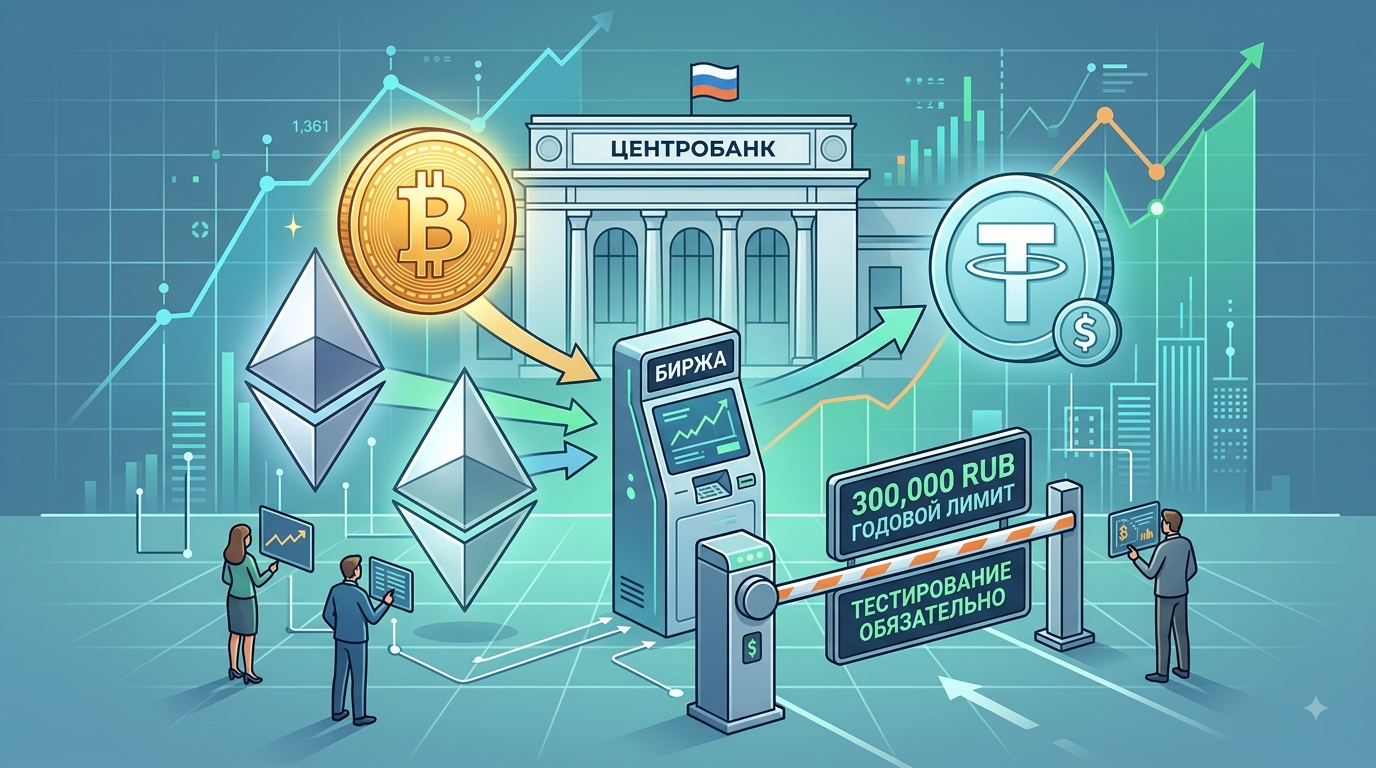
On August 11, 2026, the Bank of Russia named the first three crypto assets available for public trading on exchanges: Bitcoin, Ethereum, and Tether USDT. This does not mean that digital currencies have become legal tender in Russia or that investment risks have disappeared. Rather, the news signals that the regulator is building a controlled route for transactions through permitted asset categories and intermediaries. According to TASS, citing the Bank of Russia, the selection is based on market capitalization, average daily turnover, and at least five years of price history on foreign venues.
For retail investors, the practical takeaway is simple: access will be shaped by liquidity, testing, and an annual purchase limit rather than unrestricted choice among all tokens. This article explains which cryptocurrencies on Russian exchanges made the first list, who may access them and on what terms, and what the new model changes for the market.
Which cryptocurrencies did the Bank of Russia include in the list, and why these ones?
The first list contains only Bitcoin, Ethereum, and Tether USDT. As of August 11, 2026, the Bank of Russia classified these three assets as cryptocurrencies available for public trading on exchanges. Therefore, inclusion in the list is not a blanket authorization for every coin with a large community, a high price, or social-media popularity.
The selection is based on verifiable market indicators. According to TASS, the regulator considers market capitalization, average daily trading volume, and a price-formation history on foreign trading venues of at least five years. This set of criteria focuses not on a project's promises, but on market depth, the length of the observable history, and the market participant's ability to establish a price reference from multiple sources.
Bitcoin meets these conditions as the longest-traded and most widely known crypto asset. Ethereum is significant as a core network for smart contracts and a substantial share of decentralized applications. USDT differs from both because it is positioned as a stablecoin, but its inclusion does not eliminate issuer, reserve, liquidity, or potential de-pegging risks. For investors, status on the list means that an asset meets public-trading criteria, not that returns, capital preservation, or continuous trading availability are guaranteed.
It is important to distinguish the list from the full range of future instruments. According to TASS, qualified investors will be able to acquire without restrictions all cryptocurrencies traded on organized and over-the-counter markets. However, this rule does not make every coin a retail asset. The initial choice for non-qualified participants is deliberately narrower.
What changes for non-qualified investors?
For non-qualified investors, access to crypto assets is limited to the three most liquid positions and to up to 300,000 rubles per year with each intermediary. The limit applies to transactions through a broker, crypto exchange service, or asset manager. The phrase "with each intermediary" is significant: it does not necessarily establish one aggregate cap across every possible channel, but neither does it justify circumventing regulatory requirements through multiple accounts or informal services.
The retail regime is designed primarily to reduce the consequences of sharp and difficult-to-predict price movements. On August 11, 2026, Duma TV, restating the regulator's position, emphasized that non-qualified investors will have access only to the most liquid cryptocurrencies precisely to protect them from such fluctuations. High liquidity does not prevent price declines, but it generally reduces the risk that a participant cannot execute a market order promptly because demand or supply is absent.
Testing acts as a separate filter. A TASS overview of the new legislation states that both qualified and non-qualified investors must pass special testing. This is particularly important for retail clients: the test should confirm an understanding of volatility, the risk of losing money, the specifics of key storage, and the differences between cryptocurrency and a bank deposit or bond.
|
Parameter
|
Non-Qualified Investor
|
Qualified Investor
|
|
Eligible assets
|
Bitcoin, Ethereum, and USDT from the first public list
|
All cryptocurrencies admitted to organized and over-the-counter trading
|
|
Purchase limit
|
Up to 300,000 rubles per year with each intermediary
|
No limit reported in the published information
|
|
Testing
|
Special testing is required
|
Special testing is required
|
|
Core regulatory approach
|
Limits on asset choice and amount to reduce risk
|
Broader access under a different investor status
|
The table reflects the parameters published as of August 11, not an individual recommendation. The Bank of Russia's draft directive referenced by Forbes Russia accepted comments and proposals until August 24, 2026. Before entering into a transaction, investors should therefore verify the final version of the requirements with a licensed market participant and the regulator's official materials.
Why does the 300,000-ruble limit not make investments safe?
The 300,000-ruble limit restricts the scale of a purchase, not the percentage by which a price can fall. If the price of Bitcoin, Ethereum, or USDT moves unfavorably, the value of the position may decline whether or not the asset appears on the public list. Investors should therefore set an acceptable loss amount in advance, avoid using borrowed funds for speculative positions, and keep trading capital separate from money needed for essential expenses.
The risk is especially apparent when the word "liquid" is misunderstood. Liquidity describes the ability to buy or sell an asset at lower cost and usually with a narrower spread, but it does not promise price stability. Bitcoin and Ethereum can move significantly in a short period. USDT may show lower volatility against the U.S. dollar, but it carries different risks: issuer risk, regulatory risk, settlement-infrastructure availability risk, and the risk of deviating from its peg.
Checking an intermediary's status is no less important than choosing a coin. A market participant should explain the testing process, the limit, fees, the method of asset storage, the withdrawal procedure, and the steps to take in a technical failure. If a service promises guaranteed profits, offers to bypass verification, or asks a customer to transfer funds to an employee's personal wallet, this is inconsistent with the logic of regulated access.
How will cryptocurrency infrastructure on Russian exchanges work?
The new model assumes that transactions will take place through regulated infrastructure rather than anonymous informal channels. The law signed on August 4, 2026 establishes rules for crypto exchange services, digital depositories, and other market participants; the main part of the law is expected to take effect on September 1, 2026. At the same time, the law retains the prohibition on using digital currencies and digital rights as a means of payment in Russia, although it provides several exceptions, including settlements under foreign-trade contracts between residents and non-residents.
A specific entry barrier applies to crypto exchange services. According to Interfax on July 21, 2026, such an operator may be a Russian business entity with own funds of at least 15 million rubles that is included in the Bank of Russia's register; operating without inclusion in the register is permitted until July 1, 2027. This requirement applies specifically to crypto exchange services. It should not automatically be extended to every broker, depository, or asset manager, which may be subject to its own requirements.
The transitional period should not be understood as an absence of rules. TASS reports that existing operators of digital financial asset exchanges have a transition period until March 1, 2027. Certain rules on transfer restrictions and non-resident digital depositories take effect on July 1, 2027, while some technical rules take effect on September 1, 2027. Market participants should therefore monitor not only the first list of Bitcoin, Ethereum, and USDT, but also the phased implementation of the requirements.
How can you verify an intermediary before buying cryptocurrency?
Investors should verify not only the name of a cryptocurrency, but also the status of the organization through which the transaction is made. Regulated access assumes that a client understands who receives their money, where digital assets are recorded, and under which rules the order is executed. This matters because the first publication of the list describes the admission of assets to public trading; it is not a universal license for every website or Telegram channel offering to buy Bitcoin, Ethereum, or USDT.
Begin by identifying the counterparty's role. A broker executes a trading order, a crypto exchange service arranges an exchange, an asset manager may act within an asset-management mandate, and depository infrastructure performs recordkeeping or custody functions within the relevant model. Clients should request the full legal name, register information, fee schedule, verification procedure, and the documents that define the terms of service. For a crypto exchange service, checking inclusion in the Bank of Russia's register after the applicable transitional period is especially important: the law links its operations to a Russian legal entity, own funds of at least 15 million rubles, and the regulator's register.
Before funding an account, investors should also understand the transaction mechanics. It is useful to ask how the price is formed, whether a separate fee or spread applies, whether an order can be canceled, when entitlement to the asset changes, and where cryptocurrency can be withdrawn. The lack of clear answers to these questions increases operational risk even when the selected asset is included in the public list. A screenshot of an advertisement, a promise of "fixed returns," or a link from an unknown person does not replace a contract and official legal details.
Finally, it is important to document transactions. Keep statements, execution notifications, fee information, and transfer addresses where applicable. This discipline helps reconstruct transaction history, evaluate actual performance, and prepare information for recordkeeping or a support request when necessary. It does not remove an investor's legal obligations, but it reduces the risk of losing control over the data associated with their assets.
What are the objectives of cryptocurrency regulation in Russia?
The directly stated objective of restrictions for non-qualified investors is protection against sharp and unpredictable fluctuations in cryptocurrency prices. This explains the focus on the most liquid assets and the retail purchase limit. The approach does not eliminate risk, but it separates the initial public segment from numerous illiquid altcoins, where manipulation, price gaps, and technical risks are usually greater.
The broader political and economic effects should be viewed as likely consequences rather than as officially declared motivations of the Bank of Russia. First, a domestic regulated infrastructure may reduce participants' reliance on opaque foreign channels and simplify oversight of asset movements. Under external constraints, this could make cross-border settlements more predictable where the law expressly permits exceptions for foreign-trade contracts.
Second, investor segmentation and asset filtering create a mechanism for protecting the mass market. Retail clients receive not the full spectrum of tokens, but three assets with a longer trading history and substantial liquidity. This approach aims to limit the social and financial cost of widespread losses during crashes in high-risk assets, but it should not be seen as an assessment of the prospects of Bitcoin, Ethereum, or USDT.
Third, moving transactions to intermediaries operating under defined rules creates a clearer transaction trail. This may facilitate tax and compliance processes because purchases, sales, and holdings become easier to document. However, this article does not claim that taxation is the sole or officially stated purpose of the list: specific tax obligations should be checked against current rules and an individual's particular circumstances.
Should you buy Bitcoin, Ethereum, or USDT on KuCoin?
Buying cryptocurrency makes sense only after assessing your own objective, risk tolerance, and the availability of the service in your jurisdiction. For those exploring Bitcoin, Ethereum, or USDT on KuCoin, a prudent order of steps is to complete any required verification, review fees and risk-management tools, and then start with an amount whose loss would not affect essential expenses.
The Bank of Russia's public list is not an invitation to purchase assets and does not replace an individual's own risk assessment. Users should also remember the distinction between the regime for regulated Russian intermediaries and the terms of an international platform: applicable restrictions, available products, and customer requirements may differ. Do not use borrowed money, do not rely on promises of returns, and plan in advance how you will store assets and record transactions.
Join KuCoin 9th Anniversary Trading Campaign
KuCoin is celebrating its 9th anniversary with a special platform campaign filled with exclusive rewards, trading activities, and limited-time offers. Don’t miss the chance to participate and enjoy the benefits as the exchange marks nine years of growth and innovation. Visit the official campaign page now:
Conclusion
The Bank of Russia's first list for public trading on exchanges includes Bitcoin, Ethereum, and Tether USDT. As of August 11, 2026, its rationale is clear: selection is based on capitalization, average daily trading volume, and at least five years of price history on foreign venues. For non-qualified investors, only these most liquid assets are available, along with an annual limit of up to 300,000 rubles with each intermediary and special testing.
Qualified investors receive broader access to assets on organized and over-the-counter markets, but this does not remove the need to understand the risks. Infrastructure is being developed in parallel: crypto exchange services are subject to a Russian legal-entity requirement, own funds of at least 15 million rubles, and inclusion in the Bank of Russia's register, with transitional rules in place.
The central takeaway is that regulation moves the market toward controlled access rather than making cryptocurrencies risk-free. Before purchasing, investors should check the final requirements, the intermediary's status, fees, custody rules, and their own financial resilience. A well-considered decision requires discipline, an understanding of the limits, and readiness for adverse price movements.
FAQs
1. Does inclusion in the list mean that the Bank of Russia guarantees returns on Bitcoin, Ethereum, or USDT?
No. Inclusion means that an asset meets public-trading criteria; it does not guarantee its price, liquidity at every moment, or preservation of the amount invested.
2. Will the list expand automatically once a new popular coin appears?
No. No automatic expansion has been announced. A new asset must meet the established criteria, including market indicators and at least five years of price history on foreign trading venues.
3. Can the 300,000-ruble limit increase if the cryptocurrency already purchased rises in price?
The limit reported by the regulator and media relates to acquiring assets through each intermediary during the year. An increase in the market value of an already purchased position does not by itself constitute a new purchase, but the operational procedure should be clarified with the intermediary.
4. Does the public-trading regime allow cryptocurrency to be used to pay for goods in Russia?
No. The law retains the prohibition on using digital currencies and digital rights as a means of payment in Russia, although it lists certain exceptions.
5. Does the transitional period allow the use of any unregulated crypto service?
No. Transitional timeframes concern specific legal requirements and market participants; they do not permit users to disregard counterparty checks, platform rules, or applicable law.
Disclaimer : This material is provided for informational purposes only and does not constitute financial, investment, legal, or tax advice. Transactions involving cryptocurrencies and tokenized assets carry substantial risks — including price volatility, limited liquidity, counterparty exposure, and the potential for total loss of invested capital. Readers should conduct their own research and, where appropriate, consult a qualified professional before making any financial decisions.