

Why Are Crypto Markets Falling While Tokenization and Institutional Adoption Keep Growing?
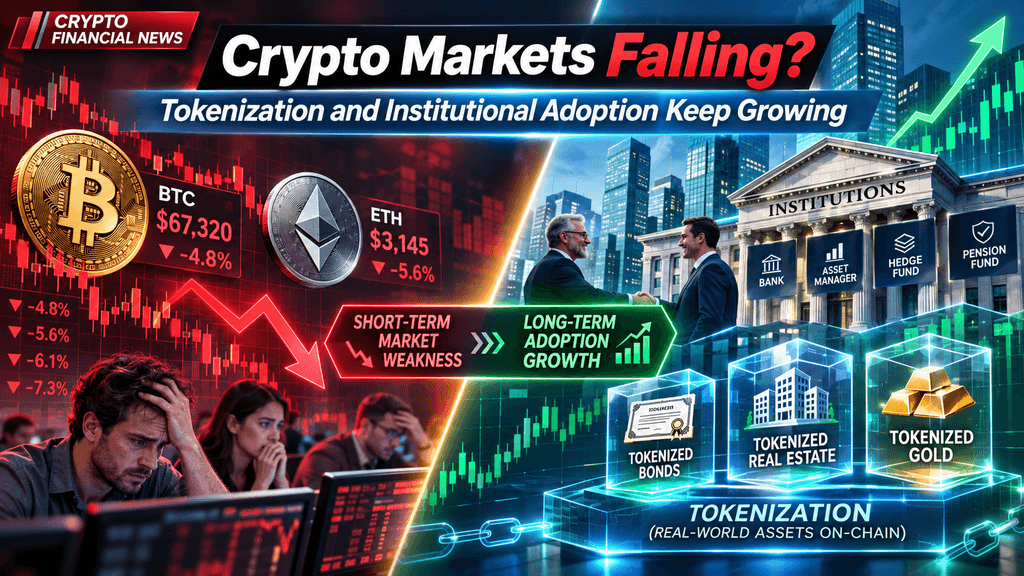
Cryptocurrency markets are facing renewed pressure in November 2026, as inflation concerns, Federal Reserve policy expectations, and institutional fund outflows weigh on digital asset prices. Binance Research reported that the global crypto market capitalization fell 9.1% to approximately $2.70 trillion in October. U.S. spot Bitcoin ETFs recorded around $516 million in net outflows, while Ether ETFs lost approximately $1.6 billion. Bitcoin subsequently dropped to $73,708 on November 8, its lowest level since August.
However, the market correction does not necessarily signal weakening long-term demand for blockchain technology. Crypto prices are responding to short-term macroeconomic and liquidity pressures, while institutional adoption is increasingly driven by tokenized securities, stablecoin payments, and blockchain-based financial infrastructure. DTCC's launch of its Tokenization Service and State Street's latest institutional research demonstrate this growing distinction. The central question is whether these developments can turn institutional interest into sustainable economic activity beyond speculative cryptocurrency trading.
Key Takeaways
-
Crypto markets are under pressure: Global market capitalization declined 9.1% to $2.70 trillion in October 2026, while Bitcoin and Ethereum reached two-month lows in November.
-
Macroeconomic conditions remain influential: Inflation concerns, higher interest-rate expectations, and ETF outflows have weakened demand for digital assets.
-
Institutional adoption continues: State Street found that 51% of surveyed institutions expect digital assets to become mainstream within five years.
-
Tokenization is gaining practical momentum: DTCC launched its Tokenization Service on October 28, connecting blockchain-based securities representations with established financial infrastructure.
-
Long-term growth depends on real-world applications: Stablecoin settlement, tokenized financial products, regulatory clarity, and institutional infrastructure will determine the industry's next stage.
Why Are Cryptocurrency Markets Pulling Back in November 2026?
Cryptocurrency markets are declining primarily because tighter financial conditions, weaker investment flows, and broader risk aversion have reduced demand for volatile assets. The correction reflects several interconnected developments rather than a fundamental failure of blockchain technology.
According to Binance Research's November 10 report, total cryptocurrency market capitalization declined 9.1% to approximately $2.70 trillion in October. The report attributed the weakness to higher-than-expected inflation, changing Federal Reserve expectations, and concerns about technology companies' AI spending and financing requirements. The selling continued into November: Reuters reported that Bitcoin fell to $73,708 and Ethereum to $2,223 on November 8, their lowest levels since August. These were reported market lows, not November 11 closing prices.
The macroeconomic environment has become particularly important. U.S. September inflation reached 3.7% year over year, according to Binance Research, while the Federal Reserve maintained interest rates at its October 28 meeting. Futures markets subsequently priced an approximately 80%–85% probability of a December rate increase at the time of the report. Higher interest-rate expectations can reduce appetite for non-yielding assets, increase financing costs, and encourage investors to reduce leveraged positions. These probabilities represent market expectations rather than a confirmed Federal Reserve decision.
Institutional flows and technology-stock weakness have added pressure. Binance Research recorded approximately $516 million in October net outflows from U.S. spot Bitcoin ETFs and $1.6 billion from Ether ETFs. It also reported that five major AI spenders invested approximately $230 billion in capital expenditure during the third quarter, exceeding their combined $199 billion operating cash flow. Concerns about AI investment returns contributed to a wider reassessment of risk assets. Franklin Templeton similarly identified macroeconomic uncertainty, ETF outflows, and derivatives deleveraging as important factors behind the cryptocurrency correction.
Is Institutional Crypto Adoption Still Growing Despite Market Volatility?
Institutional crypto adoption is continuing because financial organizations increasingly view blockchain as financial infrastructure rather than simply a way to gain exposure to Bitcoin and Ethereum. Their priorities are expanding toward custody, payments, fund issuance, tokenized securities, and settlement, creating a longer-term adoption trend that does not necessarily move in line with cryptocurrency prices.
State Street's October 6, 2026, Digital Assets Study provides evidence of this shift. The survey covered 300 asset managers, asset owners, and wealth managers across major financial markets. It found that 51% of respondents expect digital assets to become mainstream within five years, compared with 42% in 2025 and just 11% in 2024. Furthermore, 35% already manage or distribute digital assets, while another 28% have established provider relationships and infrastructure that would allow them to participate when client demand emerges.
Key findings from State Street's 2026 Digital Assets Study
| Institutional indicator | Survey finding |
| Expect digital assets to become mainstream within five years | 51% |
| Already manage or distribute digital assets | 35% |
| Have infrastructure ready for future participation | 28% |
| Plan to distribute digital assets to institutional investors | 82% |
| Plan tokenized versions of existing investment products | 84% |
| Expect average digital asset allocation to increase | 11% to 17% |
Source: State Street, October 6, 2026. Survey of 300 institutional respondents.
The changing priorities are particularly important. State Street found that 66% of respondents expect digital assets to have a material impact on custody, 54% on payments, and 51% on fund issuance. Approximately 53% identified cost reduction and operational efficiency as major expected benefits. These findings suggest that institutional adoption is moving beyond portfolio allocation toward the practical integration of digital assets into existing financial services.
This explains why market volatility does not necessarily stop institutional infrastructure development. A bank building digital custody capabilities or an asset manager preparing tokenized investment products is making a longer-term operational decision. Its investment depends on client demand, regulatory requirements, and technology readiness, rather than solely on Bitcoin's daily price. However, survey intentions and infrastructure readiness should not be confused with completed investments or realized transaction volumes.
Why Is Tokenization Becoming a Major Crypto Growth Driver?
Tokenization is becoming an important growth driver because it connects blockchain technology with traditional financial assets, potentially improving how securities are issued, transferred, and settled. Rather than relying exclusively on cryptocurrency trading, this development creates opportunities for blockchain networks to support established financial activities.
Real-world asset tokenization (RWA) involves creating digital representations of assets or legally defined financial rights on a blockchain. These assets can include government securities, money market funds, corporate bonds, equities, and other investments. Depending on the product structure, tokens may represent direct ownership, beneficial interests, or contractual claims. The potential benefits include more efficient settlement, programmable asset transfers, improved collateral mobility, and fractional access to certain investments. However, tokenization does not automatically guarantee liquidity or establish legal ownership; those protections depend on the issuer, custody arrangements, contractual terms, and applicable regulations.
A particularly important development came on October 28, 2026, when the Depository Trust & Clearing Corporation (DTCC) launched its Tokenization Service through its subsidiary, the Depository Trust Company. The service allows eligible participants to create tokenized representations of selected securities already held within DTC's custody infrastructure. DTCC reported more than $114 trillion in assets under custody and confirmed that 20 participants had signed agreements to access the service, including JPMorgan, Bank of America, Citi, Fidelity Investments, Morgan Stanley, State Street, and UBS. The service initially connects with the Canton Network and DTCC's private Besu network, with additional networks planned for 2027.
The significance of DTCC's initiative lies in its connection to established financial market infrastructure. Tokenized securities are designed to retain the ownership rights, investor protections, and economic entitlements of their traditional counterparts. This provides institutions with a framework for exploring blockchain-based asset transfers without abandoning the existing custody and securities infrastructure. Nevertheless, the service is not a wholesale migration of the U.S. securities market to blockchain. Its initial scope covers eligible assets and participants, and actual adoption will depend on transaction volumes, operational performance, and market demand.
Tokenized equities provide another example of this development. Binance Research reported on November 10 that bStocks reached approximately $1 billion in assets under management within 125 days of launch. Its on-chain utilization rate reached 18.54%, compared with an industry average of 13.91%, while 56% of trading volume occurred outside U.S. market hours. These figures suggest that extended trading access and integration with decentralized finance applications may be attracting users. However, tokenized equity products do not necessarily provide the same ownership, voting, dividend, or redemption rights as directly held traditional shares.
Stablecoins are another essential component because tokenized assets need a reliable payment and settlement mechanism. Institutions can use digital cash to transfer value, purchase tokenized securities, and settle transactions on blockchain networks. State Street's study found that 64% of respondents identified settlement of tokenized assets as a leading digital-cash use case. Bank-issued dollar stablecoins and tokenized deposits were also among the preferred forms of digital cash. This illustrates why tokenization and stablecoin adoption are developing together rather than as separate market trends.
What Risks Could Slow Institutional Adoption and Tokenization?
Institutional adoption and tokenization have considerable potential, but their expansion depends on resolving regulatory, security, and liquidity challenges. Financial institutions require enforceable asset rights, reliable custody, consistent operating standards, and sufficient market depth before blockchain-based financial products can achieve widespread use.
Regulatory clarity remains particularly important. On October 21, 2026, the Office of the Comptroller of the Currency finalized its rule implementing the GENIUS Act for payment stablecoin issuers and certain related activities under its jurisdiction. The rule addresses reserve assets, redemption, risk management, custody, reporting, and supervision, and is scheduled to take effect on January 18, 2027. This represents progress toward a more defined framework for payment stablecoins, but it does not establish comprehensive regulation for every digital asset or tokenized security. Broader market-structure questions also remain unresolved.
Security and custody are equally important. Institutions must protect private keys, verify transactions, maintain asset segregation, and establish reliable recovery procedures. State Street found that 69% of respondents considered experience operating within an appropriate regulatory framework the most important characteristic of a digital asset service provider, while 54% prioritized cybersecurity. These findings show that institutional adoption depends on operational trust as much as technological innovation. For tokenized assets, institutions must also ensure that on-chain representations correspond to enforceable rights in the underlying assets.
Liquidity and interoperability present further challenges. A tokenized bond or equity may be transferable on a blockchain but still lack sufficient buyers, sellers, or reliable pricing in secondary markets. Different networks may also use incompatible technical standards, custody arrangements, and compliance systems. Consequently, financial institutions may need to maintain connections between traditional and blockchain-based infrastructure for an extended period. DTCC's multi-network approach reflects this reality: rather than replacing existing systems immediately, it seeks to connect them with additional digital environments.
What Is the Outlook for Crypto Markets in 2027?
The 2027 outlook will depend on two related but distinct developments: whether macroeconomic conditions become more supportive of digital asset prices and whether institutional blockchain applications generate measurable economic activity. A recovery in Bitcoin and Ethereum could improve market sentiment, while tokenization and stablecoin adoption may provide longer-term demand for financial infrastructure.
In the short term, inflation, Federal Reserve policy, ETF flows, and broader risk appetite will remain important drivers. Binance Research noted that monetary tightening momentum among G10 central banks had eased from its July peak, although policy conditions remained restrictive. If inflation moderates and financial conditions become less hostile, investors may gradually increase exposure to risk assets. However, this does not guarantee a sustained cryptocurrency recovery. Continued ETF outflows, leveraged-position liquidations, or renewed macroeconomic uncertainty could still weigh on prices.
The longer-term opportunity is increasingly connected to practical financial applications. State Street's findings on tokenized investment products, DTCC's new securities infrastructure, and the OCC's stablecoin framework suggest that traditional finance is building the operational foundations for broader blockchain adoption. These developments could support demand for custody, settlement, digital cash, and tokenized asset services. Yet the economic benefits will depend on real usage, not simply the number of projects announced or tokens issued.
An important distinction is that institutional adoption does not automatically translate into higher Bitcoin or Ethereum prices. A bank can use blockchain settlement without purchasing substantial amounts of Bitcoin, while a tokenized fund may operate without creating direct demand for the native token of its underlying network. The relationship between infrastructure growth and cryptocurrency valuations depends on transaction fees, network activity, settlement demand, and how individual protocols capture economic value. Investors should therefore evaluate market prices and infrastructure adoption separately.
What Should Investors Watch as Crypto Markets Evolve?
Investors should monitor both macroeconomic indicators and measurable institutional adoption to understand where the cryptocurrency market is heading. Bitcoin prices and ETF flows help explain short-term market conditions, while stablecoin activity, tokenized asset growth, and institutional infrastructure provide evidence of longer-term industry development.
Six indicators are particularly useful:
-
Federal Reserve policy and inflation: U.S. CPI, employment data, Treasury yields, and interest-rate expectations help determine whether financial conditions are becoming more supportive of risk assets.
-
Spot Bitcoin and Ethereum ETF flows: Sustained net inflows can indicate renewed demand through regulated investment products.
-
Stablecoin supply and transaction activity: Circulating supply, payment volumes, and settlement activity help distinguish actual financial usage from speculative trading.
-
Tokenized RWA value: Growth in tokenized government securities, funds, and equities indicates whether blockchain-based financial products are gaining traction.
-
Institutional infrastructure development: New custody, settlement, and tokenization services provide evidence of adoption beyond experimental projects.
-
Regulatory implementation: Progress in stablecoin rules, securities frameworks, and custody requirements influences how quickly financial institutions can expand their activities.
The distinction between adoption metrics and cryptocurrency valuations is particularly important. An increase in tokenized asset value does not automatically translate into higher Bitcoin or Ethereum prices. Investors should examine whether new applications generate meaningful blockchain transactions, recurring settlement demand, and sustainable economic value for the networks supporting them.
A useful way to assess progress is to prioritize actual usage over announcements. For example, the number of institutions signing agreements to access a tokenization service is informative, but transaction volumes, assets actively deployed, and recurring client activity provide stronger evidence of commercial adoption. The same applies to stablecoins: issuance growth should be evaluated alongside payment usage, reserve transparency, and redemption activity.
FAQs
Why Do Cryptocurrency Prices Fall When Interest Rates Rise?
Higher interest rates increase the opportunity cost of holding non-yielding assets and can raise borrowing costs. Investors may consequently reduce exposure to volatile cryptocurrencies, particularly when tighter financial conditions coincide with weaker liquidity and reduced leverage.
Can Tokenized Real-World Assets Grow During a Crypto Bear Market?
Yes. Tokenization projects can continue attracting institutional investment during cryptocurrency market corrections because their development is driven by financial infrastructure requirements, asset management, and settlement efficiency rather than cryptocurrency prices alone.
What Is the Difference Between RWA Tokenization and Traditional Securities?
Traditional securities are issued, recorded, and transferred through established financial market infrastructure. RWA tokenization creates blockchain-based representations of underlying assets or legally defined financial rights. The actual ownership rights and protections depend on the product's legal structure and applicable regulations.
Why Are Banks and Asset Managers Interested in Stablecoins?
Banks and asset managers are exploring stablecoins for digital payments, cash management, collateral transfers, and securities settlement. Their potential advantages include faster transfers and continuous transaction availability, although reserve quality, redemption arrangements, and regulatory compliance remain essential.
Will Institutional Adoption Make Cryptocurrency Markets Less Volatile?
Institutional participation may improve market liquidity, infrastructure, and risk management over time, but it cannot eliminate volatility. Cryptocurrency prices will remain sensitive to macroeconomic conditions, investor positioning, leverage, and changes in market demand.
Disclaimer: This general market information, possibly from third-party, commercial, or sponsored sources, is provided for reference and educational purposes only and does not constitute financial or investment advice, an offer, solicitation, or guarantee. We disclaim liability for its accuracy, completeness, reliability, and any resulting losses. Investments/trading are risky; past performance doesn’t guarantee future results. Users should research, judge prudently, and take full responsibility. For further details, please consult KuCoin’s Terms of Use and Risk Disclosure.