

Crypto in Broker and Asset Manager Capital: What the Bank of Russia’s 25% Cap Would Change
Introduction
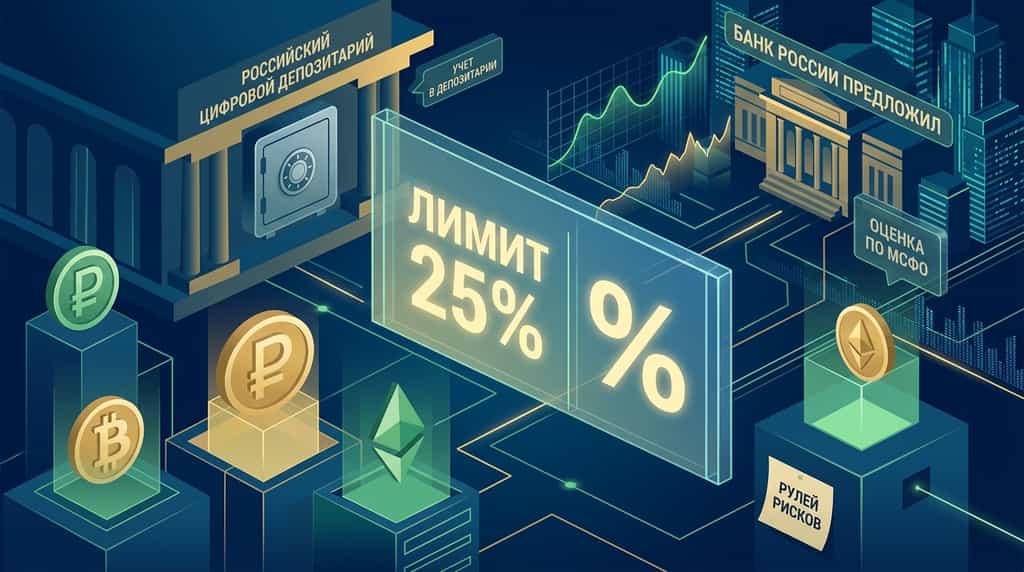
Can the inclusion of cryptocurrencies in brokers’ capital calculations be considered official recognition that they are safe assets? No — it is primarily a proposed framework for accounting and risk management. The Bank of Russia is not proposing that client funds be moved into cryptocurrencies on a large scale. Instead, it is proposing accounting rules for existing and potential digital-currency operations. According to the regulator’s statement of August 14, 2026, brokers, asset managers, forex dealers, and non-credit organizations that exchange digital currencies would be able to recognize only instruments admitted to organized trading and recorded with a Russian digital depository. Their share could not exceed 25% of the assets accepted for calculating own funds. The proposal represents a limited inclusion of cryptocurrencies in prudential requirements, not an elimination of investment risks.
What Exactly Has the Bank of Russia Proposed?
The Bank of Russia has proposed including digital currencies in the calculation of own funds and capital-adequacy ratios for professional market participants. The draft instruction was published for regulatory-impact assessment, and comments on it are being accepted from August 14 through August 29, 2026.
The initiative is connected with professional participants gaining access to the digital-currency market and non-credit financial organizations potentially beginning a separate type of activity — digital-currency exchange. The regulator needs to establish in advance how such assets should be reflected in capital, how their effect on credit and market risk should be assessed, and how potential losses for intermediaries should be recognized.
In other words, the proposal is primarily about financial accounting and risk-management rules. The phrase “include cryptocurrencies in capital calculations” does not mean that a broker would be able to replace bonds or cash with digital currencies without restrictions. It means that the regulator is defining the conditions under which certain crypto assets may be recognized when calculating financial-stability ratios.
Which Organizations Would Be Covered by the Proposal?
The proposal would apply to brokers, asset managers, forex dealers, and non-credit organizations that exchange digital currencies. This list matters because the rules would cover not only traditional securities-market intermediaries but also crypto exchanges whose activities are directly connected with digital currencies.
At the same time, recognizing cryptocurrency in an organization’s capital is not the same as a client owning cryptocurrency. An intermediary’s own assets and client funds have different legal and accounting regimes. Therefore, the news should not be interpreted as permission to direct client assets into cryptocurrency without an appropriate product, consent, and procedures required by law.
Why Was the 25% Cap Established?
The 25% cap is intended to prevent cryptocurrency risk from becoming the dominant factor in a professional participant’s capital. Under the proposal, digital currencies that meet the regulator’s requirements could not exceed one quarter of the aggregate value of assets accepted for calculating own funds.
This approach can be described as “limited inclusion, strict valuation, and risk control.” If a cryptocurrency falls sharply in price, an organization with a large concentration of digital assets would face a decline in the value of its capital. The cap reduces the likelihood that one highly volatile asset class would simultaneously weaken capital-adequacy indicators and the intermediary’s ability to cover losses.
The cap also separates regulatory recognition of an existing activity from an investment recommendation. The Bank of Russia is not stating that digital currencies have stable value or are suitable for all clients. On the contrary, the structure of the restriction shows that the regulator is taking the possibility of substantial losses into account.
|
Proposal element
|
Practical meaning
|
|
Maximum share
|
Eligible digital currencies may account for no more than 25% of assets accepted for calculating own funds.
|
|
Trading admission
|
Only digital currencies admitted to organized trading by a Russian operator could be recognized.
|
|
Custody and recordkeeping
|
For brokers, asset managers, and forex dealers, the assets would have to be recorded with a Russian digital depository.
|
|
Valuation
|
Value would be determined at fair value in accordance with IFRS.
|
|
Risk
|
Digital currencies would be considered when assessing credit and market risk.
|
Which Cryptocurrencies Could Be Included in Capital?
Not every cryptocurrency would qualify. Only instruments that pass through the infrastructure specified in the proposal could be recognized. The first condition is admission to organized trading by a Russian operator. The second condition for brokers, asset managers, and forex dealers is registration with a Russian digital depository.
These requirements address several issues at once. Organized trading creates a formal environment for executing transactions, determining quotations, and monitoring operations. A digital depository should provide records of rights and preserve information about the assets. Together, these mechanisms reduce uncertainty around the origin, ownership, and value of a digital currency.
Cryptocurrencies that do not meet the requirements would not have the same effect. According to the published terms, investments in other digital currencies would reduce the amount of capital used in the ratio calculation. Therefore, an ineligible asset would not merely fail to help an organization meet the ratio; it could worsen its calculated position.
Why Is a Digital Depository Important?
A digital depository is needed to confirm that an asset is properly recorded, rather than merely to store keys formally or maintain a record in a private wallet. A financial intermediary must be able to demonstrate how much digital currency it owns, where it is recorded, how access is controlled, and whether transactions can be restored after a failure.
This is particularly important when capital is reviewed. If an organization reports digital currency as an asset, the regulator must be able to match the reported value with a verifiable ownership right and a reliable recordkeeping system. The infrastructure requirement is therefore part of risk control, not a technical formality.
How Would Digital Currencies Be Valued?
For capital-calculation purposes, digital currencies would have to be measured at fair value in accordance with IFRS. This means that the organization would need to use a well-founded approach to determining market value and apply it consistently in its reporting.
Fair value does not guarantee a stable price. It only establishes the principle under which an asset is valued at the reporting date using available market information. For cryptocurrencies, the quality of trading, market depth, reliability of price sources, and ability to liquidate a position quickly without a substantial discount are especially important.
Problems arise when a market is illiquid or quotations on different venues diverge materially. In that case, the organization must determine which price genuinely reflects market conditions. The more difficult that price is to verify, the greater the risk of error in the amount of own funds and the capital-adequacy ratio.
Valuation must also take operational circumstances into account. These include settlement delays, restricted access to a trading venue, technical failures, wallet blocking, lost keys, or an attack on the infrastructure. Even if the price displayed on screen appears current, the organization may be unable to sell the asset at that price when necessary.
How Would Cryptocurrencies Affect Capital Adequacy?
Digital currencies would be considered when assessing credit and market risk, while the capital-adequacy ratio should show whether an intermediary has sufficient funds to cover potential losses. As a result, the effect of cryptocurrency would depend not only on its balance-sheet value but also on the risk associated with holding it.
Market risk arises from price changes. If the value of a digital currency falls, the value of the asset declines and the capital buffer could shrink. Credit risk may arise when a transaction involves a counterparty, depository, exchange organization, or another intermediary that fails to meet its obligation.
The proposal therefore cannot be described solely as regulatory easing. It creates an opportunity to recognize certain digital assets while also requiring the associated threats to be reflected. For an organization, this means controlling limits, concentration, counterparty quality, valuation procedures, and access protection.
Which Risks Would Remain?
The primary risk remains the high volatility of digital currencies. Prices can change rapidly because of market sentiment, liquidity, regulatory news, or technical events. A 30% price decline in an asset held in a significant amount could materially affect financial results and capital calculations, even if the transaction was permitted and properly recorded.
The second risk is insufficient liquidity. The ability to sell an asset at fair value cannot be taken for granted. During market stress, trading volume may decline, spreads may widen, and order execution may take longer.
The third risk is infrastructure risk. It includes cyberattacks, compromised keys, employee errors, software failures, and incorrect transaction routing. For an intermediary, these events could result not only in a direct loss of the asset but also in client claims, suspended operations, and additional expenses.
The fourth risk is methodological. Different sources may produce different prices, while the rules for recognizing or writing down an asset may be complex. Requirements for fair value and digital-depository records should therefore be supported by internal procedures for control, reconciliation, and documentation.
What Would This Mean for Russia’s Crypto Market?
The initiative could become a step toward building institutional infrastructure for the digital market. When a regulator defines rules for valuation, custody, trading admission, and capital accounting, market participants receive a clearer foundation for developing products and processes.
For brokers and asset managers, lower regulatory uncertainty could make it easier to plan new services. They would have a clearer understanding of which assets are eligible, how to value them at the reporting date, and how to reflect risks in the ratio. The separate reference to crypto exchanges in the proposal shows that their activities are being considered in the context of intermediaries’ financial stability.
For the crypto industry, this could signal a gradual shift toward a more formal operating model. However, the signal should not be turned into a claim that the Bank of Russia has recognized cryptocurrencies as safe investment assets. Regulatory inclusion in capital calculations means that risk becomes measurable and subject to control; it does not disappear.
The eventual effect will depend on the final wording of the proposal, the list of eligible instruments, requirements for trading operators, and supervisory practice. Until the comment period ends and a final document is adopted, all parameters should not be treated as definitive.
How Does Digital Currency Differ from Digital Financial Assets and Securities?
Digital currency cannot automatically be equated with digital financial assets, digital rights, or traditional securities. These categories may differ in legal nature, issuance method, existence of an obligated party, trading venue, and control mechanism.
|
Category
|
Key distinction
|
|
Digital currency
|
A digital asset whose circulation and economic nature are not necessarily connected with a claim against a specific issuer.
|
|
Digital financial asset
|
A digital right issued within an established legal and platform environment.
|
|
Digital right
|
A broader legal category of a right existing in an information system.
|
|
Traditional security
|
An instrument certifying property rights and circulating under securities-market rules.
|
Using the general term “crypto assets” for all of these instruments may be convenient in everyday language, but it is inaccurate for regulatory analysis. The Bank of Russia’s proposal concerns specific digital currencies and does not mean that every token, digital financial asset, or digital right would be treated in the same way.
How Would Brokers and Asset Managers’ Operations Change?
If brokers and asset managers begin recognizing digital currencies, they would have to integrate them into their capital-control systems. In practice, this would mean verifying trading admission, confirming depository records, calculating fair value, monitoring the 25% cap, and assessing market and credit risk.
Organizations would also need to determine who is responsible for valuation, which price sources are used, how often reconciliation is performed, and what happens if requirements are breached. Internal procedures should cover scenarios involving a sharp price decline, temporary inaccessibility of a depository, and an inability to execute a transaction.
For clients, this could lead to more structured products, but it would not remove disclosure requirements. Investors would still need to understand which asset is being offered, who holds it, how its price is formed, and what restrictions apply to selling or withdrawing funds.
KuCoin Offers A More Stable Option in A Volatile Market
If you worry about the frequent ups and downs in the market, and pursue a more stable option to earn money passively, KuCoin is the right place to come:
Simple Earn: Deposit and withdraw tokens anytime, earning stable returns.
Kucoin Earn: Earn stable profits with professional asset management.
Hold to Earn: Earn rewards by holding assets in Funding, Trading, Margin, Futures, Mining, and Unified Accounts.
Staking: Unlock the earning potential of on-chain assets.
Advanced Investments: Advanced Investments offer a variety of structured products to help your money grow in any market.
Shark Fin: Principal Protection and Guaranteed Gains
Dual Investment: Buy low and sell high with transparent return calculations.
Snowball: High yields, with price protection.
Discount Buy: Buy crypto at discount prices.
KCS Loyalty: Level up to enjoy exclusive perks by staking ≥ 1 KCS.
KuCoin Wealth: Discover future value and begin your smart investing journey.
KCS Benefits: Hold and stake KCS to access benefits across the platform.
KCS Staking 2.0: Participate in KCS on-chain governance to earn yield.

Conclusion
The Bank of Russia is proposing to include digital currencies in the calculation of own funds and capital-adequacy ratios for brokers, asset managers, forex dealers, and crypto exchanges. The purpose of the initiative, however, is not to move client funds into cryptocurrencies on a large scale. It is to create rules for existing and potential operations.
The key restriction is that eligible digital currencies could account for no more than 25% of the assets accepted for calculating own funds. Only instruments admitted to organized trading by a Russian operator could qualify, and for certain participants they would also have to be recorded with a Russian digital depository. Valuation would have to be based on fair value under IFRS, while related risks would be considered in the assessment of credit and market risk.
The proposal therefore combines institutionalization with caution. It could reduce uncertainty for financial intermediaries, but it would leave substantial volatility, liquidity, custody, cybersecurity, and valuation risks in place. Inclusion in prudential ratios is not recognition that cryptocurrencies are safe assets, nor does it eliminate the need for strict controls.
Frequently Asked Questions
1. Could a broker direct all of its own funds into cryptocurrencies
No. Under the published proposal, digital currencies that meet the applicable requirements could account for no more than 25% of the assets accepted for calculating own funds. In addition, only digital currencies admitted to organized trading and meeting the recordkeeping requirements could be recognized.
2. Does the 25% cap apply to a client’s portfolio?
The published wording indicates that the cap applies to the professional participant’s assets used to calculate its own funds. It does not automatically describe the structure of every client portfolio. The terms of a specific investment product would have to be determined by separate rules, the contract, and applicable risk-disclosure requirements.
3. Would the proposal authorize payments for goods in cryptocurrency?
No. The proposal concerns the calculation of own funds and capital-adequacy ratios for financial intermediaries. It does not establish universal permission to pay for goods or services with digital currencies.
4. Would digital currencies have to be revalued every day?
The published materials point to fair-value measurement under IFRS, but the specific frequency and procedures for revaluation would have to follow the final rules, the organization’s accounting policy, and reporting requirements. It is therefore not possible to assert in advance that all participants would follow one uniform daily procedure.
5. Is the Bank of Russia recognizing cryptocurrencies as safe assets?
No. Including digital currencies in capital calculations means that their associated risks will be reflected in prudential ratios. It does not confirm price stability, investment attractiveness, or the absence of a risk of loss.
Disclaimer : This material is provided for informational purposes only and does not constitute financial, investment, legal, or tax advice. Transactions involving cryptocurrencies and tokenized assets carry substantial risks — including price volatility, limited liquidity, counterparty exposure, and the potential for total loss of invested capital. Readers should conduct their own research and, where appropriate, consult a qualified professional before making any financial decisions.