

What Is Cluster Protocol (CP)? KuCoin Listing, Tokenomics and AI Agent Infrastructure Explained
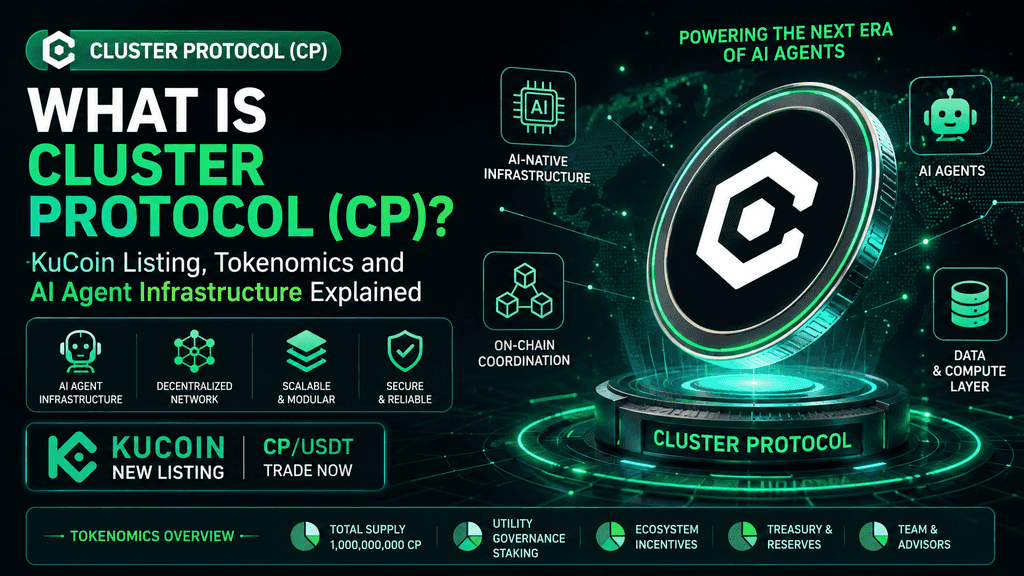
Cluster Protocol (CP) is entering the spotlight as its native token prepares to begin spot trading on KuCoin. The project positions itself as a unified AI infrastructure layer designed to connect artificial intelligence models, GPU compute, tokenized data and autonomous payments within a single environment on Base. KuCoin has scheduled CP/USDT trading for September 2, 2026, at 15:00 UTC, with the token deployed as a Base ERC-20 asset.
The listing gives traders access to CP, but the larger story is the infrastructure behind the token. Cluster Protocol is targeting a future in which AI agents can independently discover models, purchase data, use computing resources and pay for those services without requiring a human to approve every transaction. Whether that vision creates sustainable demand for CP will depend less on the listing itself and more on whether developers and autonomous agents actually use the network.
What Is Cluster Protocol (CP)?
Cluster Protocol describes itself as a unified orchestration layer for autonomous AI workflows. Instead of building a single AI model, the project is attempting to aggregate several resources that developers normally obtain from different providers. Its infrastructure includes an inference gateway for AI models, GPU compute, a tokenized data marketplace and onchain settlement. According to Cluster, more than 500 AI models can be accessed through an OpenAI-compatible interface.
The idea addresses a growing problem in AI infrastructure: fragmentation. A developer may use one provider for text generation, another for image models, a cloud platform for GPUs, a separate marketplace for data and another system for billing. Cluster aims to put those resources behind a more unified interface so an application or autonomous agent can move between them without maintaining a completely separate commercial relationship with every provider.
In simple terms, the Cluster model can be viewed as AI models + data + compute + machine payments under one infrastructure layer. That positioning also explains why CP is designed primarily as a utility token rather than simply as a cryptocurrency attached to an AI brand.
Why the KuCoin Listing Matters
KuCoin announced CP under its “World Premiere” listing campaign, with deposits supported through BASE-ERC20. A call auction is scheduled from 14:00 to 15:00 UTC on September 2, followed by CP/USDT spot trading at 15:00 UTC. Withdrawals are scheduled to open at 10:00 UTC on September 3. KuCoin also plans to make CP/USDT available through several of its spot trading bot products once trading begins.
For Cluster Protocol, the immediate importance of the listing is price discovery, liquidity and market access. Before a token has a liquid public market, discussions about its value are largely theoretical. A spot market allows participants to establish a market price and, from there, calculate circulating market capitalization and fully diluted valuation.
However, an exchange listing should not be confused with evidence of product-market fit. KuCoin access may increase awareness of CP, but it does not demonstrate that developers are using Cluster's AI APIs or that autonomous agents are generating meaningful demand for compute and data. Those adoption metrics will matter more over the longer term.
How Cluster Protocol’s AI Infrastructure Works
Cluster's inference infrastructure is designed around one OpenAI-compatible API. The project says its gateway spans more than 500 models across text, image, audio, embeddings, reranking and other AI tasks. An application already built around an OpenAI-style API can therefore theoretically access Cluster by changing its endpoint rather than rebuilding its entire model integration. The project also describes automatic failover and multi-provider access as parts of the architecture.
Compute forms the second major layer. AI developers need GPUs not only for running inference but also for model hosting and fine-tuning. Cluster's design connects GPU provisioning with its model and data infrastructure, allowing a developer to fine-tune a model and then serve it through the same broader inference environment. This creates a potential loop in which data feeds training, GPU resources provide compute and the resulting model becomes accessible through the network.
That distinction is important. Cluster is not primarily competing to build a better foundation model than OpenAI, Anthropic or other model developers. It is attempting to become an orchestration and commerce layer around AI resources, where different models and compute providers can compete to satisfy requests from developers and agents.
Why Tokenized Data Is Part of the Cluster Model
Models and GPUs are only two pieces of the AI stack. Training, fine-tuning and specialized AI applications also depend heavily on data. Cluster's Tokenized Data Marketplace is designed to give datasets onchain ownership while storing underlying data through IPFS. The project's infrastructure materials describe ERC-721-based ownership and automatic revenue distribution through its payment system.
The concept addresses an increasingly important question in artificial intelligence: who owns valuable training data and how should data creators be compensated when their information is used? Instead of treating a dataset as a file that changes hands privately, tokenization can create an identifiable ownership record and programmable payment mechanism.
Whether this model achieves meaningful adoption remains to be seen. Data quality, licensing rights, privacy and genuine buyer demand will matter at least as much as tokenization. Still, the marketplace expands Cluster's proposition beyond simply aggregating AI models by trying to connect data ownership, AI consumption and payments within the same ecosystem.
What Is x402 and Why Does It Matter for AI Agents?
x402 is an open payment protocol built around the HTTP 402 Payment Required standard. At a high level, a client requests a resource, the server responds with payment instructions if the resource requires payment, the client submits a payment and the server verifies it before delivering the resource. Coinbase's x402 documentation specifically identifies AI agents autonomously paying for API access as one of the protocol's potential use cases.
That mechanism becomes particularly relevant when thinking about autonomous software. Traditional API commerce was designed primarily around humans or companies: create an account, provide billing information, obtain an API key and pay according to a subscription or invoice. An autonomous agent that must ask a human to repeat those steps every time it needs a different service is not economically autonomous. x402 creates the possibility of machine-to-machine payments, where software can pay programmatically for individual resources.
Cluster integrates this concept with its Base-based AI infrastructure. An agent could theoretically request inference, obtain data or purchase compute and settle the charge onchain. Base itself provides developer resources for creating agents that can autonomously hold assets and pay for API requests through x402. This is one of the more important parts of the Cluster thesis: the project is betting that future AI agents will need not only intelligence, but also their own purchasing capability.
What Is the CP Token Used For?
CP is designed as the settlement and utility token inside Cluster Protocol. The project's tokenomics documentation says CP is used to pay for AI model calls, GPU jobs and dataset purchases. Cluster also describes higher access tiers that may provide preferential access to network resources during periods of high demand.
That gives CP a clearer intended function than many tokens whose use cases are limited to governance or incentives. If an AI agent purchases inference, pays for GPU time or obtains a dataset through Cluster, the design aims to make CP part of that economic activity. The critical distinction, however, is between designed utility and actual demand. Putting a token into a payment workflow does not automatically guarantee that the workflow will attract enough users to create substantial token demand.
CP also should not be described as equity or a direct claim on Cluster Protocol's business income. The project's documentation explicitly states that CP provides no ownership or profit rights, while staking incentives are not dividends, interest or entitlement to protocol revenue.
CP Tokenomics Explained
Cluster Protocol has fixed the maximum supply of CP at 5 billion tokens. According to its published tokenomics, 1,369,091,667 CP are expected to circulate on day one, representing 27.38% of maximum supply. The project says no team, Seed or Series A/Strategic tokens unlock at launch.
| Allocation | Share of CP Supply |
| Community | 40.38% |
| Foundation | 21.00% |
| Team & Advisors | 17.00% |
| Series A & Strategic | 9.33% |
| Liquidity | 8.00% |
| Seed | 4.29% |
The Community allocation is the largest at 40.38%, covering areas including airdrops, rewards and incentives. Team and Advisor tokens have an 18-month cliff followed by 24 months of linear release. Seed and Series A/Strategic allocations remain locked for 12 months before releasing over the following 24 months. The project also says the two funding rounds raised a combined $7.75 million, with DAO5, Paper Ventures, JPEG Trading and Mapleblock Capital among the Series A and strategic backers.
The relatively long investor and team cliffs reduce immediate TGE supply from those groups, but they do not eliminate longer-term dilution. As CP matures, investors will need to compare future unlocks with organic demand generated by network activity.
How Should Investors Think About CP Valuation?
The nominal price of CP will tell only part of the story once trading begins. New-token valuations are better understood by comparing circulating market capitalization with fully diluted valuation (FDV). Market capitalization multiplies the token price by currently circulating supply, while FDV applies that price to the maximum supply.
With approximately 1.369 billion CP circulating initially and a maximum supply of 5 billion, a hypothetical CP price of $0.10 would imply a circulating market capitalization of roughly $136.9 million and an FDV of about $500 million. At $0.20, those figures would be approximately $273.8 million and $1 billion, respectively. These figures are mathematical illustrations, not forecasts of CP's listing price.
This distinction matters because only around 27.38% of maximum supply is scheduled to circulate initially. A token may appear inexpensive based on its unit price while still carrying a substantial fully diluted valuation. Long-term analysis therefore needs to account for future supply as well as current liquidity.
What Could Drive Long-Term Demand for CP?
The strongest long-term case for CP depends on usage rather than exchange activity. Cluster's thesis assumes that developers and autonomous agents will increasingly consume AI resources programmatically. If that happens, measurable demand could appear through model inference requests, GPU workloads, dataset purchases and x402-based payments. The project's infrastructure currently advertises more than 500 models, tokenized datasets, GPU compute and agent-focused payment infrastructure on Base.
Cluster is also developing CodeXero, which it describes as a browser-native, prompt-to-dApp layer. That product is designed to sit above the underlying infrastructure and make it easier to create and deploy blockchain applications using natural language. The broader strategy therefore extends from infrastructure into tools that could generate direct demand for those underlying resources.
The key question is whether those products convert into paying activity. Funding, model counts and token listings can help a project develop and attract attention, but sustainable token economics ultimately require users. Metrics such as active developers, API requests, GPU utilization, dataset transactions and payment volume would provide stronger evidence of adoption than the CP price alone.
What Are the Biggest Risks for Cluster Protocol?
Competition is the first major challenge. AI infrastructure is one of technology's most competitive markets. Cluster is not only competing with crypto-native AI networks, but also indirectly with major cloud platforms, specialized inference providers, GPU marketplaces and established model APIs. Offering hundreds of models through a unified interface may simplify access, but users still need a compelling reason to move workloads away from existing providers.
Adoption is the second challenge. Model availability does not equal model demand. A platform can technically support hundreds of AI models while generating limited usage. Likewise, tokenizing datasets does not guarantee buyers, and providing x402 settlement does not prove that autonomous agents will prefer that payment architecture. Cluster's machine-to-machine economy therefore remains a thesis that must be validated through real activity.
The final risk is token-specific. CP is a newly listed crypto asset with an initial circulating supply below maximum supply and a multiyear unlock schedule. New tokens can experience large price swings as liquidity develops and investors attempt to establish fair value. The fundamental question is therefore not simply whether AI agents need models, data and compute, but whether they will use Cluster Protocol specifically at a scale sufficient to support its token economy.
What to Watch After the CP Listing
After trading begins, market participants should look beyond the first percentage move. Trading volume and order-book depth will help show whether price discovery is supported by meaningful liquidity. Circulating market capitalization should be compared with FDV, while the published vesting schedule can help put future supply increases into context.
The more important long-term indicators will exist outside exchanges. Growth in API usage, developer activity, GPU consumption, dataset transactions and x402 payments would provide evidence that Cluster's infrastructure is being used for its intended purpose. Product developments around CodeXero and the agent infrastructure could also indicate whether the project is attracting users beyond token traders.
A strong first-day CP performance would not automatically prove product adoption, just as weak early trading would not necessarily invalidate the infrastructure thesis. Exchange markets price expectations; protocol activity determines whether those expectations eventually have fundamental support.
Is Cluster Protocol More Than Another AI Crypto Token?
Cluster Protocol is attempting to address a genuine infrastructure problem: AI resources remain fragmented across models, compute providers, data markets and billing systems. Its proposed solution combines those components into a unified environment where human developers and autonomous software can access resources and settle payments programmatically.
The x402 component makes the project particularly relevant to the emerging AI-agent narrative. If autonomous agents eventually need to purchase inference, data and compute without constant human intervention, machine-native settlement could become an important part of the AI stack. Cluster is betting that its Base-based orchestration layer can serve that economy.
The KuCoin listing puts CP in front of traders and establishes a market for the token. The harder test comes next: whether Cluster Protocol can put its infrastructure in front of enough developers and autonomous agents to create sustainable demand for the models, compute, data and payments that CP is designed to support.
FAQs
What blockchain is CP built on?
CP is deployed as an ERC-20 token on Base, the Ethereum Layer 2 network incubated by Coinbase. KuCoin supports CP deposits through BASE-ERC20, while Cluster uses Base as its onchain settlement layer for payments and ownership records.
What is the maximum supply of CP?
The maximum CP supply is 5 billion tokens. Cluster's published tokenomics says the contract has no mint function, meaning additional CP cannot be created through a future minting mechanism under the current contract design. Approximately 1.369 billion CP, or 27.38% of maximum supply, are scheduled to circulate initially.
Can CP be mined?
CP is not a proof-of-work cryptocurrency like Bitcoin and is not distributed through traditional mining. Its supply and release schedule are defined through the project's token allocation and vesting structure, which covers categories such as Community, Foundation, Liquidity, Team, Seed and strategic investors.
Is Cluster Protocol itself an AI model?
No. Cluster Protocol is better understood as AI infrastructure rather than a single foundation model. It aggregates access to hundreds of models while also connecting GPU compute, tokenized data and payment infrastructure. Developers can therefore use Cluster as an orchestration layer to reach different AI resources rather than treating it as a direct alternative to an individual model such as ChatGPT or Claude.
What is CodeXero?
CodeXero is an application-layer product within the Cluster ecosystem. Cluster describes it as a browser-native prompt-to-dApp system that allows users to create and deploy blockchain applications using natural-language instructions. It sits above the project's model, data and compute infrastructure and is intended to demonstrate how those underlying AI resources can be combined into user-facing products.
🔥 KuCoin Offers A More Stable Option in A Volatile Market
If you worry about the frequent ups and downs in the market, and pursue a more stable option to earn money passively, KuCoin is the right place to come:
Simple Earn: Deposit and withdraw tokens anytime, earning stable returns.
Kucoin Earn: Earn stable profits with professional asset management.
Hold to Earn: Earn rewards by holding assets in Funding, Trading, Margin, Futures, Mining, and Unified Accounts.
Staking: Unlock the earning potential of on-chain assets.
Advanced Investments: Advanced Investments offer a variety of structured products to help your money grow in any market.
Shark Fin: Principal Protection and Guaranteed Gains
Dual Investment: Buy low and sell high with transparent return calculations.
Snowball: High yields, with price protection.
Discount Buy: Buy crypto at discount prices.
KCS Loyalty: Level up to enjoy exclusive perks by staking ≥ 1 KCS.
KuCoin Wealth: Discover future value and begin your smart investing journey.
KCS Benefits: Hold and stake KCS to access benefits across the platform.
KCS Staking 2.0: Participate in KCS on-chain governance to earn yield.
Disclaimer: This content is for informational purposes only and does not constitute investment advice. Cryptocurrency investments carry risk. Please do your own research (DYOR).