

CFTC Sets October 28 AI Forum on Agentic Trading and Crypto Markets
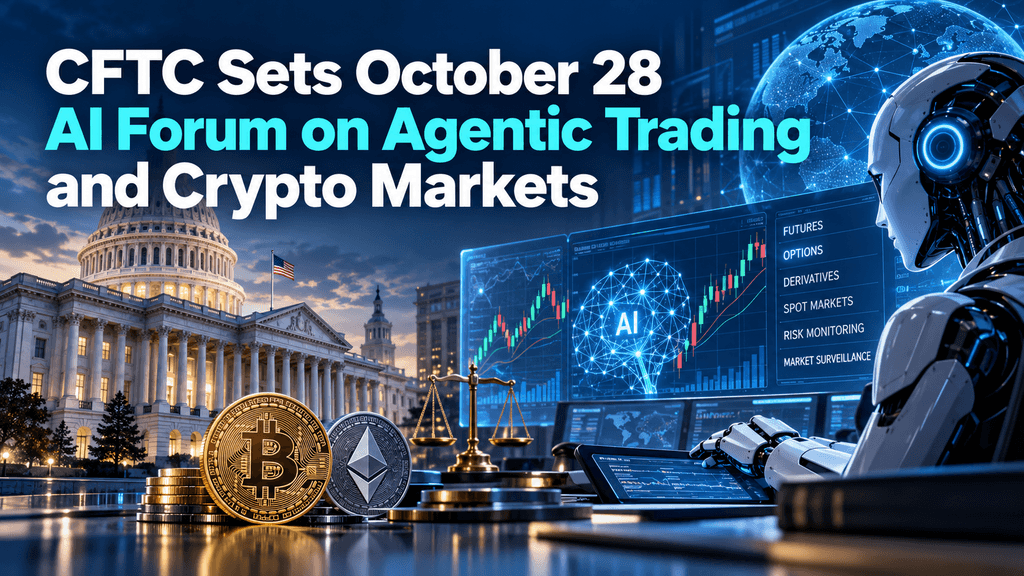
The U.S. Commodity Futures Trading Commission (CFTC) announced the agenda for its first Frontier Forum on Super Intelligence on October 20, 2026, with the event scheduled for October 28. Organized by the CFTC Innovation Task Force, the forum will examine how artificial intelligence and autonomous trading agents could reshape derivatives markets, financial transactions, and regulatory oversight. CFTC Chairman Michael S. Selig will deliver the keynote address, while industry specialists will discuss AI-powered trading, risk management, and agentic finance. The discussions also have implications for cryptocurrency derivatives and blockchain infrastructure as financial institutions explore more autonomous systems. However, the CFTC has not announced new AI trading regulations through the forum agenda.
CFTC Announces October 28 AI Forum Agenda and Industry Speakers
The CFTC released the official agenda for its inaugural Frontier Forum on Super Intelligence on October 20, 2026, ahead of the event scheduled for October 28. Organized by the CFTC Innovation Task Force, the forum will bring together financial technology executives, developers, and policy specialists to examine how artificial intelligence and autonomous financial agents could influence U.S. derivatives markets. Discussions will focus on AI-powered trading, price discovery, risk management, and regulatory oversight, with CFTC Chairman Michael S. Selig delivering the keynote address. The event forms part of the agency's broader effort to understand emerging financial technologies while addressing potential risks to market participants.
CFTC Frontier Forum Schedule and Key Discussion Topics
The October 28 forum will begin at 1:00 p.m. with opening remarks from Michael J. Passalacqua, head of the CFTC Innovation Task Force, followed by a keynote from Chairman Selig. The first panel, titled Use of Super Intelligence in Derivatives Markets, will run from 1:15 p.m. to 2:30 p.m. and be moderated by Greg Xethalis. Participants will examine how advanced AI systems could influence market operations, affect price discovery, and change existing risk-management practices. The discussion will also consider how regulators could supervise increasingly automated derivatives markets as financial institutions explore more sophisticated AI applications.
Following a 15-minute break, the second session, Agentic Trading, will take place from 2:45 p.m. to 4:00 p.m., moderated by Katherine Kirpatrick Bos. This panel will examine autonomous AI agents capable of conducting financial transactions, including how such systems interact with existing trading infrastructure and operate on behalf of market participants. Participants will also discuss whether and how the CFTC's regulatory framework should apply to these activities. The agency has confirmed that the forum will be livestreamed through its official website, allowing interested members of the public to follow the discussions. The published agenda outlines policy questions rather than announcing new AI trading regulations.
Financial Technology and Blockchain Companies Participating in the Forum
The CFTC has named eight industry panelists representing organizations involved in financial technology, trading infrastructure, software development, and regulatory policy. The lineup includes Kush Bavaria, co-founder and CEO of Ornn; Brett Harrison, co-founder and president of Architect; Ronit Jain, co-founder and CEO of Liquid Compute; and Kelly Littlepage, co-founder and CEO of OneChronos. Their participation brings perspectives from companies working across different areas of financial technology and market infrastructure. The combination of executives and technical specialists is relevant to discussions about how emerging AI applications could interact with established trading systems and influence market operations.
The remaining panelists include Hedera's chief policy officer and Brendan Ryan, a software engineer at Tempo, bringing blockchain-related perspectives to the discussion. Nick Elliott, director of government affairs at Innovation Council Action, and Andrew Kayiira, director of technology and financial innovation at the Investment Company Institute, complete the announced lineup. The participation of organizations associated with blockchain infrastructure highlights the relevance of agentic finance to digital transactions, although the forum's scope extends beyond cryptocurrency markets. The CFTC has also clarified that participation does not constitute regulatory endorsement of any company, technology, or financial product.
How Agentic AI Trading Could Transform Derivatives and Financial Markets
Agentic AI trading could transform derivatives and financial markets by enabling autonomous systems to analyze market conditions, make trading decisions, and execute transactions within predefined limits. Unlike conventional automated tools, advanced AI agents may interpret financial information, coordinate multiple tasks, and adapt their strategies as conditions change. These capabilities could improve trading efficiency, market analysis, and risk monitoring. However, greater automation also raises concerns about unpredictable decisions, market volatility, and operational risks. Understanding these differences is important as financial institutions consider how much decision-making authority to delegate to automated systems.
Autonomous AI Agents Versus Traditional Trading Bots
Traditional crypto trading bots typically execute orders using predefined rules, such as price thresholds, technical indicators, or specific market signals. For example, a bot might automatically buy an asset when its price reaches a selected level. Agentic AI systems can handle more complex decision-making, including analyzing financial news, evaluating market trends, and selecting actions within authorized limits. Some systems may also coordinate activities across multiple trading platforms. However, the distinction depends on the degree of autonomy, as traditional algorithmic trading systems can also use advanced machine learning.
In derivatives markets, autonomous AI agents could help traders monitor futures positions, evaluate margin requirements, and adjust exposure as market conditions change. A futures grid trading bot provides a separate example of how predefined price intervals can automate derivatives orders. More autonomous AI systems may process large amounts of financial data, identify potential risks, and support portfolio management and order execution. However, autonomous decisions do not guarantee profitable trades, particularly during unexpected market events. Reliable data, appropriate risk limits, and human oversight remain essential for managing automated trading activities.
AI-Driven Price Discovery and Risk Management Introduce New Challenges
Artificial intelligence could influence price discovery, market liquidity, and risk management by helping financial institutions analyze trading activity and respond more quickly to changing conditions. AI models may identify unusual price movements, evaluate market depth, and detect potential risks across derivatives portfolios. However, widespread reliance on similar algorithms could create correlated trading behavior, potentially amplifying volatility during periods of financial stress. Automated systems may also react to inaccurate information or unexpected market developments, increasing the risk of execution errors and sudden position adjustments. These challenges are particularly relevant in leveraged derivatives markets, where rapid price changes can trigger margin calls and forced liquidations. Effective monitoring, exposure limits, and human intervention remain important safeguards as AI-driven trading becomes more sophisticated.
CFTC AI Trading Regulation, Market Oversight, and Accountability Risks
CFTC AI trading regulation focuses on how existing financial-market rules apply when artificial intelligence is used to make or execute trading decisions. As autonomous systems become more capable, regulators face questions about accountability, market integrity, and compliance with established derivatives requirements. The CFTC's October 28, 2026, forum will examine these emerging issues, but its announcement does not introduce new AI-specific trading regulations. Existing legal obligations remain relevant to firms using automated financial technologies. The regulatory focus includes how firms maintain effective controls when trading decisions are delegated to software rather than handled directly by employees.
Existing CFTC AI Guidance and Regulatory Requirements
On December 5, 2024, the CFTC issued Staff Advisory Letter No. 24-17, reminding regulated entities that existing Commodity Exchange Act requirements and CFTC regulations also apply to AI-powered activities. The advisory addresses responsibilities relevant to derivatives exchanges, clearing organizations, swap execution facilities, and other registered market participants. Firms adopting AI must continue meeting applicable obligations involving market supervision, risk controls, recordkeeping, and operational compliance. The guidance also highlights the importance of assessing AI-related risks and maintaining appropriate internal procedures. Importantly, the advisory clarifies existing responsibilities rather than establishing a separate regulatory framework exclusively for autonomous trading agents.
Accountability and Market Oversight for Autonomous AI Transactions
One major challenge in AI financial market oversight is determining responsibility when autonomous systems execute unauthorized, erroneous, or potentially manipulative transactions. Trading firms may need clearly defined authorization limits, transaction monitoring, audit records, and procedures for stopping automated activity when unusual behavior occurs. Regulators must also consider whether existing surveillance systems can identify problematic trading patterns involving AI agents. Greater autonomy does not automatically remove a firm's applicable legal responsibilities, even when third-party technology providers are involved. These questions become particularly important when software makes rapid financial decisions without continuous human approval.
Global AI Risk Management Standards and Financial Stability
International regulators are also developing approaches to managing AI-related financial risks. On October 15, 2026, the Financial Stability Board (FSB) published 12 sound practices for responsible AI adoption by financial institutions. The framework emphasizes organizational governance, data quality, model evaluation, explainability, human oversight, cybersecurity, and third-party risk management. It encourages institutions to assess AI systems throughout their development and deployment rather than relying solely on initial testing. Although these practices are not binding CFTC regulations, they provide relevant international guidance as financial firms expand their use of autonomous technologies. Their broader objective is to strengthen operational resilience and reduce risks that could affect financial stability.
CFTC AI Forum Implications for Cryptocurrency Markets and Future Regulation
The CFTC AI forum could have important implications for cryptocurrency markets, particularly as autonomous trading systems become more closely connected with digital-asset derivatives and blockchain infrastructure. AI agents may support automated transactions, portfolio management, and financial services that operate with limited human involvement. The October 28, 2026, forum will examine questions relevant to these technologies, while the CFTC's broader innovation agenda addresses both cryptocurrency and artificial intelligence. However, the forum itself does not establish new cryptocurrency trading rules or approve specific AI-powered financial products. Its relevance to digital assets lies primarily in the regulatory questions that increasingly automated financial services could raise.
Agentic Finance, Crypto Derivatives, and Blockchain Infrastructure
Agentic finance could expand the use of autonomous systems in cryptocurrency derivatives trading, including Bitcoin and Ethereum futures and perpetual contracts. AI agents may help monitor market exposure, evaluate funding rates, and execute authorized transactions based on changing conditions. In markets that operate around the clock, automated systems can also support continuous position monitoring and risk assessments. The broader use of AI in crypto trading illustrates how automation and data analysis can support financial decision-making. However, cryptocurrency derivatives often involve leverage, making reliable execution controls and liquidation-risk management particularly important.
Blockchain technology introduces additional applications for autonomous financial agents. Smart contracts and programmable payment systems can enable authorized transactions and asset transfers without requiring continuous manual processing. The participation of Hedera and Tempo representatives in the CFTC forum highlights the involvement of blockchain-related organizations in discussions about financial innovation. Separately, on September 24, 2026, the CFTC updated guidance addressing tokenized investments of customer funds and blockchain-based recordkeeping. These developments demonstrate the regulator's broader engagement with digital-asset infrastructure, although the forum does not announce specific blockchain approvals.
Potential Regulatory Developments After the October 28 Forum
The CFTC's broader regulatory agenda provides important context for future cryptocurrency policy. On March 24, 2026, the agency established its Innovation Task Force to address crypto assets, blockchain technology, AI systems, and prediction markets. On October 5, the CFTC separately published an advance notice of proposed rulemaking concerning certain retail crypto asset transactions, seeking public input on a potential regulatory framework. This consultation is distinct from the AI forum and does not establish new rules for autonomous agents. Together, these initiatives show how the agency is examining emerging technologies through different regulatory processes.
Following the October 28 forum, market participants can monitor official CFTC statements, published proceedings, and any subsequent consultations for developments involving AI trading oversight and cryptocurrency regulation. Areas of interest include how autonomous agents interact with regulated trading platforms, the responsibilities of financial intermediaries, and the treatment of blockchain-based transactions. Any future guidance or rulemaking would require separate official action rather than automatically following from the forum discussions. For cryptocurrency traders and technology developers, the main consideration is how regulatory expectations evolve as AI-powered financial services become more sophisticated.
In Conclusion
The CFTC's October 28, 2026, AI forum marks an important discussion about the growing role of autonomous trading systems in derivatives and financial markets. By bringing together technology developers, industry executives, and policy specialists, the agency aims to examine how agentic finance could affect market operations, risk management, and regulatory oversight. The discussions will help clarify which practical challenges deserve closer examination as financial institutions adopt more capable AI systems. They also provide an opportunity to consider how innovation can develop alongside existing market safeguards. The discussions highlight questions surrounding automated derivatives trading, blockchain infrastructure, and the responsibilities of AI-powered financial systems. However, the forum does not introduce new trading regulations or establish immediate policy changes. The next important development will be the forum's discussions and any subsequent official CFTC actions, which may provide greater clarity about the regulatory treatment of autonomous financial technologies. Until then, existing requirements and established risk-management practices remain the relevant starting points for regulated market participants.
🔥 Beyond the Headlines: What KuCoin 5.0 Means for You
Market news moves fast — but where you act on it matters just as much. This October, KuCoin launches KuCoin 5.0, transforming KuCoin into a rebuilt platform. Here's what actually changes for you:
-
One account for everything. Older platforms split your money across separate "spot," "margin," and "futures" accounts and expected you to understand why. KuCoin 5.0's unified account removes that entirely — deposit once, and everything is simply there (only available to VIPs for now).
-
Real-world assets (RWA). Tokenized exposure to traditional assets like commodities, right inside your crypto account. One of the fastest-growing segments in global finance is no longer reserved for institutions — you access it from the same balance you trade with.
-
Earn while you learn. Not ready to trade? KCUSD lets your stablecoins earn daily, auto-compounding interest. The lowest-stress way to put your idle deposit to work for 4% yield.
-
An AI assistant in plain language. Ask questions, get market context, understand what you're looking at — built into the platform, no jargon required.
-
An app that doesn't overwhelm. Faster, cleaner, and consistent — intuitive from the first tap, not after a tutorial.
-
Safety you can check, not just trust. A MiCAR-licensed EU entity, Proof of Reserves you can verify yourself, and internationally certified security (SOC 2 Type II, ISO 27001:2022).
Create your account in minutes — and start on the platform built for where crypto is going, not where it's been.
FAQs
Where can the public watch the CFTC AI forum?
The CFTC's October 28, 2026, Frontier Forum will be livestreamed on its official website, CFTC.gov. The agency has also published telephone access information for remote participants. Interested viewers can follow the discussions without attending the event in person. Checking the official event announcement is the most reliable way to confirm access instructions and any schedule changes.
Can individuals submit feedback on future CFTC AI trading regulations?
Yes. Individuals, developers, and financial institutions can submit feedback when the CFTC opens a formal public comment period. For comment periods opened on or after April 28, 2026, submissions are handled through Regulations.gov. The October 28 forum announcement does not itself establish a new AI trading rulemaking comment period. Any separate consultation will identify the relevant subject matter, submission procedures, and deadline.
Does the CFTC regulate all cryptocurrency transactions involving AI?
No. The CFTC has broad oversight of commodity derivatives, including applicable cryptocurrency futures and options. Its authority over spot cryptocurrency markets is generally more limited, although it can pursue certain fraud and manipulation violations. Regulatory jurisdiction depends on the financial product, transaction structure, and applicable laws. Using AI to execute a transaction does not, by itself, determine which financial regulator has jurisdiction.
Do AI trading platforms need CFTC registration?
Registration requirements depend on the services a platform or business provides, not simply whether it uses artificial intelligence. Firms offering regulated derivatives brokerage, advisory, or trading services may require appropriate registration. Users can check relevant registration and disciplinary information through the CFTC and National Futures Association. A technology provider and a regulated financial intermediary may have different obligations depending on their respective activities.
Can autonomous AI agents execute transactions through decentralized finance platforms?
Technically, AI agents can interact with compatible decentralized finance applications through authorized wallets, smart contracts, and blockchain interfaces. However, transaction permissions, cybersecurity controls, and smart contract vulnerabilities require careful management. Blockchain transactions may also be difficult or impossible to reverse after execution. Users should understand which actions an agent can authorize before granting it access to digital assets.
Disclaimer: This article is for informational purposes only and does not constitute investment advice. Financial markets involve risks, and past performance does not guarantee future results.