

Cerebras Q3 2026 Revenue Hits $210.8M, Up 55% YoY as Company Raises Full-Year Outlook

Cerebras Systems reported third-quarter 2026 revenue of $210.8 million, up 55% year over year, as rising demand for AI inference services strengthened its cloud computing business. Announced on November 12, 2026, the results showed cloud and other services revenue increasing 265% to $141.9 million, prompting Cerebras to raise its full-year non-GAAP core revenue outlook to $940 million–$960 million. CBRS shares gained 11.22% in the following trading session as investors assessed the stronger forecast and new customer agreements. Still, widening GAAP losses and the costs of deploying additional computing infrastructure remain important qualifications to the company's growth story.
Key Takeaways
-
Cerebras reported record Q3 2026 GAAP revenue of $210.8 million, a 55% increase from the same quarter in 2025.
-
Cloud and other services revenue grew 265% to $141.9 million, while reported hardware revenue fell approximately 29%.
-
The company recorded a $161.2 million GAAP net loss despite generating $29.8 million in non-GAAP core net income.
-
Management raised full-year 2026 core revenue guidance to $940 million–$960 million amid growing AI inference demand.
-
CBRS closed 11.22% higher on November 13, after the earnings release and updated outlook.
-
Management expects revenue to triple in 2027, but capacity delivery, customer concentration, and profitability remain uncertainties.
Cerebras Q3 2026 Earnings Show 55% Revenue Growth to $210.8 Million
Cerebras Systems reported record third-quarter revenue of $210.8 million, compared with $135.7 million a year earlier. According to its November 12 earnings release, higher cloud computing sales more than offset weaker direct hardware revenue. Total GAAP revenue increased by about $75.1 million, showing how the company's business mix is shifting toward services that provide customers with access to computing power rather than requiring them to purchase the systems themselves. The results also need to be read alongside Cerebras' separately reported core measures, which apply adjustments that can substantially change the apparent growth rate. Contemporary coverage of Cerebras' earnings and Microsoft agreement likewise distinguishes the company's reported and adjusted figures.
Cerebras Cloud Revenue Jumps 265% as Hardware Sales Decline
Cloud and other services revenue reached $141.9 million, compared with $38.9 million in Q3 2025, an increase of approximately 265%. The segment accounted for 67.3% of total GAAP revenue, up from 28.7% a year earlier. Cerebras attributed the increase largely to activity under its OpenAI agreement, new inference service arrangements, and additional support and maintenance revenue from deployed computing clusters. This mix matters because cloud revenue depends on capacity available for customer workloads, whereas the timing of individual hardware deliveries can produce uneven quarterly sales.
Hardware revenue declined approximately 29% to $68.9 million from $96.8 million. Cerebras' quarterly filing attributed $17.1 million of the $27.9 million reduction to noncash customer warrant amortization recorded against revenue, with a further $10.8 million reflecting lower hardware deliveries under existing arrangements. Those accounting effects make reported hardware performance different from a simple comparison of equipment shipped. Cloud sales nevertheless outweighed the decline, even as the two segments delivered markedly different gross margins and contributed differently to the company's cost structure.
Cerebras Q3 2026 Gross Margins by Business Segment
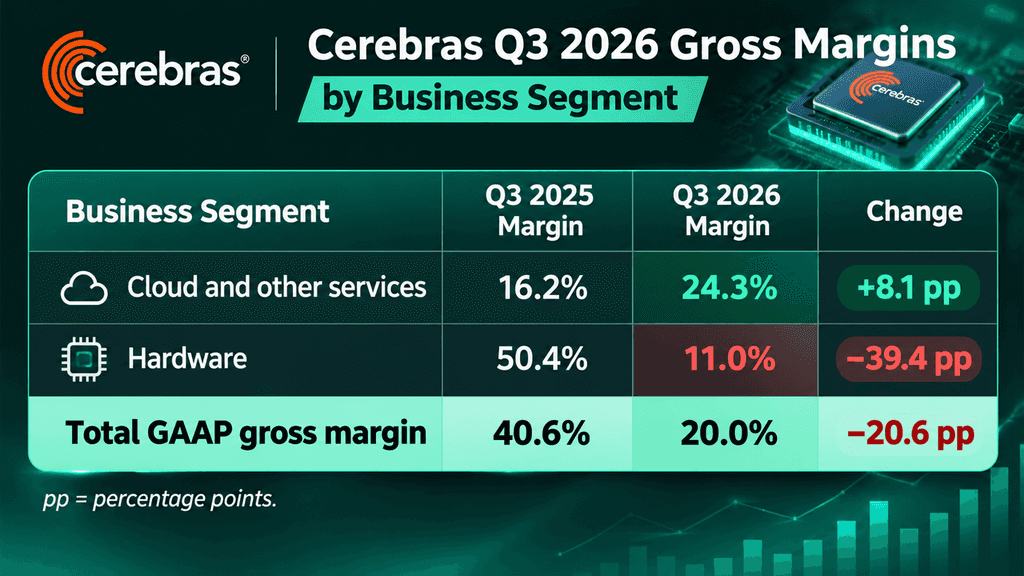
Source: Cerebras Systems Q3 2026 financial statements, released November 12, 2026. GAAP margins; pp means percentage points.
The table reveals why stronger cloud growth did not automatically lift the company's overall GAAP gross margin. Cloud margins improved, but hardware margins fell sharply, partly because of the revenue treatment of customer warrants. The distinction also helps readers compare operating trends without assuming that all segments experience identical costs when revenue expands.
Why Did Cerebras Report a GAAP Loss Despite Positive Core Income?
Despite higher revenue, Cerebras recorded a GAAP net loss of $161.2 million, compared with $22.2 million in Q3 2025. Its GAAP gross margin fell to 20% from 40.6%, while the company reported positive core net income under its own non-GAAP methodology. These measures answer different questions: GAAP figures follow standardized accounting rules, while core results exclude specified items that management considers less representative of its underlying technology and service operations. Investors should not treat the latter as a substitute for the former, particularly when adjustments are large relative to reported revenue.
The GAAP-to-core reconciliation also illustrates why the same quarter can appear very different depending on the metric selected. Cerebras excluded $16.4 million in pass-through revenue and added back $36.4 million in customer warrant amortization to calculate core revenue of $230.9 million. In its income reconciliation, the company adjusted for substantial stock-based compensation as well as other specified items. These adjustments affect interpretation of margins and profitability, so comparisons with rival AI infrastructure companies require matching accounting definitions rather than comparing headlines alone.
The financial disclosures show several further distinctions:
-
Core revenue: $230.9 million, up approximately 70% year over year, versus $210.8 million under GAAP.
-
Core gross margin: 41%, compared with a 20% GAAP gross margin for the quarter.
-
Core net income: $29.8 million, versus a core net loss of $10.9 million a year earlier.
-
Operating results: A $224.1 million GAAP operating loss, compared with a $33.1 million core operating loss.
Cerebras therefore achieved strong sales growth and positive adjusted net income without reaching profitability under GAAP accounting standards. Core operating results also remained negative, an important qualification when assessing how much of the expansion has begun to support the company's day-to-day operations.
Why Did Cerebras Raise Its 2026 Revenue Outlook Amid Surging AI Cloud Demand?
Cerebras raised its full-year forecast after third-quarter performance exceeded its earlier core revenue expectations and demand for high-speed AI inference services continued to expand. The November 12 announcement linked its outlook to new cloud customers, growing enterprise interest, and the computing infrastructure needed to deliver more workloads. Management also said its potential high-speed inference sales pipeline had expanded more than tenfold during the quarter. A pipeline indicates prospective business rather than signed orders or earned revenue, so the forecast reflects management's expectations about customer adoption and deployment timing, not a guarantee of sales.
Cerebras Raises 2026 Core Revenue Guidance to $940 Million–$960 Million
Cerebras increased its full-year non-GAAP core revenue guidance to $940 million–$960 million, versus the $880 million–$890 million range issued in August. The midpoint rose by $65 million to $950 million, a 7.3% increase. Management also increased its projected core gross margin range to 42%–44% from 41%–43% and improved its expected core operating margin range to negative 10% to negative 8% from negative 19% to negative 17%. In combination, these updates show that Cerebras expects more revenue and a smaller adjusted operating loss relative to sales than previously anticipated.
For the fourth quarter, the company forecasts core revenue of $310 million–$330 million and a core gross margin of 47%–49%. Its expected core operating margin ranges from negative 1% to positive 1%, approaching break-even under the company's adjusted definition. The $320 million revenue midpoint implies approximately 38.6% sequential growth from third-quarter core revenue, a demanding step-up that depends on timely customer service availability. Because all these targets are non-GAAP forecasts, neither the full-year range nor the fourth-quarter margin projections should be presented as forecasts of GAAP profit.
How Are AI Inference Demand and Hyperscaler Agreements Supporting Cerebras' Growth?
Cerebras offers direct hardware systems alongside cloud access to its wafer-scale processors, allowing customers to use computing resources without running their own dedicated installations. Inference is the stage when a trained AI model generates responses or processes requests; applications that need low latency can place particular value on rapid output. The company reported two new hyperscaler wins, including Microsoft, and separately announced plans to provide inference through Oracle Cloud Infrastructure in 2027. These distribution arrangements could broaden potential demand, but Cerebras has not disclosed enough contract economics to establish the financial contribution of every new deal.
The company's commercial and infrastructure announcements give useful context to the revised outlook:
-
Hyperscaler relationships: Microsoft's new agreement adds a prominent cloud customer, while the planned Oracle deployment would provide another route to enterprise users in 2027.
-
Sales pipeline: CFO Bob Komin reported more than tenfold growth in potential high-speed inference opportunities during the quarter; the figure is not a tenfold increase in recognized sales.
-
Infrastructure: Cerebras said it had contracted 700 gross megawatts of data center capacity for delivery by the end of 2027, rather than reporting that all capacity was already operating.
-
Contract obligations: Remaining performance obligations totaled $26.1 billion at September 30, 2026, with a substantial share related to OpenAI and with future recognition dependent on contractual performance.
These developments underpin reporting on Cerebras' Microsoft deal and remaining performance obligations. Yet the obligations figure is not equivalent to immediate revenue or cash receipts; it reflects commitments for services that must still be provided and, in some cases, estimated pass-through amounts. The size of the figure illustrates the company's commercial exposure, while the delivery schedule determines when those commitments may become recognized revenue.
Meeting the higher outlook will therefore require more than continuing demand. Cerebras must bring contracted infrastructure into service, maintain reliable availability, and begin delivering workloads under customers' agreements. Delays or changes in usage could affect the timing of future sales even where broader interest in AI inference remains strong. The delivery timetable is therefore a measurable test of the forecast, rather than a technical detail separate from it.
CBRS Stock Reaction to Q3 Earnings and Cerebras Growth Outlook for 2027
CBRS attracted renewed investor attention after the November 12 announcement, as stronger adjusted results and higher guidance coincided with a rally in the company's shares. The move came against a backdrop of considerable volatility for recently listed AI infrastructure businesses, whose market valuations often reflect expectations for revenue several years ahead. For Cerebras, the central issue is whether commercial demand can be translated into deliveries and eventually sustainable earnings while maintaining sufficient funding for infrastructure growth. Quarterly disclosures will help establish whether the company's operating performance is keeping pace with those expectations.
How Did CBRS Stock React to Cerebras' Q3 Earnings?
CBRS closed at $108.72 on November 13, 2026, up $10.97, or 11.22%, from the prior session's closing price of $97.75. The increase followed the release of the results and the higher annual forecast, although no single announcement can be established as the only driver of the market reaction. Shares also failed to retain their highest intraday level, indicating that buying interest coexisted with price volatility. The date matters: after-hours moves reported on November 12 were preliminary, whereas the November 13 closing price is the completed regular-session outcome.
Additional figures put that trading day in perspective:
-
After-hours response: Reports described an initial advance of approximately 17% following the November 12 release.
-
Intraday range: On November 13, CBRS traded between $101.18 and $120.44 before closing below the session high.
-
Trading volume: Approximately 36.9 million shares traded, versus about 17.5 million during the preceding session.
-
52-week range: As of November 13, the quoted range stood at $77.84–$386.34, illustrating the stock's substantial fluctuations.
The earnings rally also followed an earlier period of pressure. An October examination of CBRS stock weakness and the AI chip market discussed competitive concerns and the potential effects of additional shares becoming eligible for sale. That historical context helps explain why a positive earnings reaction should be distinguished from proof that all concerns about valuation and market share have been resolved.
What Are the Biggest Risks to Cerebras' AI Cloud Growth?
Customer concentration and delivery schedules remain prominent risks. Cerebras disclosed in its third-quarter Form 10-Q that the OpenAI agreement accounted for approximately 34% of Q3 revenue. The company also reported that, as of September 30, it had delivered less computing capacity than contemplated under the arrangement before considering potentially excused delays. Cerebras expects that some delivery delays could continue into 2027. Depending on the contractual conditions, delayed capacity can lead to service credits or termination of affected commitments, creating risks to when expected revenue is recognized and how much of that revenue ultimately materializes.
Building additional AI infrastructure also requires substantial spending on processors, facilities, power supply, and operations ahead of some customer payments. At the end of September, Cerebras reported approximately $7.8 billion in cash, cash equivalents, restricted cash, and short-term investments, although not all funds were unrestricted. Financial resources can support expansion, but they do not eliminate execution risk if data center power, manufacturing capacity, or deployments arrive later than planned. Competition from Nvidia, AMD, and hyperscalers developing their own AI processors could also influence demand, pricing, and customer decisions across the sector. The market's assessment of Cerebras consequently involves more than quarterly revenue growth. Sustained adoption, timely delivery, and the ability to convert sales into stronger operating results will determine whether its large commercial commitments support financial progress rather than simply additional capital requirements.
What Could Drive Cerebras' Revenue Growth in 2027?
CEO Andrew Feldman said in the November 12 announcement that management expects revenue to triple in 2027. That is a company forecast, not a reported financial outcome, and depends on expanding computing capacity and fulfilling customer commitments. Technology development is another part of the plan: Cerebras introduced its CS-4 inference system in August 2026 and said it was approaching full production. The company has also previewed the CS-5 for early summer 2027, targeting up to 10,000 tokens per second per user, subject to the performance achieved in commercial deployments.
Manufacturing expansion could help Cerebras serve customers seeking greater computing capacity. The company has worked with Flex and Sanmina and expects its end-2026 manufacturing capacity to be more than ten times its level at the start of the year, with further expansion planned for 2027. Greater production capability, however, is not automatically equivalent to completed deployments or profitable sales. Investors will be able to assess the forecast more clearly through future reporting on delivered computing capacity, commercial customer activity, revenue recognition, and GAAP operating margins.
The next phase of growth is therefore operational as much as commercial. Cerebras has outlined demand, customer relationships, and a product roadmap, but the pace at which those elements translate into dependable service delivery will shape its financial results in 2027. Those milestones also offer a clearer basis for comparing future reported results with today's expectations.
Conclusion
Cerebras' Q3 2026 results show how growing AI inference demand is changing its revenue mix and supporting higher management expectations. Cloud services now account for most reported revenue, giving the company a business model less dependent on the timing of individual hardware deliveries. Yet the large difference between GAAP and adjusted measures shows why revenue acceleration should not be interpreted as established profitability. Investors must consider both the underlying commercial momentum and the costs associated with supplying that growth.
The main question for 2027 is whether Cerebras can convert contracted commitments into delivered services and better operating performance. Management's growth forecast depends on infrastructure availability, execution under customer agreements, and continued adoption of its technology. Subsequent filings will be especially informative about delivered capacity, revenue recognition, customer concentration, and margins rather than the headline size of prospective agreements alone.
FAQs
What is AI inference, and why is it important to Cerebras?
AI inference is the process of using a trained model to generate responses, predictions, or other outputs. Cerebras emphasizes high-speed inference for tasks such as interactive AI assistance, coding, and enterprise applications. Fast processing can reduce waiting times, although actual response speed also depends on the model, workload, and software configuration.
How can businesses access Cerebras technology without purchasing AI chips?
Organizations can use Cerebras Cloud or supported third-party cloud providers instead of buying and operating their own Cerebras systems. Hosted access may reduce the need for specialized on-site infrastructure, although customers still need to evaluate service availability, pricing, and performance for their particular applications.
What is Cerebras' disaggregated inference technology?
Disaggregated inference assigns different phases of AI processing to resources suited to those tasks rather than requiring one identical computing configuration for every phase. Cerebras says this design can improve throughput and power efficiency. The actual benefit depends on the model, workload, and deployment architecture.
What is the difference between hyperscalers and neoclouds in Cerebras' business?
Hyperscalers operate large, general-purpose cloud platforms offering numerous technology services. Neoclouds typically focus more narrowly on accelerated computing infrastructure for AI workloads. Both can distribute Cerebras computing services, but they may serve different customer needs and use distinct commercial arrangements.
Disclaimer
This general market information, possibly from third-party, commercial, or sponsored sources, is provided for reference and educational purposes only and does not constitute financial or investment advice, an offer, solicitation, or guarantee. We disclaim liability for its accuracy, completeness, reliability, and any resulting losses. Investments/trading are risky; past performance doesn’t guarantee future results. Users should research, judge prudently, and take full responsibility. For further details, please consult KuCoin’s Terms of Use and Risk Disclosure.