

The Central Bank of Russia and Belarus's National Bank Are Negotiating Unified Crypto Market Access Rules
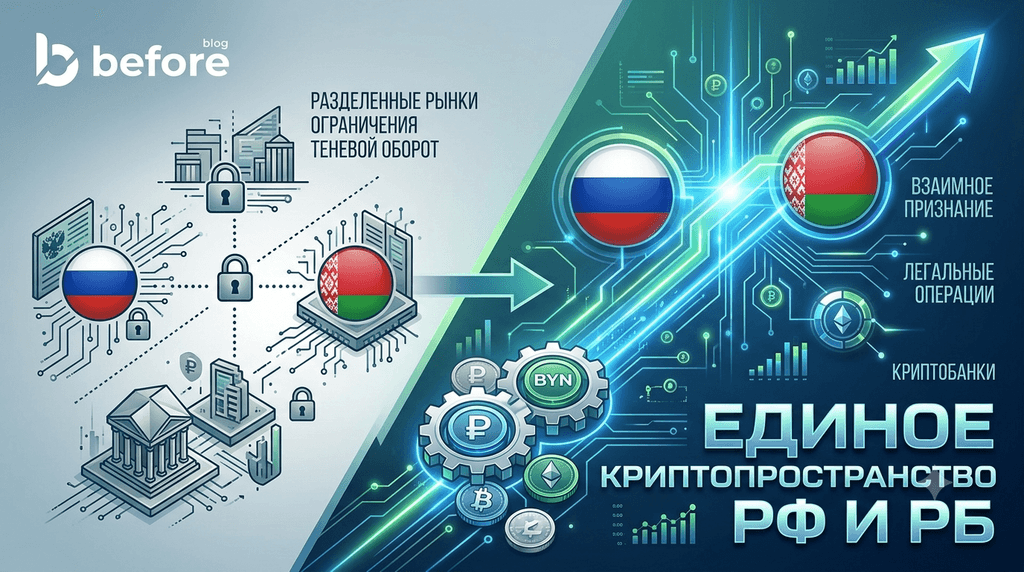
Russian traders are already using Belarusian crypto infrastructure — and the Bank of Russia has officially confirmed for the first time that it has no intention of closing this channel. On the sidelines of the Bank of Russia Financial Congress in St. Petersburg, First Deputy Governor Vladimir Chistyukhin stated that many Russian market participants are already using Belarus's infrastructure and services for cryptocurrency operations, and the regulator wants to formalize this practice rather than ban it.
The key takeaway for investors: Russia and Belarus are moving toward mutual recognition of their crypto markets rather than separation. At the same time, Russia is tightening penalties for illegal digital currency circulation, while Belarus is expanding its list of permitted operations, including copy-trading and airdrops. Below is exactly what the regulators have agreed on, how wallet and cross-border settlement rules will change, and what this means for anyone already holding assets on the KuCoin exchange.
What Have the Central Bank of Russia and Belarus's National Bank Agreed On?
The two countries' regulators have agreed on a course toward mutual recognition of crypto markets — preserving Russians' current access to Belarusian infrastructure while simplifying entry for Belarusian participants into the Russian market. Vladimir Chistyukhin reported this, noting that dialogue between the Bank of Russia and Belarus's National Bank is an ongoing working process rather than a series of one-off consultations.
According to him, the regulators' task is two-sided: preserve the opportunities Russian companies and users have already established in the Belarusian crypto market, while simultaneously building the clearest, simplest rules for Belarusian crypto organizations seeking to enter the Russian market. Chistyukhin emphasized this personally: "We will negotiate with them individually so that, on the one hand, we preserve the opportunities we currently have to use their market, and on the other hand, they get the clearest and simplest rules for entering our market." This wording matters — it shows the goal is not one-sided access, but a symmetrical model.
The key driver behind this convergence is that Belarus has already built a functioning crypto regulatory model through its High Technology Park (HTP), and Russian users have long and actively made use of it. Rather than blocking this traffic, the Bank of Russia has chosen the path of legalization and rule alignment. For the regulator, this is a pragmatic move: attempting to ban an already-established practice would either push operations into the shadow sector or put tens of thousands of users in formal violation of the law, making market oversight even harder.
It's worth noting the context of the meeting itself — the Bank of Russia Financial Congress traditionally brings together regulators, bankers, and fintech players from across the post-Soviet space, and the fact that Russian-Belarusian crypto regulation became one of the key topics at such a high-level venue signals how much priority the Bank of Russia places on this direction.
Which Wallets Will Remain Legal in Russia?
Russia still requires the use of custodial wallets only when working through licensed intermediaries, but holding assets outside centralized financial infrastructure remains legal. The Central Bank reaffirmed this position in the context of talks with Belarus: within Russia, operations through regulated intermediaries are permitted only with custodial wallets controlled by financial infrastructure — and therefore subject to regulatory and tax oversight.
At the same time, the regulator made an important clarification — users still retain the right to hold funds in non-custodial wallets, as long as this happens outside the perimeter of Russian financial intermediaries. This distinction is directly relevant to the arrangement with Belarus: a significant share of operations through Belarusian platforms and crypto banks will likely be structured through custodial schemes precisely to satisfy the requirements of both jurisdictions simultaneously.
For traders, this means personal non-custodial wallets are not directly banned, but integrating with regulated infrastructure — whether Russian or Belarusian — will require shifting to controllable, custodial solutions. In effect, a two-tier system is taking shape: fully private asset holding outside any organization remains free, while any interaction with banks, exchanges, or payment services will require transparent, identifiable custody of funds.
This model echoes an approach already used in traditional banking: cash can be kept anywhere, but any transaction through a bank requires identifying the account holder. Applying this same logic to cryptocurrency suggests that both countries' regulators now treat digital assets as a full-fledged asset class rather than a temporary exception to general rules.
When Will Russia's Digital Currency Law Take Effect?
The core law "On Digital Currency and Digital Rights" will now take effect not on July 1, but on September 1, 2026 — the date has already been pushed back in the current version of the document. The State Duma approved the bill in its first reading in April 2026, and, according to InvestFuture data from July 2, 2026, the law was originally planned to take effect on July 1, 2026, but the current draft moves the start date to September 1 of this year.
If the process proceeds without further delay, the document should be fully in force by early November — and that's when Russia will officially launch mechanisms for cross-border trade and settlements using cryptocurrency. This is directly tied to the dialogue with Belarus: without a legal basis for cross-border operations, the mutual recognition agreements would remain purely declarative and unable to move into practice.
Meanwhile, the law's second reading is being prepared — on July 8, State Duma Financial Market Committee chairman Anatoly Aksakov stated the document is already ready for that stage. Among the revisions: judicial protection for cryptocurrency owners' rights regardless of whether the assets were previously declared, as well as relief for holders of foreign crypto wallets — instead of disclosing wallet addresses, users will only need to declare balances and turnover, reducing sanctions-related risk.
The bill also introduces other significant mechanisms: crypto exchangers will only be able to credit purchased cryptocurrency to the buyer's own wallet, and digital depositories will be required to hold large transfers to third parties or abroad for 48 hours — a measure aimed at combating fraud. If an intermediary fails to meet these requirements, it will be obligated to reimburse the client for stolen funds. The distinction between qualified and non-qualified investors remains in place: non-qualified investors will be able to purchase the most liquid cryptocurrencies up to 300,000 rubles per year through each intermediary, while qualified investors will have access to any digital assets.
What Is a "Crypto Bank" in Belarus, and Why Does It Matter?
A "crypto bank" is a new type of organization in Belarus that combines the status of an HTP resident with that of a bank supervised by the National Bank, allowing it to conduct foreign economic operations using cryptocurrency fully legally. This possibility was created by a decree signed by the President of Belarus, and HTP representatives have already described the model as part of the country's long-standing comprehensive infrastructure.
Filipp Petkevich, advisor to the Secretariat of the HTP Supervisory Board, explained the mechanics: "Legislation introducing a new type of activity — the crypto bank — is about to take effect. This is a new entity combining HTP crypto-resident status with a bank under the National Bank's oversight, which will allow certain individuals and a number of legal entities to conduct foreign economic operations using cryptocurrency in a fully legal manner."
For Russian companies and individuals, this creates a potential opportunity to open accounts and conduct settlements through Belarusian crypto banks, bypassing some of the constraints of the traditional banking system, which remains under sanctions pressure. The joint work of the Bank of Russia and Belarus's National Bank is specifically aimed at removing legal barriers for Russian residents opening such accounts and making the process as predictable as possible.
It's important to understand that a crypto bank is not simply an exchange with expanded powers, but a full-fledged credit and financial institution operating under the supervision of Belarus's National Bank. This fundamentally distinguishes the Belarusian model from many other jurisdictions, where crypto exchanges and banks exist in parallel, loosely connected regulatory planes. Combining both functions within a single licensed structure potentially simplifies cross-border settlements, since a client no longer needs to route funds through a separate exchange and then separately through a bank to cash out into fiat.
Is Belarus Planning to Ease Crypto Asset Regulation?
Belarus is expanding — not narrowing — its list of legal cryptocurrency operations, with authorities discussing the legalization of copy-trading, trust management, and airdrops. Filipp Petkevich stated at a press conference: "What's being discussed today is so-called copy-trading, where a user can copy another user's trades, as well as trust management, airdrops, and many other things we're discussing."
This fundamentally distinguishes Belarus's approach from Russia's: rather than tightening controls, the country continues to expand the list of activities permitted for HTP residents. Earlier, in January 2026, Belarus already permitted the creation of crypto banks as a separate category of non-bank credit and financial organizations — an important precedent for the further liberalization now underway.
According to Petkevich, the interests of the state and law-abiding users are aligned in this area: both the state and users want more legal, safe ways to invest and use new technologies while minimizing the risk of encountering fraudsters. At the same time, the HTP explicitly requires its resident companies to inform users of investment risks — liberalized rules do not mean abandoning consumer protection.
This dynamic explains why Russian users' interest in Belarusian infrastructure keeps growing: products and operations available there are not yet legalized in Russia, or remain under tighter control. Where Russia is betting on gradual, phased expansion of permitted instruments alongside stronger controls, Belarus is moving faster and more readily introducing new forms of activity, relying on the HTP's existing infrastructure as a ready-made regulatory framework.
Is Russia Set to Tighten Enforcement Against Illegal Crypto Circulation?
Yes — alongside simplifying legal access, Russia is introducing criminal and administrative liability for illegal cryptocurrency operations. The State Duma has supported, in its first reading, a government package introducing a new Article 171.7 of the Criminal Code — "Illegal Organization of Digital Currency Circulation."
| Violation Type | Penalty |
| Illegal circulation with income or damage exceeding 3.5 million rubles | Fine of 100,000–300,000 rubles, forced labor, or up to 4 years imprisonment |
| Especially large scale (exceeding 13.5 million rubles) or organized group | Up to 7 years imprisonment with a fine of up to 1 million rubles |
| Exchanger violations of limits for non-qualified investors | Fine of 30,000–50,000 rubles for officials; 700,000–1,000,000 rubles for legal entities |
These cases will be investigated by officers of the Investigative Committee and the FSB — underscoring how seriously the state treats the shadow segment of the market. Both the criminal and administrative liability laws are set to take effect on July 1, 2027 — later than the core digital currency law — giving market participants a transition period to bring their activities into compliance.
This combination — liberalizing the legal segment while simultaneously toughening penalties for the gray market — is also characteristic of the Belarusian model, where the state is likewise pushing operations into the regulated space through the HTP, but relies less on punitive measures and more on expanding legal opportunities. Ultimately, both countries are solving the same problem — reducing the share of shadow circulation — but using different tools: Russia is increasing penalties for illegal activity, while Belarus is making the legal path more attractive and accessible.
What Does Market Convergence Mean for Traders and Asset Holders?
The alignment of rules between the Bank of Russia and Belarus's National Bank will almost inevitably lead to client data sharing and greater transparency around large transactions. Since regulators are explicitly stating a goal of "seamless" market integration, user identification (KYC) and cross-border information sharing become a logical next step in this process.
This is especially relevant for anyone planning to use Belarusian crypto banks or HTP-resident exchanges (including platforms such as Currency.com) for large legal transactions — their data will very likely become visible to regulators in both countries. For law-abiding investors, this means greater legal protection and predictability, but also less anonymity compared to the current situation, in which cross-border operations between the two countries are regulated more loosely.
At the same time, the list of legal instruments is expanding: access to copy-trading and airdrops through Belarusian infrastructure, and — looking ahead — direct cross-border cryptocurrency settlements from within Russia once the digital currency law takes effect. For foreign economic activity, the bill provides for maximum freedom in using cryptocurrencies and stablecoins in international settlements — whether through regulated intermediaries or directly via Russian or foreign infrastructure.
The practical takeaway for anyone already operating across both countries: it's worth preparing in advance for stricter identity verification and documentation of the source of funds, since the transition period — from now through the end of 2026 and into 2027 — will be a time when informal schemes are gradually replaced by regulated alternatives.
Is It Worth Trading Cryptocurrency on KuCoin Given the New Rules?
As rules tighten in Russia and loosen in Belarus, legal, regulated access to crypto assets becomes a more important factor than ever — and that's exactly what trading on KuCoin offers. While cross-border regulation between the two countries is still taking shape, using a major international exchange with transparent verification reduces the legal risk associated with working through unverified exchangers or informal P2P channels — precisely the kind of activity that now falls under Russia's new criminal liability provisions.
To start trading on KuCoin, users need to register on the platform, complete identity verification (KYC), and fund their account through one of the available methods — bank transfer, card payment, or a crypto transfer from another wallet. The exchange supports spot trading in major cryptocurrencies as well as more advanced instruments for experienced investors, including futures and staking.
Given that Russian legislation draws a clear distinction between licensed intermediaries and illegal exchangers, and that the annual limit for non-qualified investors will be 300,000 rubles per intermediary, it makes sense to choose a platform with a transparent reputation and clear compliance procedures well in advance — this reduces the risk of getting caught up in restrictions designed specifically for the gray-market segment.
Furthermore, as the digital currency law takes effect and official cross-border settlement channels emerge, users of international exchanges will find themselves in a stronger position: they will already have experience with verified trading, a transaction history, and familiarity with KYC mechanisms — exactly what regulators in both countries are increasingly demanding from crypto market participants.
Conclusion
The Bank of Russia and Belarus's National Bank have chosen the path of mutual recognition for their crypto markets rather than separation: Russians will retain access to Belarusian infrastructure, and Belarusian organizations will get clear rules for entering the Russian market. At the same time, both countries are moving in different but complementary directions — Russia is preparing to launch its digital currency law on September 1, 2026, and introducing criminal liability for illegal circulation, while Belarus is expanding its list of legal operations, including copy-trading, trust management, and airdrops.
For asset holders and traders, this means a more transparent but also more regulated environment: custodial wallets will remain mandatory when working with licensed intermediaries, and data sharing between the two countries' regulators will be a near-inevitable consequence of market convergence. Belarusian crypto banks are opening a new legal channel for cross-border settlements, while Russian legislation is building infrastructure for similar operations domestically.
The transition period — running until criminal and administrative liability takes effect in July 2027 — gives market participants time to adapt to the new rules and move their operations into the legal space. In this environment, choosing a properly regulated platform with transparent verification is no longer just a convenience — it's a way of managing legal and financial risk for years to come.
Frequently Asked Questions
Can I already legally use Belarusian crypto services while in Russia?
Yes. Russian market participants are already actively using Belarus's infrastructure and services, and the Bank of Russia has confirmed its intent to preserve — not restrict — this opportunity.
Do I have to move my assets into a custodial wallet?
Only when working through licensed Russian intermediaries. Holding assets in non-custodial wallets outside financial organizations remains legal.
What happens to cryptocurrency purchased before the law takes effect?
The current version of the law provides for judicial protection of cryptocurrency owners' rights regardless of whether the assets were previously declared, reducing risk for existing holdings.
Will criminal liability affect ordinary private investors?
The new Criminal Code article targets organizers of illegal circulation with income or damage exceeding 3.5 million rubles, not ordinary asset holders operating through licensed intermediaries.
How are Belarusian crypto banks connected to the Russian market?
The joint work of both regulators is aimed at removing legal barriers for Russian residents to open accounts and conduct settlements through Belarusian crypto banks operating under the supervision of Belarus's National Bank.