

CBR Sets Stringent Requirements for Digital Depositories: What It Means for Russia's Crypto Market
Introduction
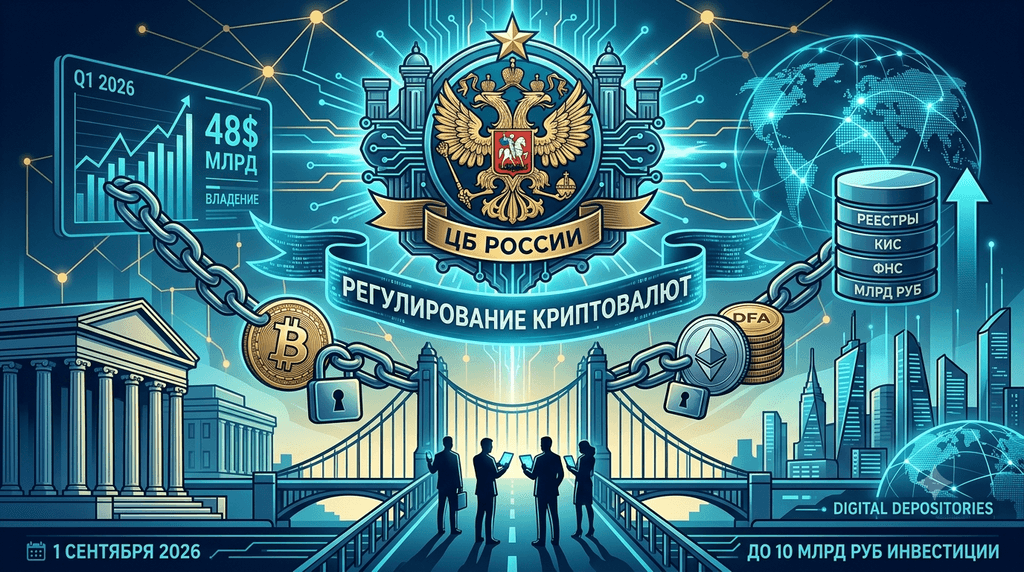
Russia is rapidly emerging as a global leader in cryptocurrency operations, ranking third in the world by crypto ownership volume ($48 billion in Q1 2026), trailing only the United States and South Korea. In response to this growth, the Bank of Russia (CBR) is introducing stringent requirements for digital depositories, creating a legal yet strictly controlled infrastructure. The new rules, outlined across 74 regulations, aim for full market transparency and the end of user anonymity. The regulator's primary goal is to ensure asset security and create a sovereign alternative to Western systems like Euroclear for cross-border settlements. However, high entry barriers—with investments reaching up to 10 billion RUB—effectively concentrate the market in the hands of major banks, excluding small businesses. This marks a transition from a "gray" market to a state-supervised system for accounting digital rights, where security is guaranteed at the cost of anonymity. This article analyzes the CBR's financial and technical requirements, their impact on investors, and the role of this new infrastructure amid international sanctions.
What Financial Requirements Has the CBR Set for Digital Depositories?
The Bank of Russia has established a multi-tiered system of requirements for the minimum size of own funds (capital) for digital depositories, effectively turning this market into a closed club for major financial players. According to the published draft directives, the minimum entry threshold starts at 50 million RUB for basic licenses. However, this is insufficient for full functionality in today's environment. If an organization plans to interact with foreign accounting systems and facilitate cross-border operations, the capital requirement increases to 100 million RUB. For the most significant participants—settlement depositories performing clearing and final settlements for trades—the minimum own funds must exceed 250 million RUB.
For clarity, here is a comparison of capital requirements based on the type of depository activity:
|
Digital Depository Type
|
Minimum Capital (Million RUB)
|
Key Feature
|
|
Basic Digital Depository
|
50
|
Accounting for DFA and digital currency within Russia
|
|
Depository with Foreign Participation
|
100
|
Integration capability with foreign systems
|
|
Settlement Digital Depository
|
250
|
Conducting clearing and final settlements
|
These standards are designed to ensure the financial stability of the infrastructure. The CBR proceeds from the premise that digital depositories carry elevated technological and operational risks. Beyond the direct capital requirement, the regulator introduces strict liquidity rules: assets in which the depository's own funds are invested must possess the highest credit quality. This excludes the use of high-risk crypto-assets to secure the organization's own stability. Thus, the regulator creates a system where reliability is guaranteed by traditional fiat assets, while the turnover of digital currencies occurs within a strictly defined legal perimeter.
How Will the Accounting and Blockchain Synchronization System Work?
The key innovation introduced by the Bank of Russia is the creation of a hybrid system combining the reliability of centralized accounting with the technological advantages of distributed ledgers. Digital depositories are required to ensure full synchronization of their internal records with the blockchain. This means every unit of digital currency or digital right will have a "double entry": one in a public or private distributed ledger, and another in the depository's official register, which carries legal weight. This model transforms cryptocurrency into an asset legally comparable to book-entry securities or stocks.
Professional market participants will be required to maintain four interconnected registers:
-
Register of Depositors: A complete database of asset owners with their identification data.
-
Register of Assets: Detailed accounting of all types of digital currencies and rights held in custody.
-
Register of Operations: A history of all transactions, ensuring immutability and traceability.
-
Register of Accounts: Real-time accounting of funds and positions.
Each asset owner will be assigned a unique 256-bit identification code, which will serve as the key to their digital profile in the state accounting system. The use of nominal accounts will allow information system operators to conduct settlements quickly and efficiently while maintaining legal purity of ownership. This differs fundamentally from classic crypto wallets, where ownership is confirmed only by knowing a private key. In the Russian "digital GOST" system, ownership is confirmed by an entry in a licensed depository's register, granting investors the right to judicial protection and guarantees of property safety.
Moreover, the Bank of Russia pays special attention to cybersecurity and data protection during the synchronization process. Digital depositories must use certified cryptographic information protection tools (CIPF) to ensure record integrity. Any discrepancy between the depository's internal register and blockchain data must be immediately investigated, and operations suspended until the incident is resolved. This creates an additional layer of protection against hacker attacks and technical failures that often plague unregulated crypto platforms. The regulator also requires backups of all registers at geographically distributed sites, ensuring data recovery even in the event of large-scale catastrophic events. Thus, the digital depository's tech stack becomes one of the most protected segments of the national financial system.
Does the New Regulation Mean the End of Anonymity for Users?
One of the most painful yet inevitable consequences of the new CBR requirements is the complete de-anonymization of all market participants. The concept of "anonymous transactions," which lies at the heart of Bitcoin's ideology, ceases to exist within the legal Russian perimeter. Digital depositories and trade organizers are granted the power and duty to perform total monitoring of operations. The regulator has clearly defined conditions under which transactions must be immediately blocked. Any suspicion of money laundering, terrorist financing, or simply the lack of clear confirmation of the source of funds will be grounds for freezing assets and terminating client service.
The creation of a unified state register of digital depositories and crypto exchanges makes the market absolutely transparent to oversight bodies. All transaction data will be available in real-time to the Federal Financial Monitoring Service (Rosfinmonitoring) and the Federal Tax Service (FTS). This means any profit from digital asset operations will automatically fall under the tax authorities' scrutiny.
"The lack of a regulatory framework made this market absolutely opaque and 'gray' in terms of taxation, as well as the provision and protection of its participants' rights. Now all these gaps will be eliminated," emphasizes Anatoly Aksakov, Chairman of the State Duma Committee on the Financial Market.
For users, this means a transition to the strictest level of "Know Your Customer" (KYC) models. Any attempt to bypass the identification system will be regarded as a violation of the law, effectively pushing illegal exchangers and P2P platforms that do not meet CBR requirements to the periphery or into the zone of criminal liability.
What Is the Role of Digital Depositories in Bypassing International Sanctions?
Amid harsh sanction pressure and the adoption of the EU's 21st sanctions package, which targets Russian banks and crypto operators, the creation of a domestic digital depository infrastructure takes on strategic importance. Russian leadership has realized that cryptocurrencies are not just a threat to financial stability but also a powerful tool for ensuring foreign economic activity. Digital depositories are intended to become the foundation for a cross-border settlement system independent of Western clearing centers and the SWIFT system.
The official position of the authorities is that Russia must build a "digital bridge" capable of replacing Euroclear and Clearstream for the accounting and settlement of digital assets. This will allow Russian exporters and importers to conduct payments in digital currencies that will be legalized and protected within the country. Since the Central Bank acts as the supreme regulator and register operator, a closed system is created, unreachable by external blocks.
This decision is of critical importance for business. In conditions where traditional bank transfers in dollars and euros are blocked or delayed for weeks, settlements through digital depositories using DFAs and legalized cryptocurrencies can occur in minutes. Thus, the digital depository becomes not just a "vault" but a key element of the national economic security system, ensuring the inflow of foreign exchange earnings and payment for critical imports bypassing Western financial barriers.
Who Will Be the Main Players in the New Market?
Analysis of the Bank of Russia's requirements shows that the digital depository market will be highly consolidated and oligopolistic. The minimum capital of 50-250 million RUB is just the tip of the iceberg. The main costs are associated with creating a complex IT infrastructure that ensures blockchain synchronization and compliance with the highest cybersecurity standards. Experts estimate that the actual investment to launch a single federal-scale digital depository could range from 500 million to 10 billion RUB.
Only the largest players in the financial sector can afford such budgets:
-
State Banks: Sberbank, VTB, Promsvyazbank (PSB).
-
Exchange Infrastructure: Moscow Exchange, SPB Exchange, and the National Settlement Depository (NSD).
-
Large Ecosystems: Such as Yandex or Gazprom structures that have their own financial divisions.
Small Web3 startups, medium-sized fintech companies, and independent crypto exchangers are effectively cut off from this market. They will either have to go underground, which will be extremely dangerous, or become agents for large players, working under a "White Label" model. This will lead to the Russian crypto market becoming an extension of the traditional banking system, where a few systematically important institutions dictate the rules. On the one hand, this increases system reliability; on the other, it reduces competition and may lead to higher commissions for end-users, as already warned by independent analysts.
Law Effective Timeline: What Should Investors Expect?
Investors and market participants must clearly understand the timeline of the upcoming changes. The main law "On Digital Currency and Digital Rights" takes effect on September 1, 2026. However, this does not mean an instantaneous transition. A transition period is provided until July 1, 2027, during which market participants must bring their activities into compliance with CBR requirements and obtain the necessary licenses.
Significant restrictions are being introduced for retail investors. According to the new norms, non-qualified investors will be able to invest no more than 300,000 RUB ($3,820) per year in cryptocurrencies through regulated Russian platforms. Any investment beyond this amount will require obtaining "qualified investor" status, which implies having specialized education, experience in financial organizations, or significant capital.
Furthermore, not all cryptocurrencies will be admitted to public trading on Russian exchanges. The CBR has set strict filters: an asset must possess high liquidity, have an average capitalization exceeding 5 trillion RUB, and meet information security criteria. This means most "altcoins" and new tokens will remain outside the legal exchange perimeter, and trading them will involve increased legal risks. Investors should prepare for a legal market that is less volatile but also less flexible than familiar decentralized platforms.
Should You Trade Cryptocurrency on KuCoin Amid New Regulations?
Against the backdrop of tightening internal regulation in Russia, many investors are questioning the role of international platforms. KuCoin, ranked among the world's top cryptocurrency exchanges, continues to be a vital window into the global world of digital assets. While the Russian infrastructure is still forming and will have significant limitations on the list of available assets and investor limits, KuCoin offers access to hundreds of promising tokens, advanced futures trading tools, and innovative DeFi products.
Trading on KuCoin under the new Russian regulation has its undeniable advantages:
-
Global Liquidity: Access to global order books, ensuring minimal spreads and high speed of trade execution.
-
Wide Selection of Assets: The ability to invest in early-stage projects that may be unavailable in the strictly regulated Russian perimeter.
-
Technological Superiority: Advanced trading bots, copy trading, and staking systems that develop faster than local banking products.
However, it is crucial for users from Russia to maintain a balance. Using KuCoin allows you to retain access to global opportunities, but you must consider national legislative requirements regarding tax reporting and asset declaration. KuCoin prioritizes the security of its users' funds and compliance with international standards, making it a reliable partner for those seeking to diversify their portfolio beyond a single jurisdiction. Join KuCoin today to access the most advanced crypto market tools and build your financial future on a global level.
Join KuCoin 9th Anniversary Trading Campaign
KuCoin is celebrating its 9th anniversary with a special platform campaign filled with exclusive rewards, trading activities, and limited-time offers. Don’t miss the chance to participate and enjoy the benefits as the exchange marks nine years of growth and innovation. Visit the official campaign page now:

Conclusion
In conclusion, the new Bank of Russia requirements for digital depositories mark the final institutionalization of the crypto market. The state has shifted from prohibition attempts to a strategy of total control, integrating digital assets into the national economy as a tool for bypassing sanctions. Creating a legal infrastructure with a high entry threshold is a compromise between system security and the freedom of private investors. On one hand, the market is being cleared of "gray" schemes, providing businesses with a legal mechanism for cross-border settlements. On the other hand, ordinary users lose anonymity and face strict investment limits of up to 300,000 RUB per year.
The law, effective September 1, 2026, will create a new landscape dominated by the largest banks and exchanges. For investors, this is a time of adaptation to transparent rules of the game. Legalization is the industry's transition to a new level of maturity. In this reality, success will belong to those who effectively combine the capabilities of the local regulated market with the advantages of global platforms like KuCoin. It is important to remember that in an era of digital control, vigilance and compliance with the law become the keys to capital preservation. The future of the crypto market in Russia is now inextricably linked to the state accounting system, requiring every participant to take a balanced approach to choosing trading strategies and platforms.
FAQs
1. What is a digital depository and why is it needed?
A digital depository is a licensed organization that maintains the official accounting of rights to cryptocurrencies and digital assets. It is necessary for the legalization of crypto ownership, providing legal protection to the owner and the ability to use assets in the official economic turnover.
2. How will the new rules affect ordinary cryptocurrency owners?
The main change is the complete loss of anonymity when working through legal Russian platforms. All data will be transmitted to the tax authorities and Rosfinmonitoring. Investment limits for non-qualified individuals (300,000 RUB per year) are also being introduced.
3. Can the CBR block my crypto-assets in a depository?
Yes, if a transaction appears suspicious to the system (AML/CFT signs), the depository is obliged to freeze the funds until the source of their origin is clarified. This is part of the strict control introduced by the regulator.
4. Why is Russia creating a Euroclear analogue for cryptocurrencies?
This is a strategic measure to bypass Western sanctions. Its own independent accounting system will allow for international settlements with friendly countries and partners without the risk of funds being blocked by unfriendly jurisdictions.
5. Will foreign exchanges like KuCoin still work after 2026?
Foreign exchanges will continue to work; however, Russian users will have to independently ensure compliance with Russian tax legislation. Global platforms will remain an important tool for accessing assets that will not be represented on the domestic market.
Disclaimer : This material is provided for informational purposes only and does not constitute financial, investment, legal, or tax advice. Transactions involving cryptocurrencies and tokenized assets carry substantial risks — including price volatility, limited liquidity, counterparty exposure, and the potential for total loss of invested capital. Readers should conduct their own research and, where appropriate, consult a qualified professional before making any financial decisions.