

BNB Overtakes BNY Mellon in Market Cap as Valuation Tops $104 Billion
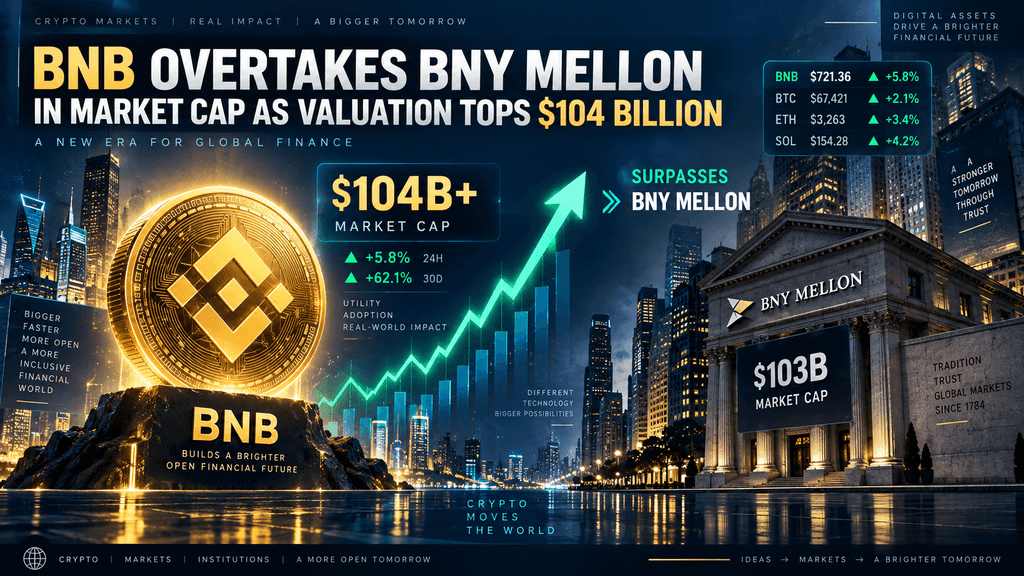
BNB has entered a valuation range once associated almost exclusively with major global corporations and financial institutions. On September 22, 2026, BNB’s market capitalization rose above $106 billion before settling near $105 billion the following day, putting the token’s circulating market value above the equity market capitalization of BNY Mellon during the same period. CoinGecko data shows BNB closing around $788 on September 22 after trading near $712 only a week earlier, while BNY Mellon’s market capitalization stood near $104.5 billion on September 21 before falling below $100 billion on September 22.
The comparison is striking, but it needs context. BNB’s market capitalization and BNY Mellon’s stock-market value measure very different things, and neither should be confused with the scale of BNY’s custody or asset-management businesses. The more important question is why investors are willing to assign BNB a valuation above $100 billion. The answer increasingly involves more than crypto-market momentum. BNB Chain is expanding network capacity, building payment infrastructure, growing stablecoin activity and positioning itself as a major venue for tokenized real-world assets. That makes the BNY Mellon comparison less interesting as a ranking and more important as a sign of how large crypto-native financial infrastructure has become.
BNB Market Cap Passes $104 Billion
BNB’s latest milestone followed a rapid September advance. CoinGecko historical data shows BNB closing at about $711.74 on September 15, rising to $761.14 by September 18 and reaching $799.14 on September 21. Its market capitalization moved from roughly $95.9 billion to more than $102.8 billion during the same period, then climbed to about $106.4 billion on September 22. By September 23, BNB’s market cap remained near $104.95 billion.
BNY Mellon’s equity value was operating in almost exactly the same range. Historical market-cap data puts BNY at approximately $104.48 billion on September 21 and about $99.64 billion on September 22. That meant BNB’s circulating token supply was briefly valued above the entire publicly traded equity value of one of the world’s largest financial-services companies.
| Metric | Approximate Value | What It Represents |
| BNB market cap | ~$105B | Token price × circulating supply |
| BNY Mellon equity market cap | ~$100B–$104B | Share price × shares outstanding |
| BNY assets under custody/admin | $62.6T | Client assets safeguarded or administered |
| BNY assets under management | $2.2T | Client assets actively managed |
The ranking itself can change quickly. BNB trades 24 hours a day, seven days a week, while BNY shares trade during stock-market sessions. A few percentage points of movement in either asset can reverse the order, so the most accurate description is that BNB briefly overtook BNY Mellon in market capitalization, not that it permanently became a larger financial institution.
Why Is BNB Rising Now?
Part of BNB’s September rally reflects the broader recovery in crypto markets. Bitcoin strengthened sharply during the same period, helping lift risk appetite across major altcoins. When BTC stabilizes or breaks higher, capital often rotates toward large-cap assets with established liquidity, and BNB is one of the clearest beneficiaries of that pattern. The move from roughly $712 to almost $800 in less than a week therefore cannot be separated from the wider crypto-market environment.
At the same time, BNB’s rally is increasingly supported by an ecosystem story that extends beyond simple market beta. BNB Chain has recently pushed network scaling, stablecoin payments and tokenized assets at the same time. That matters because BNB is not just an exchange-linked token; it is also the native asset of BNB Smart Chain and is used for gas, staking and a wide range of onchain applications.
More Than a Crypto Market Bounce
The key distinction is that price momentum and network fundamentals are moving in the same direction, even if they are not perfectly correlated. A stronger crypto market can help reprice BNB quickly, but the sustainability of a $100 billion-plus valuation depends on whether BNB Chain continues to generate real activity across payments, decentralized finance and tokenized financial products.
That is why BNB’s recent move is more interesting than a simple altcoin rally. The token is benefiting from market conditions, but its long-term narrative is becoming increasingly tied to whether BNB Chain can evolve into a broader financial infrastructure layer.
BNB Chain Is Scaling Faster
One of the clearest recent technical developments is the Pasteur hard fork, which went live on BNB Smart Chain on August 25. The upgrade introduced BEP-675, a new block-building architecture designed to remove redundant execution work before validators finalize blocks. By mid-September, BNB Chain reported that the new architecture was already powering roughly 98% of blocks over a recent three-day period.
BNB Chain also reported that BidBlock V2 was processing an average of 28% more gas per block than the previous version under live mainnet conditions. Validators were simultaneously raising the gas limit toward 70 million, with future scaling stages potentially moving toward 80 million or 90 million.
Why Network Capacity Matters for BNB
Higher capacity matters because BNB’s utility depends partly on the activity taking place on BNB Smart Chain. More efficient block production can support more transactions, applications and users without requiring the network to rely on congestion as a source of scarcity.
But this does not mean that a 28% increase in gas capacity should directly translate into a higher BNB price. The more meaningful chain of evidence is whether capacity improvements lead to greater usage, higher transaction counts, deeper liquidity and stronger application activity. Network upgrades create the opportunity for growth; they do not guarantee it.
Payments Are Becoming a Bigger BNB Story
Payments have become one of BNB Chain’s most visible priorities. On September 1, the network announced the BSC Payment Lane, a planned Q4 2026 upgrade that will reserve a minimum amount of block gas for payment transactions during periods of congestion. Eligible transactions include native BNB transfers, USDT, USDC and certain audited tokens approved through governance.
BNB Chain says payment activity already appears in roughly 99.6% of BSC blocks. The Payment Lane is designed to prevent remittances, merchant transfers and withdrawals from being delayed when speculative activity pushes transaction fees higher. The network has also extended zero-gas-fee promotions for USDC, USD1 and U through the end of September, with more than $4.5 million in gas costs already covered for users.
From DeFi Chain to Payment Infrastructure
This is an important shift in positioning. BNB Chain has historically been associated with decentralized exchanges, yield farming, retail crypto activity and meme coins. A dedicated payment lane and subsidized stablecoin transfers suggest the network increasingly wants to compete for remittances, merchant payments and stablecoin settlement.
That gives BNB a broader narrative. Instead of being viewed primarily as an exchange-related token or gas asset, it can increasingly be framed as the native token of a network trying to support payments, stablecoins and onchain financial activity at scale.
Tokenized Stocks and RWA Add Another Growth Story
Real-world assets are another major part of BNB Chain’s expansion. In June, BNB Chain said more than 709 tokenized stocks and ETFs were available across its ecosystem, with cumulative tokenized-stock volume exceeding $5 billion and associated market capitalization above $1 billion. The network positioned those assets as usable not only for trading and holding, but also across its broader DeFi environment.
That matters because tokenized stocks represent a different kind of growth from traditional crypto-native activity. Instead of competing only for users trading crypto tokens, BNB Chain is also competing to host digital representations of traditional securities and other real-world financial assets.
Why RWA Could Matter for BNB
If tokenized stocks, Treasuries, money-market products, gold and other RWAs continue moving onto BNB Chain, they can generate additional transactions, liquidity and demand for blockchain infrastructure. BNB remains the network’s native gas asset, so a larger onchain financial economy can strengthen its utility story even if there is no simple one-to-one relationship between RWA growth and BNB price.
The strategic significance is that BNB Chain is no longer competing only with Ethereum, Solana and other smart-contract networks for crypto-native DeFi users. It is increasingly competing for traditional financial assets that are moving onchain.
Binance’s Circle Deal Adds to the Stablecoin Narrative
Another recent development adds to the broader stablecoin story. Reuters reported on September 22 that Binance invested $100 million in Circle, the issuer of USDC, as part of an expanded strategic partnership. The agreement deepens cooperation around USDC at a time when stablecoin payments and settlement are becoming an increasingly important part of global crypto infrastructure.
It is important not to blur the boundaries between the entities involved. Binance, BNB Chain and the BNB token are related within the broader ecosystem but are not the same legal or economic entity. A Binance investment in Circle does not directly add $100 million of value to BNB, nor does it mean BNB Chain owns Circle.
Why the Deal Still Matters for Market Sentiment
The deal matters because it reinforces a broader ecosystem narrative. Binance is strengthening its relationship with one of the largest stablecoin issuers at the same time BNB Chain is building payment-specific infrastructure and subsidizing stablecoin transfers.
For investors, those developments can collectively support the idea that the Binance and BNB ecosystem is positioning itself around stablecoins and digital payments. That is best understood as strategic context rather than a direct explanation for BNB’s price.
Is BNB Really Bigger Than BNY Mellon?
Not in the way the headline may imply. BNB’s market capitalization is calculated by multiplying the token price by circulating supply. BNY Mellon’s market capitalization is calculated by multiplying its share price by shares outstanding. The two figures are comparable as market valuations, but they do not describe the same type of economic asset.
The difference becomes obvious when BNY’s operating scale is considered. As of June 30, 2026, BNY reported $62.6 trillion in assets under custody and/or administration and $2.2 trillion in assets under management. The company says it touches approximately 20% of the world’s investable assets and provides custody services across more than 100 markets.
Market Cap Measures Valuation, Not Operational Scale
BNY’s roughly $100 billion equity market cap reflects what investors are willing to pay for ownership of the company. It does not represent the value of all client assets passing through BNY’s custody and asset-management systems.
Similarly, BNB’s $105 billion market cap does not mean the BNB Chain economy generates $105 billion in revenue or holds $105 billion of assets. It reflects the market value of the circulating token supply.
The most accurate conclusion is therefore narrower but still significant:
The market currently values BNB’s circulating token supply at roughly the same level as investors value BNY Mellon’s publicly traded equity.
That is still a remarkable milestone, but it is different from saying BNB is operationally larger than BNY.
BNY Mellon Is Moving Into Crypto Too
The comparison becomes even more interesting because BNY itself is moving deeper into digital assets. The bank has been expanding capabilities around digital-asset custody, tokenization and digital transfer infrastructure. In August, BNY announced new global digital transfer-agency capabilities, extending traditional fund servicing into digital markets.
BNY’s broader digital-asset strategy shows that the story is not simply “crypto versus banks.” Traditional financial institutions increasingly see tokenization, digital custody and blockchain-based infrastructure as areas that can complement their existing businesses rather than replace them outright.
Crypto and TradFi Are Moving Closer
That creates a more useful way to interpret the BNB-BNY comparison. BNB represents a crypto-native financial network moving toward payments, stablecoins and tokenized securities. BNY represents a traditional financial institution increasingly adding digital-asset infrastructure to its existing custody and asset-management systems.
The two are approaching the same future from opposite directions. Crypto networks are adding more traditional financial functions, while traditional institutions are adopting more blockchain-native technology.
Can BNB Stay Above a $100 Billion Valuation?
The first factor to watch is the broader crypto market. BNB remains strongly influenced by Bitcoin and general risk appetite. If BTC continues to hold its recent gains, large-cap altcoins such as BNB are more likely to maintain supportive market conditions. A sharp crypto-wide reversal would make it harder for BNB to hold a triple-digit-billion valuation regardless of ecosystem progress.
The second factor is network activity. Investors should pay more attention to usage than to global market-cap rankings. If BNB Chain’s scaling improvements are followed by stronger transaction activity, stablecoin transfers, decentralized finance usage and RWA adoption, the ecosystem will provide more fundamental support for the token’s valuation.
| Indicator | Why It Matters |
| BNB near the $800 area | Measures near-term momentum |
| Market cap above $100B | Keeps BNB in the top tier of crypto assets |
| BNB Chain activity | Tests real network demand |
| Stablecoin transfers | Measures payment and settlement adoption |
| DeFi liquidity | Shows capital committed to the ecosystem |
| RWA activity | Tests the tokenized-finance narrative |
| Payment Lane adoption | Shows whether infrastructure changes produce real usage |
The third factor is execution. Payment Lane is still planned for Q4, while RWA and stablecoin initiatives need to continue attracting users rather than remaining primarily narrative drivers. The long-term case for BNB depends on whether infrastructure becomes measurable activity.
What Could Put Pressure on BNB?
The most obvious risk is a broader crypto correction. BNB remains a volatile digital asset, and its high valuation is still closely tied to sentiment across the crypto market. If Bitcoin weakens sharply, BNB could lose value even if BNB Chain continues to expand technically.
Another risk is ecosystem concentration. BNB’s identity remains strongly linked to Binance and BNB Chain. Regulatory, operational or reputational developments affecting either part of that ecosystem can influence market confidence. Reuters reported on September 22 that Binance was facing renewed U.S. scrutiny over possible Iran sanctions violations, illustrating how external regulatory developments can quickly become relevant to investor sentiment even when they are separate from BNB Chain’s technical performance.
The final risk is valuation running ahead of usage. A token can appreciate faster than the underlying network’s users, liquidity or economic activity. Holding a $100 billion-plus valuation over time will therefore require more than bullish market momentum; BNB Chain must convert scaling, payment and tokenization initiatives into sustained onchain demand.
What Does the BNY Mellon Milestone Really Mean?
The milestone has symbolic importance because it shows how far crypto-native assets have moved into the global valuation landscape. BNB launched less than a decade ago, yet its circulating supply is now valued in the same range as the equity of a financial institution whose roots go back more than two centuries.
It also reflects BNB’s changing identity. The asset began primarily as a utility token associated with Binance but is now tied to a much wider blockchain economy involving smart contracts, stablecoins, payments, DeFi and tokenized securities. That broader role makes the $100 billion valuation easier to understand than if BNB were still only an exchange-fee token.
Still, the comparison should remain precise. BNB’s higher market cap does not prove that BNB Chain has surpassed BNY Mellon in revenue, financial assets or operational reach. It shows that crypto-native network assets are now being valued at levels once associated almost exclusively with major banks, technology companies and multinational corporations.
🔥 Beyond the Headlines: What KuCoin 5.0 Means for You
Market news moves fast — but where you act on it matters just as much. This October, KuCoin launches KuCoin 5.0, transforming KuCoin into a rebuilt platform. Here's what actually changes for you:
-
One account for everything. Older platforms split your money across separate "spot," "margin," and "futures" accounts and expected you to understand why. KuCoin 5.0's unified account removes that entirely — deposit once, and everything is simply there (only available to VIPs for now).
-
Stocks, indices, and commodities. KuCoin 5.0 expands beyond crypto into global markets. When crypto chops sideways and equities rally (or the reverse), you rotate in minutes instead of opening a brokerage account and waiting days for fiat rails.
-
Real-world assets (RWA). Tokenized exposure to traditional assets like commodities, right inside your crypto account. One of the fastest-growing segments in global finance is no longer reserved for institutions — you access it from the same balance you trade with.
-
Earn while you learn. Not ready to trade? KCUSD lets your stablecoins earn daily, auto-compounding interest. The lowest-stress way to put your idle deposit to work for 4% yield.
-
An AI assistant in plain language. Ask questions, get market context, understand what you're looking at — built into the platform, no jargon required.
-
An app that doesn't overwhelm. Faster, cleaner, and consistent — intuitive from the first tap, not after a tutorial.
-
Safety you can check, not just trust. A MiCAR-licensed EU entity, Proof of Reserves you can verify yourself, and internationally certified security (SOC 2 Type II, ISO 27001:2022).
Create your account in minutes — and start on the platform built for where crypto is going, not where it's been.
Conclusion: BNB’s $104 Billion Valuation Is About More Than a Ranking
BNB’s market capitalization rising above $104 billion and briefly overtaking BNY Mellon is a striking headline, but the ranking itself is the least important part of the story. BNB climbed from roughly $712 to near $800 in less than a week as crypto markets strengthened, while its ecosystem simultaneously advanced network scaling, stablecoin payments and tokenized finance.
The BNY Mellon comparison also highlights how different forms of financial infrastructure are beginning to converge. BNB Chain is adding functions traditionally associated with payments and capital markets, while BNY is expanding into digital custody and tokenization. Yet their market caps still measure fundamentally different things, and BNY’s $62.6 trillion in assets under custody or administration should not be confused with its equity value.
The real test for BNB is therefore not whether it stays ahead of BNY Mellon on a market-cap leaderboard. It is whether BNB Chain can convert a $100 billion-plus token valuation into sustained activity across payments, DeFi, stablecoins and tokenized real-world assets.
FAQs
What Is the All-Time High Price of BNB?
BNB has traded near record territory during previous crypto-market cycles, and its historical peak depends on the data source and exchange used. Investors comparing current prices with previous highs should use the same market-data provider because intraday highs can differ slightly across exchanges.
How Is BNB Market Cap Calculated?
BNB market capitalization is calculated by multiplying the current token price by the circulating supply. This is the same basic method used for most cryptocurrencies, but it should not be confused with revenue, total value locked or the value of assets using BNB Chain.
Does BNB Have a Maximum Supply?
BNB has a limited supply structure rather than an unlimited issuance model. Its total supply has also been reduced over time through token-burning mechanisms designed to permanently remove BNB from circulation.
What Is the Difference Between BNB and BNB Chain?
BNB is the native token used for gas, staking and other functions. BNB Chain is the broader blockchain ecosystem and infrastructure on which decentralized applications, payments, stablecoins, DeFi protocols and tokenized assets operate.
How Does the BNB Burn Affect Supply?
BNB uses burn mechanisms that permanently remove tokens from supply. In theory, lower supply can increase scarcity if demand remains constant or rises, but token burns do not guarantee price appreciation. Market conditions, network activity and investor demand remain major drivers of valuation.
Disclaimer: This content is for informational purposes only and does not constitute investment advice. Cryptocurrency investments carry risk. Please do your own research (DYOR).