

BlackRock Shifts to Short-Term Treasuries and Downgrades U.S. Stocks: What It Means for Investors
BlackRock has shifted its investment outlook toward short-term U.S. Treasuries, reducing its preference for American stocks as rising bond yields and uncertainty surrounding artificial intelligence spending reshape financial markets. In its October 12, 2026, commentary, the BlackRock Investment Institute upgraded short-term government debt to overweight and downgraded U.S. equities from overweight to neutral. In its October 12, 2026, assessment, BlackRock cited a 10-year U.S. Treasury yield near 5.25%, highlighting the increasingly competitive income available from government bonds. However, BlackRock continues to favor selected AI-related companies, suggesting that its revised strategy focuses on managing near-term risks rather than abandoning stock market growth. The changes raise important questions about Treasury returns, equity valuations, and portfolio diversification.
BlackRock’s Updated U.S. Stock and Treasury Outlook
On October 12, 2026, the BlackRock Investment Institute revised its tactical investment strategy, shifting toward short-term U.S. Treasuries while reducing its preference for American stocks. The adjustment follows a substantial increase in government bond yields and growing concerns about market volatility linked to artificial intelligence infrastructure spending. According to BlackRock's official market commentary, higher Treasury yields now offer more attractive income opportunities, prompting the firm to reassess its exposure to government bonds and equities. The announcement also came ahead of important U.S. inflation data that could influence market expectations for future interest rates.
BlackRock’s Revised Asset Allocation Across Stocks and Bonds
The updated outlook covers several major asset classes, reflecting BlackRock's efforts to balance income opportunities with market risks. The changes also indicate a more selective approach to portfolio positioning as higher borrowing costs and shifting Federal Reserve expectations influence financial markets. Short-term government securities have become more attractive for income generation, while equity exposure is being reassessed amid uncertainty surrounding corporate financing and AI-related investment. Each rating reflects BlackRock's preferred positioning relative to a benchmark allocation rather than a prediction of an asset's absolute return.
The table below compares BlackRock's tactical positioning across six asset classes as of October 12, 2026, showing where the firm adjusted its outlook and where its investment preferences remained unchanged.
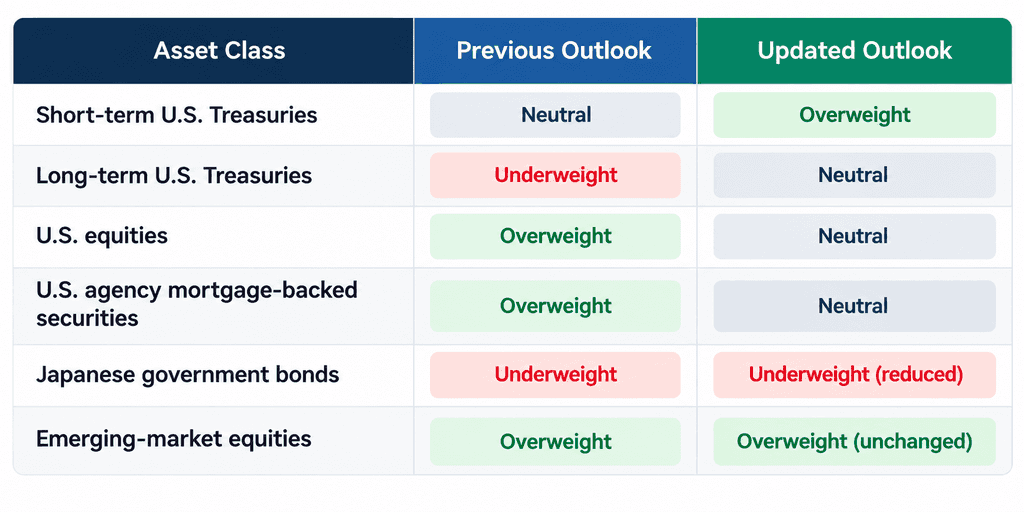
How BlackRock’s 2026 Outlook Differs From Its Previous Strategy
BlackRock's latest Treasury positioning marks a departure from the strategy it adopted in October 2020, when the benchmark 10-year U.S. Treasury yield was below 0.9%. The firm maintained a predominantly underweight stance on government bonds over the following six years, with occasional periods of neutral positioning. By October 2026, the 10-year yield had climbed to approximately 5.25%, providing substantially higher income potential than during the earlier low-rate environment. BlackRock views this increase as an opportunity to secure attractive yields while managing exposure to further interest-rate fluctuations. Higher starting yields can also help offset some bond-price losses if market interest rates continue rising, although the extent of that protection depends on the security's duration.
Despite its more cautious positioning, BlackRock has not adopted an outright bearish outlook on U.S. stocks. Its revised strategy reflects short-term risk management rather than a fundamental change in expectations for corporate growth. The firm remains constructive on selected AI-related companies and listed infrastructure businesses, where strong earnings potential and demand for computing infrastructure may support investment returns. A neutral equity rating can still involve substantial U.S. stock holdings, depending on the portfolio's underlying benchmark and investment mandate. Importantly, these adjustments represent BlackRock Investment Institute's tactical research views over a six- to 12-month horizon, not confirmed trading decisions across all BlackRock-managed portfolios.
Why Is BlackRock Favoring Short-Term Treasuries as Yields Rise?
BlackRock sees an opportunity to earn higher government bond income without taking on excessive exposure to long-term interest-rate movements. Its October 2026 analysis found that the 10-year U.S. Treasury yield had increased by approximately 110 basis points since the start of the year, driven primarily by rising expected real interest rates rather than higher inflation expectations. Strong competition for investment capital, elevated energy prices, and changing Federal Reserve expectations have contributed to the increase. BlackRock believes these conditions have improved the potential returns available from Treasury securities, particularly shorter-term maturities, where investors face less sensitivity to further yield increases.
Federal Reserve Rate Expectations and Short-Term Treasury Returns
A key factor behind BlackRock's preference is its assessment that financial markets may be expecting too much additional monetary tightening. According to the firm's analysis, investors had priced in 160 additional basis points of Federal Reserve tightening over the following 12 months compared with expectations in January 2026. BlackRock considers this repricing excessive, suggesting that shorter-term bonds could benefit if expectations for future interest rates ease. Unlike longer-duration securities, short-term Treasuries generally experience smaller price declines when yields rise, making them less exposed to further interest-rate volatility.
Higher starting yields also provide an income buffer against potential bond-price losses. BlackRock estimates that, under its assumptions, Treasury yields could increase by approximately 75 basis points over 12 months before income is fully offset by price declines. This is a model-based estimate rather than guaranteed protection, and actual returns depend on bond maturity and market conditions. The combination of higher income and lower duration sensitivity supports BlackRock's preference for shorter-term government debt, although persistent inflation or unexpectedly aggressive Federal Reserve tightening could weaken the outlook.
Key Reasons Behind BlackRock’s U.S. Stock Downgrade and AI Investment Risks
BlackRock's decision to reduce its U.S. equity exposure reflects growing uncertainty about the financial returns from the artificial intelligence investment boom. While AI continues to support corporate growth, the rapid expansion of data centers, computing infrastructure, and energy-intensive technologies has introduced new financial and operational challenges. The firm believes higher financing costs and potential volatility surrounding AI development could create uneven performance across technology stocks. Its revised approach focuses on managing near-term risks while preserving exposure to companies with strong earnings potential. Investors are increasingly assessing whether substantial AI-related spending can translate into sustainable revenue growth and improved profit margins. The gap between infrastructure investment and realized earnings could become an important factor in determining how technology companies perform.
Rising AI Infrastructure Spending and Financing Risks
The expansion of AI infrastructure requires substantial capital for advanced semiconductors, data centers, electricity supply, and supporting networks. Companies financing these projects face growing pressure to demonstrate that future revenue can justify construction and operating expenses. BlackRock is also monitoring increased policy attention surrounding AI development across U.S. jurisdictions, which could affect infrastructure planning and project execution. These factors introduce uncertainty about the timing and profitability of major investments, particularly for businesses relying heavily on external financing. Delays in securing electricity connections, obtaining permits, or deploying new computing capacity could further extend the time needed for infrastructure projects to generate returns.
Higher Interest Rates Put Pressure on U.S. Stock Valuations
Elevated interest rates are making profitability and capital efficiency more important in determining corporate valuations. Companies must generate returns above their cost of capital to justify continued expansion, while those facing expensive borrowing or weaker cash flows may encounter greater financial pressure. BlackRock expects higher rates to create a clearer distinction between financially resilient businesses and companies struggling to deliver sufficient returns. This could increase differences in stock performance across the technology sector, even as demand for artificial intelligence continues to grow. Higher discount rates can also reduce the present value of expected future earnings, placing additional valuation pressure on growth-oriented companies whose profits are projected further into the future.
Strong Corporate Earnings Support BlackRock’s Long-Term AI Outlook
Despite concerns about market volatility, BlackRock continues to see strength in corporate earnings. Citing FactSet estimates, the firm noted that S&P 500 companies were expected to report nearly 30% year-over-year earnings growth in the third quarter of 2026. This forecast supports its constructive view of AI-related businesses and listed infrastructure, particularly companies benefiting from strong demand and limited infrastructure capacity. However, these earnings expectations are not finalized results, and favorable industry prospects do not guarantee higher stock prices. BlackRock's decision to take profits reflects a preference for greater flexibility while assessing whether future earnings can support existing valuations. The concentration of expected profit growth among major technology companies also makes earnings guidance, capital expenditure plans, and cash-flow performance important indicators of whether elevated market valuations remain justified.
What BlackRock’s Treasury Shift Means for Investors and Financial Markets
BlackRock's revised investment outlook highlights a changing relationship between government bonds, equities, and portfolio returns. As fixed-income securities offer more competitive yields, investors have greater flexibility to balance income generation with exposure to stock market growth. The shift could also influence how financial markets respond to economic data, corporate earnings, and monetary policy decisions. However, higher Treasury yields do not guarantee stronger bond performance or weaker stock returns, making portfolio allocation and market conditions important considerations. Changes in the relative appeal of stocks and bonds may also affect institutional investment flows, particularly as pension funds and asset managers review their return targets and risk exposure. For individual investors, the appropriate balance between fixed income and equities depends on financial objectives, liquidity needs, and the ability to withstand market fluctuations.
Portfolio Diversification and Income Opportunities for Investors
The renewed appeal of government debt could encourage investors to reconsider portfolios heavily concentrated in equities. Higher starting yields allow fixed-income investments to contribute more income, potentially reducing the need to rely entirely on stock appreciation. Traditional 60/40 portfolios, which allocate 60% to stocks and 40% to bonds, may also attract renewed attention. However, diversification benefits depend on market conditions, particularly because stocks and bonds can decline together when inflation or interest-rate concerns intensify. A Treasury ladder, which spreads investments across different maturity dates, offers another way to distribute reinvestment decisions over time rather than concentrating them at a single maturity.
Investment horizons remain important when evaluating Treasury exposure. Investors holding individual Treasury securities to maturity generally receive their scheduled payments and principal, assuming the U.S. government meets its obligations, while those selling early may experience price losses. Bond exchange-traded funds (ETFs) carry different considerations because their portfolios are continuously managed and their share prices fluctuate. Investors must also account for reinvestment risk, inflation, and currency movements, particularly when holding dollar-denominated assets outside the United States. Comparing an ETF's average duration, expense ratio, and underlying holdings can help investors understand differences in risk and potential returns between similar fixed-income products.
Market Trends and Economic Indicators Investors Should Watch
Upcoming inflation reports and Federal Reserve decisions will be important indicators of whether financial conditions support BlackRock's revised outlook. Changes in the Consumer Price Index (CPI), employment figures, and Treasury yield curves can influence expectations for future borrowing costs. Softer inflation could ease pressure on bond markets, while unexpectedly persistent price increases might push yields higher. Investors should monitor both short-term and long-term rates because movements across different maturities can reveal changes in monetary policy expectations and broader economic uncertainty. The spread between two-year and 10-year Treasury yields is another useful indicator, providing insight into how markets assess future interest rates and economic growth.
Corporate earnings and market breadth will provide further insight into the resilience of U.S. equities. Investors can assess whether profit growth extends beyond a small group of large technology companies and whether businesses maintain healthy margins despite elevated capital costs. Meanwhile, changes in bond fund flows, credit spreads, and stock-bond correlations may indicate how investors are adjusting their risk exposure. The direction of Treasury yields and the sustainability of corporate earnings will be particularly important in determining whether financial markets favor income-oriented assets or renewed equity investment. Company guidance on operating cash flow and planned capital expenditure could also help determine whether expected earnings growth is translating into stronger financial performance.
🔥 Beyond the Headlines: What KuCoin 5.0 Means for You
Market news moves fast — but where you act on it matters just as much. This October, KuCoin launches KuCoin 5.0, transforming KuCoin into a rebuilt platform. Here's what actually changes for you:
-
One account for everything. Older platforms split your money across separate "spot," "margin," and "futures" accounts and expected you to understand why. KuCoin 5.0's unified account removes that entirely — deposit once, and everything is simply there (only available to VIPs for now).
-
Stocks, indices, and commodities. KuCoin 5.0 expands beyond crypto into global markets. When crypto chops sideways and equities rally (or the reverse), you rotate in minutes instead of opening a brokerage account and waiting days for fiat rails.
-
Real-world assets (RWA). Tokenized exposure to traditional assets like commodities, right inside your crypto account. One of the fastest-growing segments in global finance is no longer reserved for institutions — you access it from the same balance you trade with.
-
Earn while you learn. Not ready to trade? KCUSD lets your stablecoins earn daily, auto-compounding interest. The lowest-stress way to put your idle deposit to work for 4% yield.
-
An AI assistant in plain language. Ask questions, get market context, understand what you're looking at — built into the platform, no jargon required.
-
An app that doesn't overwhelm. Faster, cleaner, and consistent — intuitive from the first tap, not after a tutorial.
-
Safety you can check, not just trust. A MiCAR-licensed EU entity, Proof of Reserves you can verify yourself, and internationally certified security (SOC 2 Type II, ISO 27001:2022).
Create your account in minutes — and start on the platform built for where crypto is going, not where it's been.
Conclusion
BlackRock's decision to favor short-term U.S. Treasuries while reducing its U.S. stock allocation reflects a changing investment environment in which government bonds offer more competitive income opportunities. The firm's revised outlook balances the appeal of higher yields against uncertainty surrounding interest rates, corporate financing, and AI infrastructure investment. Rather than signaling an expected stock market decline, the adjustment highlights the importance of evaluating returns alongside potential risks. The key consideration is how these developments affect portfolio diversification, income requirements, and exposure to market volatility. Future inflation reports, Federal Reserve decisions, and corporate earnings will help determine whether current conditions continue to support BlackRock's revised positioning.
FAQs
Does BlackRock's Treasury Upgrade Affect iShares ETF Investors?
Not automatically. BlackRock Investment Institute's tactical outlook does not require every iShares ETF to change its holdings. Index-tracking funds generally follow their underlying benchmarks, while actively managed funds operate according to their stated investment strategies. Investors should review individual fund disclosures to identify actual portfolio changes.
How Can Individual Investors Buy Short-Term U.S. Treasuries?
Eligible investors can purchase Treasury bills through TreasuryDirect or participating banks and brokerage platforms. Treasury bills generally mature within one year, with a minimum purchase of $100 through TreasuryDirect. Account eligibility varies, and investors outside the United States may need to use an international brokerage offering access to U.S. government securities.
Does a 5% Treasury Yield Mean Investors Earn 5% in Three Months?
No. Treasury yields are generally quoted on an annualized basis, not as returns for the entire holding period. A three-month Treasury bill with an annualized yield of 5% would earn substantially less than 5% over its three-month term. Actual earnings depend on the purchase price, maturity, and applicable yield calculation.
What Is the Difference Between Treasury Bills and Short-Term Treasury ETFs?
Treasury bills have specified maturity dates and pay their face value at maturity, assuming the government fulfills its obligations. Short-term Treasury ETFs hold portfolios of securities that change over time and generally have no fixed maturity date for shareholders. ETF investors also face ongoing fund expenses and fluctuations in market prices.
Can Treasury Inflation-Protected Securities Protect Against Rising Inflation?
Treasury Inflation-Protected Securities (TIPS) adjust their principal according to changes in the Consumer Price Index. This provides inflation protection for investors holding individual TIPS to maturity. However, their market prices can still fall when real interest rates rise, and their longer maturities make them different from the short-term securities favored in BlackRock's outlook.
Disclaimer: This article is for informational purposes only and does not constitute investment advice. Financial markets involve risks, and past performance does not guarantee future results.