

BlackRock Crypto AUM Hits $79.6B: Key Drivers Behind the 63% Q3 Spike
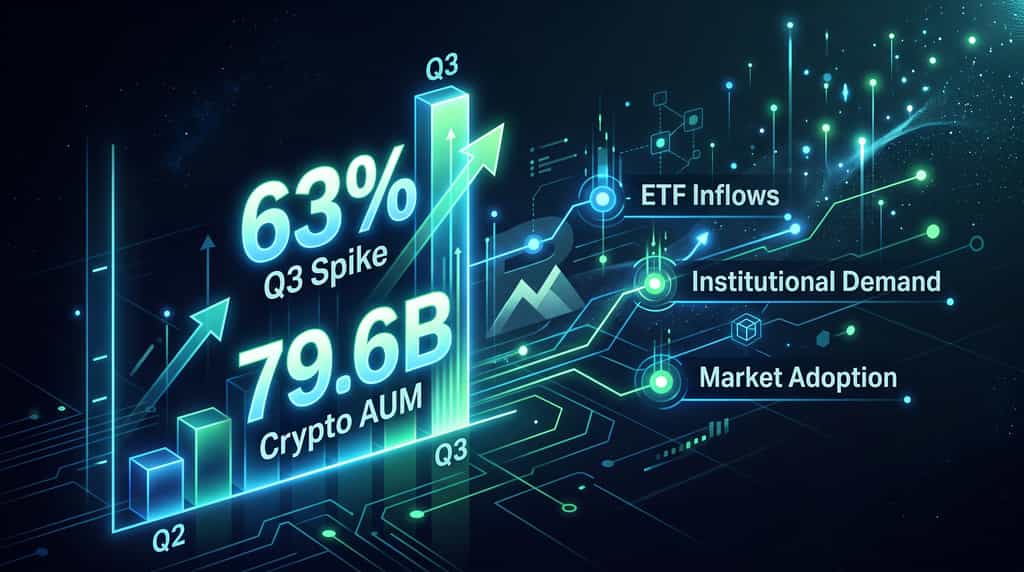
Did you know that the world's largest asset manager now oversees nearly $80 billion in digital assets, effectively bridging the gap between traditional Wall Street finance and the decentralized cryptocurrency ecosystem? In a stunning financial reversal, BlackRock’s cryptocurrency assets under management (AUM) surged by 63% during the third quarter of 2026, reaching an impressive $79.6 billion. This sharp recovery effectively answers the lingering question of whether institutional appetite for digital assets could withstand the market volatility experienced earlier in the year. The primary catalysts behind this remarkable Q3 spike were a combination of massive market price appreciation, led by a resurgent Bitcoin, and renewed net inflows from investors eager to capitalize on the market's upward trajectory. This article delves deep into BlackRock's recently released Q3 2026 earnings report, analyzing the exact drivers of this 63% AUM increase, evaluating the balance between organic inflows and market-driven gains, and exploring what this means for the future of institutional cryptocurrency investment.
Key Takeaways
-
Massive Q3 Rebound: BlackRock’s digital assets under management skyrocketed by 63%, jumping from $48.8 billion at the end of Q2 2026 to $79.6 billion by the close of September 2026.
-
Market Gains Led the Surge: Price appreciation in the underlying cryptocurrency markets contributed $22.9 billion to the quarterly growth, vastly outpacing the contribution from new capital.
-
Inflows Returned: Investors injected $7.9 billion in net new capital into BlackRock’s crypto products during Q3, successfully reversing the $2.2 billion in outflows suffered during the first half of the year.
-
Revenue Generation: The asset manager collected $39 million in base fees and securities lending revenue from its digital asset portfolio during the third quarter.
-
Year-Over-Year Deficit: Despite the explosive quarter, the $79.6 billion figure still sits 23% below the $104 billion crypto AUM BlackRock recorded a year earlier in September 2025.
BlackRock's Digital Asset AUM Reaches $79.6 Billion in Q3 2026
BlackRock’s digital asset products concluded the third quarter of 2026 with a robust $79.6 billion in assets under management, representing a staggering 63% increase from the $48.8 billion reported just three months earlier. This pivotal data point, extracted directly from the firm's Q3 earnings release on October 14, 2026, underscores a rapid and decisive recovery for institutional cryptocurrency products. The sharp upward trajectory indicates that both retail and institutional clients utilizing BlackRock’s investment vehicles have regained their footing after a highly turbulent first half of the year. The $79.6 billion figure encompasses the entirety of BlackRock's digital asset portfolio, effectively capturing the value held within immensely popular products like the iShares Bitcoin Trust (IBIT) and the firm's Ethereum-focused offerings.
The sheer scale of this quarterly expansion highlights the aggressive volatility inherent in cryptocurrency assets, even when wrapped in traditional, highly regulated financial wrappers like exchange-traded funds (ETFs). A 63% expansion in AUM within a single 90-day window is a rarity in traditional finance, where quarterly growth is typically measured in single-digit percentages. For BlackRock, this volatility works as a dual-edged sword; it can rapidly erode AUM during bear markets, but it can also exponentially inflate AUM during bullish macroeconomic cycles. The third quarter of 2026 was defined by the latter. As macroeconomic conditions shifted—driven by complex factors including changing interest rate expectations, institutional positioning, and global liquidity dynamics—BlackRock's digital asset division found itself perfectly positioned to capture the upside. The firm's infrastructure, which allows traditional brokerage accounts to seamlessly access spot cryptocurrency exposure, acted as a massive funnel for capital returning to the market.
However, understanding the mechanics of this $79.6 billion total requires a deeper look into the specific components of AUM growth. Asset management growth is never a monolithic metric; it is always a combination of net new capital entering the funds and the changing market value of the assets already held within those funds. In the case of BlackRock’s Q3 performance, the distinction between these two factors is critical for assessing the true health of investor demand versus mere market inflation.
Market Price Appreciation: The Dominant Force Behind the 63% Growth
Market price appreciation accounted for the vast majority of BlackRock’s Q3 digital asset growth, contributing a massive $22.9 billion to the total AUM expansion. This means that nearly three-quarters of the $30.8 billion added to the firm's crypto portfolio during the quarter came not from new investor money, but simply from the rising value of the Bitcoin and Ethereum already held in custody. During this period, the broader cryptocurrency market experienced a vigorous recovery. Bitcoin, the dominant asset in BlackRock's digital portfolio, rallied by more than 42% during the quarter, surging from approximately $58,564 to a local high near $84,000. Because BlackRock’s ETFs directly hold the underlying spot assets, any percentage increase in the price of Bitcoin translates linearly to an increase in the AUM of the associated funds.
This heavy reliance on market performance to drive AUM highlights the unique characteristics of cryptocurrency ETFs compared to traditional fixed-income or equity funds. When Bitcoin's price accelerates aggressively, the AUM of funds like IBIT balloons automatically, without BlackRock needing to acquire a single new customer or process a new deposit. This passive growth mechanism was the primary engine for the Q3 spike. The $22.9 billion in market-driven gains effectively papered over the lingering anxieties from the first half of the year, providing a massive psychological and numerical boost to the firm's digital asset division.
| Growth Metric | Amount (in Billions USD) | Percentage of Total Q3 Growth |
| Starting AUM (End of Q2 2026) | $48.8B | N/A |
| Net Investor Inflows | $7.9B | ~25.6% |
| Market Price Appreciation | $22.9B | ~74.4% |
| Ending AUM (End of Q3 2026) | $79.6B | 100% |
While market appreciation is highly beneficial for headline AUM figures, it is fundamentally distinct from organic business growth. Price action is entirely outside of BlackRock's control, dictated instead by global macroeconomic forces, regulatory developments, and decentralized market sentiment. Therefore, while the $22.9 billion boost is financially significant, industry analysts often look closely at the accompanying inflow data to gauge the true underlying health and momentum of the asset manager's product offerings. A price rally without accompanying inflows would suggest a stagnant user base; fortunately for BlackRock, the Q3 data revealed a very different story.
Renewed Client Inflows Signal Returning Institutional Confidence
Investors added a robust $7.9 billion in fresh capital to BlackRock’s digital asset products during the third quarter, a crucial influx that successfully reversed the negative trend established earlier in the year. Over the first six months of 2026, BlackRock had recorded approximately $2.2 billion in net withdrawals from its crypto offerings as investors fled the market amid price drawdowns and macroeconomic uncertainty. The Q3 reversal, injecting nearly $8 billion in new money, demonstrates a definitive shift in investor sentiment and a renewed willingness to allocate capital to digital assets through traditional financial rails.
The return of strong inflows is the most bullish indicator within BlackRock's Q3 earnings report regarding its crypto division. While market prices can fluctuate wildly, net inflows represent active decisions by financial advisors, institutional allocators, and retail investors to deploy fiat currency into BlackRock's funds.() This $7.9 billion is fresh "dry powder" entering the cryptocurrency ecosystem. It acts as a stabilizing force and suggests that the structural demand for regulated crypto exposure remains entirely intact. The inflows arrived alongside rising valuations, indicating a classic momentum-trading environment where rising prices encourage sidelined capital to re-enter the market to avoid missing out on further gains.
The daily trading dynamics behind these inflows paint a picture of sustained, if sometimes uneven, demand. For example, during the quarter, specific trading sessions saw BlackRock's iShares Bitcoin Trust (IBIT) significantly outperform its competitors. On certain days in early October, IBIT's specific intake exceeded the net total of the entire US spot Bitcoin ETF category, meaning that while other funds were shedding assets, BlackRock was absorbing them. This dynamic speaks to BlackRock's unparalleled brand strength and distribution network. In a highly competitive ETF landscape where multiple issuers offer virtually identical spot Bitcoin products at similar expense ratios, BlackRock's ability to capture the lion's share of the $7.9 billion in inflows highlights its dominance as the preferred partner for risk-averse institutions stepping into the crypto space.
Revenue Generation: Fees and Securities Lending
BlackRock generated $39 million in base fees and securities lending revenue specifically from its digital asset products during the third quarter of 2026. While the firm's official earnings release combines "Digital assets, commodities and multi-asset ETFs" into a broader $164 million revenue line item, the specific $39 million figure highlights the direct financial benefit the firm derives from operating in the crypto sector. This revenue is primarily generated through the management fees charged to investors holding shares of products like IBIT and ETHA, calculated as a small percentage of the total assets under management.
To understand the significance of this $39 million, it must be contextualized within BlackRock's colossal corporate scale. At the end of Q3 2026, BlackRock reported a staggering $15.49 trillion in total assets under management. Consequently, the $79.6 billion in digital assets represents barely over 0.5% of the firm's total portfolio. Similarly, the $39 million in crypto-related revenue is a tiny fraction of the company's multi-billion dollar quarterly earnings. However, the strategic importance of this revenue stream far outweighs its current nominal value.
| Metric | Digital Assets Portfolio | Total BlackRock Operations | Crypto % of Total |
| Assets Under Management | $79.6 Billion | $15.49 Trillion | ~0.51% |
| Quarterly Net Inflows | $7.9 Billion | $205.5 Billion | ~3.84% |
By securing $39 million in fees from a highly innovative and volatile sector, BlackRock is proving the commercial viability of bridging Wall Street with blockchain assets. Furthermore, the inclusion of securities lending revenue indicates that BlackRock is actively managing these assets to generate additional yield, a standard practice in traditional ETF management that is now being applied to digital assets. Although crypto currently accounts for less than 1% of BlackRock's empire, it represents one of the fastest-growing financial products in history. The asset manager is effectively planting a flag in the digital economy, ensuring that as global wealth increasingly interacts with tokenized assets and cryptocurrencies, BlackRock remains the primary toll collector.
Comparing Q3 2026 to Year-Ago Levels: The $104 Billion Benchmark
Despite the impressive 63% quarter-over-quarter surge, BlackRock’s $79.6 billion crypto AUM remains 23% below the high-water mark of $104 billion established a year earlier in September 2025. This year-over-year deficit provides crucial context, serving as a sobering reminder of the severe market contraction that occurred between late 2025 and mid-2026. The fact that an addition of $30.8 billion in a single quarter was not enough to reclaim previous all-time highs illustrates the sheer depth of the preceding drawdown.
The gap between the current $79.6 billion and the previous $104 billion is primarily a story of sustained mark-to-market losses. Over the preceding twelve months, market price movements erased approximately $30.6 billion from the value of BlackRock's crypto holdings. During that same one-year period, net inflows amounted to a positive $6.3 billion. Because the market value destruction ($30.6 billion) was roughly five times larger than the fresh capital entering the funds ($6.3 billion), the overall AUM experienced a net year-over-year decline. The Q3 2026 performance successfully halted a grueling two-quarter slide, but it represents a recovery phase rather than new historical expansion.
This dynamic highlights a fundamental challenge for asset managers heavily invested in cryptocurrency products. Because traditional ETFs charge fees based on total AUM, the firm's revenue is inextricably linked to the highly volatile price of the underlying asset. A severe crypto bear market not only scares away new inflows but actively shrinks the existing fee base as the assets lose value. BlackRock's Q3 recovery was spectacular, but the lingering 23% year-over-year deficit proves that the digital asset sector still requires substantial, sustained price appreciation to fully recover the immense value lost during the 2026 market correction.
The Broader Impact on Institutional Cryptocurrency Adoption
The data stemming from BlackRock's Q3 2026 earnings report serves as a definitive bellwether for the broader institutional cryptocurrency market. When the world's largest asset manager reports nearly $8 billion in fresh inflows and a 63% spike in crypto AUM, it sends a powerful signal to the rest of the financial industry. It validates the thesis that institutional interest in Bitcoin and Ethereum is not a fleeting trend, but a structural shift in asset allocation strategies. The fact that investors chose to aggressively "buy the dip" and inject billions into BlackRock's ETFs following a difficult first half of the year suggests a maturing market.
Institutions are increasingly viewing digital assets through a long-term macroeconomic lens, recognizing their utility as portfolio diversifiers and potential hedges against fiat currency debasement. BlackRock's success with products like IBIT provides a regulated, secure, and operationally familiar pathway for this capital to deploy. As we move toward the end of 2026, the $79.6 billion AUM milestone stands as a testament to the resilience of the crypto asset class. While the market remains susceptible to intense volatility and regulatory scrutiny, the presence of Wall Street titans like BlackRock ensures that digital assets are firmly embedded within the global financial system. The Q3 spike is not just a victory for BlackRock's balance sheet; it is a critical step in the ongoing mainstream financialization of cryptocurrency.
Conclusion
BlackRock’s third-quarter 2026 earnings report delivered a resounding confirmation of the cryptocurrency market's resilience, with the firm's digital asset AUM surging 63% to hit $79.6 billion. This impressive recovery was decisively led by a massive $22.9 billion boost from market price appreciation, alongside a highly encouraging $7.9 billion in fresh net inflows. This influx of capital successfully reversed the negative outflow trends seen in the first half of the year, signaling a strong return of institutional and retail confidence. Furthermore, the generation of $39 million in quarterly fees proves that digital assets are becoming a reliable, albeit currently small, revenue stream for the $15.5 trillion asset manager. However, the broader context remains vital; despite the explosive Q3 growth, the total crypto AUM is still 23% below the $104 billion peak recorded in September 2025. This underscores the immense volatility of the asset class and the deep impact of the preceding market correction. Ultimately, BlackRock's Q3 performance solidifies its position as the undisputed bridge between traditional Wall Street capital and the decentralized digital asset economy, setting the stage for continued institutional integration in the years to come.
🔥 Beyond the Headlines: What KuCoin 5.0 Means for You
Market news moves fast — but where you act on it matters just as much. This October, KuCoin launches KuCoin 5.0, transforming KuCoin into a rebuilt platform. Here's what actually changes for you:
-
One account for everything. Older platforms split your money across separate "spot," "margin," and "futures" accounts and expected you to understand why. KuCoin 5.0's unified account removes that entirely — deposit once, and everything is simply there (only available to VIPs for now).
-
Stocks, indices, and commodities. KuCoin 5.0 expands beyond crypto into global markets. When crypto chops sideways and equities rally (or the reverse), you rotate in minutes instead of opening a brokerage account and waiting days for fiat rails.
-
Real-world assets (RWA). Tokenized exposure to traditional assets like commodities, right inside your crypto account. One of the fastest-growing segments in global finance is no longer reserved for institutions — you access it from the same balance you trade with.
-
Earn while you learn. Not ready to trade? KCUSD lets your stablecoins earn daily, auto-compounding interest. The lowest-stress way to put your idle deposit to work for 4% yield.
-
An AI assistant in plain language. Ask questions, get market context, understand what you're looking at — built into the platform, no jargon required.
-
An app that doesn't overwhelm. Faster, cleaner, and consistent — intuitive from the first tap, not after a tutorial.
-
Safety you can check, not just trust. A MiCAR-licensed EU entity, Proof of Reserves you can verify yourself, and internationally certified security (SOC 2 Type II, ISO 27001:2022).
Create your account in minutes — and start on the platform built for where crypto is going, not where it's been.
FAQs
What exact figure did BlackRock's crypto AUM reach in Q3 2026?
BlackRock's digital assets under management reached $79.6 billion by the end of the third quarter of 2026, representing a 63% increase from the $48.8 billion reported at the end of the second quarter.
How much of BlackRock's Q3 crypto growth was due to new investor money?
Of the $30.8 billion added to BlackRock's crypto AUM in Q3, investors contributed $7.9 billion in net new inflows. The remaining $22.9 billion was driven entirely by the market price appreciation of the underlying cryptocurrencies.
Did BlackRock's crypto AUM break its all-time high in Q3 2026?
No. Despite the massive 63% quarter-over-quarter surge, the $79.6 billion total remains 23% below the high-water mark of $104 billion that BlackRock recorded a year earlier in September 2025.
How much revenue did BlackRock generate from its digital asset products in Q3?
BlackRock reported generating $39 million in base fees and securities lending revenue from its digital asset portfolio during the third quarter of 2026.
What percentage of BlackRock's total AUM do digital assets represent?
With BlackRock managing approximately $15.49 trillion in total assets at the end of Q3 2026, the $79.6 billion held in digital assets accounts for roughly 0.51% of the firm's overall portfolio.
Disclaimer: This article is for informational purposes only and does not constitute financial or investment advice. Cryptocurrency investments carry significant risk. Always conduct your own research before trading.