

Binance Invests $100 Million in Circle and Signs a 5-Year USDC Promotion Deal
Introduction
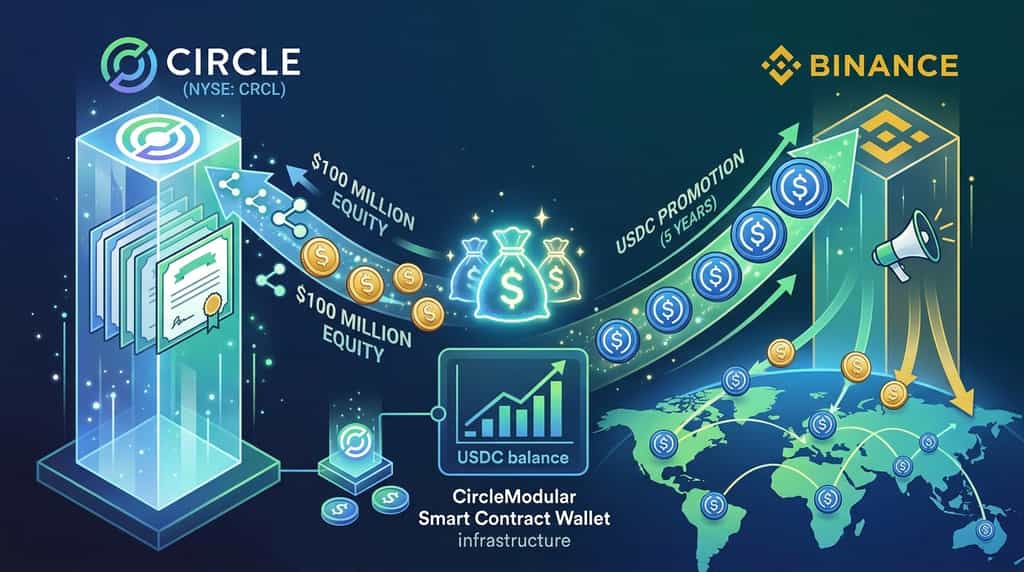
Circle Internet Group and Binance closed two linked transactions on September 17, 2026: a $100 million private placement of Circle Class A shares and a five-year commercial agreement to promote USDC on Binance’s platform. According to Circle’s official announcement and an SEC Form 8-K filed on September 22, 2026, Binance bought 1,237,011 shares at $80.84 each and agreed not to transfer those shares for up to two years. Circle will pay Binance a monthly incentive fee based on USDC held through Circle’s Modular Smart Contract Wallet infrastructure, while Binance will expand promotion, awareness, and integration of USDC, especially in emerging markets.
The deal is the third version of the companies’ partnership in under two years. It replaces earlier commercial agreements from November 2024 and August 2025. For traders, the story is simple: one of the world’s largest crypto platforms is tying equity, distribution, and wallet infrastructure to Circle’s dollar stablecoin.
What Did Binance and Circle Agree in the $100 Million Deal?
Binance bought a minority equity stake in Circle and signed a five-year USDC promotion contract on the same day. According to Circle’s September 22, 2026 press release, the companies expanded their strategic partnership and renewed their commercial agreement for five years, with a focus on expanding USDC access across emerging markets.
Circle’s SEC Form 8-K states that on September 17, 2026, Circle issued and sold 1,237,011 shares of Class A common stock to Binance at $80.84 per share for aggregate proceeds of $100 million. The filing says the price reflected a discount to the market price of CRCL prior to closing. Circle’s press release describes that discount as five percent.
The share sale closed immediately after the companies executed the subscription agreement and the expanded commercial arrangements. Binance agreed not to transfer the shares for up to two years from the closing date, subject to customary exceptions. The 8-K also notes that Binance generally cannot sell, transfer, assign, pledge, hypothecate, or otherwise dispose of the shares until the earlier of two years or certain termination events, while retaining voting rights.
Circle is a New York Stock Exchange-listed company (NYSE: CRCL). The private placement was exempt from registration under the Securities Act of 1933. That structure lets Circle raise capital from a strategic partner without a public offering, while giving Binance a locked-up equity interest aligned with USDC growth.
How Does the Five-Year USDC Promotion Agreement Work?
Circle will pay Binance a monthly incentive fee tied to USDC balances, and Binance will promote USDC on its platform for five years. According to the September 22, 2026 Form 8-K, Circle subsidiaries entered into arrangements with Binance that expand the parties’ existing strategic partnership relating to the promotion of USDC held through Circle’s Modular Smart Contract Wallet infrastructure service.
Under those arrangements, Circle agreed to pay Binance a monthly incentive fee representing a percentage of the amount of USDC held through that wallet service. Binance agreed to undertake certain other activities to promote USDC on its platform. The arrangement has a five-year term. Either company may unilaterally terminate the arrangements before expiration if specified events occur.
Circle’s press release adds commercial context. Binance will accelerate promotion, awareness, and integration of USDC on its platform, especially across emerging markets. Circle will provide infrastructure services that support holding and using USDC. Jeremy Allaire, co-founder, chairman, and CEO of Circle, said Binance has built one of the largest platforms for using digital currency and the most widely used wallet in the world for dollar stablecoins. Richard Teng, co-CEO of Binance, called the $100 million investment and five-year commitment “long-duration conviction.”
The fee structure matters. Circle is paying for distribution. Binance is paid as USDC held through Circle’s wallet infrastructure grows. That links Circle’s marketing spend to balances on Binance-related rails rather than to a one-time sponsorship.
How Large Is USDC in the Current Stablecoin Market?
USDC remains the second-largest dollar stablecoin by market cap, with circulating supply near $75 billion as of late September 2026. According to CoinMarketCap data around September 22–23, 2026, USDC’s market capitalization stood near $75.28 billion, with circulating supply of about 75.29 billion USDC and 24-hour volume above $18 billion.
CoinGecko data for September 23, 2026 listed USDC market capitalization near $75.28 billion. Stablecoin Beat, updated September 22, 2026, put the total stablecoin market at $303.6 billion, with USDT at $183.4 billion and USDC at $74.6 billion. Circle’s own USDC page previously reported $74.3 billion in circulation as of September 3, 2026.
Those figures place USDC well behind Tether but far ahead of smaller dollar tokens. The Binance deal does not change reserve composition. Circle describes USDC as fully backed by cash and cash-equivalent reserves and redeemable 1:1 for U.S. dollars. The majority of the reserve is invested in the Circle Reserve Fund, an SEC-registered government money market fund, with cash held at regulated financial institutions and the fund portfolio custodied at The Bank of New York Mellon and managed by BlackRock, according to Circle disclosures.
The partnership is about distribution, not a change in how USDC is reserved. More promotion on Binance can raise balances held through Circle wallet infrastructure. It does not, by itself, alter the 1:1 redemption design.
Binance cannot freely sell its Circle shares for up to two years, which reduces near-term selling pressure from this placement. Circle’s press release says Binance agreed not to transfer the shares for a period of up to two years from the closing date, subject to customary exceptions. The Form 8-K confirms the lockup and that Binance retains voting rights during the restriction period.
A lockup is not a guarantee of future share price. It does mean this $100 million block is not designed as a quick flip. Binance’s economic interest in CRCL now sits alongside a fee stream tied to USDC balances. If USDC held through Circle’s Modular Smart Contract Wallet infrastructure rises, Circle pays more monthly fees and Binance’s equity thesis is more closely tied to the same product.
The purchase price of $80.84 reflected a five percent discount to the pre-closing market price, according to Circle. Private placements often include a discount because the buyer accepts transfer limits and a delayed ability to hedge or sell. Investors watching CRCL should treat the placement as a strategic issuance, not as a public secondary offering.
Circle remains a listed company with public float outside this stake. The 8-K does not present the 1,237,011 shares as control of the company. It is a strategic minority position.
How Could the Deal Affect USDC Liquidity and Emerging-Market Access?
Greater Binance promotion can increase USDC trading pairs, wallet balances, and on-ramps in markets where Binance already has users. Circle’s September 22, 2026 announcement frames the commercial agreement as a push to expand USDC access across emerging markets. Allaire said the companies see opportunities to expand dollar access and support savings and investment with digital asset products.
Liquidity effects are indirect. USDC already trades at a tight peg near $1.00. CoinMarketCap listed the USDC price at about $0.9999 on September 22–23, 2026. A promotion deal does not create new dollars. It can concentrate more existing and newly minted USDC on Binance products if users choose USDC for trading, transfers, or treasury balances.
Circle’s Modular Smart Contract Wallet infrastructure is the metering point for the monthly fee. Balances held through that service determine the incentive payment. That gives both firms a shared reason to route USDC activity onto infrastructure Circle can measure.
Traders should separate marketing reach from reserve quality. USDC’s usefulness still depends on redemption access, banking rails, chain support, and exchange listings. The Binance agreement adds a large distribution partner. It does not replace independent review of Circle’s reserve reports.
Beyond the Headlines: What KuCoin 5.0 Means for You
Market news moves fast — but where you act on it matters just as much. This October, KuCoin launches KuCoin 5.0, transforming KuCoin into a rebuilt platform. Here's what actually changes for you:
-
One account for everything. Older platforms split your money across separate "spot," "margin," and "futures" accounts and expected you to understand why. KuCoin 5.0's unified account removes that entirely — deposit once, and everything is simply there (only available to VIPs for now).
-
Stocks, indices, and commodities. KuCoin 5.0 expands beyond crypto into global markets. When crypto chops sideways and equities rally (or the reverse), you rotate in minutes instead of opening a brokerage account and waiting days for fiat rails.
-
Real-world assets (RWA). Tokenized exposure to traditional assets like commodities, right inside your crypto account. One of the fastest-growing segments in global finance is no longer reserved for institutions — you access it from the same balance you trade with.
-
Earn while you learn. Not ready to trade? KCUSD lets your stablecoins earn daily, auto-compounding interest. The lowest-stress way to put your idle deposit to work for 4% yield.
-
An AI assistant in plain language. Ask questions, get market context, understand what you're looking at — built into the platform, no jargon required.
-
An app that doesn't overwhelm. Faster, cleaner, and consistent — intuitive from the first tap, not after a tutorial.
-
Safety you can check, not just trust. A MiCAR-licensed EU entity, Proof of Reserves you can verify yourself, and internationally certified security (SOC 2 Type II, ISO 27001:2022).
Create your account in minutes — and start on the platform built for where crypto is going, not where it's been.
Conclusion
Binance’s $100 million Circle stake and five-year USDC promotion deal closed together on September 17, 2026, and were disclosed on September 22, 2026. Circle sold 1,237,011 Class A shares at $80.84, raising $100 million at a five percent discount, according to Circle and the related SEC Form 8-K. Binance accepted a transfer lockup of up to two years and kept voting rights. Circle agreed to pay a monthly incentive fee based on USDC held through its Modular Smart Contract Wallet infrastructure, while Binance agreed to promote and integrate USDC, with emphasis on emerging markets.
The contract replaces November 2024 and August 2025 agreements. USDC’s market cap remained near $75 billion in late September 2026, according to CoinMarketCap and CoinGecko, second to USDT in a stablecoin market of about $304 billion. The partnership strengthens distribution. It does not change USDC’s 1:1 reserve model or remove termination, competition, or market risks. Traders who use USDC can watch wallet-balance incentives, exchange listings, and official reserve disclosures as the five-year term begins.
FAQs
Did Binance buy Circle or only a stake?
Binance bought a minority stake. Circle issued 1,237,011 Class A shares for $100 million. The filing does not describe a change of control.
When did the transactions close?
Both the share sale and the expanded commercial arrangements closed on September 17, 2026. Circle disclosed them in a September 22, 2026 announcement and Form 8-K.
Is the monthly fee amount public?
No. Circle said the fee is a percentage of USDC held through its Modular Smart Contract Wallet infrastructure. The exact percentage is not stated in the public 8-K summary.
Can Binance sell the Circle shares immediately?
No. Binance agreed not to transfer the shares for up to two years from closing, subject to customary exceptions and certain termination-related conditions.
Does the deal change how USDC is backed?
No. Circle continues to describe USDC as fully reserved and redeemable 1:1 for U.S. dollars. The agreement covers promotion, infrastructure, and equity, not a new reserve design.
Disclaimer: This article is for informational purposes only and does not constitute financial, legal, or investment advice. Always conduct your own research before interacting with digital assets.