

What Is the Aztec Tierra Upgrade, and How Does Alpha V6 Fix Critical V5 Vulnerabilities?
Introduction
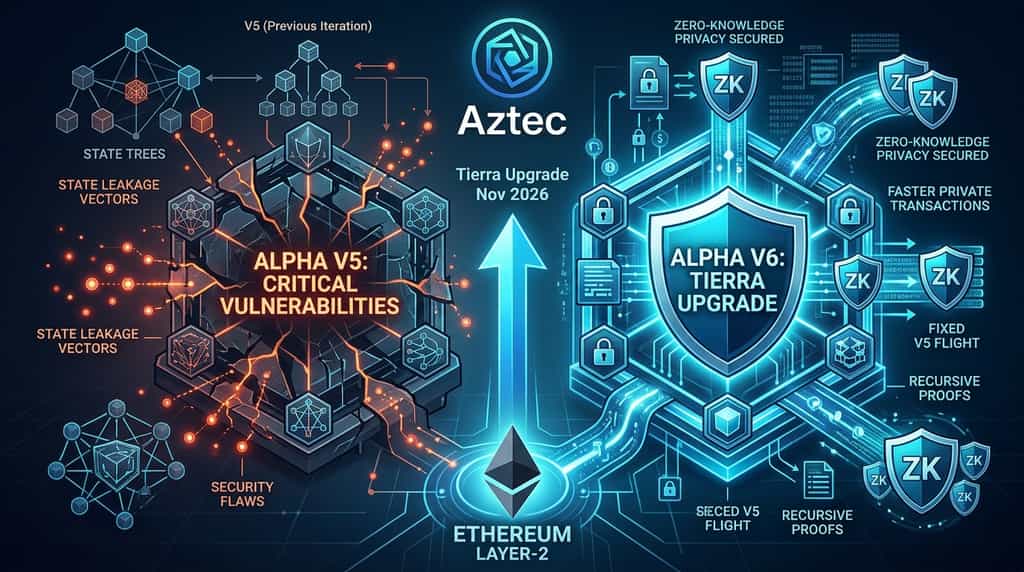
The release of the Aztec Tierra upgrade in November 2026 marks a major milestone for privacy-focused decentralized finance infrastructure. As zero-knowledge rollups on Ethereum continue to evolve, protocol security and transaction efficiency remain paramount. The introduction of Alpha V6 addresses critical protocol vulnerabilities identified in the previous V5 iteration while significantly improving transaction processing speeds for shielded smart contracts. This upgrade reshapes how zero-knowledge execution layers handle cryptographic state transitions and user confidentiality.
Key Takeaways
The Aztec Tierra upgrade, deployed in November 2026, introduces the Alpha V6 architecture to resolve critical vulnerabilities inherent in the V5 iteration and optimize private transaction performance.
-
Core Fix: Alpha V6 eliminates severe state-leakage vectors and circuit optimization bottlenecks present in V5, securing user transaction confidentiality.
-
Performance Gains: The upgrade accelerates private smart contract execution, substantially lowering proof generation latency on Ethereum layer-2 deployments.
-
Cryptography Foundation: Tierra leverages advanced recursive zero-knowledge proofs to verify state validity without exposing transactional metadata.
-
Ecosystem Impact: The upgrade provides developers with a more robust, auditable framework for building privacy-preserving decentralized applications.
What Led to the Development of the Aztec Tierra Upgrade?
The Aztec Tierra upgrade was developed in response to architectural limitations and security audit findings associated with the preceding V5 network iterations. As privacy networks scale, they must balance cryptographic complexity with execution speed and developer accessibility. The V5 architecture, while pioneering decentralized private smart contracts, exposed optimization hurdles and specific vulnerability vectors related to state validation logic.
Network architects designed the Tierra upgrade to overhaul the core prover mechanics and state management systems. By isolating zero-knowledge circuit components and tightening verification boundaries, the protocol mitigates the risk of unauthorized state introspection. Furthermore, historical bottlenecks in private state updates necessitated a structural rewrite of how shielded transactions interact with unshielded Ethereum settlement layers.
How Does Alpha V6 Resolve the Critical Vulnerabilities of V5?
Alpha V6 introduces fundamental structural changes to cryptographic circuit design, effectively patching the security flaws uncovered in V5 environments. In the V5 architecture, certain state transition proofs occasionally leaked metadata regarding underlying transaction amounts and interacting addresses under specific edge-case conditions. Alpha V6 rectifies this by implementing stricter nullifier validation checks and decoupling recursive proof verification steps.
The vulnerability resolution process in Alpha V6 relies on three primary mechanisms:
-
Enhanced Nullifier Isolation: Prevents double-spending attempts while ensuring that the cryptographic link between sender and receiver remains completely obfuscated from external observers.
-
Circuit Compartmentalization: Breaks down monolithic zero-knowledge circuits into modular sub-circuits, containing potential compilation or constraint errors within isolated execution environments.
-
Deterministic State Merkle Trees: Upgrades the underlying database and state commitment tree structures to eliminate race conditions during high-volume rollup batch processing.
What Performance Improvements Does Alpha V6 Bring to Private Transactions?
Beyond security patches, the Alpha V6 release within the Tierra upgrade delivers measurable improvements in transaction throughput and proof generation latency. Private transactions on Ethereum-based zero-knowledge rollups historically suffered from high computational overhead, often requiring significant client-side resources to generate valid cryptographic proofs. Alpha V6 optimizes these prover algorithms to reduce resource consumption.
| Performance Metric | Alpha V5 Baseline | Alpha V6 (Tierra Upgrade) |
| Average Proof Generation Time | Moderate to High (Client-heavy) | Optimized via recursive parallelization |
| State Bloat Management | Standard tree pruning | Dynamic commitment compaction |
| Smart Contract Compilation | Extended build times | Modularized sub-circuit compilation |
| Verification Overhead | Higher gas cost on settlement | Optimized batch verification logic |
These enhancements lower the barrier to entry for end users executing complex, multi-step private transactions, bringing decentralized application performance closer to standard public ledger speeds.
How Do Privacy-Preserving Smart Contracts Operate Under Tierra?
Privacy-preserving smart contracts combine public verification with private execution, ensuring that state variables remain encrypted on-chain while consensus rules are rigorously enforced. Under the Tierra upgrade, developers utilize customized execution environments where smart contract logic evaluates encrypted inputs using zero-knowledge proofs.
The system relies on user-side proof generation, where the user computes the valid state transition locally and submits only the cryptographic proof and updated commitment hashes to the network. The consensus validators verify the proof without ever viewing the underlying variables, balances, or interaction histories. This methodology decouples transaction utility from data transparency, protecting institutional and retail participants against front-running and financial surveillance.
What Should Developers and Validators Consider Following the Tierra Upgrade?
The deployment of Alpha V6 requires infrastructure operators, validators, and decentralized application developers to update their node software and adapt to modified smart contract compilation standards. Because Alpha V6 deprecates legacy V5 interface methods, smart contract codebases must be refactored to align with the new modular circuit architecture.
Developers must audit their applications for compatibility with the updated developer toolkits released alongside Tierra. Similarly, node operators need to provision adequate hardware resources to support the revised recursive proof generation pipelines, ensuring seamless participation in network consensus and block production.
FAQs
What is the primary purpose of the Aztec Tierra upgrade?
The Tierra upgrade aims to resolve critical security vulnerabilities present in the V5 iteration while significantly improving private transaction processing speeds and circuit efficiency.
How does Alpha V6 protect user transaction data?
Alpha V6 utilizes advanced zero-knowledge cryptography, enhanced nullifier isolation, and modular circuit compartmentalization to ensure transaction amounts and participant metadata remain completely confidential.
Are legacy V5 smart contracts compatible with Alpha V6?
No. Because Alpha V6 introduces structural changes to cryptographic circuits and verification logic, developers must refactor and update existing smart contracts to operate on the new architecture.
Who maintains the Aztec network protocol?
The Aztec protocol is developed and maintained by a decentralized community of core contributors, cryptographers, and independent researchers dedicated to scaling Ethereum privacy.
Where can developers find technical documentation for Alpha V6?
Developers can access official protocol specifications, migration guides, and node operator manuals through Aztec's official developer documentation portals and GitHub repositories.
Disclaimer
This general market information, possibly from third-party, commercial, or sponsored sources, is provided for reference and educational purposes only and does not constitute financial or investment advice, an offer, solicitation, or guarantee. We disclaim liability for its accuracy, completeness, reliability, and any resulting losses. Investments/trading are risky; past performance doesn’t guarantee future results. Users should research, judge prudently, and take full responsibility. For further details, please consult KuCoin’s Terms of Use and Risk Disclosure.