

Trump Backs Kevin Warsh After Fed Rate Hike: October 2026 Outlook
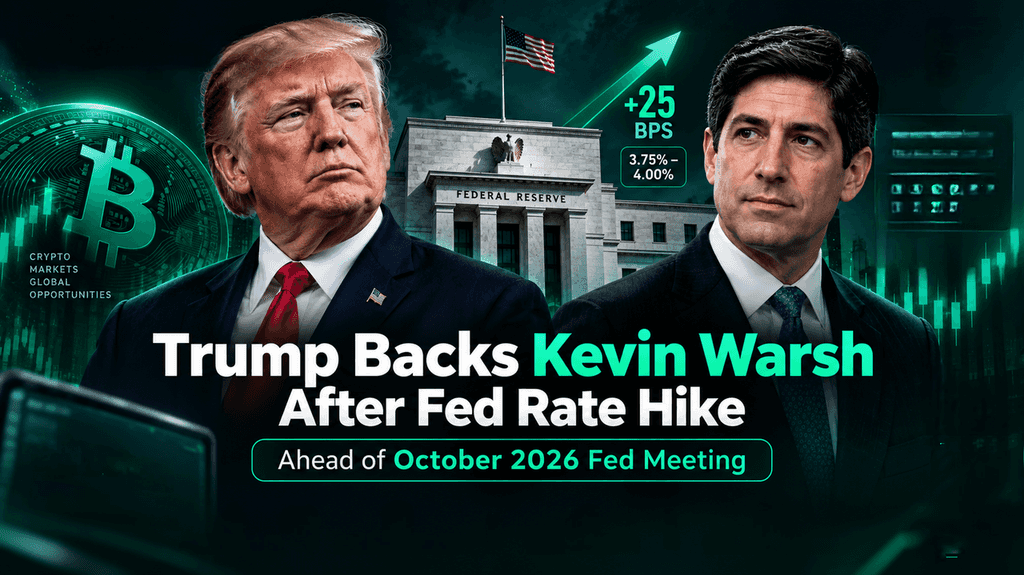
President Donald Trump continued to back Federal Reserve Chair Kevin Warsh after the September 2026 Fed rate hike, even as he maintained that U.S. interest rates should be substantially lower. The response highlighted a clear policy divide between Trump and the Federal Reserve ahead of the October 27–28, 2026 FOMC meeting, where policymakers will decide whether persistent inflation warrants another increase or whether the central bank should pause and assess the impact of tighter financial conditions. The Federal Reserve raised its benchmark target range by 25 basis points to 3.75%–4.00% on September 16, with the FOMC approving the decision by a unanimous 12–0 vote. For investors following crypto markets, attention is now shifting from the September move to the broader October Fed rate outlook, upcoming inflation and employment reports, and whether another increase could put greater political pressure on Warsh while influencing Treasury yields, financial conditions and risk assets such as Bitcoin.
Why Did Trump Back Kevin Warsh After the Fed Rate Hike?
Trump’s response to the September decision showed that he was trying to separate his support for Warsh from his disagreement with Federal Reserve policy. He continued to argue that borrowing costs should be much lower, but he stopped short of blaming Warsh personally for the rate increase. Instead, Trump emphasized that the decision was made collectively and suggested that Warsh’s individual vote would not have changed the final outcome. That distinction matters because it allowed Trump to continue supporting the Fed chair he appointed while maintaining his criticism of higher interest rates.
Trump’s Phone Call With Kevin Warsh
Trump disclosed that he had spoken with Warsh before the Federal Reserve announced its decision. According to Trump’s account, he told Warsh that opposing the increase would not materially alter the result because other policymakers were prepared to support higher rates. Warsh later declined to discuss private conversations with the president, leaving Trump’s description as the main public account of the exchange.
The timing of the conversation attracted attention because Federal Reserve independence remains an important part of U.S. monetary policy. The president appoints Fed governors and the chair subject to Senate confirmation, but the White House does not directly set interest rates. Decisions are made through the Federal Open Market Committee, meaning the chair has significant influence but does not control policy alone.
The September 16 decision ultimately demonstrated broad agreement within the committee. The FOMC voted 12–0 to raise the federal funds target range by a quarter percentage point to 3.75%–4.00%. The Fed said economic activity was expanding at a solid pace, domestic spending remained resilient and inflation was still elevated. Warsh therefore supported the same action as every other voting member, reinforcing Trump’s argument that the decision was not simply the choice of one Fed chair.
Trump Still Wanted Lower Interest Rates
Trump’s support for Warsh did not mean he had changed his position on monetary policy. After the September decision, he again argued that U.S. interest rates should be 1% or lower, far below the Fed’s new target range. His preferred level would represent a dramatically easier monetary stance than the one policymakers currently consider appropriate for bringing inflation back toward their 2% objective.
That leaves a clear policy disagreement. Trump has focused on the benefits of cheaper borrowing, while the Fed has continued to emphasize inflation risks and the need to prevent price pressures from becoming entrenched. The September rate hike showed that policymakers were willing to tighten financial conditions even while the president publicly called for the opposite approach.
The disagreement could become more important if the Fed raises rates again later in 2026. Trump has so far continued to defend Warsh personally, but another increase could test whether that support can be maintained if borrowing costs remain elevated closer to the midterm elections.
-
Personal backing: Trump continued expressing confidence in Warsh despite opposing higher rates.
-
Collective decision: Warsh supported the same September increase as every other voting FOMC member.
-
Future uncertainty: Trump’s response does not establish how he would react to another rate hike in October or December.
Why the Federal Reserve Raised Interest Rates in September 2026
The Federal Reserve raised rates in September because inflation remained above its 2% target while the economy continued to expand at a solid pace. Policymakers judged that tighter monetary conditions could help slow demand and prevent inflation from remaining elevated for longer. At the same time, resilient consumer spending, continued job creation and solid investment gave the Fed more room to tighten policy without immediately risking a sharp economic contraction. The decision reflected the central bank’s attempt to balance persistent inflation against the possibility that higher borrowing costs could eventually weaken growth.
Persistent Inflation Supported the September Fed Rate Hike
August consumer-price data helped explain why Fed officials remained cautious. The Consumer Price Index rose 0.4% in August, compared with a 0.1% increase in July, while annual inflation stood at 3.4%. Gasoline prices increased 3.9% during the month and accounted for more than one-third of the rise in the overall CPI, showing how energy costs were again contributing to headline inflation.
The monthly increase did not mean inflation was accelerating across every category. Core CPI, which excludes food and energy, rose 0.3% during the month and 2.4% from a year earlier. Still, the stronger headline number showed that price pressures had not fully disappeared and could strengthen again if energy costs or other supply-sensitive categories moved higher.
The Fed’s preferred inflation measure is the personal consumption expenditures price index, not CPI. Its September projections placed 2026 PCE inflation at 3.7% and core PCE inflation at 3.4%, both well above the central bank’s 2% target. Policymakers projected inflation would ease gradually rather than fall quickly, supporting the case for keeping monetary policy restrictive until they gained greater confidence that price growth was moving sustainably lower.
Resilient Jobs and Spending Gave the Fed Room to Act
The U.S. labor market remained relatively stable before the September decision. Employers added 162,000 nonfarm payroll jobs in August, while the unemployment rate remained unchanged at 4.1%. Those figures did not point to an economy overheating, but they also did not show the kind of sudden labor-market deterioration that might have pushed the Fed toward easier policy.
The Fed also described domestic spending as resilient and capital investment as robust. Its September economic projections put 2026 real GDP growth at 2.3% and the unemployment rate at 4.1%, suggesting officials expected the economy to continue expanding despite higher borrowing costs. That combination gave policymakers more flexibility to focus on inflation without immediately prioritizing support for employment.
Higher rates, however, do not affect every household or business at the same speed. People with existing fixed-rate mortgages may feel little immediate change, while those applying for new home loans, auto financing or business credit can face higher costs almost immediately. This delayed transmission is why the Fed must assess not only current economic strength but also how much tightening is already working its way through the economy.
Higher Interest Rates Can Tighten Conditions for Crypto Markets
Federal Reserve policy can influence crypto markets by changing financial conditions, investor risk appetite and the returns available on traditional interest-bearing assets. When Treasury yields and deposit rates rise, investors can earn more from relatively lower-risk assets, which can reduce the appeal of assets that do not generate a native yield. Higher rates can also strengthen the dollar or tighten liquidity, although those relationships are not always consistent from one market cycle to another.
A Fed rate hike does not automatically determine Bitcoin price movements. Bitcoin and altcoins are influenced by many other factors, including institutional flows, regulation, ETF demand, leverage, blockchain activity and broader market sentiment. A rate hike that investors have already priced in can also have a very different effect from an unexpected policy surprise.
Several channels remain worth watching. Higher cash and Treasury yields can change the relative appeal of Bitcoin, while financing conditions can affect leveraged trading. Borrowing rates used for Bitcoin margin trading are determined separately and depend on platform liquidity and borrowing demand rather than moving directly with the federal funds rate. Markets also tend to react strongly to changes in expectations, meaning Warsh’s guidance about future policy may matter as much as the rate decision itself.
October 2026 Fed Rate Outlook: Risks to the Trump–Warsh Truce
The October 2026 Fed rate outlook carries both economic and political uncertainty. The next FOMC meeting is scheduled for October 27–28, and policymakers will have several important inflation and employment reports to consider before then. Unlike the September and December meetings, October is not scheduled to include a new Summary of Economic Projections, which means investors will rely more heavily on the policy statement and Warsh’s press conference for clues about what could happen next. At the same time, another rate increase could intensify the political disagreement between Trump and the Fed if borrowing costs remain high heading into the November midterm elections.
Another Fed Rate Hike Is Possible, but Timing Remains Open
The September projections indicate that further tightening remains a real possibility. The median FOMC participant projected a 4.1% federal funds rate at the end of 2026, compared with the current target range of 3.75%–4.00%. That median forecast is consistent with at least one additional quarter-point increase before the end of the year.
The individual forecasts show an even clearer bias toward additional tightening. Of the 18 policymakers who submitted projections, 16 expected a year-end rate above the midpoint of the current target range. That means most officials saw at least one additional hike as appropriate when the September projections were prepared, although those estimates can change as new data arrive.
The projections do not specify whether another increase would come in October or December. Policymakers could raise rates at the next meeting, wait for more evidence or change course entirely if inflation weakens or economic growth slows sharply. This makes incoming data especially important and explains why market-implied probabilities can shift quickly after each major economic release.
Key Economic Reports Before the October FOMC Meeting
The data calendar before the October Fed meeting is particularly important because some major reports will not arrive until after policymakers have already voted. The September PCE inflation report and the advance estimate of third-quarter GDP are scheduled for October 29, one day after the FOMC meeting ends. That means officials will have to make the October decision without those two major updates.
Several earlier reports could therefore play a larger role. The August Personal Income and Outlays report on September 30 will provide another reading on the PCE price index and consumer spending. The September employment report on October 2 will update payroll growth, unemployment and wage trends, while the September CPI report on October 14 will provide another important measure of inflation before policymakers meet.
The Fed is unlikely to base its decision on a single release. A combination of resilient hiring and stubborn inflation could strengthen the argument for another increase, while softer price growth and weaker employment could support a pause. Revisions also matter, particularly in payroll data, because the first estimate can sometimes give an incomplete picture of labor-market momentum.
Political Pressure Could Test the Trump–Warsh Truce
Another rate hike could bring the Trump–Warsh relationship back into the spotlight. The October meeting comes only weeks before the November midterm elections, when inflation, mortgage rates, credit costs and household finances are likely to remain politically sensitive. Trump has repeatedly called for substantially lower rates, while Warsh has supported the Fed’s tighter policy stance in response to inflation. Trump has separated his criticism of Fed policy from his assessment of Warsh personally. He has continued to express confidence in the chair while attacking the broader level of U.S. interest rates. That distinction has prevented the disagreement from becoming a direct institutional confrontation, but it could become harder to maintain if Warsh supports another increase.
For crypto investors monitoring the BTC/USDT spot market, the key is to separate political headlines from actual changes in monetary-policy expectations. Political tensions can create volatility, but they do not automatically change the federal funds rate. Inflation data, Treasury yields, Fed communication and futures-market pricing remain more direct indicators of whether the underlying interest-rate outlook is becoming more restrictive.
Conclusion
Trump’s continued support for Kevin Warsh has kept their disagreement over interest rates from turning into an immediate personal confrontation, but the underlying policy divide remains significant. Trump wants substantially lower borrowing costs, while the Federal Reserve has raised its target range to 3.75%–4.00% because inflation remains above its 2% goal. The October 27–28 FOMC meeting could become the next major test, particularly because most policymakers projected at least one additional increase before the end of 2026. Incoming CPI, employment and consumer-spending data will help determine whether the Fed tightens again or pauses, while investors will also watch for any shift in Trump’s public support for Warsh. For financial and crypto markets, the broader question is not simply whether the Fed raises rates again, but how long policy remains restrictive, how inflation evolves and whether political pressure begins to affect confidence around the central bank’s future direction.
🔥 Beyond the Headlines: What KuCoin 5.0 Means for You
Market news moves fast — but where you act on it matters just as much. This October, KuCoin launches KuCoin 5.0, transforming KuCoin into a rebuilt platform. Here's what actually changes for you:
-
One account for everything. Older platforms split your money across separate "spot," "margin," and "futures" accounts and expected you to understand why. KuCoin 5.0's unified account removes that entirely — deposit once, and everything is simply there.
-
Stocks, indices, and commodities. KuCoin 5.0 expands beyond crypto into global markets. When crypto chops sideways and equities rally (or the reverse), you rotate in minutes instead of opening a brokerage account and waiting days for fiat rails.
-
Real-world assets (RWA). Tokenized exposure to traditional assets like commodities, right inside your crypto account. One of the fastest-growing segments in global finance is no longer reserved for institutions — you access it from the same balance you trade with.
-
Earn while you learn. Not ready to trade? KCUSD lets your stablecoins earn daily, auto-compounding interest. The lowest-stress way to put your idle deposit to work for 4% yield.
-
An AI assistant in plain language. Ask questions, get market context, understand what you're looking at — built into the platform, no jargon required.
-
An app that doesn't overwhelm. Faster, cleaner, and consistent — intuitive from the first tap, not after a tutorial.
-
Safety you can check, not just trust. A MiCAR-licensed EU entity, Proof of Reserves you can verify yourself, and internationally certified security (SOC 2 Type II, ISO 27001:2022).
Create your account in minutes — and start on the platform built for where crypto is going, not where it's been.
FAQs
Can Donald Trump overrule a Federal Reserve interest-rate decision?
No. The U.S. president cannot veto an FOMC interest-rate decision or directly set the federal funds target range. Monetary policy is decided collectively by voting members of the Federal Open Market Committee, although presidents appoint Fed governors and the chair subject to Senate confirmation. Political criticism can influence public debate around the Fed, but it does not automatically change an interest-rate decision once the committee has approved it.
What does a 25-basis-point Fed rate hike mean?
A 25-basis-point rate hike means an interest rate rises by 0.25 percentage points, so a rate of 4.00% would become 4.25%. Financial markets use basis points because they make small changes in interest rates easier to describe precisely. As a simple example, if a 0.25-percentage-point increase were fully passed through to a constant $10,000 loan balance, it would add roughly $25 in annual simple interest before fees, repayment changes or compounding.
Why do news reports show different federal funds rates?
Reports may refer to the Fed’s target range, the midpoint of that range or the effective federal funds rate. The FOMC sets a target range, while the Federal Reserve Bank of New York calculates the effective federal funds rate from actual overnight transactions between financial institutions. Because these measures describe slightly different things, two reports can show different numbers while both accurately reflecting U.S. short-term interest rates.
What is a hawkish pause by the Federal Reserve?
A hawkish pause occurs when the Fed keeps its policy rate unchanged while signaling that another increase remains possible or that rates may need to stay elevated for longer. A pause therefore does not necessarily mean policymakers are preparing to cut rates. Investors usually examine the FOMC statement, the Fed chair’s press conference and changes in economic projections to judge whether a pause reflects caution before another hike or the likely end of a tightening cycle.
Disclaimer
The information provided on this page may originate from third-party sources and does not necessarily represent the views or opinions of KuCoin. This content is intended solely for general informational purposes and should not be considered financial, investment, or professional advice. KuCoin does not guarantee the accuracy, completeness, or reliability of the information, and is not responsible for any errors, omissions, or outcomes resulting from its use. Investing in digital assets carries inherent risks. Please carefully evaluate your risk tolerance and financial situation before making any investment decisions. For further details, please consult KuCoin’s Terms of Use and Risk Disclosure